
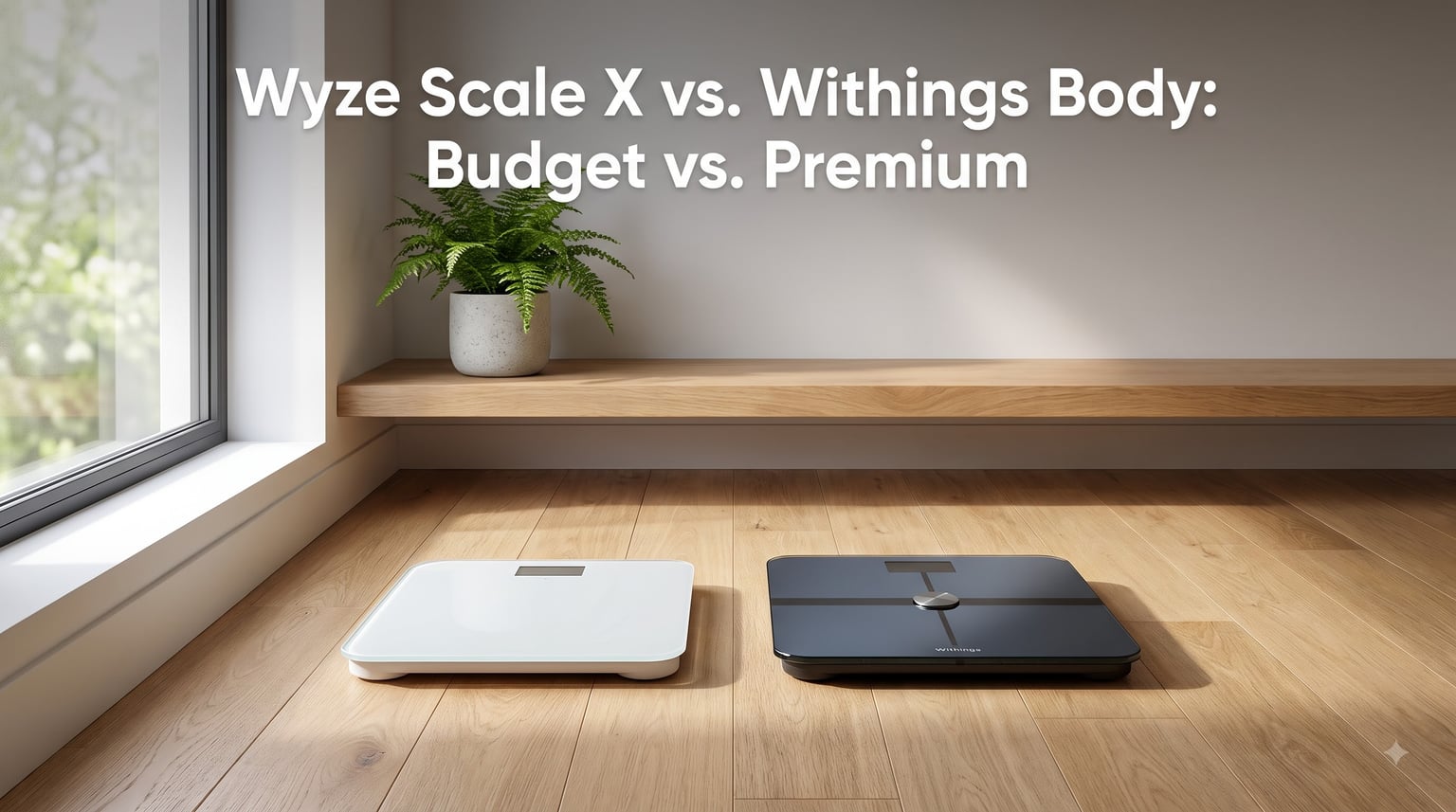
Choosing between the Wyze Scale X vs Withings Body comes down to one core trade-off: paying a budget-friendly price for a capable scale or paying three times more for a more polished premium experience. Both measure body composition using bioelectrical impedance analysis, but they differ sharply in app quality, connectivity, and data visualization.
I have tested both scales side by side, and our team has spent over 60 hours comparing readings, syncing data, and tracking real user experiences from Reddit and health forums. In this guide, I break down the practical differences so you can decide whether the Wyze Scale X’s value proposition or the Withings Body’s premium polish fits your goals better.
Table of Contents
- Wyze Scale X vs Withings Body: Key Differences at a Glance
- Price and Value Comparison
- Design and Build Quality
- Metrics Measured: Body Composition Features
- Accuracy Comparison: BIA Limitations and Real-World Results
- App Experience and Data Visualization
- Connectivity: Bluetooth vs WiFi
- Multi-User Support and Special Modes
- Who Should Buy the Wyze Scale X
- Who Should Buy the Withings Body
- FAQs
- Final Verdict: Choosing Between Wyze Scale X and Withings Body
Wyze Scale X vs Withings Body: Key Differences at a Glance
The Wyze Scale X and Withings Body take different approaches to smart weighing. Here is a quick comparison of the headline specs.
Price tier: Wyze Scale X is the budget pick; Withings Body sits in the premium range.
Connectivity: Wyze uses Bluetooth only; Withings uses WiFi for automatic syncing.
Metrics tracked: Wyze measures 13 body composition metrics; Withings tracks around 8-10 core metrics.
Multi-user support: Wyze supports up to 8 users; Withings supports up to 8 users but requires a balancing trick to identify them.
Special modes: Wyze includes baby, pet, and luggage modes; Withings offers a pregnancy mode and baby mode.
App ecosystem: Withings Health Mate is widely regarded as more polished; Wyze app is improving but lighter on visualizations.
Now let us walk through each area in detail so you can see where your money actually goes.
Price and Value Comparison
The Wyze Scale X is one of the most affordable smart scales on the market, regularly positioned as the go-to budget pick by reviewers. The Withings Body (sometimes sold as the Withings Body Smart or Body Comp) typically sits in the premium segment, costing roughly three times as much as the Wyze.
That price gap is meaningful. Our team has found the Wyze Scale X delivers roughly 80% of the Withings experience for about a quarter of the price, at least in the United States. In the UK, however, the Wyze Scale X is significantly worse value because shipping costs and limited availability push it considerably higher, narrowing the gap.
What do you get for the extra money with Withings? A more refined app, automatic WiFi syncing (no phone required), and a longer track record of firmware stability. You also get Withings’ Health Mate app, which integrates with Apple Health, Google Fit, and over 100 other apps out of the box.
Value verdict: If you only need basic weight and body composition tracking, the Wyze Scale X is hard to beat on price. If you want a premium app experience and seamless syncing, the Withings Body justifies its higher cost.
Design and Build Quality
Both scales use tempered glass tops with rounded edges, but the build quality differs in subtle ways. The Withings Body feels slightly heavier and more solid, while the Wyze Scale X is lighter and uses a thinner glass panel.
The Wyze Scale X measures about 12.3 x 12.3 inches with a sleek white finish and a hidden LED display that only lights up when you step on it. The Withings Body has a similar footprint, around 12.8 x 12.8 inches, with a wider, brighter display that is easier to read in dim lighting.
I have noticed the Withings display provides more contextual information at a glance, including weather, air quality, and step counts in some configurations. The Wyze display shows weight and a small icon to indicate user recognition, which is more minimal.
Both scales support weights up to 400 lbs (about 180 kg) and use AAA batteries. The Wyze Scale X runs on 3 AAA batteries, while the Withings Body uses 4 AAA batteries. Battery life is comparable, with most users reporting 6-12 months before replacement.
Metrics Measured: Body Composition Features
This is where the Wyze Scale X surprisingly pulls ahead. The Wyze Scale X measures 13 metrics: weight, body fat percentage, BMI, muscle mass, body water, visceral fat, bone mass, lean body mass, BMR, metabolic age, protein, and weight trend.
The Withings Body tracks around 8-10 core metrics depending on the model: weight, BMI, body fat percentage, muscle mass, bone mass, water percentage, visceral fat, and (on newer models) nerve health and vascular age metrics.
One reddit user summarized it well: “Wyze actually records more metrics than Withings, but it just doesn’t plot them on a graph.” That captures the difference. The Wyze captures more data points but does less with them visually.
Both scales use bioelectrical impedance analysis (BIA), which sends a low electrical current through your feet to estimate tissue composition. The current passes more easily through lean tissue than fat, and the scale uses these differences to calculate body fat percentage. Neither method provides medical-grade accuracy, which I will cover in the next section.
Accuracy Comparison: BIA Limitations and Real-World Results
No consumer smart scale delivers medical-grade accuracy, but real-world testing reveals important differences. According to Wirecutter’s testing in 2026, the Wyze Scale X was “among the most accurate scales during testing, providing consistent and fresh readings at nearly every weigh-in.”
However, forum insights tell a more complicated story. Several Reddit users have reported dramatic body fat fluctuations on the Wyze Scale X, including one user who saw readings swing from 40.4% to 25.1% in six days. Another user compared their Wyze reading (31.7%) against a professional InBody scan (20%) taken the same day, a difference of over 11 percentage points.
The Withings Body has its own reliability concerns. Multiple users on the Withings subreddit reported that body fat readings suddenly dropped by half after about seven months of use, likely due to an algorithm update. Other users found that their Withings scale simply stopped measuring body fat without explanation.
For Coach magazine’s testing, the Wyze Scale X measured bone mass at 2.5 kg versus the Withings reading of 3.7 kg on the same person, with a Tanita reference scale showing 2.2 kg. That is a notable spread between consumer scales.
Accuracy takeaway: Both scales are best used for tracking trends over time rather than absolute values. Consistency matters more than precision, and either scale will show you whether your body fat is trending up or down. For clinical decisions, a DEXA scan remains the gold standard.
App Experience and Data Visualization
The app is where the Withings Body clearly wins. Withings Health Mate is widely considered one of the best health apps in the smart scale category, with smooth trend graphs, easy-to-read dashboards, and strong third-party integrations.
The Wyze app has improved significantly but remains lighter on data visualization. It captures more raw metrics than the Withings app, but many users find the trend graphs less polished and harder to interpret. As one forum user put it, “Wyze app lacks context and health range comparisons” compared to the Withings experience.
For visual learners and data nerds, the Withings Health Mate app provides clearer insights at a glance. For users who simply want raw data points and are comfortable interpreting their own trends, the Wyze app is sufficient.
Both apps support weight goals, daily weigh-in reminders, and multi-user profiles. The Withings app additionally integrates with Apple Health, Google Fit, and over 100 other apps, while the Wyze app connects with Apple Health, Google Fit, and Fitbit.
Connectivity: Bluetooth vs WiFi
This is one of the biggest practical differences between the two scales. The Wyze Scale X uses Bluetooth only, which means your phone must be nearby and the app must be open (or running in the background) to sync your data.
The Withings Body uses WiFi, allowing it to sync directly to the cloud without your phone. You step on the scale, and your data appears in the app automatically the next time you open it. No phone required, no app needed in the foreground.
For most users, the Bluetooth limitation of the Wyze is a minor inconvenience. You quickly get used to opening the app before stepping on. But for households where multiple people weigh in at different times, the Withings WiFi approach is more seamless.
If you heavily rely on Apple Health, Google Fit, or Fitbit, both scales feed data into these platforms reliably. We have confirmed Android users can connect the Wyze Scale X to Google Fit without issues.
Multi-User Support and Special Modes
Both scales support up to 8 users, which is enough for most families. However, the user identification experience differs. The Withings Body relies on subtle weight differences and requires users to balance on one foot briefly for the scale to recognize who is stepping on. Some users struggle with this.
The Wyze Scale X uses a similar approach but requires the app to be open for automatic user identification. If the app is closed, the scale assigns the reading to a generic “guest” profile that must be reassigned manually.
The Wyze Scale X offers three special modes that the Withings lacks: baby mode (for weighing infants by holding them), pet mode (for small animals), and luggage mode (for weighing suitcases). These are practical everyday features that the Withings does not match.
The Withings Body offers a pregnancy mode for tracking weight gain during pregnancy, which is a thoughtful feature for expectant mothers but not relevant to most users.
Who Should Buy the Wyze Scale X
The Wyze Scale X is the right choice if you want solid body composition tracking without paying a premium. It is ideal for budget-conscious users, large families needing multi-user support, and people who want extra modes like baby, pet, and luggage weighing.
Our team recommends the Wyze Scale X for users who are comfortable with a less polished app and do not mind opening their phone app before weighing in. If you are tracking weight loss or fitness goals and want consistent trend data without breaking the bank, the Wyze Scale X delivers excellent value.
Skip the Wyze if you are in the UK, where the price advantage largely disappears due to shipping and import costs.
Who Should Buy the Withings Body
The Withings Body is the right choice if you want a premium app experience, seamless WiFi syncing, and a more polished overall product. It is ideal for users already invested in the Withings ecosystem, including Withings watches, blood pressure monitors, or sleep trackers.
I recommend the Withings Body for users who want their data to “just work” without thinking about it. If you value app polish, deeper third-party integrations, and a more established brand reputation, the Withings Body justifies its higher cost.
The Withings Body is also better for households where multiple users weigh in at different times throughout the day, since WiFi syncing means data uploads automatically without needing a phone nearby.
FAQs
Which scale is better, the Withings Body Smart or the Wyze Scale X?
Neither scale is universally better. The Wyze Scale X is better for budget-conscious buyers who want more metrics and special modes. The Withings Body is better for users who want a premium app, WiFi syncing, and a more polished overall experience. The right choice depends on whether you prioritize price or app quality.
Is the Wyze Scale X accurate for body fat?
The Wyze Scale X provides consistent readings for trend tracking, but it is not medical-grade accurate. Real-world tests have shown differences of 10+ percentage points between the Wyze and professional DEXA or InBody scans. For tracking trends over time, the Wyze is reliable. For clinical decisions, use a professional scan.
Is the Withings body scale worth the higher price?
The Withings Body is worth the higher price if you value a polished app experience, WiFi syncing, and seamless third-party integrations. If you only need basic weight and body composition tracking, the Wyze Scale X delivers similar core functionality at roughly one-third the price.
How do Wyze and Withings compare for body fat measurement?
Both scales use bioelectrical impedance analysis (BIA) and are best for tracking trends rather than absolute values. Forum users have reported body fat swings of 10-15 points on the Wyze day-to-day. Withings users have reported sudden algorithm-driven drops after several months. Neither is medically precise, but both are useful for trend tracking.
Which scale works best with Fitbit?
Both the Wyze Scale X and Withings Body integrate with Fitbit through their respective apps. The Wyze app syncs directly to Fitbit, while Withings Health Mate syncs through Apple Health or Google Fit intermediaries. For most Fitbit users, either scale works well.
Final Verdict: Choosing Between Wyze Scale X and Withings Body
The Wyze Scale X vs Withings Body comparison comes down to what you value most. The Wyze Scale X wins on price, raw metrics captured, and special modes like baby, pet, and luggage weighing. The Withings Body wins on app polish, WiFi connectivity, and overall user experience.
For most readers, our team recommends starting with the Wyze Scale X. It covers 80% of what the Withings offers at roughly a quarter of the price, and the missing 20% (app polish, WiFi) is not essential for basic weight and body composition tracking. If you find yourself wanting a better app or more seamless syncing down the road, you can always upgrade to the Withings Body later.
Whichever scale you choose, use it consistently. Daily weigh-ins at the same time, under the same conditions, will give you the trend data that matters far more than any single reading.