
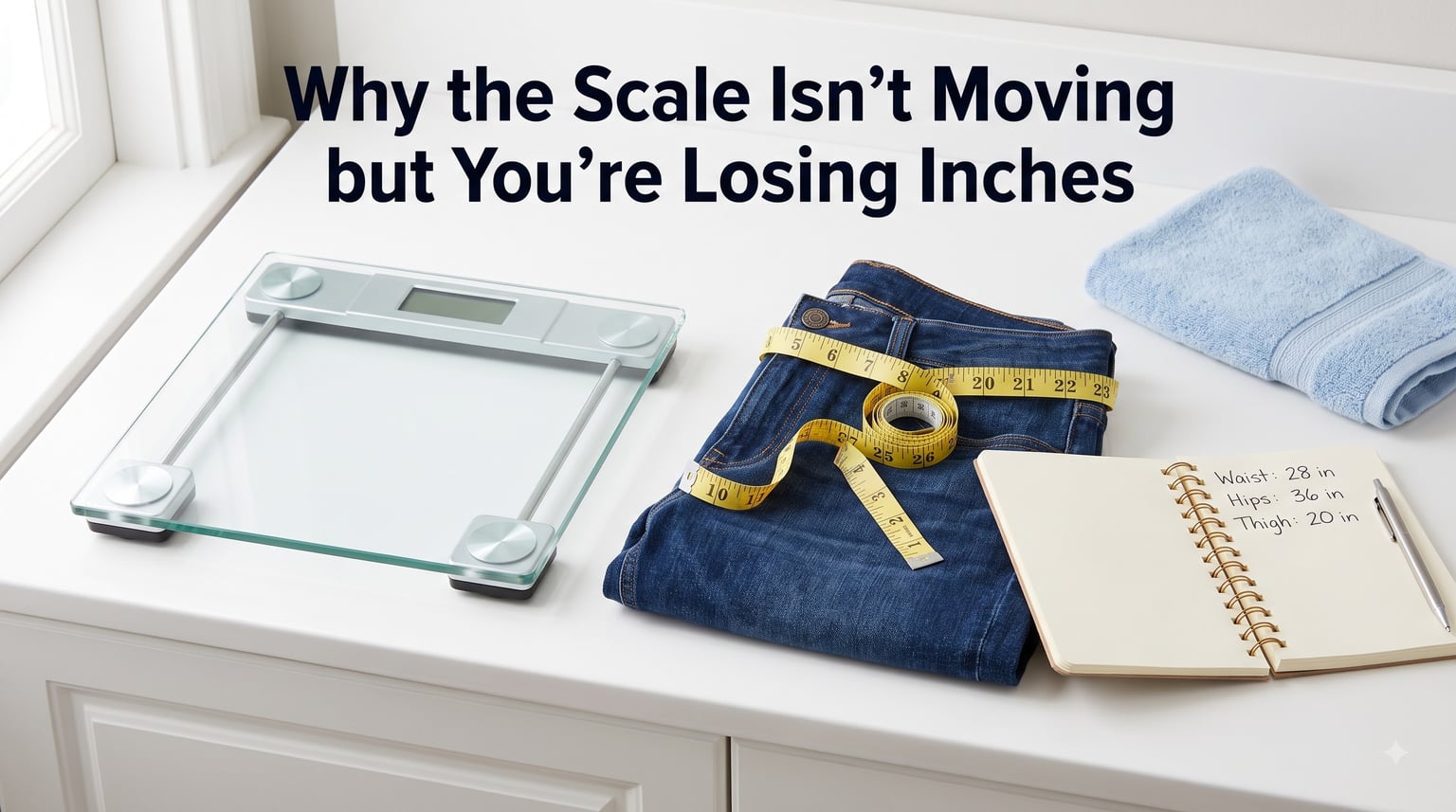
You step on the scale after two weeks of clean eating, consistent workouts, and better sleep. The number hasn’t budged. But your jeans button easier, your belt sits a notch tighter, and someone at work just asked if you’ve been working out.
If this sounds familiar, you’re experiencing something incredibly common: your scale not moving but losing inches. It’s one of the most frustrating and misunderstood parts of a fitness journey. I’ve watched hundreds of people in our community hit this exact wall and question whether everything they’re doing is even working.
Here’s the short answer: your body is likely undergoing recomposition. You’re losing fat and gaining muscle at roughly the same rate, and because muscle is denser than fat, the scale stays flat while your body physically shrinks. There are also water retention, hormonal shifts, and metabolic factors involved.
In this guide, I’ll break down exactly why the scale isn’t moving but you’re losing inches, what your body is actually doing, when to celebrate versus when to dig deeper, and how to track progress in ways that actually reflect your hard work.
Table of Contents
- Body Recomposition: Why the Scale Not Moving but Losing Inches Is Actually Progress
- Water Retention: The Hidden Factor Behind Inches Lost But Not Pounds
- Weight Loss Plateau vs Body Recomposition: Knowing the Difference
- Hormonal Factors: Why Women May Lose Inches But Not Weight
- Timeline Expectations: When Will the Scale Catch Up?
- How to Measure Progress Without the Scale: Non-Scale Victories Checklist
- The Mental Game: Reframing Scale Frustration Into Motivation
- When to Be Concerned vs When to Celebrate
- Frequently Asked Questions
- The Bottom Line
Body Recomposition: Why the Scale Not Moving but Losing Inches Is Actually Progress
Body recomposition is the number one reason your scale not moving but losing inches is happening. When you combine strength training with a calorie deficit, your body does two things simultaneously: it breaks down stored fat for energy and builds new muscle tissue from dietary protein. These two processes can offset each other almost perfectly on the scale.
Here’s the analogy that finally made it click for me. Think of a pound of pennies versus a pound of cotton balls. Both weigh exactly one pound. But the pennies take up a tiny fraction of the space. Muscle is like the pennies, and fat is like the cotton balls. Muscle tissue is significantly denser than fat tissue, meaning five pounds of muscle occupies far less physical space than five pounds of fat.
So when you lose two pounds of fat and gain two pounds of muscle, the scale reads exactly the same. But your waist, hips, thighs, and arms are measurably smaller. This is why you can drop a dress size or a jeans size without the scale moving a single pound.
Research consistently shows that body recomposition is most pronounced in people who are new to strength training, returning after a break, or carrying higher body fat percentages. Beginners can experience rapid muscle growth in the first 3 to 6 months of training, which means this scale-flat-but-shrinking phase is most common during exactly the time people expect to see the biggest drops.
This is why fitness professionals and registered dietitians repeatedly emphasize one point: losing inches is a better indicator of fat loss than the scale. Your body composition, the ratio of fat to lean mass, is changing in your favor even when the number refuses to cooperate.
Water Retention: The Hidden Factor Behind Inches Lost But Not Pounds
Water retention is the second major reason you might be losing inches but not pounds. Your body holds onto water for a variety of reasons, and that water weight can easily mask several pounds of real fat loss on the scale.
When you start exercising, especially strength training, you create microscopic tears in your muscle fibers. Your body responds with inflammation as part of the repair process, and inflammation draws water to the area. This is completely normal and actually necessary for muscle growth, but it can add 2 to 4 pounds of water weight that has nothing to do with fat.
Dietary factors play a role too. Eating more carbohydrates than usual causes your body to store glycogen, and every gram of glycogen holds roughly 3 grams of water with it. If you’ve recently increased your carb intake or started a refeeding phase, that water weight is temporary but real on the scale.
Sodium is another common culprit. A single high-sodium meal can cause your body to retain water for 2 to 3 days afterward. For women, hormonal fluctuations throughout the menstrual cycle can add 3 to 5 pounds of water weight that resolves on its own within a week.
The timeline here matters. Exercise-related water retention from a new training program typically resolves within 1 to 3 weeks as your body adapts. Hormonal water weight follows your cycle. Dietary water weight clears in a few days once sodium and carb intake normalize. In every case, the fat you’ve lost is still gone. The water is just temporarily sitting on top of it.
Weight Loss Plateau vs Body Recomposition: Knowing the Difference
Not every scale stall is body recomposition. Sometimes you’ve genuinely hit a weight loss plateau, and the difference matters because the solutions are different.
A true plateau happens when your calorie expenditure has dropped to match your calorie intake. This can occur because you’ve lost weight and your body requires fewer calories to maintain itself, or because your metabolism has adapted through a process called adaptive thermogenesis. Your basal metabolic rate literally slows down in response to prolonged calorie restriction.
Here’s how to tell the difference. If your clothes fit better, your measurements are shrinking, and you’re getting stronger in your workouts, you’re experiencing recomposition. The scale is misleading you, but your body is changing in the right direction.
If your clothes fit the same, your measurements haven’t changed in 3 to 4 weeks, and your workouts feel stale, you may be in a genuine plateau. In that case, you might need to adjust your calorie intake, change your training stimulus, or take a diet break to reset your metabolic hormones.
The best diagnostic tool is tracking multiple markers at once. If even one marker beyond the scale is improving, whether that’s measurements, strength, energy, or how your clothes fit, your routine is still working. The Reddit fitness community puts it perfectly: “my pants don’t lie.” If your clothes are getting looser, you’re making progress regardless of what the scale says.
Hormonal Factors: Why Women May Lose Inches But Not Weight
If you’re a woman noticing that you’re losing inches but not weight, hormones deserve specific attention. The female body naturally fluctuates in water retention throughout the month in ways that can completely obscure fat loss on the scale.
During the luteal phase, the two weeks before your period, progesterone levels rise and cause your body to hold onto water. Many women see the scale jump 3 to 5 pounds during this window, even while actively losing fat. This weight disappears during the follicular phase, but if you only weigh yourself during the wrong week, you’d think nothing was working.
Cortisol, the stress hormone, also causes water retention and can slow fat loss when chronically elevated. If you’re dealing with work stress, poor sleep, or overtraining, cortisol may be working against you even when your diet and exercise are dialed in.
For women in perimenopause and menopause, shifting estrogen levels change where your body stores fat and how quickly it releases it. Many women in their 40s and 50s report losing inches more slowly but consistently, even when the scale seems stuck for weeks at a time. This is normal, expected, and not a sign that your efforts are wasted.
The solution for all of these hormonal factors is patience and smarter tracking. Weigh yourself at the same point in your cycle each month, or better yet, focus on measurements and how your clothes fit.
Timeline Expectations: When Will the Scale Catch Up?
One of the biggest content gaps I noticed across competitor articles is that nobody gives a clear timeline. People want to know how long this phase lasts, so let me be specific based on what our community reports and what the research shows.
If you’ve recently started strength training or significantly increased your training intensity, expect a 4 to 8 week period where the scale stays flat or even goes up slightly while your measurements shrink. This is the recomposition window, and it’s temporary. Once your initial muscle-building surge levels off, fat loss will start showing on the scale again.
If water retention is the culprit, you should see the scale drop within 1 to 3 weeks of consistent habits. Water weight is the most temporary factor and clears fastest.
If you’re in a genuine plateau from metabolic adaptation, it typically takes 2 to 4 weeks of adjusted calories or training to restart progress. This might mean a temporary diet break at maintenance calories to reset leptin and other metabolic hormones.
For women tracking through hormonal cycles, always compare your weight to the same week of your previous cycle. Comparing week 1 to week 3 of your cycle will give you misleading results every time.
How to Measure Progress Without the Scale: Non-Scale Victories Checklist
If the scale has been your only progress tracker, it’s time to diversify. Here’s a practical system for measuring progress that captures what the scale can’t.
Take body measurements. Use a soft tape measure to track your waist, hips, thighs, arms, and chest every 2 weeks. Measure at the same spots each time, ideally in the morning before eating. Waist measurement is one of the strongest predictors of health improvement, and it’s far more responsive to real fat loss than body weight.
Do the clothing fit test. Pick a pair of jeans or a fitted shirt that was snug when you started. Try them on every 2 to 3 weeks. This is the method our community trusts most, because fabric doesn’t lie about body composition changes.
Take progress photos. Stand in the same lighting, same pose, same time of day, and take front, side, and back photos every 2 to 4 weeks. You will notice changes in photos that are invisible day to day. Most people are shocked by the difference between week 1 and week 8 photos even when the scale never moved.
Track performance markers. Record your workout weights, reps, and running or walking times. Getting stronger and faster is direct evidence that your body is changing, even if the scale disagrees.
Monitor energy and wellbeing. Better sleep, more stable energy, improved mood, fewer cravings, and clearer thinking are all signs that your habits are working. These are non-scale victories that matter just as much as any number.
Your Non-Scale Victories Checklist:
- Clothes fit looser, especially around the waist
- Waist measurement is shrinking over time
- You can see visible muscle definition
- Workout weights or reps are increasing
- Energy levels are higher throughout the day
- Sleep quality has improved
- Cravings have decreased
- Progress photos show visible changes
- You feel stronger in daily activities
- Someone has noticed changes in your appearance
The Mental Game: Reframing Scale Frustration Into Motivation
This is the section most fitness articles skip entirely. The psychological side of the scale not moving but losing inches is real, and if you don’t address it, you’ll quit before your body has time to show you the results.
I’ve seen it happen over and over. Someone starts a program, feels amazing for two weeks, steps on the scale, sees no change, and immediately spirals into “this isn’t working.” They either quit, or worse, they restrict calories further, add more cardio, and push their body into a stress response that makes everything worse.
Here’s the reframe that changes everything. The scale measures your relationship with gravity. It cannot tell you how much of your body is fat, muscle, water, bone, or the lunch you ate an hour ago. It cannot detect improved insulin sensitivity, reduced inflammation, better cardiovascular health, or the confidence you feel when your clothes fit right.
When the scale frustrates you, shift your question. Instead of asking “why isn’t the weight going down,” ask “is my body changing in the ways that matter?” If your measurements are improving, your strength is increasing, and your clothes fit better, the answer is yes. Every single time.
If you find yourself weighing in daily and letting that number dictate your mood, consider stepping away from the scale entirely for 2 to 4 weeks. Many people in our community report that taking a scale break completely transformed their mindset and motivation. Without the daily number to obsess over, they started noticing all the other progress markers they’d been ignoring.
Comparison is another trap. Seeing someone else drop 10 pounds in two weeks while you’re stuck can feel discouraging. But you don’t know their starting point, their training history, their water weight situation, or whether their weight loss is sustainable. Focus on your own trend line, not someone else’s highlight reel.
When to Be Concerned vs When to Celebrate
Most of the time, losing inches while the scale stays flat is something to celebrate. But there are a few situations worth paying attention to.
Celebrate when: Your measurements are shrinking, your clothes fit better, you’re getting stronger, and your energy is stable or improving. This is textbook body recomposition, and it represents some of the healthiest progress you can make.
Pay attention when: The scale hasn’t moved for 6 to 8 weeks AND your measurements haven’t changed either. This may indicate a genuine plateau that requires a nutrition or training adjustment. It doesn’t mean you’re failing, it just means your body has adapted and needs a new stimulus.
Consult a professional when: You’re experiencing unexplained weight changes alongside fatigue, hair loss, menstrual irregularities, or other symptoms. These could indicate a thyroid issue, hormonal imbalance, or other medical factor that warrants a conversation with your doctor.
Frequently Asked Questions
Why is my scale not moving even though I’m losing inches?
Your scale isn’t moving because you’re likely experiencing body recomposition. You’re losing fat and gaining muscle at roughly the same rate, and since muscle is denser than fat, your body shrinks in size without a change in weight. Water retention from new exercise, sodium, or hormonal fluctuations can also mask fat loss on the scale.
Am I still losing fat if the scale doesn’t move?
Yes. If your measurements are shrinking and your clothes fit better, you are losing fat regardless of what the scale says. The scale measures total body weight including muscle, water, bone, and undigested food, so it cannot distinguish fat loss from other changes. Track waist measurements and progress photos for a more accurate picture.
Why am I losing weight but not going down a size?
If the scale is dropping but your clothing size isn’t changing, you may be losing water weight or muscle rather than fat. This can happen with crash diets or excessive cardio without strength training. Focus on adequate protein intake and resistance training to ensure the weight you lose comes from fat stores, not lean muscle tissue.
Why do I feel thinner but weigh the same?
You feel thinner because your body composition is changing. Fat takes up more space than muscle for the same weight, so as you lose fat and gain or maintain muscle, your body physically takes up less room. You may also be carrying less water weight in your midsection, making you feel leaner even at the same scale weight.
How often should I weigh myself?
Research suggests weighing yourself 2 to 3 times per week and tracking the weekly average is more useful than daily weigh-ins. Daily weight fluctuates by 2 to 5 pounds due to water, sodium, hormones, and digestion. If weighing yourself causes anxiety or affects your mood, take a break from the scale entirely and track measurements and how your clothes fit instead.
The Bottom Line
Understanding why the scale isn’t moving but you’re losing inches comes down to one core truth: the scale is a blunt instrument that cannot measure what’s actually happening in your body. Body recomposition, water retention, hormonal shifts, and metabolic adaptation all play roles in keeping that number flat while your body transforms underneath it.
Your next steps are simple. Diversify how you track progress. Start measuring your waist, take progress photos, pay attention to how your clothes fit, and log your workout performance. If any of these markers are improving, you are succeeding, period. Trust the process, give your body time, and let the mirror, the tape measure, and your favorite pair of jeans tell you the real story.