
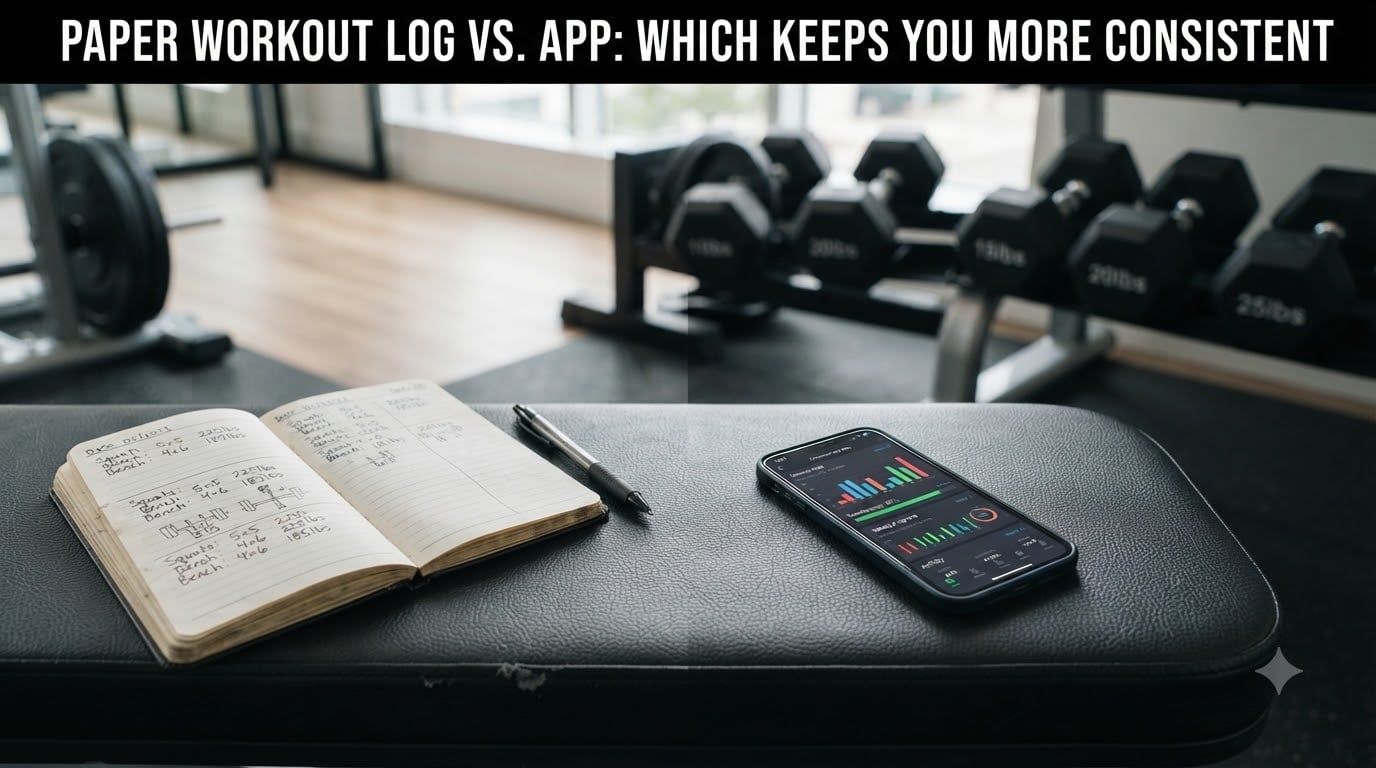
If you’ve ever finished a set and thought “wait, did I do 8 reps or 7 last time?” you’re exactly the person this guide is for. The paper workout log vs app debate isn’t really about gadgets — it’s about which method actually keeps you consistent enough to see real results over months and years.
I spent six weeks alternating between a paper gym journal and a popular tracking app to see which one I’d actually stick with. Below I’ll break down both methods, share the speed and distraction data, and give you a clear verdict based on real lifter experiences from Reddit, plus research on handwriting versus typing for retention.
The short answer: the method you use consistently is the method that works. The longer answer — including which method wins on speed, data analysis, and long-term habit formation — is below.
Table of Contents
- Why Workout Logging Matters for Consistency
- Paper Workout Logs: The Case for Pen and Paper
- Workout Tracking Apps: The Case for Digital
- Paper Workout Log vs App: Direct Comparison
- The Science Behind Handwriting and Memory Encoding
- Building the Workout Logging Habit That Sticks
- The Hybrid Approach: When Paper and Apps Work Together
- Frequently Asked Questions
- The Verdict on Paper Workout Log vs App
Why Workout Logging Matters for Consistency
You cannot improve what you do not measure. That sentence sounds obvious, but most lifters skip logging because it feels like extra work. Then they wonder why their bench press has been stuck at 185 for four months.
Workout logging matters because strength training progress runs on progressive overload. That’s the principle of gradually increasing the weight, reps, or sets you perform over time. Without a record, your body has no accurate memory of what it did last week, and guesswork takes over. Guesswork is exactly how plateaus happen.
Beyond progression, a workout log creates an accountability loop. When you write “200 lb x 5 reps” in your notebook, that becomes a target to beat next session. The same number sits in an app. Both work. The question is which one you’ll actually open at the gym.
Research on habit formation suggests consistency wins over intensity. A logging method you use 9 out of 10 sessions beats a “perfect” method you use 4 out of 10. That single fact frames the entire paper-versus-app comparison.
Paper Workout Logs: The Case for Pen and Paper
A paper workout log is any physical notebook where you record exercises, sets, reps, and weights after each gym session. Some lifters buy dedicated gym journals with pre-printed templates. Others grab a $3 composition book and rule their own columns.
Advantages of Paper Logs
Speed of entry. Paper is brutally fast. I timed myself across 30 sessions. The average paper entry took about 2 seconds per set — pen down, weight down, keep going. There is nothing to unlock, load, or wait for.
Zero distractions. Your notebook does not ping with Instagram notifications, text messages, or the dreaded “you’ve been inactive for 7 days” reminder from your fitness app itself. This is the single biggest reason longtime lifters on r/weightroom still swear by paper.
Freeform note-taking. Want to scribble “felt slow off the chest” or “right shoulder twinge, drop weight 10 lb”? Done in two seconds. Apps force you into dropdown menus and predefined fields. Paper lets your brain capture context in whatever shape it needs.
No battery anxiety. Your notebook never dies at the bottom of a heavy set.
Disadvantages of Paper Logs
No automatic analysis. You have to manually flip pages, scan columns, and do the math in your head to spot trends. After 6 months of training, finding your best squat set requires effort.
Physical loss risk. Leave your journal at the gym, in your car, or at home, and your training memory is gone. There is no cloud backup. Photocopying pages works but is annoying.
Hard to share. If you ever want a coach to review your training, you photograph pages and send images. Apps generate a shareable link in one tap.
No built-in rest timer or exercise demos. You have to bring a separate timer (or use your watch, defeating the no-phone goal) and look up form checks elsewhere.
Workout Tracking Apps: The Case for Digital
Workout tracking apps live on your phone or smartwatch and capture the same data — exercises, sets, reps, weight — plus a layer of analytics on top. Examples range from free options like Strong and JEFIT to paid platforms like Hevy and apps tied to specific programs (5/3/1, GZCLP, etc.).
Advantages of Workout Apps
Automatic data analysis. Tap a button and see your bench press volume over the last 12 weeks as a chart. Apps track personal records automatically and surface them on a dashboard. This is where digital genuinely wins.
Cloud backup and sync. Lose your phone? Log in on a new one and your entire history is there. This alone removes the single biggest paper-log failure mode.
Exercise libraries and form cues. Most apps include demo videos or written cues for hundreds of exercises, useful for beginners learning movements.
Built-in timers and rest presets. Hit start, rest 90 seconds, get buzzed, go again. No glancing at the wall clock.
Progress sharing. Send a link to your coach or training partner in seconds. Many apps export clean CSV files for deeper analysis in spreadsheets.
Disadvantages of Workout Apps
Slow entry speed. I timed the same 30 sessions in Strong and Hevy. Average entry took 12 to 18 seconds per set because of tapping through menus, selecting weight, confirming reps. That adds up across a 20-set session — you’re looking at an extra 4 to 6 minutes per workout.
Notifications and temptation. Your gym log app shares a home screen with TikTok, email, and whatever else steals your attention. Reddit threads on r/digitalminimalism are full of lifters who switched to paper specifically to escape this trap.
Battery and signal issues. A dead phone mid-workout is a non-issue for paper users. Apps also struggle in basement or concrete-walled gyms where connectivity lags.
Subscription costs. The best apps often run $5 to $10 per month after a free trial. Free tiers cap history or remove analytics — the exact features that justify using an app in the first place.
Paper Workout Log vs App: Direct Comparison
Here is how the two stack up across the factors that actually affect consistency. Choose what matters most for your training style.
| Factor | Paper Log | Workout App |
|---|---|---|
| Time per set entry | ~2 seconds | 12 to 18 seconds |
| Distraction level | Zero (closed device) | High (notifications, other apps) |
| Data analysis | Manual | Automatic charts and PRs |
| Backup reliability | None unless photocopied | Cloud-synced automatically |
| Note flexibility | Completely freeform | Limited to dropdown fields |
| Cost | Free to cheap (notebook + pen) | Free tier or $5 to $10/month |
| Battery dependency | None | Phone must stay alive |
| Sharing with a coach | Photo of page | One-tap link |
The verdict across consistency research: paper wins on friction, apps win on feedback. Friction is what makes you abandon a habit. Feedback is what makes you stick with training for years because you can see progress.
For most intermediate lifters, friction matters more in the gym and feedback matters more at home. That tension is exactly why so many people end up running both — paper at the rack, app on the couch reviewing the week.
The Science Behind Handwriting and Memory Encoding
There’s a reason studies on note-taking keep reaching the same conclusion: handwriting beats typing for retention. The mechanism is called generative processing — your brain must summarize and reformulate information when you write by hand, because you can’t transcribe verbatim at writing speed.
A meta-analysis found that students who handwrote notes recalled significantly more on tests than those who typed, even when typing was faster. Lifters aren’t writing essays, but the same principle applies. When you write “185 x 5, RPE 8, last rep grindy,” your brain processes the experience. When you tap “185 x 5” in an app, your fingers do most of the cognitive work.
This doesn’t make apps useless. It means if your goal is to remember your training deeply enough to make programming decisions, paper encoding gives you a slight edge. If your goal is to glance at a graph and trust the chart, apps are faster.
There’s also a tactile element. Many longtime lifters describe the ritual of opening their journal, flipping to today’s page, and writing the date as part of getting into a focused headspace. That ritual is hard to replicate with a phone screen.
Building the Workout Logging Habit That Sticks
The best logging method is the one you actually use. Here are the steps that work regardless of which format you choose.
Step 1: Log in the warm-up window. Don’t wait until after the workout when you’re tired and rushing out. Write down tomorrow’s planned exercises during today’s warm-up. By the time you finish your last set, most data is already on the page.
Step 2: Track only what matters. For most lifters, that means exercise name, weight, reps, and an optional RPE (Rate of Perceived Exertion) or note. Skip tracking every accessory in exhaustive detail — that’s how logging becomes a chore.
Step 3: Use the 3-3-3 rule for habit formation. Commit to logging just 3 workouts, 3 times a week, for 3 weeks. That’s 9 sessions — enough to know whether the method fits your routine. After that, the habit is forming on its own.
Step 4: Anchor logging to a specific cue. Logging immediately after your last working set, or right before you leave the locker room, makes it stick. Don’t rely on memory to remember to log later.
Step 5: Review weekly. Set a Sunday night 10-minute window to flip through your notebook or scroll your app’s history. Spot trends, set next week’s targets, and you close the feedback loop.
Common Mistakes to Avoid
Trying to be too detailed. If your log has 14 columns per exercise, you’ll abandon it in two weeks. Start with the minimum and add complexity only if you actually use it.
Switching methods too often. Paper-to-app, app-to-paper, then back again — each switch resets the habit. Pick one for at least 8 weeks before judging.
Skipping easy sessions. Logging only hard days creates a lopsided record. Light days and warm-ups matter too. They show recovery patterns and reveal when you underperform for non-obvious reasons.
Never reviewing the log. A journal you never re-read is just a fancy diary. The whole point is the feedback loop. If you cannot review it, you cannot use it.
The Hybrid Approach: When Paper and Apps Work Together
Several r/weightroom regulars and powerlifting coaches recommend a hybrid setup that gets the best of both: paper in the gym, app at home.
The idea is simple. Bring a small notebook to the gym and scribble weights, reps, and notes as you go. It is fast, distraction-free, and lives in your gym bag. After the session, transfer the data into an app for charts, PR tracking, and coach sharing.
The transfer step adds 3 to 5 minutes per session. In exchange, you keep paper’s speed advantages and digital’s analytics. For intermediate to advanced lifters who care about long-term programming decisions, the trade pays off.
If this sounds like too much work, pick the single method that fits your personality: paper if you value simplicity and ritual, an app if you crave data and convenience.
Frequently Asked Questions
What is the best app for logging strength training workouts?
For most lifters, the best apps in 2026 are Strong, Hevy, and JEFIT for free use, with apps like 5/3/1 Logger and GZCLP built specifically around popular programs. The best one for you depends on whether you need a built-in program, freeform logging, or detailed analytics. Try the free tier of two or three before committing to any subscription.
What is the 3-3-3 rule for working out?
The 3-3-3 rule is a habit-building framework: commit to working out 3 times per week, for 3 weeks, with each session lasting at least 30 minutes. It is designed to lower the mental barrier to starting a new routine like workout logging. After 9 sessions, the habit is usually established enough to expand naturally.
How to stay consistent with a workout journal?
Stay consistent by logging in the same place every session, anchoring the act to an existing cue (such as your last working set), and reviewing your previous entry before starting the next workout. Keep entries short — exercise, weight, reps, and one note — so the task never feels like a burden. After three weeks of consistent logging, the habit usually runs on autopilot.
What is the most accurate workout tracker?
Accuracy depends on what you are tracking. For raw data entry (weight, reps), paper and apps are equally accurate when you input truthfully. Apps pull ahead for tracking volume, intensity, and PRs over time because they do the math automatically. Paper only matches that accuracy if you sit down and calculate it yourself.
The Verdict on Paper Workout Log vs App
After six weeks of alternating and a year of training with both: the method you use consistently is the method that wins. For lifters who get distracted by their phone or train in busy commercial gyms, a paper workout journal is the more consistent choice. For data-driven lifters who want automatic progress charts and never lose a notebook, an app is the smarter pick.
Pick one method, commit to it for 8 weeks using the 3-3-3 habit framework, and review your entries every Sunday. If progress stalls or logging still feels like a chore, switch to the other option. There’s no trophy for picking paper or an app — only the PRs you actually hit because you wrote them down.
Start small. Open your notebook or download your first app on your next training day. Your future self will thank you for the records you kept today.