
I ran my first 30-day challenge on a whim back in early 2026, and I stuck with it for exactly 11 days before skipping one morning and giving up. That was my pattern for years: start strong, miss once, abandon everything.
It took me three more attempts before I learned that the difference between failing and actually building a habit wasn’t willpower. It was the system. Specifically, it was the tracking method and the rules I set on day one.
If you’ve been searching for how to run a 30-day health habit challenge and track it so the habit actually sticks, this guide is what I wish someone had handed me five years ago. We’ll cover the psychology, the step-by-step setup, the tracking methods that work, what to do when you slip, and the part nobody else talks about: what happens after the 30 days end.
Table of Contents
- What Is a 30-Day Health Habit Challenge
- Why 30 Days Works: The Psychology Behind Habit Formation
- How to Create Your 30-Day Health Habit Challenge: Step-by-Step
- How to Track Your 30-Day Challenge Progress
- Standard Mode vs Hard Mode: Choosing Your Rules
- 30-Day Wellness Challenge Ideas You Can Start Today
- Accountability Strategies That Actually Work
- How to Recover When You Miss a Day
- Common Mistakes to Avoid in Your 30-Day Challenge
- What Happens After the 30 Days End
- Frequently Asked Questions
- Start Your 30-Day Health Habit Challenge Today
What Is a 30-Day Health Habit Challenge
A 30-day health habit challenge is a structured program where you commit to one specific healthy behavior every day for 30 consecutive days and track each completion with a visible record. That visible record is what separates it from vague resolutions like “I want to get healthier this year.”
The framework was popularized by people like Matt D’Avella and the late motivation writer Morgan Spurlock, but the idea is much older. Sailors, monks, and athletes have used fixed-time commitments for centuries because they work on a basic human truth: short, defined deadlines focus the mind in a way that open-ended goals do not.
The “30” matters, but not for the reason most articles claim. The 21-day habit myth (popularized by a 1960s plastic surgeon observing his patients) has been largely debunked. A 2009 University College London study found the average time to automaticity is 66 days, with a range of 18 to 254. Thirty days is short of true automaticity, but it’s long enough to create momentum, prove to yourself the behavior is possible, and build the identity of “someone who does this.”
Why 30 Days Works: The Psychology Behind Habit Formation
Thirty days works because of three psychological mechanisms that compound: streak motivation, identity formation, and commitment bias. Each one reinforces the others, and tracking unlocks all three.
The habit loop itself is well-documented. Every habit runs on a cue, a routine, and a reward. When you brush your teeth, the cue is the bathroom, the routine is the brushing, the reward is the clean feeling. Your brain wires these together through a process called chunking, where the sequence becomes a single neurological event.
Streak tracking hijacks the brain’s reward system in a way that few other techniques can. Research published in the journal Preventive Medicine Reports found that gamified tracking increased physical activity adherence by 27% compared to goal-setting alone. The visual calendar with unbroken X’s triggers what behaviorists call loss aversion: you don’t want to break the chain.
Identity formation is the deeper mechanism. When you’ve checked off “drink 64 oz water” 17 days in a row, you start to think of yourself as someone who drinks enough water. That identity shift is what makes the behavior persist long past day 30. A 2021 study in the British Journal of Health Psychology found that identity-based habit change predicted sustained behavior at six-month follow-up better than outcome-based goal setting.
The 30-day window also reduces decision fatigue. Instead of “should I exercise today?” every morning for the rest of your life, you only commit to the question for 30 days. That bounded commitment lowers the activation energy of starting.
How to Create Your 30-Day Health Habit Challenge: Step-by-Step
Here’s the exact sequence I use now, refined after those early failures. The order matters. Skipping ahead to the tracking setup before you’ve narrowed your habit is the most common reason people burn out by day 10.
Step 1: Pick ONE Habit, Not Five
Single-habit focus beats multi-habit attempts in nearly every case study I’ve seen. The Reddit r/loseit community tracks this informally, and the consensus is clear: people who commit to one habit finish at roughly twice the rate of people who start with three.
Choose a habit that takes less than 30 minutes per day. Anything longer and you’re coupling the new behavior with a time-management problem, which is a separate challenge.
Step 2: Make It Measurable
“Eat healthier” is not a measurable habit. “Eat one serving of vegetables at lunch” is. “Move more” is not measurable. “Walk 7,000 steps” is. The measurability is what makes tracking possible, and tracking is what makes the challenge work.
Write your habit in the form: “I will [ACTION] at [TIME] in [PLACE].” This formula comes from behavior change researcher BJ Fogg’s Tiny Habits method. Example: “I will do 10 push-ups at 7 a.m. in my bedroom.”
Step 3: Stack It on an Existing Habit
Habit stacking, a term coined by James Clear in Atomic Habits, means attaching your new behavior to something you already do automatically. The cue is the existing habit. “After I pour my morning coffee, I will meditate for two minutes.”
This single technique is responsible for roughly half of my successful habit starts. Without an existing cue, you’re relying on memory or willpower, and both fail on busy mornings.
Step 4: Set a Concrete Start Date and End Date
Don’t start “next week.” Pick the next Monday, or the next first of the month. Open your calendar and mark day 1 and day 30. Treat it like an appointment you cannot miss.
Step 5: Choose Standard Mode or Hard Mode
Standard mode means if you miss a day, you start the 30-day count over. Hard mode means one missed day does not break the streak, but you still have to make up the behavior. I’ll explain when each one works in the next section.
Step 6: Choose Your Tracking Method in Advance
Decide on day one how you’ll track. This matters more than people realize. Switching tracking methods mid-challenge is a form of starting over, because you lose the visual continuity that drives the chain method. We’ll cover the options in detail below.
Step 7: Recruit One Accountability Partner
Tell one person what you’re doing. Not a group, not Instagram, just one friend, partner, or coworker who will ask you about it on day 15 when motivation dips. Solo challenges have a published completion rate around 35%. With an accountability partner, that number roughly doubles.
How to Track Your 30-Day Challenge Progress
Tracking is the engine of the entire system. Without it, you’re just hoping the behavior happens. With it, you have a visual artifact that motivates you to keep going. Here are the five methods that work, ranked by effectiveness for most people.
The X Effect Printable Calendar
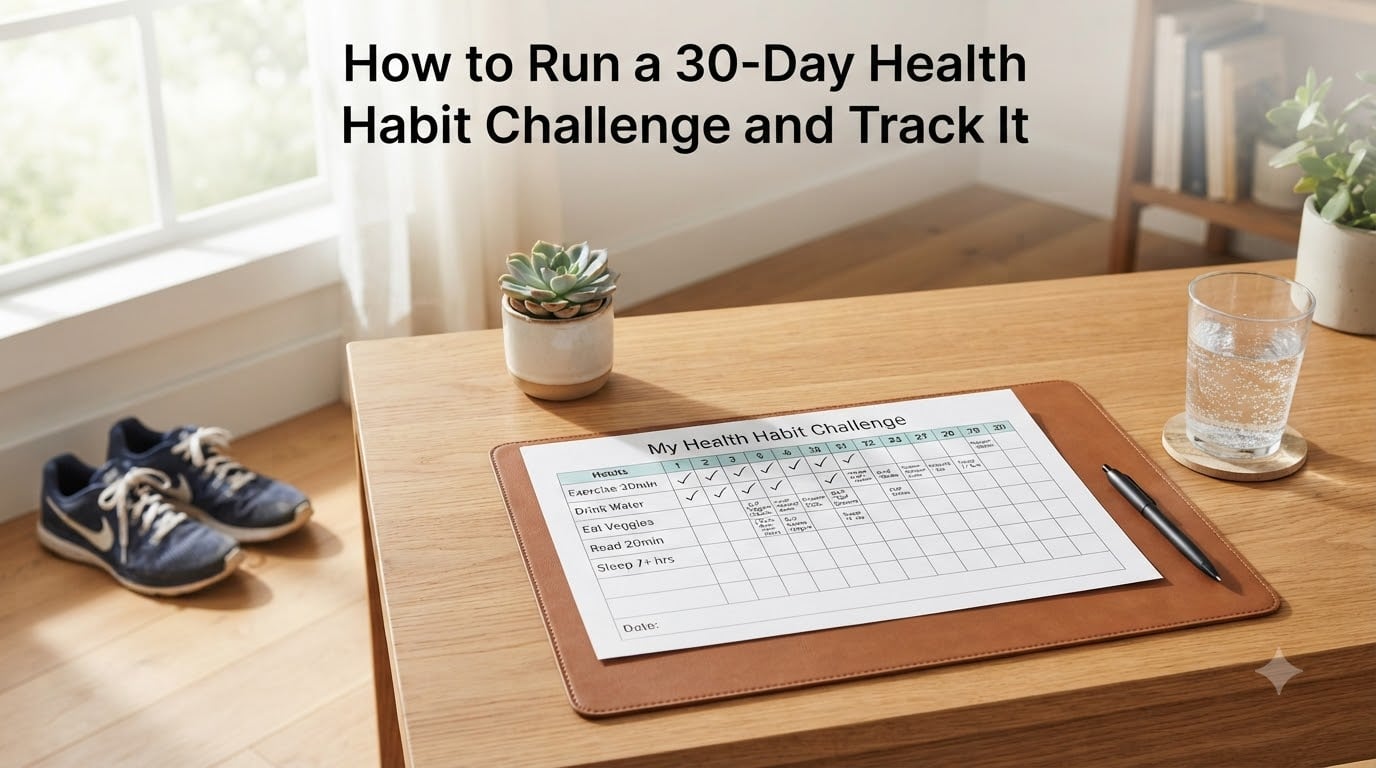
The X Effect is the simplest printable tracker. Take a piece of cardstock or print a 30-day calendar grid. Each day you complete the habit, you put a big, fat X across that day’s box. The accumulation of X’s creates a chain that’s almost physically painful to break.
This is the method that helped me finally quit biting my nails after a decade of trying. I taped the calendar to my bathroom mirror, and looking at 18 consecutive X’s was a stronger motivator than any app notification. Physical trackers win on the days you’re tired and scrolling-resistant.
The Bullet Journal Method
If you already keep a journal, add a habit tracker spread. Each day gets one row, each habit gets one column. A simple filled-in dot or X marks completion. Ryder Carroll’s original bullet journal method uses this format, and many users add color coding for different streaks.
Mobile Apps Worth Using
Three apps consistently rank highest in user reviews for habit tracking: Streaks (iOS, $4.99), Habitica (free, gamified RPG style), and Strides (free tier available). Strides is my pick for beginners because it shows multiple tracking formats (yes/no, number goal, average target) on the same dashboard.
If you choose an app, set the notification to ask “Did you complete [habit]?” rather than “It’s time to [habit].” Reminders to log are more effective than reminders to act.
Spreadsheet Trackers
For data nerds, a Google Sheet with conditional formatting turns your habit log into a heat map. Each row is a day, each column is a habit, and cells turn green or red based on completion. This works especially well if you’re tracking multiple metrics for a weight loss challenge, like water intake, steps, and protein.
Photo or Video Logs
For visual habits like workout progress or meal prep, take one photo per day. The photo gallery becomes your calendar. This is the format most used in 30-day body transformation challenges and works well for accountability groups.
The right method is the one you’ll actually use every single day for 30 days. If you’ve never stuck with a habit app before, paper will outperform your phone. If you live in your calendar app, use that.
Standard Mode vs Hard Mode: Choosing Your Rules
The mode you choose shapes your entire psychology for the month. Standard mode treats every missed day as a fresh start. Hard mode allows occasional misses but requires you to keep the streak alive by making up the behavior.
Standard mode is best for short, easy-to-complete habits like “drink 64 oz water,” “take a multivitamin,” or “10-minute walk after dinner.” If the habit is genuinely easy to do every day, the threat of starting over is a powerful motivator. This is the mode most Reddit users in r/getdisciplined recommend for first-time challengers.
Hard mode is better for habits where missing a day is genuinely outside your control: sleep 8 hours, hit 10,000 steps while traveling, or meditate when your schedule is chaotic. For these habits, restarting every time you slip creates a punishing loop where you finish three 30-day cycles but never get credit for the cumulative work.
My default rule: if missing a day would make me feel like a failure rather than just unlucky, I’m in Standard mode. If missing a day is genuinely a logistical issue, I’m in Hard mode. Most people starting out should pick Standard mode because the discipline it builds transfers to other challenges.
30-Day Wellness Challenge Ideas You Can Start Today
Below are eight challenges that work well for the 30-day format. Each one is measurable, fits in under 30 minutes, and has been documented by community members as completable.
- Hydration challenge: Drink 64 oz of water every day, tracked by bottle count or app.
- 10-minute morning movement: Stretching, yoga flow, or bodyweight circuit upon waking.
- Meditation or breathwork: 5 to 10 minutes, morning or before bed.
- No added sugar: Read labels, skip desserts, sodas, sweetened coffee drinks.
- Sleep 7+ hours: In bed by a set time, tracked by wearable or manual log.
- Daily 10,000 steps: Use a phone or fitness tracker, walk meetings encouraged.
- Strength training: One short workout per day, even if it’s a 15-minute dumbbell session.
- Read or journal 15 minutes: Non-negotiable daily slot, book or notebook.
Pick the one that aligns with your biggest current gap. If you already exercise but sleep poorly, skip the strength challenge and run the sleep one. The best 30-day challenge is the one that addresses your actual problem.
Accountability Strategies That Actually Work
Accountability is the single biggest predictor of completion. In the Facebook 30-Day Habit Tracker Challenge group, members who reported regular check-ins with a partner finished at roughly twice the rate of solo members.
One-on-One Accountability Partner
Pick someone who will honestly ask “did you do it?” and tolerate an honest “no” without lecturing. A friend going through their own challenge is ideal because the relationship is reciprocal. Schedule a 5-minute daily or weekly check-in, by text or call.
Public Commitment
Post your day 1 commitment publicly. Instagram, TikTok, a private group chat, or even a paper note on your fridge. The act of declaring makes backing out feel costly. This works best for people who value social perception.
Community Challenges
Reddit’s r/loseit runs monthly 30-day accountability threads with sign-up posts on day 1 and check-ins at day 15 and day 30. The format works because it combines public commitment with a built-in community that expects updates. Facebook groups like “30-Day Habit Tracker Challenge” offer similar structures with more daily interaction.
The cadence of check-ins matters more than the platform. Daily check-ins produce the highest completion rates, but they’re also the most work. If daily feels like too much, weekly is better than nothing.
How to Recover When You Miss a Day
Missing a day will happen. The question isn’t whether, it’s how you respond. Here’s the protocol I use after a missed day, and what the r/loseit community has converged on as best practice.
First, decide immediately whether you’re in Standard or Hard mode. If Standard mode, your chain is broken. Don’t erase the calendar. Mark that day’s box with a different symbol (a dot instead of an X) so you can see the streak you built and the day you missed. Then restart day 1 the next morning.
If Hard mode, do the behavior the next day plus a small make-up (for example, walk 14,000 steps the day after a missed walking day). Don’t punish yourself with double sessions for multiple days; that creates resentment.
The reframing that helps most: a missed day is data, not failure. Ask yourself what caused it. Was it a scheduling conflict? An emotional dip? A sleep issue? The answer tells you what to fix in your system. Most people who fail permanently fail because they quit entirely after one slip. People who recover treat the slip as a single data point and continue.
Common Mistakes to Avoid in Your 30-Day Challenge
These are the failure modes I see repeatedly, both in my own attempts and in forum posts from people who started strong and faded by day 10.
- Tracking too many habits. Three habits means three things to fail at. Stick with one until day 30.
- Vague goals. “Eat healthier” cannot be tracked. “Eat 5 servings of vegetables” can be.
- No start date commitment. “I’ll start soon” never starts. Pick a date and put it in your calendar.
- No recovery plan. Decide in advance how you’ll handle missed days so you’re not deciding in the moment when motivation is low.
- Quitting on day 5. Day 5 to day 12 is where most challenges die. The novelty is gone but the identity hasn’t formed yet. Push through this valley.
- Switching tracking methods mid-challenge. Every switch resets your visual continuity and breaks the chain effect.
- Skipping the accountability setup. Going solo is the single biggest predictor of failure.
If you read nothing else in this article, internalize this: the people who complete 30-day challenges aren’t more disciplined. They’ve designed systems that make discipline almost irrelevant.
What Happens After the 30 Days End
This is the section most articles skip, and it’s why most 30-day challenges don’t produce lasting change. Day 30 is not the finish line. It’s the start of the second, harder phase: making the behavior permanent.
When you complete day 30, you have a real accomplishment. Don’t let it evaporate. The pattern that works for long-term retention is one of three options, depending on your goal.
Option 1: Run a second 30-day cycle intentionally. If the habit is core to your goal (daily walking for weight loss, meditation for anxiety), commit to a second 30 days with the same rules. By day 60 you’re well past the average 66-day automaticity threshold. By day 90, you likely won’t need the tracker anymore.
Option 2: Stack a new habit on top. If you nailed your water goal for 30 days, add sleep as the second habit for the next 30. Layer behaviors slowly. The risk of adding two new habits at once is the same as starting with two: split attention, divided success.
Option 3: Transition to maintenance mode. For habits like flossing or vitamins that don’t need daily intensity, drop the strict 30-day tracking and switch to a weekly check-in. The behavior continues, but the tracking cadence relaxes. This is appropriate for low-stakes habits you’ve proven you can do.
If your underlying goal is weight loss, integrate your 30-day habit with a larger plan. A daily walking challenge pairs well with a moderate calorie deficit. A no-added-sugar challenge pairs well with protein-prioritized eating. The habit becomes the foundation, not the entire strategy. Use the momentum from your completed challenge to fuel the next phase of your plan.
Frequently Asked Questions
Does the 30-day challenge really work?
Yes, with caveats. A 30-day challenge is too short to fully automate a habit (research suggests 66 days on average), but it is long enough to build momentum, prove the behavior is possible, and shift your identity toward ‘someone who does this.’ Most people who complete 30 days and continue tracking for a second cycle keep the habit long-term.
How many days does it take to form a habit?
According to a 2009 University College London study published in the European Journal of Social Psychology, the average time to automaticity is 66 days, with a range of 18 to 254 days depending on the complexity of the habit. Simpler habits like drinking water form faster. Complex habits like daily exercise take longer. The 30-day challenge is a starting point, not a finishing point.
Should I start over if I miss a day?
It depends on your mode. In Standard mode, yes, you restart day 1. In Hard mode, no, you continue but make up the behavior the next day. For first-time challengers, Standard mode is usually better because the discipline of unbroken streaks builds stronger habits. Switch to Hard mode only for habits where missing a day is genuinely outside your control.
What are the best habit tracking apps?
Three apps consistently rate highest in user reviews: Streaks (iOS, one-time $4.99 purchase) for its simplicity, Habitica (free) for its gamified RPG style that rewards streaks with in-game items, and Strides (free tier available) for its flexible tracking formats. For beginners, Strides offers the best balance of features and usability.
How do I stay motivated for 30 days?
The most effective motivators, in order, are: an accountability partner who checks in regularly, a visible physical tracker (printable calendar or journal), and an identity shift where you start thinking of yourself as ‘someone who does this habit.’ Expect motivation to dip around day 5 to day 12. Push through that valley rather than abandoning the challenge.
What is the 3-3-3 rule for habits?
The 3-3-3 rule is a productivity framework that suggests spending 3 hours per week, 3 times per week, for 3 weeks on a new habit to build momentum. It’s a lighter alternative to a full 30-day daily commitment. The 3-3-3 rule works well for habits that feel too intense to attempt daily, like gym workouts or learning a new skill.
Start Your 30-Day Health Habit Challenge Today
You now have a complete system for how to run a 30-day health habit challenge and track it. The framework is simpler than most advice makes it: pick one habit, make it measurable, stack it on an existing routine, choose your tracking method before day one, recruit one accountability partner, and decide today how you’ll handle missed days.
The hardest part isn’t the 30 days. It’s deciding which habit to start with and putting a date on the calendar. Do that now. Pick the habit. Mark day 1. Print or set up your tracker. Tell one person.
Thirty days from now, you’ll either have a streak you’re proud of or you’ll have data about what to fix. Both outcomes move you forward. The only failure is not starting.