
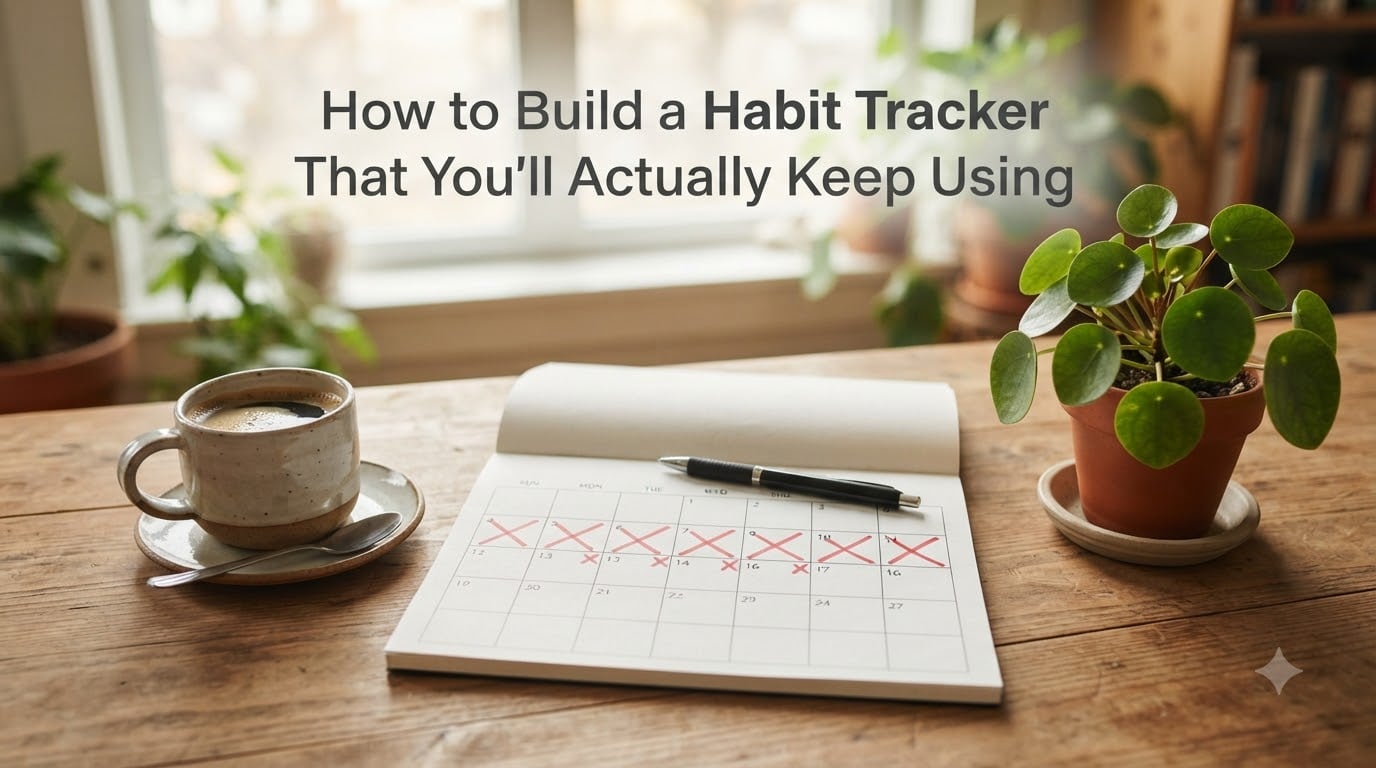
I have started and abandoned more habit trackers than I can count. There was the elaborate spreadsheet with 15 color-coded columns that lasted exactly four days. The expensive app I paid a yearly subscription for and opened maybe six times. The bullet journal spread that took two hours to draw and exactly zero days to abandon.
Sound familiar? You are not alone. Forum data from communities like r/productivity and r/Habits shows the same pattern repeating across thousands of people. The problem is rarely motivation or discipline. The problem is the tracker itself was designed to fail from the start.
Learning how to build a habit tracker that actually sticks changes everything. The right setup works with your psychology instead of against it. It removes friction, builds momentum, and makes consistency feel natural rather than forced. This guide walks you through every step, from choosing your format to recovering when life inevitably gets in the way.
Table of Contents
- What Is a Habit Tracker (and Why Most People Quit Within a Week)
- Why Habit Tracking Actually Works
- Choosing Your Method: Digital vs Analog vs Hybrid
- How to Build a Habit Tracker: Step-by-Step Setup Guide
- 5 Common Mistakes That Kill Habit Trackers
- What Habits Should You Track?
- How to Recover When You Miss a Day (Without Quitting)
- How Long Does It Take to Build a Habit?
- Frequently Asked Questions
- Conclusion
What Is a Habit Tracker (and Why Most People Quit Within a Week)
A habit tracker is a simple tool that measures whether you performed a specific behavior, typically by marking each day you complete the habit. That is it. No fancy dashboards required.
You record whether you did a habit immediately after doing it, building visual evidence of your consistency over time. A calendar with X marks through each day works. A notebook with checkmarks works. A basic app with a single button works.
Here is the paradox that catches almost everyone. Habit tracking is itself a habit. And most people build their tracker in a way that requires willpower to maintain, which is exactly backwards. When your tracker demands 20 minutes of daily upkeep, tracking 12 different behaviors with detailed notes, you are stacking a hard new habit on top of other hard new habits.
Reddit users in r/Habits highlight this constantly. They build elaborate systems, feel excited for the first three days, then quietly stop checking off habits because the tracker itself became another chore on an already full plate.
The fix is simple but counterintuitive. Your habit tracker should take less than 60 seconds to update. If it takes longer, the tracker is the problem, not you.
Why Habit Tracking Actually Works
Habit trackers succeed because they exploit three deeply wired features of human psychology. Understanding these mechanisms helps you design a system that feels effortless.
1. Visual Cues Create Automatic Reminders
A visible tracker sitting on your desk or phone home screen acts as a constant environmental trigger. You do not need to remember to check it because it is already in your field of vision. This is the cue in the classic cue-routine-reward habit loop that behavioral psychology has studied for decades.
When your tracker is tucked inside an app you never open, the cue disappears. When it is a physical calendar on your bathroom mirror, you see it every morning without trying.
2. Immediate Satisfaction Beats Delayed Rewards
Habits like exercise, reading, and healthy eating pay off months down the road. Your brain struggles to stay motivated for rewards that distant. Checking off a box gives you a small hit of satisfaction right now, today, this second.
That checkmark becomes the reward your brain craves. The streak of consecutive checkmarks amplifies this effect. You start wanting to preserve the streak, which pulls you through days when motivation is low.
3. Tracking Reinforces Identity Change
Every time you mark a habit complete, you cast a vote for the type of person you are becoming. Twenty checkmarks for reading this month is visible proof that you are a reader. This is not motivational fluff. Research in identity-based habit formation shows that people who internalize a new identity stick with habits significantly longer than those focused on outcomes.
Your tracker becomes a physical record of who you are becoming. That psychological shift is powerful, and it happens automatically when tracking is consistent.
Choosing Your Method: Digital vs Analog vs Hybrid
There is no single best habit tracking method. The best method is the one you will actually use, which depends entirely on your personality and daily routines. Here is a practical decision framework.
Analog Tracking (Paper Notebooks and Calendars)
Paper works best for visual learners and people who love the physical act of crossing things off. A simple wall calendar where you draw an X through each successful day is arguably the most effective tracker ever invented.
The Bullet Journal community on Reddit swears by hand-drawn habit grids. The act of creating the tracker builds investment and intentionality. Downsides include no reminders, no automatic data, and the need to redraw grids monthly.
Digital Tracking (Apps and Spreadsheets)
Apps shine for people who always have their phone nearby and want reminders, data visualization, and unlimited trackers. A habit tracker app can send push notifications, calculate streaks automatically, and show progress charts over months.
Forum users consistently request free apps with unlimited trackers, calendar views, and data export. The key is choosing one that is simple enough to use daily without friction. Avoid apps that require five taps to check off a single habit.
Spreadsheets work well for analytical minds who want full control. Building a habit tracker in Excel or Google Sheets gives you complete customization. You can add conditional formatting, monthly summary charts, and trend analysis.
The Hybrid Approach
Many people find the sweet spot is a combination. A paper tracker on the fridge for the whole family to see, plus a phone app for personal habits that need reminders. Or a wall calendar for the one keystone habit that matters most, with a spreadsheet for detailed tracking.
Start simple. Use what you already have. A piece of paper and a pen beats a fancy app you never open.
How to Build a Habit Tracker: Step-by-Step Setup Guide
This is the core process. Follow these seven steps in order, and you will have a working habit tracker set up in under 30 minutes.
Step 1: Pick one habit. Just one. Choose the single habit that would have the biggest positive impact on your life right now. For most people this is a keystone habit like daily exercise, reading, meditation, or going to bed at a consistent time. Resist the urge to track five things. You can add more later once tracking itself becomes automatic.
Step 2: Shrink it to its minimum viable version. Apply the two-minute rule. If your habit is reading 30 minutes a day, your tracked behavior is reading one page. If it is exercising, your minimum is putting on workout clothes and doing one pushup. The tracker records the minimum version, not the full workout. This removes the activation energy that stops you before you start.
Step 3: Attach it to an existing habit (habit stacking). Find something you already do every single day without fail. Brushing your teeth, making coffee, starting your computer, sitting down after dinner. Stack your new habit immediately after this anchor behavior. The formula is simple: after I [existing habit], I will [new habit]. This is called an implementation intention, and research shows it dramatically increases follow-through.
Step 4: Choose your tracking format. Based on the decision framework above, pick the simplest tool that fits your routine. Paper calendar on the wall. Notebook on your nightstand. Single-purpose app on your phone. Do not overthink this. Pick one in under five minutes.
Step 5: Place your tracker where you cannot miss it. Location is everything. A tracker you have to go find is a tracker you will forget. Tape it to your bathroom mirror. Pin it next to your computer monitor. Make it the first app on your home screen. The visual cue must be unavoidable.
Step 6: Set up a daily check-in trigger. Decide exactly when you will update your tracker. The best time is immediately after completing the habit, not at the end of the day. If you meditate at 7 AM, you check off the box at 7:05 AM. This links the reward of tracking to the behavior itself.
Step 7: Add a weekly review. Pick one day per week to look at your tracker and reflect. Sunday evening works well. Ask yourself what went right, what was hard, and whether the habit still feels right. This 10-minute review keeps you connected to your why and helps you adjust before small problems become big ones.
5 Common Mistakes That Kill Habit Trackers
I have made every one of these mistakes personally. Here are the five that destroy habit trackers most often, drawn from both research and real user experiences across productivity forums.
Mistake 1: Tracking Too Many Habits at Once
This is the number one killer, mentioned repeatedly across r/productivity and r/Habits. Someone gets motivated, lists 10 or 15 habits, and burns out within a week. Tracking itself becomes overwhelming. Start with one habit. Add a second only after the first has been consistent for at least two weeks.
Mistake 2: No Anchor or Trigger
A habit without an anchor is a wish. If your plan is to meditate at some point during the day, you will forget. Without a specific existing behavior to attach your new habit to, there is no cue to trigger action. Always use the habit stacking formula from Step 3 above.
Mistake 3: Perfectionist Streak Thinking
The streak mentality says that one missed day ruins everything, so why continue? This all-or-nothing thinking causes more abandoned trackers than any other psychological trap. A broken streak feels like failure, even though missing one day out of 30 is a 97 percent success rate. Reframe streaks as evidence of commitment, not perfection.
Mistake 4: No Recovery Plan
You will miss days. Everyone does. The question is not whether you will miss, but what you do afterward. Without a pre-planned recovery strategy, a single missed day spirals into a week, then a month, then a quietly abandoned tracker. The next section covers how to build a recovery plan that actually works.
Mistake 5: Tracking Outcomes Instead of Behaviors
Tracking your weight instead of tracking whether you exercised today is a subtle but devastating mistake. Outcomes like weight, income, or grades are influenced by dozens of factors outside your control. Behaviors like working out, making sales calls, or studying are entirely within your control. Track what you do, not what results from what you do.
What Habits Should You Track?
The best habits to track are small, specific, and within your direct control. Here are ideas organized by category, drawn from what real people actually track across productivity communities.
Health and wellness: Drink a glass of water with each meal, take a 10-minute walk, eat a vegetable with dinner, stretch for five minutes, go to bed before 11 PM.
Mind and learning: Read two pages of a book, write three sentences in a journal, practice a language for five minutes, meditate for one minute, learn one new word.
Productivity and work: Plan your top three tasks for the day, clear your inbox to zero, work one focused session without your phone, write 200 words, review your goals.
Relationships and connection: Text one friend, tell someone you appreciate them, have a device-free meal, call a family member.
Personal finance: Check your bank balance, save a specific amount, avoid a specific spending trigger, log your expenses.
Notice the pattern. Every item is small enough to do even on a terrible day. Two pages of reading. One minute of meditation. Five minutes of stretching. These are minimum viable habits, designed so that you never have a legitimate excuse to skip.
For your first tracker, pick one habit from any category. Just one. Expand later.
How to Recover When You Miss a Day (Without Quitting)
You will miss a day. Maybe you got sick, traveled, had a family emergency, or simply forgot. This is not a failure. It is a normal, expected part of habit formation. What separates people who succeed from people who quit is how they respond to the first missed day.
The rule that saves more habit trackers than any other is simple: never miss twice.
Missing one day is an accident. Missing two days is the beginning of a new pattern. The moment you notice you missed yesterday, your only job is to do the habit today. Not to catch up. Not to punish yourself. Just to show up once.
This works because automaticity, the psychological state where a habit feels automatic, is built by frequency rather than perfection. Research shows that occasional missed days have essentially zero effect on long-term habit formation, as long as you resume quickly. The missed day does not matter. The response to the missed day is everything.
Here is a practical recovery protocol. When you miss a day, do not open your tracker and feel guilty. Instead, shrink the habit to its absolute minimum for that one recovery day. Read one sentence. Do one pushup. Meditate for one breath. The goal is not performance. The goal is to reinforce the identity of someone who shows up.
One Reddit user in r/getdisciplined put it perfectly. They said the most important day of their habit journey was the day they missed and came back the next morning. That single act of returning taught them more about consistency than 30 perfect days ever could.
How Long Does It Take to Build a Habit?
The 21-day myth needs to die. It originated from a misinterpretation of plastic surgeon Maxwell Maltz’s observations in the 1960s and has been debunked repeatedly by modern research.
The actual answer comes from a landmark study by researcher Phillippa Lally at University College London. She found that the average time to reach automaticity, the point where a habit feels truly automatic, is 66 days. But the range is enormous. Simple habits like drinking water with lunch might become automatic in 18 days. Complex habits like going to the gym might take 254 days.
Here is what to expect across your first 90 days of habit tracking.
Days 1 to 10 (The Honeymoon): Motivation is high. Everything feels exciting. The tracker is new and satisfying. This is the easiest phase, and it tricks you into thinking habit building is easy. It is not. Real habit formation starts after the novelty wears off.
Days 11 to 30 (The Dip): Motivation fades. The tracker starts feeling like a chore. You will miss a day or two. This is where most people quit. If you can push through using the never-miss-twice rule and your minimum viable habit, you will break through to the next phase.
Days 31 to 66 (Building Automaticity): The habit starts feeling more natural. You sometimes catch yourself doing it without thinking. The tracker shifts from being a motivational tool to a simple record. You still need it, but less intensely.
Days 67 to 90 (Integration): The habit feels weird to skip. Missing a day creates genuine discomfort, not guilt. This is the sign that automaticity is taking hold. Your habit tracker has done its core job and can shift into maintenance mode.
Frequently Asked Questions
What is the 3-3-3 rule for habits?
The 3-3-3 rule for habits means picking three habits to focus on, doing them for three months, and spending no more than three minutes on each one per session. This framework prevents overwhelm by keeping your habit list short, giving enough time for automaticity to develop, and using the two-minute rule to remove activation friction.
How do I create my own habit tracker?
To create your own habit tracker, start by choosing one specific habit and shrinking it to a two-minute minimum version. Pick the simplest format you will actually use, such as a wall calendar, notebook, spreadsheet, or basic app. Attach the habit to an existing daily routine using the formula after I do X, I will do Y. Place your tracker where you cannot miss it, check off each day immediately after completing the habit, and do a weekly review every Sunday. The entire setup should take under 30 minutes.
What is the best habit tracking method?
The best habit tracking method is the one you will actually use consistently. For visual learners, a simple wall calendar with X marks through each successful day is extremely effective. For people who always have their phone nearby, a single-purpose app with reminders works well. For analytical minds, a spreadsheet with conditional formatting offers full control. The key principle is to choose the method with the lowest daily friction, meaning it takes less than 60 seconds to update.
Do habit trackers actually work?
Yes, habit trackers work because they leverage three proven psychological mechanisms. First, they create a visual cue that serves as an automatic daily reminder. Second, checking off a completed habit provides immediate satisfaction, which your brain craves more than delayed rewards. Third, the visible streak of completed days reinforces your identity as someone who follows through. Research on implementation intentions and behavior tracking shows that people who track their habits are significantly more likely to maintain them long-term compared to those who do not track.
Conclusion
Building a habit tracker that you actually keep using comes down to one principle. Make it so simple and so visible that following through feels easier than skipping. Start with one habit, shrink it to its minimum viable version, attach it to something you already do every day, and put the tracker where you literally cannot avoid seeing it.
The most important day of your entire habit journey is not day one. It is the day after you miss. When you come back the next morning and check off the box anyway, you prove to yourself that this habit is part of who you are. That single act of returning matters more than 30 perfect days in a row.
Learning how to build a habit tracker is really about learning how to work with your own psychology instead of fighting it. Pick one habit right now. Grab a piece of paper. Draw seven boxes for this week. You can refine the system later. The only thing that matters today is starting.