
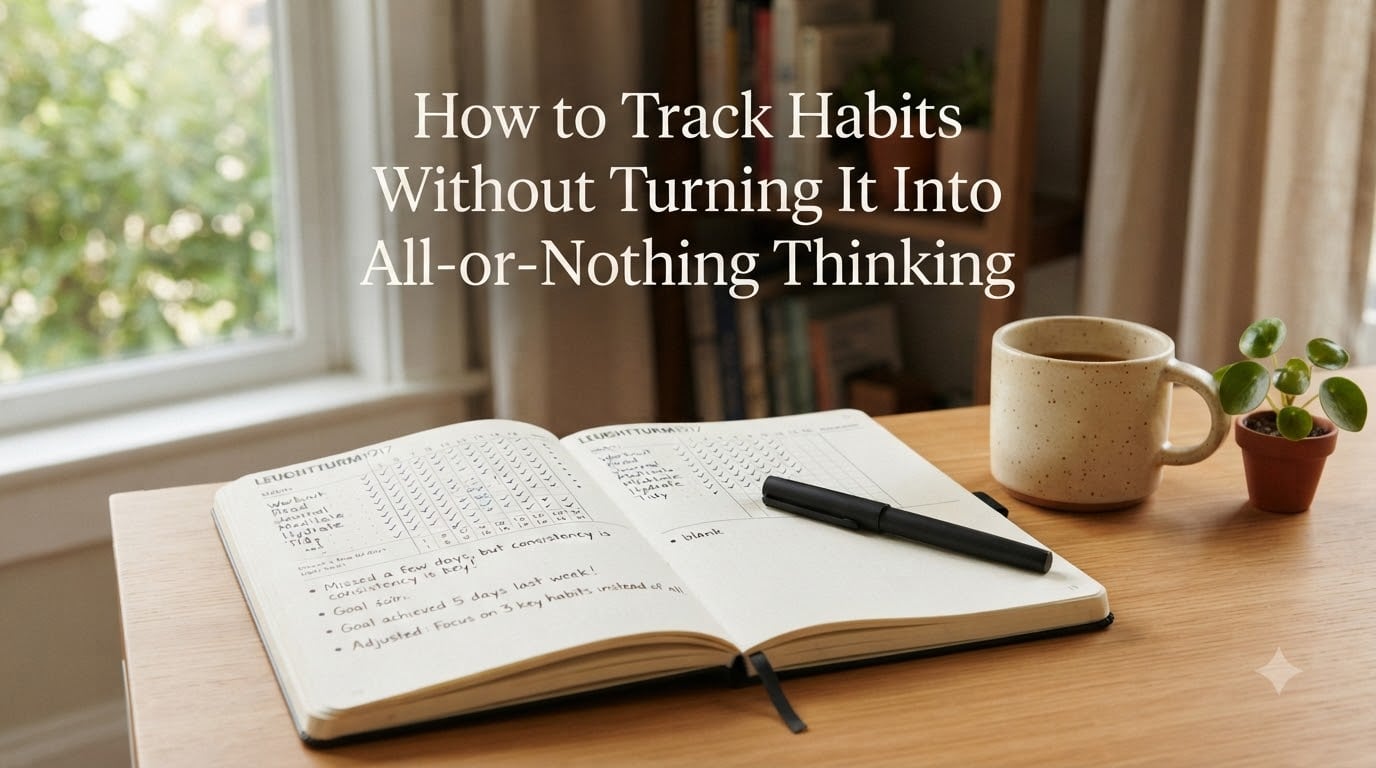
You started a habit tracker with excitement, color-coded boxes and all. Then you missed one day, and suddenly the whole system felt like proof of failure. If this sounds familiar, you are not alone, and the problem is not you. The problem is how habit tracking often collides with a thinking pattern psychologists call all-or-nothing thinking.
In this guide, I will walk you through how to track habits without turning it into all-or-nothing thinking. We will cover what this mindset actually is, why habit tracking triggers it, and most importantly, practical strategies I have used and seen work for real people. My goal is to help you build habits that survive imperfect weeks, not just perfect ones.
Table of Contents
- Why Habit Tracking Triggers All-or-Nothing Thinking
- The Psychology Behind All-or-Nothing Thinking in Habits
- How to Track Habits Without Turning It Into All-or-Nothing Thinking
- Flexible Tracking Methods That Reduce Stress
- How to Handle Missed Days Without Guilt
- The 3-3-3 Rule for Habits Explained
- Proven Strategies to Challenge All-or-Nothing Thinking
- Environmental Design for Sustainable Habits
- Frequently Asked Questions
- Conclusion
Why Habit Tracking Triggers All-or-Nothing Thinking
All-or-nothing thinking, sometimes called black-and-white or dichotomous thinking, is a cognitive distortion where you evaluate progress in extremes. Either you hit your goal perfectly, or you have failed completely. There is no middle ground in this mental model.
Habit trackers are built on streaks, checkmarks, and binary success. Did you meditate today? Yes or no. Did you hit your step count? Yes or no. The data is clean and the visual is satisfying. But that very cleanliness creates a trap. The moment you break the streak, the tracker silently tells you that your perfect run is over, and for many of us, that single red X feels enormous.
Psychology Today explains that this type of thinking shows up in two forms: performance-based perfectionism, where one slip means the whole effort was wasted, and ability-based self-judgment, where missing a habit becomes proof that you are simply not the kind of person who can do this. Both forms make habit tracking feel like a personality test instead of a tool.
The Psychology Behind All-or-Nothing Thinking in Habits
All-or-nothing thinking shows up across many conditions and personality profiles. It is a common symptom of ADHD, where the dopamine-driven brain already struggles with consistency and finds broken streaks especially painful. It also appears frequently in perfectionism, anxiety, and patterns associated with BPD. Knowing this can reduce the shame that comes with the thought pattern.
On forums like Reddit’s r/perfectionism and r/getdisciplined, users describe habit trackers that make them feel “depressed” or “rigid.” One person said a single missed day led them to abandon the entire system, even after 90 days of perfect consistency. Another wrote that they avoided opening their habit app altogether because the sight of an empty square triggered self-judgment.
This happens because our brains treat streaks as identity markers, not just data. When the streak breaks, it can feel like evidence against who you are, rather than information about what you did yesterday. Recognizing this is the first step toward breaking the cycle.
How to Track Habits Without Turning It Into All-or-Nothing Thinking
The core approach is to separate tracking from judging. Your tracker should record what happened, not assign moral value to it. Shift from a streak-based mindset to a consistency-based one. Track how often you show up across a week or month, not whether you were perfect today.
Here is the simplest version: choose a small habit, give yourself permission to miss days, and define success as a range rather than a line. If your goal is to exercise three times a week, hitting two counts as a success. If your goal is to journal daily, journaling six out of seven days still means you are a person who journals.
Flexible Tracking Methods That Reduce Stress
Not all habit trackers are created equal. The most common kind is streak-based, and it is also the most likely to trigger all-or-nothing thinking. Flexible tracking methods focus on patterns, averages, and flexibility windows.
Some options worth trying:
- Weekly check-ins instead of daily streaks. Look at how many days you hit your habit out of seven. The goal becomes a percentage, not perfection.
- Two-strike rule. You only need to start over if you miss two days in a row. One missed day is just life.
- Minimum viable habit. On low-energy days, do a tiny version. Two minutes of stretching counts. One glass of water counts. The bar stays low enough that showing up is almost always possible.
- Identity log instead of checkboxes. Write one sentence about how you showed up as the person you want to be. The data is qualitative, not binary.
- Habit stacking with grace days. Build in a planned rest day each week so you are not tracking perfection, just consistency.
The best way to track habits is the one you will actually keep using after a bad day. For many people, that means abandoning streak counters entirely.
How to Handle Missed Days Without Guilt
Missing one day is the most common trigger for full abandonment. You sleep in, skip your workout, eat off-plan, and then the story in your head becomes, “Well, I already messed up.” This is the all-or-nothing pattern at work.
The shift is small but powerful. Treat missed days as data, not verdicts. Ask yourself what got in the way, what you can adjust tomorrow, and what support you need. That is the same response you would give a friend who missed a day, and you deserve the same kindness.
If you have missed several days in a row, the path back is even simpler. Do not try to “make up” the missed days. Do not double down to prove something. Just resume the habit at its smallest version tomorrow. If you have completely abandoned habit tracking, start fresh with one habit, no streak counter, and a flexible definition of success.
The 3-3-3 Rule for Habits Explained
The 3-3-3 rule is a simple framework for building habits without pressure. It works like this:
- Choose 3 daily habits you want to maintain. Keep the list short so it feels manageable.
- Spend 3 minutes on each habit at minimum. Lowering the time barrier makes the habit easier to start and easier to keep on rough days.
- Commit for 3 weeks instead of 30 days or longer. A shorter initial window removes the feeling of a life sentence and gives you permission to reassess.
After three weeks, you will have a much clearer sense of what is realistic for your actual life. Some habits will feel automatic, and you can keep them. Others will need adjusting, and that is the point. The 3-3-3 rule is built on the idea that consistency over short, defined windows beats intensity over long, undefined ones.
Proven Strategies to Challenge All-or-Nothing Thinking
Changing how you think is not about willpower. It is about practice. Here are four strategies that consistently help reduce rigid thinking around habits.
1. Reframe “failed” as “learned.” When you miss a habit, write down what you learned about your schedule, energy, or environment. This turns the slip-up into information.
2. Use the “and” technique. Replace “I missed my habit today, so I am failing” with “I missed my habit today, and I am still showing up for myself.” Both things can be true at once.
3. Practice self-compassion out loud. Research from Dr. Kristin Neff shows that self-compassion is a stronger predictor of habit maintenance than self-criticism. Talk to yourself the way you would talk to a friend.
4. Set process goals, not outcome goals. Instead of “lose 10 pounds,” track “I move my body three times a week.” Process goals survive bad days. Outcome goals often do not.
These strategies work because they interrupt the automatic thought loop that turns a single missed day into a full identity crisis.
Environmental Design for Sustainable Habits
One of the most overlooked tools for reducing all-or-nothing thinking is your environment. When the right cue is in front of you, you do not need motivation or perfect streaks. You just need to follow the design.
For weight loss and habit goals specifically, this can look like prepping healthy snacks on Sunday so weekday decisions are easier. Or putting your walking shoes by the door so the cue is visible. Or laying out your planner the night before so tracking takes 30 seconds, not five minutes.
Good design reduces the number of decisions you have to make. Fewer decisions mean fewer chances for the all-or-nothing voice to convince you that anything less than perfect is not worth doing.
Frequently Asked Questions
What is the 3-3-3 rule for habits?
The 3-3-3 rule is a simple habit-building framework. You pick 3 daily habits, commit to spending just 3 minutes on each, and stick with the routine for 3 weeks before evaluating. The short time commitment and short window reduce pressure and make it easier to stay consistent without falling into all-or-nothing thinking.
Is all-or-nothing thinking a common symptom of ADHD?
Yes, all-or-nothing thinking shows up frequently in ADHD. The dopamine-driven brain already struggles with consistency, and broken streaks can feel especially painful or shame-inducing. Recognizing the link between ADHD and rigid thinking patterns can reduce self-blame and help you design more flexible tracking systems.
What is the best way to track habits?
The best way to track habits is the method you will actually keep using after a missed day. For most people, that means flexible systems like weekly check-ins, the two-strike rule, or minimum viable habits instead of daily streaks. The goal is to track consistency over time, not perfection on any single day.
How can I challenge all-or-nothing thinking?
You can challenge all-or-nothing thinking by reframing missed days as data rather than failure, using the ‘and’ technique to hold two truths at once, practicing self-compassion out loud, and setting process goals instead of outcome goals. Consistent practice with these strategies interrupts the automatic thought loop that turns one slip-up into total abandonment.
Conclusion
Learning how to track habits without turning it into all-or-nothing thinking is less about finding a perfect system and more about choosing a kind one. Your tracker should help you see your patterns, not pass judgment on your character.
Start small, build in flexibility, and treat missed days as part of the data, not the end of the story. That is how habits actually last.