
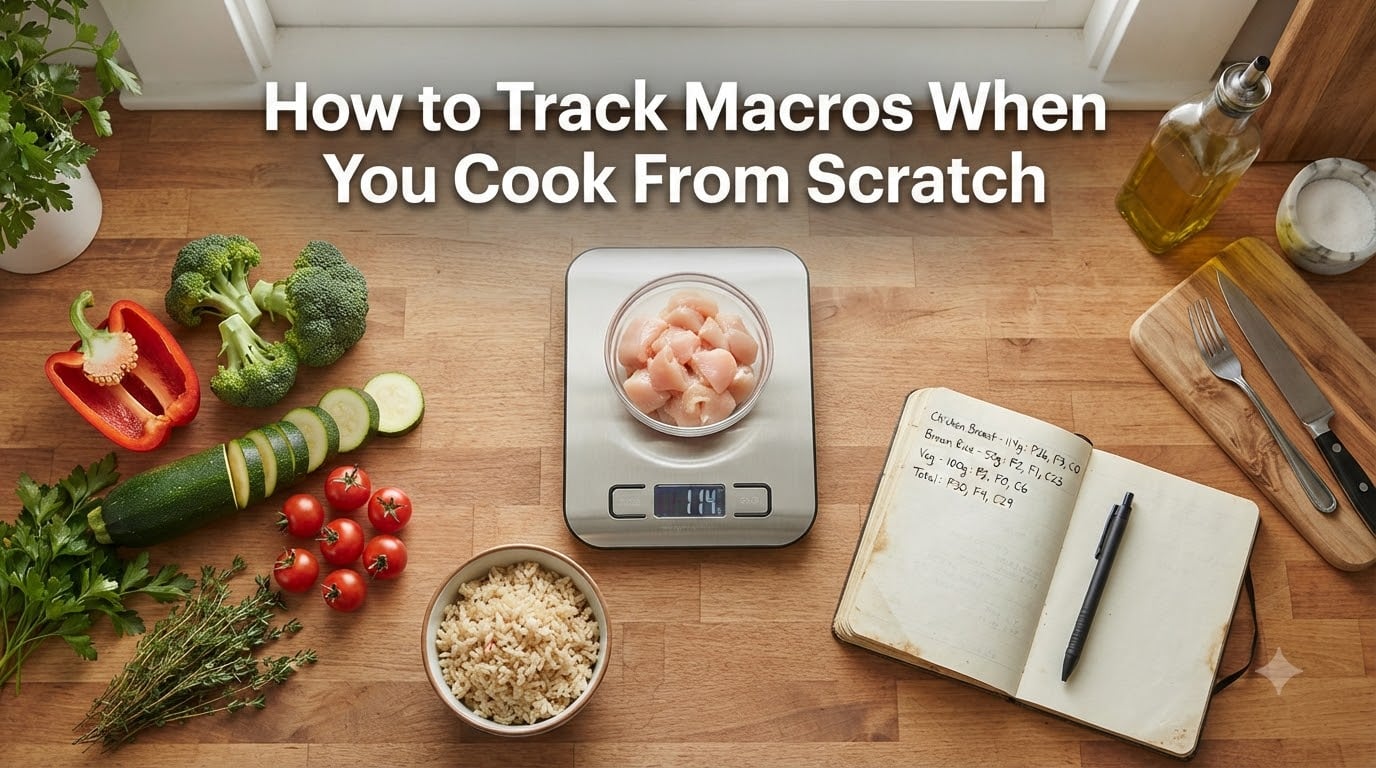
Tracking macros when you cook from scratch is one of the most common frustrations I hear from people trying to hit specific protein, carb, and fat targets. Homemade meals have no nutrition label to flip over, no barcode to scan, and no quick entry in your favorite app. I have spent years testing different methods for tracking homemade recipes, and I will walk you through the exact system that works.
The good news is that the entire process boils down to one principle: add up the macros for each ingredient and divide by the number of servings. Once you learn that pattern, every homemade recipe becomes trackable, whether you are making a quick weeknight stir fry or batch cooking chicken and rice for the entire week. In this guide, I will share the four-step method I rely on, plus how to handle tricky situations like tasting while cooking, family-style meals, and raw versus cooked weight.
Table of Contents
How to Track Macros When You Cook From Scratch: Step-by-Step
If you want to track macros when you cook from scratch, here is the exact four-step process I use every single time. These steps work whether you are making soup, casseroles, sheet pan dinners, or anything in between.
Step 1: Weigh Every Ingredient Before Cooking
The first step is to weigh each ingredient in grams on a digital food scale before it goes into the pot. I place a bowl on the scale, tare it to zero, then add each ingredient and record the weight in grams as I go.
This is the step most people skip, and it is the one that makes the biggest difference in accuracy. A cup of chopped onion can weigh anywhere from 80 to 160 grams depending on how finely you chop it. A “medium” chicken breast can range from 120 to 200 grams. Measuring in grams removes all of that guesswork. As one Cronometer forum user put it: “Weigh and measure out the ingredients you have added. Write them down or add them to the recipe as you go.”
Pro tip: weigh ingredients raw, before any moisture loss or fat rendering happens. I will explain why this matters so much in the raw versus cooked weight section below.
Step 2: Look Up Nutrition Values for Each Ingredient
Once you have a list of weights, the next step is to find the calorie and macro values for each ingredient. You have three reliable options: a tracking app with a verified database, the USDA FoodData Central website, or a nutrition label from the original packaging.
I prefer apps with verified entries over user-generated content because the FDA allows nutrition labels to be off by up to 20 percent, and user entries can be even less accurate. Cronometer pulls from the USDA database and the NCCDB, which is why it is my top pick for homemade recipes.
Here is what you want to record for each ingredient:
- Calories
- Protein in grams
- Carbohydrates in grams
- Fat in grams
If the app supports a recipe builder feature, log each ingredient directly into the recipe. If not, jot them down in a notes app or spreadsheet as you cook.
Step 3: Add Up the Total Macros for the Entire Recipe
Now you add everything together. Total calories equal the sum of calories from each ingredient. Total protein, total carbs, and total fat work the same way.
For example, if your chicken stir fry recipe contains 400 grams of chicken breast, 200 grams of bell peppers, 150 grams of broccoli, 30 grams of olive oil, and 200 grams of cooked rice, you would look up each one, get the macros, and add them all together. Your recipe builder app will do this automatically, but doing it by hand teaches you what each ingredient actually contributes.
This is also a great way to spot ingredients that quietly add a lot of calories. Oils, butter, nuts, and sauces are the usual culprits.
Step 4: Divide by the Number of Servings
The final step is to divide each total by the number of servings in the recipe. If your stir fry makes 4 servings, divide everything by 4 to get the macros per serving.
The serving size you choose matters a lot here. You are not locked into what a recipe card calls a serving. Pick the portion that matches how you actually eat. I usually weigh my finished plate and back-calculate from there.
Here is a quick example of the math:
- Total recipe: 1,800 calories, 140g protein, 120g carbs, 70g fat
- 4 servings: 450 calories, 35g protein, 30g carbs, 17.5g fat per serving
That is it. Four steps, and you now have accurate macros for any homemade meal.
Raw vs Cooked Weight: Which Should You Track?
Always weigh and log ingredients in their raw form whenever possible. Raw weight is consistent and predictable. Cooked weight is not. A chicken breast can lose 25 to 30 percent of its weight during cooking from water evaporation. Rice absorbs water and gains weight. Ground beef loses fat volume when it renders out.
Most nutrition databases and food labels report values for the raw form, which is another reason raw weighing lines up perfectly with what your app will calculate. If you forget to weigh something raw and only have the cooked weight, you can still estimate. Check the USDA entry for a typical raw-to-cooked conversion for that food, or look up a similar ingredient with a “cooked” entry in your app.
The one exception is when a recipe explicitly uses a pre-cooked ingredient, like canned beans or rotisserie chicken. In that case, weigh the cooked product directly and use a cooked entry from the database.
Best Tracking Apps for Homemade Recipes
Apps are the easiest way to track macros when you cook from scratch, especially if they have a dedicated recipe builder. Here is how the top three compare for homemade recipe tracking.
Cronometer is the most accurate option for serious macro trackers. Its database is verified and pulls from the USDA and the NCC Food Composition Database. The recipe builder lets you add ingredients by gram weight and instantly totals the macros. If you care about micronutrients alongside macros, Cronometer is unmatched.
MyFitnessPal has the largest food database by far, which means you are more likely to find a match for unusual ingredients. The recipe builder is solid but the database includes many user-submitted entries with questionable accuracy. Stick to entries with the green checkmark for verified labels.
MacroFactor focuses on adaptive coaching and uses your logged data to recommend daily calorie and macro targets. Its recipe builder is functional, and the app is excellent if you want the algorithm to adjust your targets over time based on your actual results.
For most people who cook a lot from scratch, I recommend Cronometer for accuracy or MyFitnessPal for convenience. Pair either one with a good digital food scale and you have everything you need.
Handling Tricky Situations
The four-step method covers most meals, but some real-world cooking scenarios throw it off. Here is how I handle each one.
Tasting While Cooking
If you taste as you cook, you have two clean ways to account for it. The first option is to take only small tastes and assume 20 to 50 unaccounted calories at the end. This is what I do, and it works because a tablespoon of broth or sauce barely moves the needle.
The second option is to add an extra “phantom serving” at the end of your math. If your recipe makes 4 servings but you tasted it 6 times while cooking, divide by 6 instead of 4. The actual calorie cost of tasting is probably less than this, but it errs on the side of caution.
Family-Style Meals
Family-style serving is the hardest scenario to track accurately. When you put a big pot on the table and everyone serves themselves, portion sizes vary.
The best workaround is to weigh the empty serving dish before dinner and weigh it again after. The difference is exactly what was eaten, and you can divide that by the number of people at the table. For your personal portion, weigh your plate before and after to know exactly what you ate.
Batch Cooking and Meal Prep
Batch cooking makes macro tracking easier, not harder. You make a big recipe once, divide it into containers, and weigh each container. From there you can log the same meal over and over without re-doing the math.
For maximum efficiency, weigh each finished container and let your app save the recipe. I label containers with the date and the per-container macros so I never have to think about it later.
Cooking Loss and Oil Absorption
Cooking loss and oil absorption are the silent calorie adders that throw people off. When you pan-fry vegetables in oil, they absorb a meaningful amount of fat. When you simmer a stew, some water evaporates and concentrates the calories.
The simplest fix is to weigh the entire finished dish and divide by the number of servings. The finished weight already accounts for whatever happened during cooking, so the per-serving math reflects reality.
Common Mistakes to Avoid
Here are the mistakes I see over and over when people try to track macros for homemade meals.
Measuring in cups instead of grams. Cups are wildly inaccurate for solid foods. Always use grams. A food scale costs under $20 and pays for itself within a week of accurate tracking.
Forgetting cooking oils and butter. A tablespoon of olive oil has 120 calories. If you saute in two tablespoons and forget to log them, you are 240 calories off on every meal that uses that base.
Inconsistent serving sizes. If you declare a serving as “one bowl” but bowls are different sizes, your tracking will be off. Weigh each portion, at least until you have a consistent visual reference.
Trusting unverified app entries. User-submitted entries can have errors. Stick to verified sources or USDA database entries whenever you can.
Skipping the recipe because it is too complex. Even a 15-ingredient dish takes only a few minutes to log if you already have the weights. The complexity is in your head, not the app.
The Spreadsheet Method: Going App-Free
If you would rather skip apps entirely, a simple spreadsheet works just as well. Create columns for ingredient name, weight in grams, calories, protein, carbs, and fat. Log each ingredient as you add it, then use SUM formulas to total each column. Divide by your serving count at the bottom.
Pull nutrition values from the USDA FoodData Central website, which is free and authoritative. If you want to verify the calorie math manually, use the 4-4-9 rule: protein has 4 calories per gram, carbs have 4 calories per gram, and fat has 9 calories per gram. Multiply each macro by its calorie density, add them up, and you should land within a few calories of the database value.
The 4-4-9 rule is accurate for whole foods. It can drift for processed foods with sugar alcohols, fiber additives, or other modified carbs, but for chicken, rice, vegetables, and oil it is spot on.
Frequently Asked Questions
How to track macros with homemade recipes?
Weigh each ingredient in grams before cooking, look up the calories and macros for each ingredient in a verified database, add up the totals for the entire recipe, then divide by the number of servings. Save the recipe in your tracking app so you can reuse it for future batches.
How to count macros raw or cooked?
Always weigh and log ingredients raw when possible. Raw weight is consistent and matches what most nutrition databases report. Cooked weight varies because of water loss, fat rendering, and oil absorption. If you forget to weigh raw, look up a cooked entry in your database or estimate using a raw-to-cooked conversion.
Is the 4-4-9 rule accurate?
Yes, the 4-4-9 rule is accurate for whole foods. Protein and carbs each contain 4 calories per gram, and fat contains 9 calories per gram. For processed foods with sugar alcohols or modified fibers, the rule can drift. For chicken, rice, vegetables, oils, and other whole ingredients it is reliable.
How to count calories when cooking from scratch?
Weigh every ingredient in grams before cooking, find the calorie value for each ingredient in a verified database like USDA FoodData Central, add all the calories together for the entire recipe, then divide by the number of servings. This gives you accurate calories per portion.
What is the best app for tracking homemade meals?
Cronometer is the best app for tracking homemade meals because it uses verified USDA and NCC database entries. MyFitnessPal is a strong alternative with the largest food database. MacroFactor is ideal if you want adaptive coaching that adjusts your targets based on your results.
Conclusion
Tracking macros when you cook from scratch comes down to four steps: weigh your ingredients in grams, look up the nutrition values, add up the totals, and divide by the number of servings. Once you build a few recipes into your tracking app, the process gets faster and faster.
Do not aim for perfection. Aim for consistency. Even tracking at 80 percent accuracy will keep you on track toward your goals, and the homemade meals you cook with intention will always be more nourishing than the packaged alternatives. Start with one recipe this week, log every ingredient, and you will see how doable the process really is.