
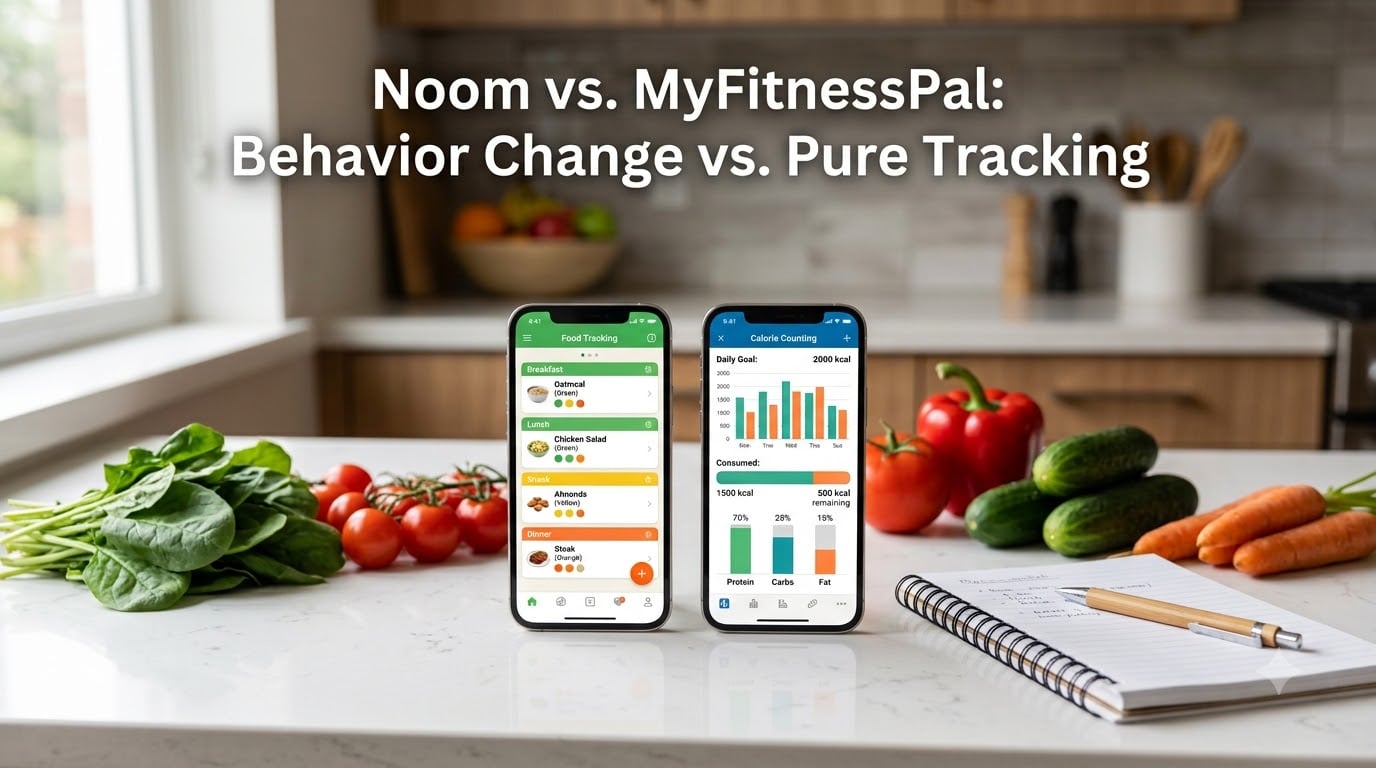
Choosing between Noom and MyFitnessPal comes down to one fundamental question: do you want an app that changes how you think about food, or one that simply tracks what you eat? In this Noom vs MyFitnessPal comparison, I break down the core differences between a psychology-based behavior change program and a data-first calorie tracking tool so you can pick the one that actually fits your lifestyle.
Noom uses daily lessons, color-coded food categories, and personal coaching to reshape eating habits from the inside out. MyFitnessPal relies on one of the largest food databases in the world to make calorie and macro logging as fast and accurate as possible. Both can help you lose weight, but they take completely different roads to get there.
After digging into forum discussions, user reviews, and feature breakdowns, our team found that the right choice depends less on which app is universally better and more on which approach matches your personality. We spent weeks comparing both platforms, reading real Reddit testimonials, and analyzing pricing models so you do not have to guess.
Here is the short version: Noom takes a psychology-first approach that treats weight loss as a mindset problem, while MyFitnessPal is a pure tracking tool focused on data. If you want coaching, daily lessons, and behavior change support, Noom is built for that. If you want fast, accurate calorie logging with the largest food database available, MyFitnessPal is the stronger pick. Let’s walk through everything you need to know.
Table of Contents
- The Core Philosophy Difference: Behavior Change vs. Pure Tracking
- How Noom Works
- How MyFitnessPal Works
- Noom vs MyFitnessPal: Feature-by-Feature Comparison
- Food Tracking and Database Accuracy
- Calorie Budget Differences Explained
- Coaching and Support Comparison
- Pricing Comparison
- Real User Experiences: What Reddit Users Say
- Pros and Cons of Each App
- Who Should Choose Noom vs MyFitnessPal
- Frequently Asked Questions
- Conclusion
The Core Philosophy Difference: Behavior Change vs. Pure Tracking
The biggest distinction in the Noom vs MyFitnessPal debate is philosophical. Noom was built around cognitive behavioral therapy principles. The app treats weight loss as a mindset problem first and a math problem second. Every feature, from the daily psychology lessons to the color-coded food system, exists to help you understand why you eat the way you do.
MyFitnessPal takes the opposite approach. It is a pure tracking tool that trusts you to make good decisions if you have good data. The app gives you a calorie target, a massive food database, and macro breakdowns, then gets out of your way. There are no lessons, no curriculum, and no behavior modules.
This difference matters because long-term weight loss success depends heavily on adherence. If you struggle with emotional eating, mindless snacking, or yo-yo dieting, Noom’s behavior change framework might give you tools that raw data alone cannot. If you are already disciplined and just need a reliable calorie counter, MyFitnessPal’s straightforward tracking will feel like a breath of fresh air.
Neither approach is inherently superior. Research on weight loss consistently shows that the best program is the one you stick with. Understanding your own tendencies before choosing is what separates people who hit their goals from those who abandon ship after three weeks.
Think of it this way. MyFitnessPal is like a speedometer that tells you exactly how fast you are going. Noom is like a driving instructor who sits in the passenger seat and helps you understand why you speed, when you are likely to speed, and how to build better driving habits. Both can get you to your destination, but the experience is completely different.
How Noom Works
Noom describes itself as a psychology-based weight loss program, and the structure backs that up. When you sign up, you complete an intake quiz that asks about your goals, habits, triggers, and lifestyle. The app then creates a personalized plan with a daily calorie budget and a curriculum of short reading assignments.
Each day, Noom serves up bite-sized lessons that take about 10 to 15 minutes to complete. These lessons cover topics like emotional eating, stress management, decision fatigue, and how to navigate social situations without derailing your progress. The content draws from cognitive behavioral therapy techniques adapted for everyday users.
The curriculum is structured in units that build on each other over weeks. Early lessons focus on awareness and identifying triggers. Later lessons move into goal-setting, habit formation, and relapse prevention. This progression mirrors what you would experience in a structured coaching program, which is part of why Noom costs more than a basic tracking app.
The food logging system in Noom uses a color-coded approach. Foods are categorized as green, yellow, or orange based on their caloric density. Green foods like vegetables, fruits, and whole grains are encouraged and can be eaten generously. Yellow foods like lean proteins, legumes, and low-fat dairy are moderate portions. Orange foods like pizza, desserts, and fried items are not forbidden, but you are nudged to limit them.
This color system is intentional. Instead of making you count every calorie obsessively, Noom helps you develop an intuitive sense of which foods are nutrient-dense and which are calorie-dense. Over time, the goal is that you make better choices naturally without needing the app at every meal.
Noom also assigns you a personal goal coach and places you in a group with other users. You can message your coach for support, and the group chat functions as a peer accountability space. The level of human contact varies, but the structure is designed to make you feel supported rather than left to figure things out alone.
How MyFitnessPal Works
MyFitnessPal is a calorie tracking app in the most literal sense. You set your weight loss goal, and the app calculates a daily calorie target based on your age, height, weight, and activity level. From there, you log everything you eat and drink, and the app keeps a running total of your calories consumed versus your budget.
The crown jewel of MyFitnessPal is its food database. With over 14 million foods listed, it is one of the most comprehensive databases available in any calorie counting app. You can search by name, scan a barcode, or even import recipes. This makes logging fast, which is critical because the biggest reason people quit tracking apps is the friction of data entry.
The database includes brand-name products, restaurant menu items, generic foods, and user-submitted entries. This breadth means you can almost always find what you ate without manual entry. The barcode scanner is especially useful for packaged foods and works reliably across thousands of products.
MyFitnessPal also tracks macronutrients, letting you monitor protein, carbs, and fat intake. The free version shows basic macro totals, while the Premium version unlocks more detailed macro goals, meal planning tools, and the ability to set different macro ratios for different days. For users who follow specific diets like keto, high-protein, or intermittent fasting, this flexibility is valuable.
Exercise tracking is built in as well. You can log workouts manually by selecting from hundreds of activities, and MyFitnessPal adjusts your calorie budget based on estimated calories burned. The app integrates with a wide range of wearables and fitness apps, including Fitbit, Apple Watch, Garmin, and Samsung Health, so your activity data flows in automatically without duplicate entry.
What MyFitnessPal does not do is teach you about nutrition, habits, or psychology. There is no curriculum, no daily lesson, and no coach. The app assumes you know what to eat and just need help tracking it. For experienced dieters and data-driven users, this is exactly what they want.
Noom vs MyFitnessPal: Feature-by-Feature Comparison
Here is a side-by-side breakdown of how the two apps compare across the categories that matter most to anyone choosing a weight loss app:
- Approach: Noom uses behavior change psychology with daily lessons and coaching. MyFitnessPal uses pure calorie and macro tracking with no educational component.
- Food database: MyFitnessPal has over 14 million foods with strong barcode coverage. Noom has a smaller database with reported accuracy gaps for certain products.
- Food categorization: Noom uses a green, yellow, orange color system based on caloric density. MyFitnessPal uses raw calorie and macro numbers.
- Coaching: Noom includes a personal goal coach and group support chat. MyFitnessPal offers community forums but no personal coach.
- Education: Noom provides daily psychology-based curriculum lasting 10 to 15 minutes. MyFitnessPal has no educational component whatsoever.
- Exercise tracking: MyFitnessPal has robust workout logging with hundreds of activities and strong wearable integration. Noom has basic exercise tracking with limited device support.
- Time commitment: Noom requires 10 to 15 minutes daily for lessons plus food logging time. MyFitnessPal requires only the time it takes to log your meals.
- Barcode scanning: Both apps offer barcode scanning. MyFitnessPal’s scanner is more reliable due to its larger database of packaged products.
- Wearable integration: MyFitnessPal connects with Fitbit, Apple Watch, Garmin, Samsung Health, and more. Noom has limited wearable support.
- Meal planning: MyFitnessPal Premium includes meal planning tools and recipe imports. Noom provides food suggestions within its curriculum but no dedicated meal planner.
- Calorie budget: Noom typically assigns higher, more comfortable calorie budgets. MyFitnessPal tends to assign more aggressive deficits.
Food Tracking and Database Accuracy
When it comes to food database size and accuracy, MyFitnessPal has a clear edge. With over 14 million foods, including restaurant items, brand-name products, and user-submitted entries, you can find almost anything you eat. The barcode scanner works smoothly for packaged foods, and recipe imports make home-cooked meals easy to log.
The sheer size of MyFitnessPal’s database matters in daily practice. When you are standing in your kitchen with a plate of food, the ability to find the exact product in three seconds versus manually entering macros can be the difference between logging consistently and giving up after a week. Speed and convenience are the main reasons MyFitnessPal users stay loyal.
Noom’s food database is noticeably smaller, and this is one of the most common complaints from users who switch from MyFitnessPal. Reddit users in the CICO and Noom communities frequently report that Noom’s food entries are less accurate, with calorie and macro information that sometimes does not match the actual product label.
This matters more than you might think. If you are carefully tracking a calorie deficit, inaccurate entries can throw off your entire budget by hundreds of calories per day. Over a week, that can be the difference between losing weight and spinning your wheels without knowing why.
However, Noom’s color-coding system means precise calorie numbers matter less to the overall experience. The app encourages you to focus on food density and categories rather than obsessing over every gram. Some users find this liberating. Others find it frustrating when they want precise data and cannot find accurate entries for the foods they eat.
If database accuracy is your top priority, MyFitnessPal wins this category without question. If you prefer a qualitative approach that guides your food choices without fixating on exact numbers, Noom’s system may actually reduce your anxiety around eating.
Calorie Budget Differences Explained
One of the most confusing things for people trying both apps is that Noom and MyFitnessPal often give very different calorie budgets. This is a pain point that almost no competitor covers in detail, but it comes up constantly in Reddit discussions across the Noom, CICO, and MyFitnessPal communities.
MyFitnessPal tends to assign more aggressive calorie deficits. Many users, especially shorter women or those with lower activity levels, report being assigned budgets as low as 1200 calories per day. This is the minimum calorie intake generally considered safe, and eating at that level long-term can feel restrictive and unsustainable for many people.
The reason is that MyFitnessPal calculates your Basal Metabolic Rate and then applies a standard deficit based on your stated weight loss pace. If you select the fastest pace (2 pounds per week), the app may bottom out at 1200 calories regardless of your starting metrics. This can work, but it is not comfortable for everyone.
Noom typically assigns higher calorie budgets. The app factors in your activity level, weight loss pace preference, and behavioral factors to arrive at a target that aims for a more moderate deficit. Users frequently report that Noom gives them 200 to 400 more calories per day than MyFitnessPal for the same goals.
This does not mean one app is wrong. It means they use different formulas and philosophies. Noom prioritizes sustainability and adherence, betting that a slower, more comfortable deficit will keep you on track longer. MyFitnessPal prioritizes efficiency, giving you the numbers needed for faster results if you can stick with them.
If you have tried MyFitnessPal and felt constantly hungry or discouraged by a low budget, Noom’s approach might solve that problem. On the other hand, if you want to see results quickly and are comfortable with a more aggressive deficit, MyFitnessPal gives you the tools to do that.
Coaching and Support Comparison
This is where the Noom vs MyFitnessPal gap widens significantly. Noom includes coaching as a core part of its program. When you sign up, you are assigned a personal goal coach who checks in with you regularly through the app. You can ask questions, share struggles, and get encouragement tailored to your situation.
You are also placed in a small group with other Noom users who share similar goals. The group chat functions as a support circle where members share wins, ask questions, and hold each other accountable. For people who thrive on community and accountability, this can be the difference between sticking with the program and quitting after two weeks.
It is worth noting that Noom coaches are not necessarily registered dietitians. They are trained specialists who guide you through the curriculum and provide motivational support. If you have specific medical or nutritional conditions, you may need a licensed professional in addition to or instead of the app’s coaching.
MyFitnessPal has no personal coaching component. The app does have community forums where users can interact, share recipes, and ask questions. But there is no assigned coach, no structured support system, and no one checking in on your progress. You are entirely self-directed.
For some users, that independence is exactly the point. They do not want messages from a coach or pressure from a group. They just want to log their food and get on with their day. MyFitnessPal respects that preference by keeping things simple and friction-free.
The trade-off is time and cost. Noom’s coaching requires a bigger financial investment and a time commitment of 10 to 15 minutes per day for lessons. MyFitnessPal asks nothing beyond the few minutes it takes to log your meals. If you do not want homework or coaching, Noom’s structure can feel like a chore rather than a benefit.
Pricing Comparison
Cost is a major factor in the Noom vs MyFitnessPal decision, and the price gap between these two apps is significant. Understanding what you get for your money helps clarify whether the extra investment is worth it for your situation.
Noom operates on a subscription model that costs roughly $60 to $70 per month depending on the plan length you choose. Longer commitments bring the monthly cost down, but you pay upfront for the full period. There is no meaningful free version. Every feature, including coaching and lessons, requires a paid subscription.
For a six-month commitment, Noom’s pricing can come down to around $40 per month, which is more manageable but still a substantial investment. You are paying for the coaching, the curriculum, and the structured program, not just a tracking tool. Whether that is worth it depends entirely on how much you value behavior change support.
MyFitnessPal has a functional free version that includes basic calorie tracking, food logging, and database access. The free version does show ads and limits some features, but the core tracking experience works well enough for many users. The Premium tier costs about $20 per month or around $80 per year.
Premium unlocks advanced macro tracking, meal planning tools, recipe imports, and an ad-free experience. For users who want macro flexibility or are annoyed by ads, the annual Premium plan at roughly $80 is a reasonable investment that costs less than two months of Noom.
The bottom line on pricing is that MyFitnessPal is substantially cheaper. The free version alone works well enough for many users, and Premium costs a fraction of what Noom charges. Noom costs several times more, and you need to decide whether the coaching, lessons, and behavior change curriculum justify that premium.
Real User Experiences: What Reddit Users Say
Brand marketing only tells part of the story. To get a real sense of how these apps perform over time, our team dug through Reddit threads in the Noom, CICO, and MyFitnessPal communities. Here is what actual users report after spending weeks or months with each app.
One recurring theme is the switching phenomenon. Users move in both directions, and the reasons are telling. A Reddit user who tried Noom for three weeks shared that they lost 2.5 pounds but were going back to MyFitnessPal. They found Noom’s lessons felt elementary and preferred MyFitnessPal’s simplicity. Another user who posted a six-month review of Noom as a former MyFitnessPal user found Noom’s articles “cringey” and preferred straightforward tracking without the reading assignments.
On the flip side, users who switch from MyFitnessPal to Noom often cite the calorie budget difference. One user reported that MyFitnessPal gave them a much lower calorie budget than Noom for the same profile. For people who felt starving on MyFitnessPal’s 1200-calorie target, Noom’s higher budget was a relief that made adherence possible for the first time.
Another common observation centers on Noom’s color-coding system. Some users find it genuinely helpful for making better food choices without obsessing over numbers. The visual cue of seeing a food labeled orange is enough to make them reconsider without needing to check exact calories. Others find it restrictive and discouraging, especially when foods they enjoy are categorized as orange.
The Noom database also comes up frequently. Users who were used to MyFitnessPal’s extensive food entries express frustration when they cannot find accurate listings for their favorite products on Noom. This is a practical friction point that affects the daily experience more than any feature comparison table can convey.
The pattern that emerges from real user experiences is clear: Noom works best for people who need structure, coaching, and a mindset shift. MyFitnessPal works best for people who want fast, reliable tracking without the extra layers. Neither app universally wins, and many users only discover their preference by trying both.
Pros and Cons of Each App
No single app is perfect. Based on our research into user reviews, forum discussions, and feature analysis, here is a balanced look at where each app shines and where it falls short.
Noom Pros:
- Structured behavior change curriculum that addresses emotional and psychological eating at its root
- Personal coaching provides accountability and personalized guidance from a real person
- Color-coded food system simplifies decision-making without banning any foods entirely
- Higher calorie budgets feel more sustainable for many users, reducing the risk of binge-restrict cycles
- Group support creates community and shared motivation during difficult stretches
- Evidence-based approach drawing from cognitive behavioral therapy techniques
Noom Cons:
- Significantly more expensive than MyFitnessPal, with no functional free version
- Smaller food database with reported accuracy issues for certain products
- Daily lessons require a 10 to 15 minute time commitment that not everyone wants
- Some users find the curriculum too basic, repetitive, or condescending in tone
- Limited wearable and fitness tracker integration compared to competitors
- Coaches are trained specialists, not necessarily licensed dietitians or medical professionals
MyFitnessPal Pros:
- Massive food database with over 14 million entries makes finding foods fast and reliable
- Functional free version covers basic tracking needs without any cost
- Fast logging with reliable barcode scanning that works across thousands of products
- Excellent wearable integration across Fitbit, Apple Watch, Garmin, Samsung Health, and more
- Detailed macro tracking for specific diet approaches like keto, high-protein, and intermittent fasting
- Low pressure, self-directed format that respects your independence
MyFitnessPal Cons:
- Free version includes ads and restricts key features like detailed macro goals
- Calorie budgets can be aggressively low, especially for shorter or less active users
- No personal coaching or behavior change support for users who need structure
- User-submitted food entries can be inaccurate, requiring careful verification
- No educational component to help users build sustainable long-term habits
- Community forums exist but lack the structured accountability of Noom’s group system
Who Should Choose Noom vs MyFitnessPal
By now you probably have a sense of which direction fits you better. Here is a straightforward framework to help you decide. These profiles are based on the user experiences and pain points we found across forums, reviews, and direct feature comparisons.
Choose Noom if you:
- Have tried calorie counting before and quit because it felt meaningless without context
- Struggle with emotional eating, stress eating, or binge episodes tied to triggers
- Want coaching and accountability from a real person who checks in on your progress
- Are willing to spend 10 to 15 minutes daily reading lessons and completing exercises
- Prefer a structured program over a self-directed tool that leaves you to figure things out
- Want a higher, more comfortable calorie budget that feels sustainable long-term
- Have been diagnosed or suspect you have patterns of disordered eating tied to mindset
Choose MyFitnessPal if you:
- Are self-motivated and just need accurate, fast tracking data to manage your nutrition
- Want the largest possible food database for easy logging of any food you encounter
- Prefer a lower-cost or free option that does not require an ongoing subscription
- Follow a specific diet like keto, high-protein, or macros-based that requires precise tracking
- Use a fitness wearable and want seamless integration without manual exercise logging
- Want to log food quickly without extra steps, reading assignments, or coaching conversations
- Already understand nutrition basics and do not need an educational curriculum
If you are still unsure, consider this practical approach: many users start with MyFitnessPal’s free version to build the habit of logging. If they find themselves struggling with consistency, emotional eating patterns, or feeling lost without guidance, they switch to Noom for the coaching and behavior change support. There is no rule against trying both, and a short trial of each can quickly reveal which format clicks with your personality.
Frequently Asked Questions
Is Noom or MyFitnessPal more accurate?
MyFitnessPal is generally more accurate for calorie and food data because it has a larger database with over 14 million foods and more reliable barcode scanning. Noom’s smaller database has known accuracy issues, though its color-coded system reduces reliance on precise numbers.
What is the highest rated weight loss app?
Both Noom and MyFitnessPal consistently rank among the top-rated weight loss apps. Noom tends to score higher for user satisfaction in behavior change, while MyFitnessPal leads in tracking convenience and database size. Editor’s choice awards frequently split between the two depending on the criteria.
Is there a better app than Noom?
There is no universally better app than Noom, but alternatives like MyFitnessPal, Cronometer, and Lose It may suit certain users better. If you want pure tracking without the coaching cost, MyFitnessPal or Cronometer are strong alternatives. If you want behavior change support in a different format, Second Nature and WW are worth considering.
How long does it take to lose 20 pounds on Noom?
Most Noom users lose 20 pounds in 3 to 5 months, depending on their starting weight, calorie budget, and activity level. Noom targets a sustainable rate of 1 to 2 pounds per week, which means 20 pounds typically takes 10 to 20 weeks. Users who follow the lessons and stay consistent tend to see faster results.
What do doctors say about Noom?
Many doctors and registered dietitians view Noom positively because its behavior change approach addresses the root causes of overeating rather than just counting calories. The cognitive behavioral therapy techniques are evidence-based. However, some clinicians caution that Noom’s coaching is not a substitute for personalized medical or nutritional guidance from a licensed professional.
Do people actually lose weight on Noom?
Yes, many people lose weight on Noom. The app reports that 78 percent of users lose weight during their first 16 weeks. Independent reviews and Reddit user experiences confirm real weight loss, though results vary based on adherence. Users who complete the daily lessons and log consistently see the best outcomes.
Conclusion
The Noom vs MyFitnessPal comparison does not have a universal winner because the two apps solve different problems. Noom is a behavior change program that uses psychology, coaching, and daily lessons to help you build sustainable eating habits. MyFitnessPal is a powerful tracking tool that gives you the data and database to manage your own nutrition independently.
If you need structure, coaching, and help understanding your relationship with food, Noom is worth the investment. If you are self-directed and want fast, accurate tracking at a lower cost, MyFitnessPal is the smarter choice. The key is matching the app to your personality rather than chasing someone else’s idea of which is better.
The best next step is to try MyFitnessPal’s free version first to see if self-directed tracking works for you. If you find yourself struggling with consistency or emotional eating after a few weeks, Noom’s coaching and curriculum might be exactly what you need to break through. Whatever you choose, the most important thing is starting today and committing to the process.