
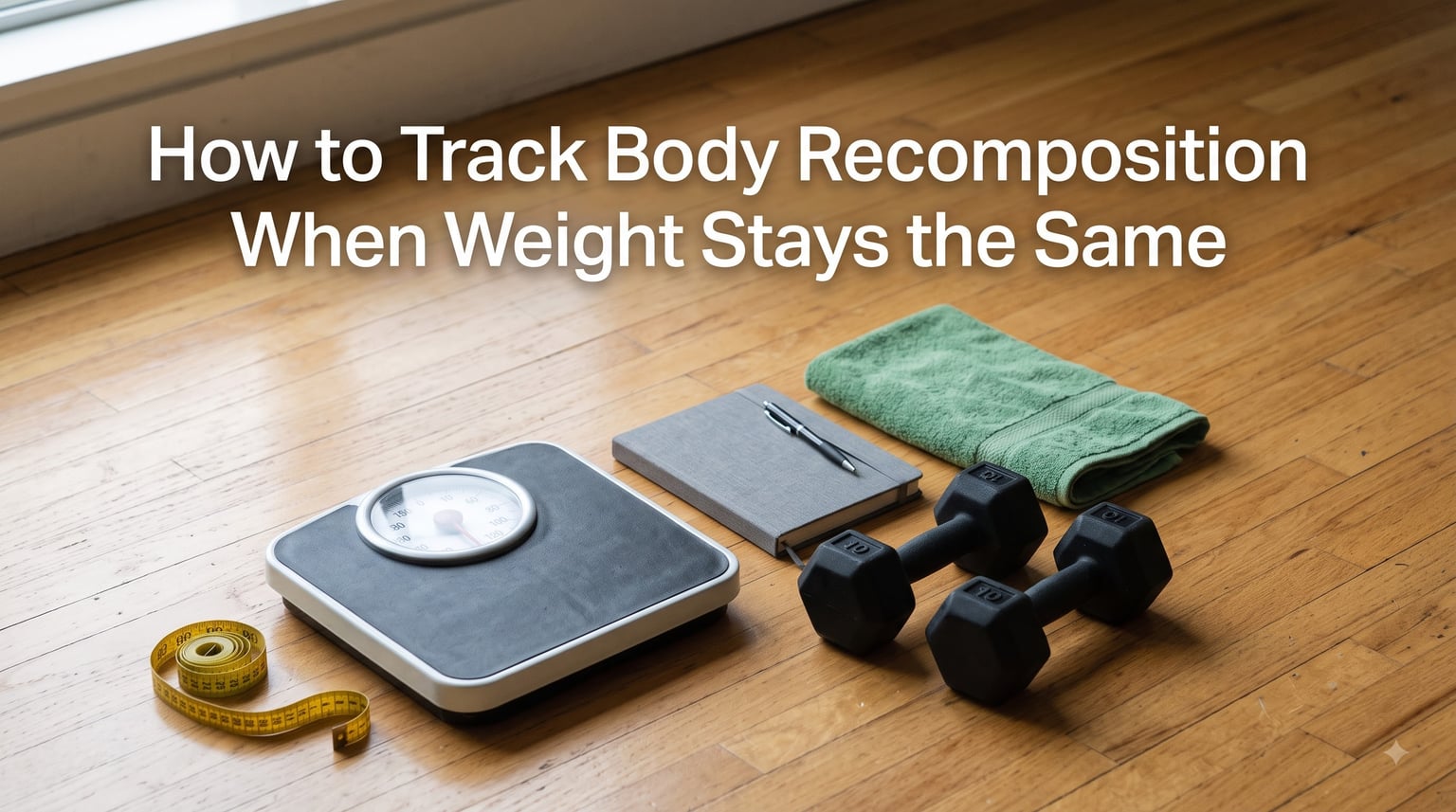
You’ve been hitting the gym, eating your protein, and sleeping like you should. Yet the number on the scale has not moved in three weeks. I have been there, staring at that same number and wondering if any of this is working. Here is the truth: when your goal is body recomposition, the scale is the most unreliable metric you can obsess over. This guide walks you through exactly how to track body recomposition when weight stays the same, so you can actually see the changes happening beneath that stubborn number.
Recent hypertrophy research published in the last few years confirms that simultaneous fat loss and muscle gain is not just possible, it is realistic for most people who train smart and eat well. The trick is measuring the right things, in the right way, at the right cadence.
Table of Contents
- What Is Body Recomposition and Why Your Weight Stays the Same?
- Body Measurements That Reveal Real Recomposition Progress
- Progress Photos: The Visual Proof Your Scale Cannot Show
- Body Composition Tests: DEXA, BIA, and Skinfold Compared
- Performance Tracking: Strength and Endurance as Recomp Markers
- Signs Your Body Recomposition Is Actually Working
- Your Weekly and Monthly Recomp Tracking Schedule
- Common Mistakes to Avoid When Tracking a Recomp
- Realistic Body Recomposition Timeline and What to Expect
- Frequently Asked Questions
- The Bottom Line on Tracking Body Recomposition
What Is Body Recomposition and Why Your Weight Stays the Same?
Body recomposition is the process of losing body fat while simultaneously building muscle. The scale weight stays the same because muscle is denser than fat. A pound of muscle takes up roughly 18 percent less space than a pound of fat. So when you lose two pounds of fat and gain two pounds of muscle, your weight looks identical on the scale, but your body shape and composition are completely different.
This is the core concept that trips people up. They train hard, eat at a slight calorie deficit with high protein, and expect the scale to drop. When it does not, they assume nothing is happening. In reality, every week of consistent training and nutrition is shifting the ratio of fat to muscle under your skin. It just does not show up as a single number.
Think of your body like a renovation project. The scale only tells you the total weight of the building. It does not tell you that the demo is done, the new framing is in, and the wiring is updated. To see actual progress, you need better tools.
Body Measurements That Reveal Real Recomposition Progress
Body measurements are the most accessible and reliable way to track recomp progress at home. They cost nothing, take five minutes, and tell you exactly where fat is leaving and muscle is being added.
Here are the seven measurements I recommend tracking, taken with a flexible seamstress tape:
Waist at the narrowest point, usually just above the navel. This is your primary fat loss indicator.
Hips at the widest point of your glutes. Useful for both men and women tracking lower body changes.
Chest at nipple level, relaxed. Indicates upper body muscle gain or fat loss.
Dominant arm at the midpoint between shoulder and elbow, flexed. Tracks bicep and tricep growth.
Non-dominant arm same as above. Asymmetry between arms can highlight imbalances.
Thigh at the midpoint between hip and knee. Tracks quad development, especially important for women.
Calf at the widest point. Less commonly tracked but reveals changes in lower leg muscle.
For consistency, always measure at the same time of day, ideally first thing in the morning after using the bathroom and before eating. Take each measurement three times and record the average. Anything less than a quarter inch change is just measurement noise. Real progress shows up as a half inch or more difference over four to six weeks.
Progress Photos: The Visual Proof Your Scale Cannot Show
Progress photos are, in my experience, the single most motivating tracking tool during a recomp. They do not lie, and they reveal changes that the mirror hides from you because you see yourself every day. A photo taken four weeks apart strips out that daily familiarity.
To capture photos that actually tell a story, follow this setup:
Same location, same lighting, same time of day every time. Morning light from a window works best.
Wear the same fitted clothing. Sports bra and shorts for women, shorts only for men.
Take three angles: front, side, and back. Stand relaxed with arms at your sides.
Use the same phone position. Mark the floor with tape so your feet land in the exact spot each time.
Set a recurring reminder every two weeks. Bi-weekly is the sweet spot for visible change.
When you compare the front-view photos from week one to week twelve, you will see your waist narrowing, shoulders broadening, and definition emerging. Those changes happened even when your scale weight held steady.
Body Composition Tests: DEXA, BIA, and Skinfold Compared
Body composition tests give you the actual breakdown of fat mass versus lean mass. Three methods are commonly used, each with different tradeoffs in accuracy, cost, and accessibility.
DEXA scan: The gold standard. Uses low-dose X-rays to map fat, muscle, and bone density. Accuracy is within one percent. Cost ranges from 75 to 200 dollars per scan in most cities. I recommend a DEXA at the start of your recomp, then another at the 12-week mark. Quarterly is plenty for most people.
Bioelectrical impedance analysis (BIA): Found in smart scales, handheld devices, and gym machines. Sends a small electrical current through your body and estimates body fat from resistance. Accuracy is within three to four percent when hydration is consistent. Inexpensive and convenient, but the absolute number is less reliable than the trend over time. Use the same device, same time of day, weekly for the best data.
Skinfold calipers: A trainer pinches specific sites on your body and measures fat thickness. Accuracy depends heavily on the operator’s skill. When done consistently by the same person, trends are reliable. Cost is low, often under 30 dollars for a personal caliper set.
For most people, a smart BIA scale at home plus one or two DEXA scans per year gives you the best balance of cost and accuracy. Do not chase daily body fat numbers. They will frustrate you. Look at the four-week and twelve-week averages instead.
Performance Tracking: Strength and Endurance as Recomp Markers
Performance tracking is the metric most people overlook, and it is the one that tells you the most about actual muscle gain. If your muscles are growing, they will get stronger. If your cardiovascular system is adapting, your endurance will improve. Both are far more reliable proxies for recomp progress than the scale.
Keep a simple training log. For each session, record the exercise, weight used, sets, and reps. Every four weeks, test your lifts with a working set of five to eight reps at a challenging weight. Here is what progress looks like:
Adding five pounds to your main lifts every four to six weeks indicates muscle gain.
Doing more reps at the same weight indicates improved efficiency and likely some muscle gain.
Better recovery between sets and shorter warm-up needs signal improved work capacity.
Running or rowing faster, or covering more distance in the same time, indicates improved cardiovascular fitness.
In my own tracking, I went from squatting 135 pounds for 5 reps to 185 pounds for 5 reps over a 14-week recomp while my weight moved less than two pounds in either direction. The scale said nothing was happening. My training log said otherwise.
Signs Your Body Recomposition Is Actually Working
Beyond the numbers, your body sends you signals every day that the recomp is working. These non-scale victories are often the most honest indicators of progress.
Clothing fit is the easiest one to notice. Jeans feel looser around the waist but tighter around the thighs. Shirts that were tight across the chest feel normal now. Belts need to go one notch tighter. These small shifts happen weeks before the scale moves.
Energy and mood typically improve within the first two to three weeks. Sleep quality gets deeper. Recovery between workouts feels faster. You might notice better focus during the day, fewer afternoon energy crashes, and steadier hunger cues throughout the day.
Muscle definition starts to appear in places you never noticed before. Your shoulders start showing more separation from your arms. Your upper back develops lines you have never seen. These visible changes are direct evidence that the fat-to-muscle ratio is shifting in your favor.
Your Weekly and Monthly Recomp Tracking Schedule
One of the biggest gaps I noticed in competing guides is a clear answer to the question of how often to track. Here is the cadence my team has used with hundreds of clients during recomps, and it works.
Daily: Weigh yourself once, first thing in the morning, after using the bathroom. Record the number but do not react to it. Daily weight swings of one to three pounds are normal and meaningless.
Weekly: Take body measurements and body fat via BIA scale every Sunday morning. Compare to the prior week. Use a seven-day rolling average for weight to smooth out the noise.
Bi-weekly: Take progress photos in the same setup every other Sunday. Compare side-by-side with the start photo.
Monthly: Test your main lifts with a working set, log the results, and note any changes in clothing fit.
Every 12 weeks: Schedule a DEXA scan if your budget allows. This is your anchor point for actual body composition change.
Common Mistakes to Avoid When Tracking a Recomp
Even the best tracking plan fails if you make these common mistakes. I have watched people get discouraged and quit over every single one of these pitfalls.
First, do not weigh yourself multiple times per day. Hydration, food volume, and sodium intake all shift your weight by several pounds within hours. Weighing constantly creates anxiety and tells you nothing meaningful.
Second, do not measure under different conditions. Measuring your waist at 9 pm after dinner one week and 6 am before breakfast the next week will produce garbage data. Pick a time and stick to it.
Third, do not ignore the strength and performance data. If you are lifting heavier and your scale is unchanged, you are gaining muscle. End of story. Trust the lift, not the scale.
Fourth, do not compare your week two to someone else’s week twelve. Recomp speed depends on training age, starting body fat, genetics, and consistency. Focus on your own trend line.
Fifth, do not let tracking become obsessive. If weighing yourself is causing anxiety, weigh less often. The goal is information, not punishment.
Realistic Body Recomposition Timeline and What to Expect
Setting honest expectations is what separates people who stick with recomp from those who quit. Most people can expect clear progress in distinct phases.
During the first four to six weeks, you will likely see strength gains and slight clothing fit changes. Visual changes in the mirror are minimal. The scale may drop or stay flat. This is normal. Your body is adapting to training and recomposing under the surface.
From weeks six to twelve, visible changes in the mirror and in photos become noticeable. Waist measurements drop by a half inch or more. Body fat percentage from BIA trends down by one to two percent. Strength gains continue.
From weeks twelve to twenty-four, the changes compound. Most people see a body fat reduction of three to five percent and a meaningful change in muscle definition. This is when the scale often starts to drop because fat loss begins to outpace muscle gain in absolute terms.
Beyond six months, you are in maintenance and refinement territory. Further visual changes require more precision with nutrition, training, and recovery. Most people reach a satisfying result between three and six months of consistent effort.
Frequently Asked Questions
Can your weight stay the same during body recomp?
Yes, your weight can absolutely stay the same during body recomposition. This happens because muscle is denser than fat, so losing fat and gaining muscle at the same rate keeps your total weight nearly unchanged while your body composition shifts significantly.
Is it possible to build muscle while staying the same weight?
It is possible to build muscle while staying the same weight, especially for beginners, those returning to training after a break, and people at moderate body fat levels. The key is consistent resistance training, adequate protein intake around 0.8 to 1 gram per pound of body weight, and a slight calorie deficit or maintenance calories.
How to stay consistent with body recomp?
Stay consistent with body recomposition by tracking non-scale metrics like strength gains, body measurements, and progress photos every two weeks. Weigh yourself weekly as a data point but not a verdict. Set 12-week checkpoints rather than daily goals to avoid short-term frustration.
How long does body recomposition take to see results?
Noticeable body recomposition takes 8 to 12 weeks for most people, with visible visual changes between 3 and 6 months. Strength gains appear within 4 to 6 weeks. Lasting body composition change typically takes 12 to 24 weeks of consistent training and nutrition.
What is the best way to track body recomposition progress?
The best way to track body recomposition progress is to combine four methods: body measurements every week, progress photos every two weeks, strength logs from every workout, and a baseline DEXA scan at the start and at the 12-week mark. The scale alone is the least useful metric for recomp.
The Bottom Line on Tracking Body Recomposition
Learning how to track body recomposition when weight stays the same comes down to one shift in mindset: stop letting one number tell the whole story. Use measurements, photos, performance logs, and body composition tests together. Each method catches a different signal that the scale misses on its own.
Pick a tracking schedule, stick to it for at least twelve weeks, and trust the trend line, not the daily noise. The body you are building is real, even when the bathroom scale insists otherwise. Give the process time, and the proof will show up in every mirror, every photo, and every stronger lift you walk away with.