
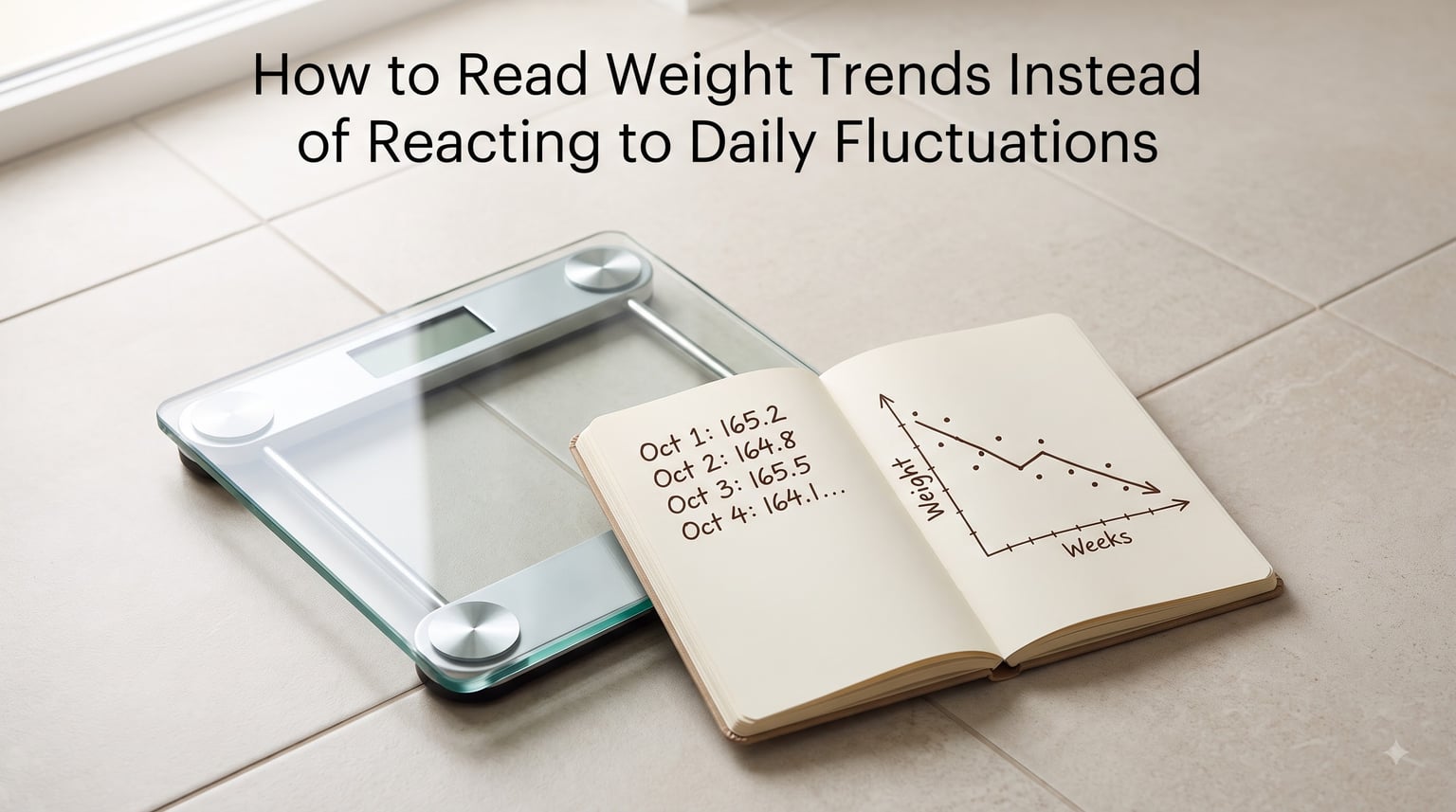
You stepped on the scale this morning and it jumped three pounds since yesterday. You ate well, hit your steps, drank your water. So why does the number say you went backward?
If this sounds familiar, you are in good company. In forums across Reddit, people describe daily weigh-ins as emotional roller coasters. One Reddit user in r/loseit wrote about feeling like giving up when the scale went up after a perfectly clean eating day. Another asked the question thousands of people type into search engines every month: how do I know if my progress is real or just fluctuation?
Here is the truth that most weight loss resources gloss over. Your daily scale weight is mostly noise. The real signal, the information that tells you whether your body is actually changing, lives in the trend over weeks and months. Learning how to read weight trends instead of reacting to daily fluctuations is the single most important skill you can build for long-term weight management.
In this guide, we will break down exactly why your weight bounces around day to day, what normal fluctuation actually looks like, and how to calculate your own trend so the daily number stops running your mood. You will also get a practical framework for handling the emotional side of tracking, because the math only helps if you can actually stick with it.
Table of Contents
- Why Daily Weight Fluctuations Happen
- Normal Weight Fluctuation Ranges
- How to Read Weight Trends Instead of Reacting to Daily Fluctuations
- How to Identify Real Weight Loss vs Noise
- The Psychology of Weight Tracking
- How to Weigh Yourself for Accurate Trend Data
- When Weight Fluctuation Might Signal Something Worth Attention
- Frequently Asked Questions
- Conclusion
Why Daily Weight Fluctuations Happen
Daily weight fluctuation is a completely normal biological process. The average adult’s weight shifts by two to five pounds over the course of a single day, and none of that movement reflects actual fat gain or loss.
When you understand what is physically happening inside your body, the daily number stops feeling so personal. Here are the main drivers behind those frustrating scale jumps.
Water Retention and Glycogen Storage
Your body stores carbohydrates as glycogen in your muscles and liver. Every gram of glycogen bonds with roughly three grams of water. When you eat more carbs than usual, even healthy ones, your glycogen stores refill and your scale weight ticks up within hours.
This is not fat. It is simply water parked alongside stored carbohydrate energy. When your glycogen levels drop, that water is released and the number falls again.
Food Weight and Digestion
Everything you eat and drink has physical weight. A large meal and a few glasses of water can add two to three pounds to the scale before your body has finished processing it. This is one reason people often ask why they weigh more at night than in the morning.
Until food is digested and waste is eliminated, that mass sits in your digestive tract and registers on the scale. It is transit weight, not tissue weight.
Sodium Intake
A salty restaurant meal can add three or four pounds of water weight overnight. Sodium causes your body to hold onto extracellular fluid, and the effect can last a day or two until your kidneys flush out the excess. Many people experience this after eating out and mistake it for fat gain.
Hormonal Changes
For women, the menstrual cycle drives predictable weight swings. Water retention commonly peaks during the luteal phase, the week before menstruation, and can add two to five pounds that disappear once the cycle resets. Stress hormones like cortisol also increase fluid retention, particularly during periods of poor sleep or high anxiety.
Exercise and Inflammation
When you start a new workout routine or push harder than usual, your muscles develop micro-tears that trigger inflammation. Your body sends water to the area to aid repair. This can add one to three pounds for several days after a hard session. It is a sign your body is adapting, not that you are moving in the wrong direction.
Normal Weight Fluctuation Ranges
Normal daily weight fluctuation ranges from two to five pounds for most adults. The average person can see swings of up to five or six pounds across a single day depending on food intake, hydration, and bathroom habits. Factors like a high-sodium meal, a heavy carbohydrate day, a hard workout, or hormonal shifts can push that range toward the higher end.
A seven-pound swing in a day is unusual but not impossible, especially after a large restaurant meal, a long flight, or during certain phases of the menstrual cycle. If you consistently see swings of eight to ten pounds or more, that may warrant a conversation with your doctor to rule out underlying issues.
The key takeaway is this: a three-pound jump overnight tells you almost nothing about fat loss or fat gain. It is your body doing what bodies do, processing and adjusting in real time.
How to Read Weight Trends Instead of Reacting to Daily Fluctuations
This is the core skill. Once you learn how to read weight trends instead of reacting to daily fluctuations, the scale transforms from an emotional trigger into a data point. Here is how to separate signal from noise and actually see what your body is doing.
Understanding Signal vs Noise
Think of your daily weigh-in as noise and your trend as signal. Noise is the random variation that happens day to day. Signal is the underlying direction your weight is actually moving over time.
A single data point tells you nothing useful. Ten data points start to form a picture. Thirty data points give you a reliable trend. The more days you track, the clearer the signal becomes and the less each individual number matters.
The Moving Average Method
A moving average smooths out daily spikes and reveals your real trend line. The simplest method anyone can use is a seven-day moving average. Here is how to calculate it.
Step 1: Weigh yourself every morning under the same conditions and record the number.
Step 2: After seven days, add all seven weights together and divide by seven. That gives you your weekly average.
Step 3: Each new day, drop the oldest weight and add the newest one, then recalculate the average.
For example, if your seven daily weights are 182, 184, 181, 185, 183, 186, and 182, your seven-day average is 183.3 pounds. The next day, you drop the 182 from day one, add your new weight, and recalculate.
Over time, you watch the average, not the daily number. If the average is trending down week over week, you are losing fat regardless of what any single day says.
Weekly and Monthly Trend Analysis
Some people prefer to compare weekly averages rather than calculate a moving average every single day. This works well too. At the end of each week, write down your average weight. After four weeks, compare your first weekly average to your fourth.
A downward shift of half a pound to one pound per week in your average represents real, sustainable progress. Monthly comparisons are even more reliable because they smooth out a full hormonal cycle and any temporary water retention events.
The Process Behavior Chart Approach
One method that comes from the Lean manufacturing world uses Process Behavior Charts. The idea, popularized by Mark Graban on his blog, is to establish a baseline using your first several weeks of daily weights. You calculate your average and then determine your natural process limits.
If a new weigh-in falls within those limits, it is normal variation and should be ignored. Only when a data point falls outside the limits, or when eight consecutive points cluster on one side of the average, do you have a real signal worth responding to. This approach turns the scale into a calm monitoring tool rather than a daily verdict.
How to Identify Real Weight Loss vs Noise
People constantly ask in forums how to tell if their weight loss is real or if they are just fluctuating. Here are the signs that separate genuine progress from daily noise.
Sign 1: Your weekly average is moving. Stop comparing today to yesterday. Compare this week’s average to last week’s average. If the number is trending down over two to three week windows, fat loss is happening.
Sign 2: Your lowest weights are getting lower. Even if your daily number bounces, pay attention to the floor. If your lowest weight each week is gradually dropping, your body is losing fat even when the daily numbers look chaotic.
Sign 3: Your clothes fit differently. The scale is one metric. If your waistband is looser, your progress photos show changes, or you are dropping a clothing size, your body is transforming regardless of what the scale says on any given morning.
Sign 4: The trend holds for three or more weeks. A single week of downward movement could be a fluke. Three consecutive weeks of declining averages confirms a real trend.
One common scenario that trips people up is the plateau. The scale seems stuck for two or even three weeks despite doing everything right. In many cases, water retention is masking ongoing fat loss. If you stay consistent, you often see a sudden whoosh where several pounds drop at once as the retained water releases.
The Psychology of Weight Tracking
This is where most articles stop. They tell you to track trends and then send you on your way. But the hard part of reading weight trends instead of reacting to daily fluctuations is not the math. It is the psychology.
Why We Overreact to Daily Numbers
Your brain is wired to respond to immediate feedback. When the scale drops, you get a dopamine hit. When it rises, your stress response activates. This reward and punishment cycle turns the daily weigh-in into an emotionally charged event that can derail an otherwise solid plan.
Forum users describe this vividly. People report feeling demotivated after a single up day, questioning their entire approach, and even abandoning their diet because one number did not match their effort. The emotional cost of daily weighing is real, and ignoring it does not make it go away.
Scale Anxiety and Obsessive Weighing
Some people develop what amounts to a compulsive relationship with the scale. They weigh in multiple times a day, after every meal, before and after workouts. Each number carries emotional weight, and the constant checking creates anxiety that sabotages consistency.
If weighing yourself triggers anxiety, binge urges, or negative self-talk, you are not weak. You are having a normal response to treating an emotionally loaded number as a daily judgment. Recognizing this pattern is the first step toward changing it.
How to See Weight as Data Not Judgment
The shift happens when you start treating each weigh-in the way a scientist treats a data point. A researcher collecting temperature readings does not have an emotional reaction to a single measurement. They plot it on a graph and look at the overall pattern.
Try this mental reframe. When you step on the scale, say the number out loud without attaching any adjective to it. Not good, not bad. Just a number. Then record it and move on with your day. Over weeks, this practice trains your brain to decouple the number from your sense of self-worth.
Handling Weigh-Ins When Progress Stalls
The hardest moment in any weight journey is the stall. You have been consistent for weeks, and the trend line has gone flat. This is where most people quit, and it is exactly when trend thinking matters most.
First, check your moving average. A flat daily number does not always mean a flat trend. Second, look at other indicators like measurements, photos, and how your clothes fit. Third, consider whether hidden factors like increased training intensity, poor sleep, or stress might be causing temporary water masking. And fourth, give it two more weeks before making any changes to your approach. Often, patience resolves what panic wants to fix.
How to Weigh Yourself for Accurate Trend Data
Good trend analysis starts with consistent data collection. If your weighing conditions vary wildly, your noise increases and your trend becomes harder to read.
Weigh yourself first thing in the morning, after using the bathroom and before eating or drinking. Wear the same clothing or none at all. Use the same scale on the same surface every time. These conditions give you the most comparable data points day to day.
Should you weigh daily or weekly? Daily weighing actually gives you better trend data because more data points produce a smoother moving average. But if daily weighing damages your mental health, weekly is perfectly fine. Choose the frequency you can sustain without emotional fallout.
Morning weight versus evening weight is not a meaningful comparison. Evening weight is always higher because it includes all the food and fluid from the day. If you must weigh in the evening for scheduling reasons, be consistent about the timing so your data stays comparable within itself.
A few practical tips make trend tracking more sustainable. Keep a simple spreadsheet or use a notes app to log daily weights. Many people, including Reddit users who have successfully maintained weight loss for years, use Google Sheets to display their weight graph alongside a trend line. Seeing the trend visually makes it much easier to trust the process on days when the daily number spikes.
When Weight Fluctuation Might Signal Something Worth Attention
Most fluctuation is harmless noise, but there are times when changes warrant a closer look.
If you experience sudden, persistent weight gain of more than five pounds that does not resolve within a week, especially when accompanied by swelling in your legs or ankles, it could indicate fluid retention related to a medical condition. This is worth discussing with your healthcare provider.
Certain medications, including antidepressants, corticosteroids, and diabetes medications, can cause significant weight shifts. If you have recently started or changed a medication and notice unusual fluctuation patterns, talk to your doctor about whether it is a known side effect.
Rapid, unexplained weight loss without dietary changes is also worth investigating. While this article focuses on the emotional side of normal fluctuation, trust your instincts. If something feels different beyond the usual daily bounce, a medical professional can help you rule out underlying causes.
Frequently Asked Questions
Is it normal for weight to fluctuate 7 pounds in a day?
A seven-pound swing in a single day is on the high end of normal but can happen, especially after a large restaurant meal high in sodium and carbohydrates, during air travel, or during certain phases of the menstrual cycle. What you are seeing is water and digestive contents, not fat. If seven-pound swings happen regularly, track your weekly average to see your real trend.
What is the 3-3-3 rule for losing weight?
The 3-3-3 rule is a simple framework: eat three balanced meals a day, space them roughly three hours apart, and include three key elements at each meal, protein, fiber, and healthy fats. This structure helps control hunger and supports consistent energy, which makes it easier to sustain the calorie deficit needed for real weight loss.
Is it normal for my weight to fluctuate from day to day?
Yes, daily weight fluctuation of two to five pounds is completely normal for most adults. Your weight changes based on water retention, food and drink still being digested, sodium intake, hormone levels, and exercise inflammation. Looking at your weekly average rather than daily numbers gives you a much more accurate picture of real progress.
Can you fluctuate 10 lbs in a day?
A ten-pound daily fluctuation is uncommon but possible in specific situations, such as after a very large meal combined with high sodium intake, significant dehydration followed by heavy rehydration, or for larger individuals with more tissue mass. If you regularly see swings of ten pounds or more without an obvious cause, consult your doctor to rule out fluid retention or other medical factors.
Conclusion
Learning how to read weight trends instead of reacting to daily fluctuations changes everything about the weight loss experience. The daily number becomes background noise instead of a daily verdict. The moving average becomes your real scoreboard. And the emotional roller coaster that derails so many people loses its power.
Start tomorrow morning. Weigh in under the same conditions, record the number without judgment, and begin building your seven-day moving average. Give it three weeks before you evaluate the trend. Your future self will thank you for choosing data over drama.