
Most people abandon their health goals within six weeks. Not because they lack willpower, but because they never built a system to track progress. When I started my first 90-day health challenge, I lasted exactly 19 days before losing momentum. The problem was not motivation. I had no tracking system, no milestones, and no way to see whether I was actually getting anywhere.
Learning how to track a 90-day health goal changed everything for me. Ninety days is long enough to see real, measurable changes in your body and habits. It is short enough to stay focused without feeling overwhelmed by a distant year-long commitment. Research from University College London found that it takes an average of 66 days to build a lasting habit, which makes 90 days the perfect window to lock in new behaviors.
In this guide, our team breaks down the complete process of tracking a 90-day health goal from day one through day 90. You will learn how to choose the right goal, pick a tracking method that fits your life, set meaningful milestones, review progress weekly, and stay motivated when enthusiasm dips around week four. We pulled insights from fitness forums, behavioral science research, and our own testing to create a system that actually works.
Table of Contents
- Why 90 Days Is the Sweet Spot for Health Goals
- How to Track a 90-Day Health Goal: Step-by-Step Guide
- Best Methods for Tracking 90-Day Health Goals
- What Health Metrics Should You Track?
- Setting Milestones and Weekly Checkpoints
- Common Mistakes to Avoid in 90-Day Health Challenges
- How to Stay Motivated for the Full 90 Days
- What Happens After Your 90-Day Challenge?
- FAQs
- Your 90-Day Health Goal Journey Starts Now
Why 90 Days Is the Sweet Spot for Health Goals
Ninety days hits a psychological sweet spot that annual goals completely miss. A year is too far away to feel urgent. Thirty days is too short for lasting change. Ninety days gives you enough runway to form habits, see physical changes, and build momentum that carries forward.
The science backs this up. The widely cited UCL habit study showed that automaticity, the point where a behavior feels effortless, takes anywhere from 18 to 254 days depending on complexity. The average was 66 days. A 90-day window pushes you past that critical threshold, giving your new habits time to solidify.
From a motivation standpoint, 90 days works because you can always see the finish line. On day 12, you know you are over an eighth of the way done. On day 45, the halfway mark feels within reach. Year-long goals do not give you that urgency until December rolls around, by which point most people have already given up.
Forum users on r/getdisciplined consistently report that breaking larger health ambitions into 90-day blocks keeps them engaged. One user described it perfectly: treating each 90-day period like a mini-year gave them the structure they needed to finally stick with a fitness routine after years of failed New Year resolutions.
How to Track a 90-Day Health Goal: Step-by-Step Guide
Tracking a 90-day health goal comes down to four clear steps. Follow this sequence and you will have a complete system that carries you from day one to day 90 with measurable progress at every checkpoint.
Step 1: Choose One Clear, Focused Health Goal
Pick a single goal. Not three goals. Not a list of improvements. One specific, measurable health objective that you can track daily. Trying to overhaul your diet, start a workout program, fix your sleep, and drink more water all at once is a recipe for burnout by week two.
Your goal needs to be specific enough to track. “Get healthier” is not trackable. “Walk 10,000 steps per day for 90 days” is. “Lose 15 pounds in 90 days” is. “Complete three strength training sessions per week for 12 weeks” is. The more specific your goal, the easier tracking becomes.
Write your goal down using this formula: I will [specific action] [frequency] for 90 days to achieve [measurable outcome]. For example: I will walk 10,000 steps every day for 90 days to improve my cardiovascular fitness and lose 10 pounds.
Step 2: Break Your Goal Into 30-Day Milestones
Divide your 90-day goal into three 30-day phases. Each phase should have its own milestone target that builds toward your final goal. This is where baseline measurement matters. Before day one, record your starting point so you have something to compare against.
If your goal is losing 15 pounds in 90 days, your milestones might look like this. Days 1 to 30: lose 6 pounds and establish a calorie tracking habit. Days 31 to 60: lose 5 more pounds and increase daily step count by 2,000. Days 61 to 90: lose the final 4 pounds and maintain your eating routine through the hardest stretch.
Milestones give you psychological wins along the way. Hitting your day-30 target releases dopamine that fuels the next 30 days. Forum users who set 30-day checkpoints within their 90-day challenges reported much higher completion rates than those who just aimed at a single day-90 outcome.
Step 3: Set Up Your Tracking System
Choose one primary tracking method and commit to it for the full 90 days. Switching tools halfway through kills momentum and creates gaps in your data. The best tracking system is the one you will actually use every single day, so be honest with yourself about what fits your routine.
Your tracking system needs to capture three things: daily actions, periodic measurements, and milestone progress. Daily actions are the things you do each day, like workouts completed, calories consumed, or hours slept. Periodic measurements are the numbers you track weekly or biweekly, like weight, body measurements, or resting heart rate. Milestone progress is your running tally of how close you are to each 30-day target.
Set up your tracker before day one. Spend 30 minutes on day zero getting everything ready. Create your spreadsheet, print your tracker, or configure your app. When day one arrives, you should be able to open your tracker and start logging without any setup friction.
Step 4: Build Weekly Reviews Into Your Routine
Schedule a weekly review on the same day and time every week. This is non-negotiable. Without weekly reviews, daily tracking becomes mindless data entry that never translates into course corrections. The review is where you actually use your data to make decisions.
My team and I use a simple weekly review framework that takes 15 minutes. Look at your daily action streaks. Did you complete your target actions at least six out of seven days? Check your periodic measurements. Are they moving in the right direction? Assess your milestone progress. Are you on pace to hit your next 30-day target? Then decide on one adjustment for the coming week.
One Reddit user on r/getdisciplined shared that their weekly Sunday review was the single most important habit in their entire 90-day challenge. Without it, they said, daily tracking would have been meaningless because they never would have noticed patterns or made changes.
Best Methods for Tracking 90-Day Health Goals
There is no single best tracking method. The right choice depends on your personality, your goal type, and how much structure you need. Here is a breakdown of the three main approaches and who each one works best for.
Mobile Apps and Digital Dashboards
Apps are ideal if you want automatic data capture and detailed analytics. Fitness apps like MyFitnessPal, Strava, and Apple Health sync with your phone and wearables to log steps, workouts, calories, and sleep without manual entry. The convenience factor is huge because the less friction in your tracking, the more likely you are to stick with it.
For a more customizable approach, Notion dashboards have become popular for 90-day goal tracking. You can build a single page that houses your goal, milestones, daily checkboxes, progress bars, and weekly review notes. The visual percentage-complete calculations give you instant feedback on where you stand.
Google Health integration is worth mentioning specifically. Google’s health tracking lets you aggregate data from multiple sources into one view, which is useful if you use different apps for different metrics. The AI overview in search results frequently cites Google Health for this reason.
Printable Trackers and Physical Planners
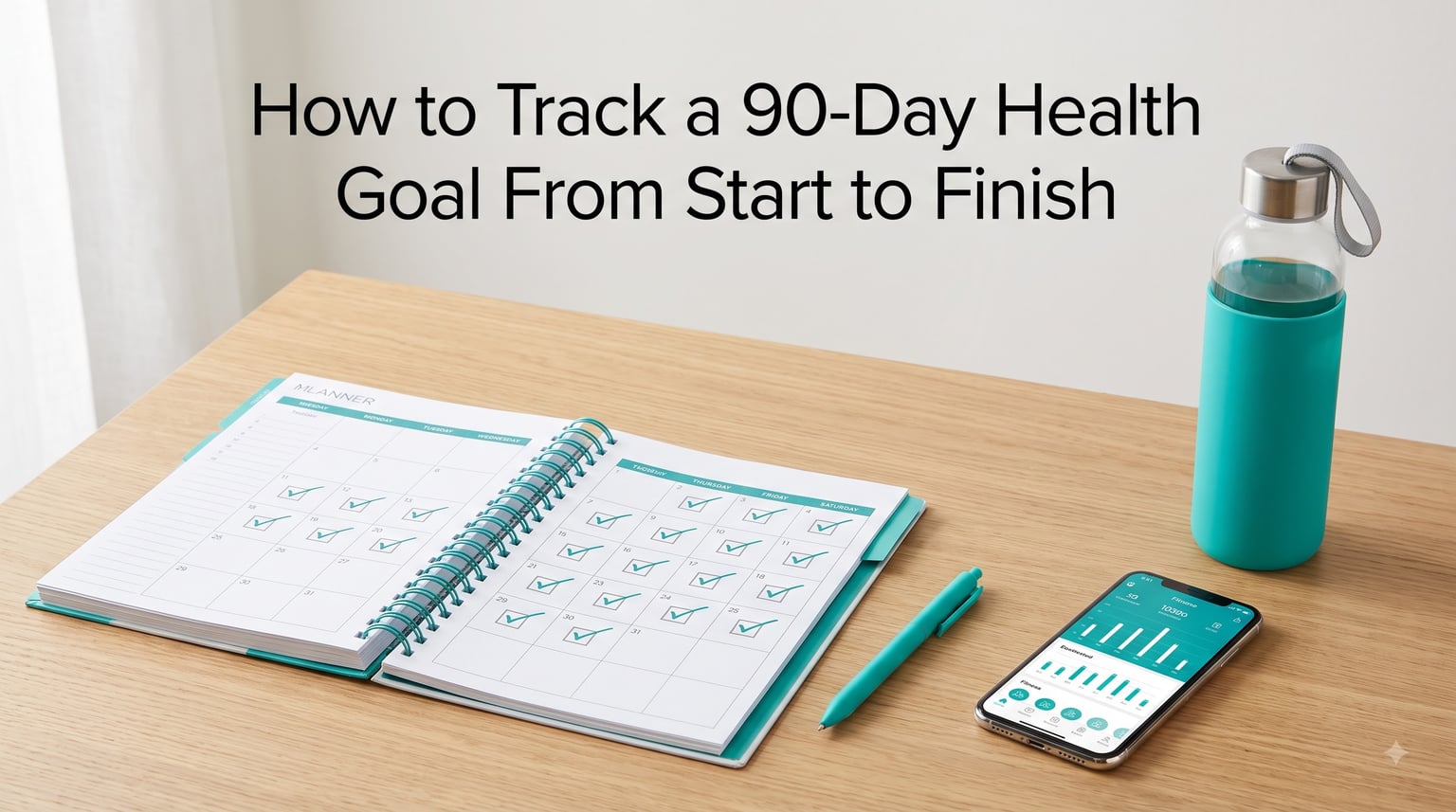
Do not underestimate the power of physically checking a box. Multiple forum users reported that the tactile experience of crossing off a day on a printed tracker provided a dopamine hit that digital apps never matched. The visual streak of checked boxes on a wall becomes a motivation engine in itself.
A 90-day challenge printable typically features a grid of 90 squares, one for each day, alongside space for your goal, milestones, and weekly notes. You can find free templates online or create your own. The key is keeping it somewhere visible, like your bathroom mirror or refrigerator, so you see it every morning.
Physical trackers work especially well for habit-based goals like drinking water, taking supplements, or doing daily mobility work. They are less suited for complex metrics like macronutrient tracking or heart rate variability, which need more data fields than a printable can reasonably hold.
Spreadsheets and Data-Driven Tracking
If you love numbers, a spreadsheet is your best friend. Google Sheets or Excel lets you track unlimited metrics, create custom formulas, generate charts, and calculate progress percentages automatically. For data-driven people, seeing a trend line flatten or curve upward is deeply satisfying and highly motivating.
A well-designed 90-day tracking spreadsheet includes columns for the date, your daily action completion, key metrics, notes, and a running progress percentage. Add conditional formatting to color-code good days green and missed days red, giving you a visual heat map of your consistency.
Spreadsheets shine for goals that involve multiple data points. If you are tracking weight, body fat percentage, waist measurements, resting heart rate, sleep hours, workout volume, and calorie intake simultaneously, a spreadsheet handles all of that in one place. Apps often force you into predetermined fields, while spreadsheets let you design your own tracking architecture.
What Health Metrics Should You Track?
Choosing the right metrics is just as important as choosing a tracking method. Track too few and you miss the full picture. Track too many and you drown in data. The sweet spot is three to five metrics that directly reflect your goal.
For weight loss goals, track body weight (weekly average, not daily fluctuations), waist measurements, progress photos every two weeks, and daily calorie intake. For fitness goals, track workout frequency, performance metrics like weight lifted or running pace, and recovery indicators like resting heart rate.
For habits like sleep or hydration, track the behavior itself. Log sleep hours per night and water intake in ounces or liters. These are simple binary or count-based metrics that take seconds to record but reveal powerful patterns over 90 days.
Non-scale victories deserve attention too. Energy levels, mood, clothing fit, and exercise performance often improve before the scale moves. Forum users who tracked how they felt each day on a 1-to-10 scale reported higher motivation because they could see improvements that weight alone did not capture.
Wearable integration can automate much of your metric tracking. Devices like Fitbit, Apple Watch, and Garmin sync with their companion apps to capture heart rate, sleep quality, steps, and active minutes automatically. This removes manual entry friction and gives you richer data without extra effort. Connect your wearable to your primary tracking app so data flows in the background while you focus on doing the work.
Setting Milestones and Weekly Checkpoints
Milestones are the backbone of your 90-day tracking system. Without them, you are just accumulating data points without a framework for interpreting them. Milestones turn raw data into actionable feedback.
The 30-60-90 structure works because it maps to the natural phases of behavior change. Days 1 to 30 are the adaptation phase, where everything feels hard and your body is adjusting. Days 31 to 60 are the momentum phase, where habits start feeling automatic and you see noticeable changes. Days 61 to 90 are the consolidation phase, where new behaviors solidify into identity-level change.
Set a specific, measurable target for each milestone. Write it as a statement you can check off with a yes or no answer. “Lost 6 pounds by day 30” is a milestone. “Tried harder” is not. The binary nature of milestone completion keeps your reviews objective rather than emotional.
Your weekly check-in is where milestone tracking happens. During your 15-minute weekly review, calculate your progress percentage toward the current milestone. If you are at day 20 of a 30-day milestone, you should be roughly 67% of the way to that target. This simple calculation instantly tells you whether you are on pace, ahead, or falling behind.
If you are behind on a milestone, do not panic. The weekly check-in exists precisely so you can course-correct before it is too late. Adjust your daily actions, increase your effort, or honestly reassess whether the milestone was realistic. Better to recalibrate on day 35 than to abandon the whole challenge on day 60.
Common Mistakes to Avoid in 90-Day Health Challenges
Most 90-day challenges fail for predictable reasons. Knowing these pitfalls ahead of time gives you the chance to avoid them entirely.
The biggest mistake is tracking too many metrics. When you try to monitor calories, macros, steps, sleep, water, workouts, weight, measurements, mood, and meditation all at once, tracking itself becomes a burden. Keep it to three to five metrics that directly tie to your goal.
Another common mistake is setting outcome-only goals without behavior targets. “Lose 15 pounds” is an outcome. “Eat in a calorie deficit six days per week” is a behavior. Outcomes are what you want. Behaviors are what you do to get there. Track behaviors daily and outcomes periodically. You control behaviors, not outcomes.
Giving up after a single missed day destroys more challenges than any other factor. Forum users repeatedly emphasized this point. Missing a workout or going over your calorie target one day does not erase the progress from the other 89 days. The phrase “never miss twice” is a powerful rule. One missed day is an accident. Two missed days is a new pattern.
Comparing your progress to others is a motivation killer. Social media makes it easy to see someone else’s day-60 results and feel inadequate about your own day-30 progress. Remember that starting points, genetics, and life circumstances vary wildly. Your tracking system measures your progress against your baseline, and that is the only comparison that matters.
Finally, not having an accountability system makes challenges harder than necessary. Sharing your goal with a friend, posting weekly updates in a community, or partnering with someone doing their own challenge creates external pressure that helps you show up on low-motivation days.
How to Stay Motivated for the Full 90 Days
Motivation is not something you have. It is something you generate through system design. The people who finish 90-day challenges do not feel motivated every day. They have systems that keep them going when motivation disappears around week four.
Visual progress is the strongest motivation lever we have found. When you can physically see your streak of completed days, your downward-trending weight chart, or your before-and-after photos side by side, it creates a feedback loop that drives continued effort. This is why printable trackers and chart-heavy spreadsheets work so well. They make progress visible.
Reward yourself at each 30-day milestone. Choose rewards that do not undermine your goal. A new workout outfit, a massage, a hiking trip, or a cooking class are all great options. The reward gives your brain something to anticipate during the grind of weeks two and three when the novelty has worn off but the results are not yet dramatic.
Community accountability was the most cited motivator in forum discussions. Users who shared their progress online, joined challenge groups, or partnered with friends reported dramatically higher completion rates. Something as simple as texting a friend your weekly numbers creates social pressure that makes quitting feel more costly than continuing.
When setbacks happen, and they will, reframe them as data rather than failures. A plateau on day 50 is not proof that your goal is impossible. It is information telling you to adjust your approach. Forum users who adopted this mindset, treating setbacks as feedback, were the ones who reached day 90.
What Happens After Your 90-Day Challenge?
Day 90 is not the end. It is the transition point. What you do in the days immediately following your challenge determines whether your new habits stick or evaporate.
First, celebrate completion. Acknowledge what you achieved over 90 days. Review your data from day one to day 90 and appreciate the distance you covered. This is not just feel-good advice. Celebration reinforces the identity of someone who finishes what they start.
Next, decide whether to maintain, build, or pivot. If your goal was weight loss and you hit your target, your next 90 days might focus on maintenance. If you built a workout habit, you might increase intensity or add a new training modality. The key is leveraging the momentum you built rather than letting it fade.
Set your next 90-day goal within a week of finishing the previous one. The biggest mistake people make is finishing a challenge and then waiting a month before starting the next one. In that gap, habits erode. Stack your challenges back to back and you turn 90-day sprints into a year of continuous improvement.
FAQs
Can you provide some examples of 90-day goals?
Strong 90-day health goal examples include losing 10 to 15 pounds, walking 10,000 steps daily for 90 days, completing three strength training sessions per week for 12 weeks, running a 5K from couch to finish line, drinking 80 ounces of water daily for 90 days, or improving sleep to 7.5 hours per night. The best goals are specific, measurable, and tied to daily actions you can track.
How to track health goals?
Choose a tracking method (app, printable, or spreadsheet), record daily actions like workouts and nutrition, log periodic measurements like weight and body measurements weekly, set 30-day milestone targets, and conduct a 15-minute weekly review to assess progress and make adjustments. Consistency matters more than the specific tool you choose.
What is the 3-3-3 rule for fitness?
The 3-3-3 rule is a simple fitness framework that involves exercising 3 times per week, eating 3 balanced meals per day, and drinking 3 liters of water daily. It provides a minimalist structure for people who want straightforward guidelines without complex tracking. This approach works well as a foundation for a 90-day challenge.
What are common mistakes in a 30-60-90 day plan?
The most common mistakes include tracking too many metrics at once, setting outcome-only goals without daily behavior targets, abandoning the plan after a single missed day, failing to conduct weekly reviews, and not adjusting milestones when progress falls behind. Another key error is comparing your progress to others instead of measuring against your own baseline.
Is a 90 day challenge long enough to see results?
Yes, 90 days is long enough to see meaningful results for most health goals. Research shows habit formation takes about 66 days on average, so 90 days gives you time to build lasting habits plus a few weeks of consolidation. For weight loss, you can safely lose 12 to 24 pounds in 90 days. For fitness, you can measurably improve strength, endurance, and body composition in that timeframe.
Your 90-Day Health Goal Journey Starts Now
Tracking a 90-day health goal is not complicated, but it requires commitment to a system. Choose one focused goal. Break it into three 30-day milestones. Set up a tracking method you will actually use daily. Conduct a weekly review to course-correct. Reframe setbacks as data. Celebrate at each 30-day checkpoint. That is the entire framework.
The people who succeed at 90-day challenges are not the ones with the most willpower. They are the ones who built tracking systems that make showing up feel automatic. Your tracker turns intention into action, and action into results. Without it, you are relying on memory and motivation, two of the least reliable tools in human psychology.
Start today. Pick your goal. Choose your tracker. Record your baseline. Day one of your 90-day health goal begins the moment you decide to take that first action and log it. Knowing how to track a 90-day health goal from start to finish gives you the map. Now it is time to walk the path.