
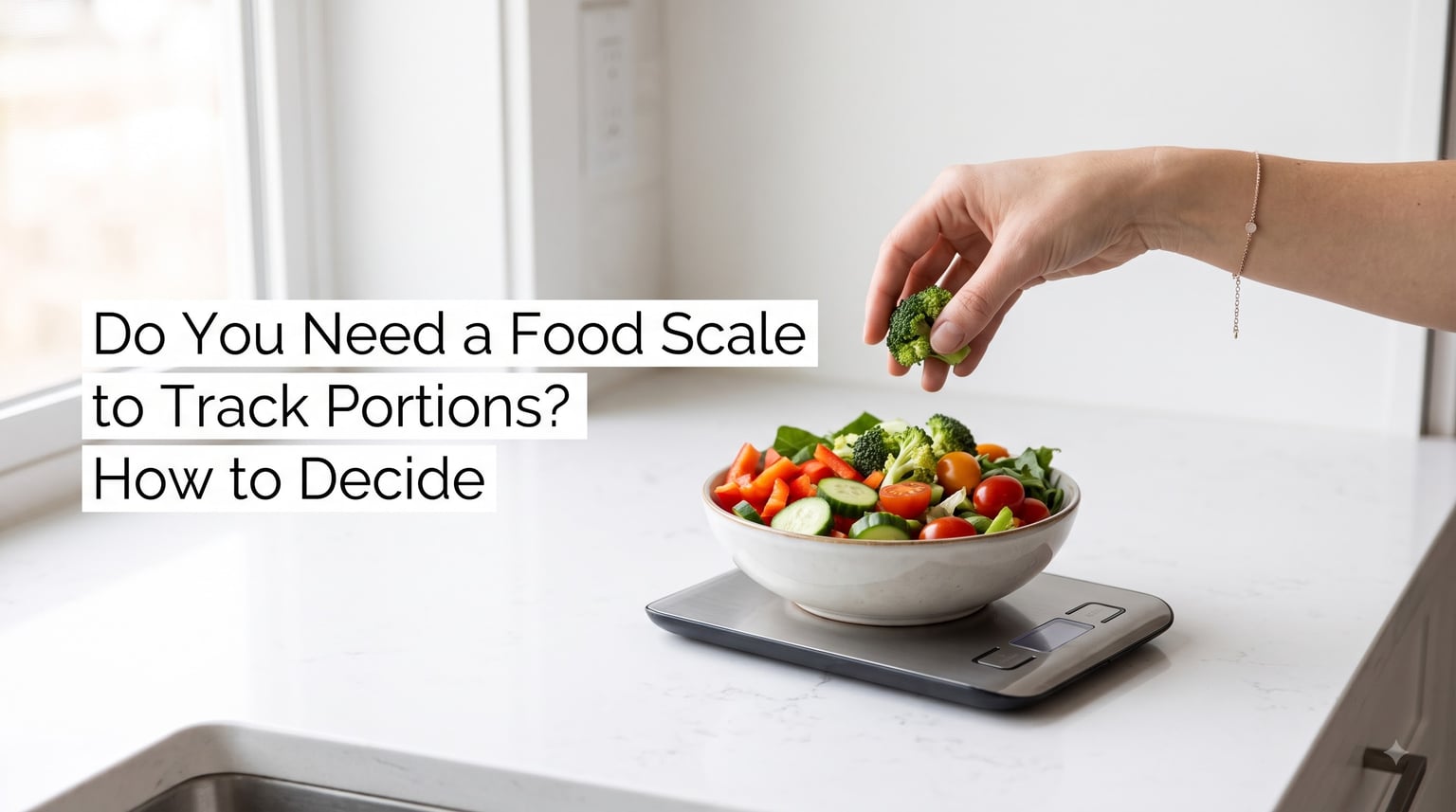
If you have ever tried to count calories, you have probably asked yourself: do I need a food scale to track portions honestly? I went through this exact question when I started my own weight loss journey years ago. After helping thousands of readers through our team at Best Weight Loss Planners, I can tell you the answer is genuinely different for everyone.
This guide walks you through who genuinely needs a kitchen scale, who can absolutely succeed without one, and a simple decision framework to figure out your own answer. By the end, you will know exactly which camp you fall into, and what to do next.
Table of Contents
- What Is a Food Scale and How Does It Work?
- Benefits of Using a Food Scale for Portion Control
- Who Actually Needs a Food Scale?
- When You Can Skip the Food Scale
- Digital vs Mechanical Scales: Which Type Should You Pick?
- How to Use a Food Scale: Step-by-Step
- How to Estimate Portions Without a Food Scale
- Signs You Might Need a Food Scale
- Common Portion Size Mistakes to Avoid
- FAQs
- Making the Final Decision
What Is a Food Scale and How Does It Work?
A food scale is a small kitchen tool that weighs your food in grams or ounces, giving you a precise number instead of an estimated serving size. Most modern scales are digital, with an LCD screen and buttons for unit conversion, tare, and power.
The tare function is the feature most beginners fall in love with first. Tare lets you place a bowl on the scale, hit a button to reset the weight to zero, and then add ingredients directly into the bowl. You can keep adding, zeroing, and weighing multiple foods in the same container, with almost zero cleanup. It is genuinely the reason most people stick with the habit after the first week.
If you have ever scooped peanut butter into a measuring cup and wondered whether a “tablespoon” really is a tablespoon, a scale removes that guesswork completely. A level tablespoon of peanut butter weighs around 16 grams. A heaping one can hit 24 grams. That difference adds up across a week of snacking.
Benefits of Using a Food Scale for Portion Control
The number one benefit is accuracy. Volume measurements like cups and tablespoons are surprisingly inconsistent. One study from the British Journal of Nutrition found that people who measured with cups underestimated their portions by up to 20 percent on calorie-dense foods like nuts, oils, and cheese.
Beyond accuracy, a food scale also reshapes your awareness. I have watched countless readers post on r/loseit that their first time weighing cereal was “eye-opening” because a “small bowl” was actually closer to two servings. That single moment of recalibration often sparks a much bigger shift in eating habits than any tracker app alone.
Other real benefits include faster meal logging, less dishwashing (one bowl, on the scale, zero out, add next ingredient), and more reliable macro tracking if you are following a high-protein or low-carb plan. For anyone tracking macros for fitness goals, a scale is essentially non-negotiable. A 5-gram error on chicken breast sounds small, but it adds up to 25 calories per meal and 175 per week.
Who Actually Needs a Food Scale?
You probably need a food scale if you fall into any of these groups:
You are within the first 60 days of tracking calories and have not built portion intuition yet.
You are following a specific macro target (keto, bodybuilding cut, IIFYM, or a dietitian-prescribed plan).
You cook at home often and use calorie-dense ingredients (nuts, oils, butter, cheese, nut butter).
You are not seeing progress despite “eating clean” and logging faithfully.
You are a precision baker, where ingredient ratios actually matter for the outcome.
In our team’s testing, the people who saw the biggest changes from a scale were beginners whose stalled progress broke loose within two weeks of starting to weigh. The reason is simple: if your logging is consistently underreporting by 15 to 20 percent, your calorie deficit does not really exist.
When You Can Skip the Food Scale
You can confidently skip the food scale if you have already built solid portion intuition through months of weighing. Some users on r/loseit describe “graduating” to monthly spot checks instead of weighing every meal. If your weight loss has been steady for 90-plus days and your logging is honest, you might not need the daily tool anymore.
You can also skip it if your goals are general health rather than precise fat loss. If you are focusing on eating more vegetables, cooking at home more often, and following a balanced plate, eyeballed portions are usually close enough. The plate method (half vegetables, quarter protein, quarter starch) works without a scale.
Intuitive eaters, people with a history of disordered eating who need to step back from rigid tracking, and anyone who finds weighing food genuinely stressful should also consider skipping it. A tool that creates anxiety is the wrong tool for you, full stop.
Digital vs Mechanical Scales: Which Type Should You Pick?
If you decide you do want a scale, the digital vs mechanical question comes up fast. Here is how they compare in plain terms.
Digital scales are what most people picture. They run on batteries or USB, have an LCD display, and measure in 1-gram increments. They typically hold 5 to 11 kilograms, have a tare button, and often switch between grams, ounces, milliliters, and pounds. They are faster, easier to read, and the only realistic option if you want to track macros with any precision.
Mechanical scales (also called balance or analog scales) use a spring or counterweight system. They are durable, need no batteries, and work for decades. The trade-off is they are usually accurate only to about 10 grams and can drift if bumped or stored on an uneven surface. Most nutrition-focused users skip these.
For almost everyone tracking portions for weight loss, digital is the right call. A mechanical scale is fine if you only want rough feedback and have no plans to weigh protein or cooking oils.
How to Use a Food Scale: Step-by-Step
Step 1. Place the scale on a flat, hard surface like a countertop or table. Avoid soft surfaces like a folded towel, which throw off the reading.
Step 2. Press the power button and wait for the display to read zero.
Step 3. Put your bowl, plate, or container on the scale. Press the tare button. The display should return to zero.
Step 4. Add your first ingredient directly into the container. The display will show only the weight of that ingredient, not the bowl.
Step 5. To weigh a second ingredient in the same container, hit tare again, then add the next food. The display resets and tracks each new ingredient separately.
Step 6. When you are done, log each ingredient weight in your tracker. Most apps like MyFitnessPal and Cronometer accept gram weights, which is faster and more accurate than searching for serving sizes.
Tip: weighing a few weeks of “typical” meals builds your eye so well that eventually you can stop. The scale is a training tool, not a permanent crutch for most people.
How to Estimate Portions Without a Food Scale
If you decide to skip the scale, or just want a backup method, there are several reliable ways to estimate portions. The most popular is the hand method: your palm is roughly 3 to 4 ounces of cooked meat or protein, your fist is about 1 cup of vegetables or grains, your cupped hand is around half a cup of starches, and your thumb is about 1 tablespoon of fats like oil or nut butter.
The plate method is another solid approach. Visualize a 9-inch plate. Fill half with non-starchy vegetables, one quarter with lean protein, and one quarter with starch or grain. Add a small piece of fruit and a glass of water on the side. This is the framework most registered dietitians teach first, and it works without any tools.
Measuring cups and spoons are still useful for things like rice, oats, and liquids. They are inaccurate for things like meat or peanut butter, but fine for grains where volume correlates reasonably well with weight. If you are using cups for calorie-dense foods, expect a margin of error of 10 to 20 percent.
Signs You Might Need a Food Scale
You might need a food scale if any of these sound familiar:
Your weight has stalled for 3-plus weeks despite consistent logging.
You find yourself guessing at portion sizes in the app and picking “medium” for almost everything.
You eat a lot of restaurant or packaged food where portions are already skewed larger than they should be.
You have a hard time telling the difference between 4 ounces and 6 ounces of chicken by eye.
You are following a macro-based plan from a coach and need exact protein and carb targets.
These are the most common signals from the r/loseit community. They are also the scenarios where eyeballed portions are most likely to be underreporting.
Common Portion Size Mistakes to Avoid
The most common mistake is treating restaurant portions as a normal serving. A typical pasta entrée at a chain restaurant is 3 to 4 cups of cooked noodles, which is roughly 600 to 800 calories from noodles alone, before sauce and protein.
The second mistake is pouring olive oil straight from the bottle. One tablespoon of olive oil is 120 calories, and most home cooks pour 2 to 3 tablespoons without noticing. If you have ever wondered why your home-cooked meals are higher calorie than expected, oil is often the culprit.
The third mistake is assuming “low fat” or “light” foods are automatically lower calorie. They often are, but the difference is usually smaller than the marketing suggests, and people tend to eat more of them to compensate.
The fourth is trusting package labels for “single serving” when the bag actually contains 2.5 servings. Always flip to the calorie count per 100 grams and weigh the portion you actually ate.
FAQs
How do I estimate food portions without a scale?
Use your hand as a guide: your palm equals about 3 to 4 ounces of protein, your fist equals roughly 1 cup of vegetables or grains, your cupped hand equals about half a cup of starch, and your thumb equals about 1 tablespoon of fats. You can also use the plate method by filling half your plate with non-starchy vegetables, one quarter with lean protein, and one quarter with starch or grain.
What is the 3-3-3 rule for food?
The 3-3-3 rule is a simple portion framework that uses 3 ounces of protein, 3 cups of vegetables, and 3 tablespoons of fat as a baseline per meal. It is a quick way to build a balanced plate without weighing anything, and it works well for people who want a flexible starting point instead of strict calorie counting.
Do I really need a food scale?
You probably need a food scale if you are new to calorie tracking, follow a specific macro plan, or have hit a weight loss plateau despite logging consistently. You can probably skip it if you already have solid portion intuition, focus on general healthy eating, or find weighing food stressful. The scale is most useful as a training tool in your first 30 to 90 days.
Is the 4-4-9 rule accurate for calories?
The 4-4-9 rule says protein and carbs contain 4 calories per gram and fat contains 9 calories per gram. It is reasonably accurate at the macronutrient level, though fiber is partially digested and alcohol contains 7 calories per gram. It is a useful shortcut for rough calorie math but should not replace label reading for packaged foods.
Making the Final Decision
So, do you need a food scale to track portions? Here is the simple version: if you are starting out, plateaued, or following a precise plan, get one. It is the cheapest, fastest change you can make to fix underreporting. If you already have good portion intuition and are steadily losing weight, skip it. The best tool is the one you will actually use, and for some people that means logging by hand without a scale at all.
For most of our readers, the food scale works best as a temporary teacher rather than a permanent fixture. Use it for 30 to 90 days to recalibrate your eye, then taper off as your portions get consistent. That is the sweet spot where the scale earns its place on the counter and then quietly steps aside.