
When my partner started working night shifts three years ago, our kitchen went from shared to chaotic. I was eating dinner at 6 pm. They were scrambling eggs at midnight. We were throwing out food, doubling our grocery bill, and eating separate takeout more nights than I’d like to admit.
If your household runs on two different schedules, you’ve probably felt the same frustration. One of you is starving at 5 am while the other just finished lunch. Someone loves spicy food; someone else wants plain chicken and rice. One of you is fine eating the same thing for five days straight; the other gets bored by Tuesday.
This guide is for couples who want to stop cooking in parallel and start meal prepping as a team, even when your hours don’t line up. You’ll learn the scheduling tactics, the prep methods, and the communication habits that make meal prep for two different schedules actually work in 2026.
Table of Contents
- How to Meal Prep for Two Different Schedules in One Household
- Find Common Ground on Meals When Preferences Differ
- Scheduling Strategies That Actually Work for Couples
- Portion Size Solutions for Different Appetites
- Budget-Friendly Meal Prep for Two People
- Storage and Leftover Management Tips
- Flexible Meal Components: The Mix-and-Match Approach
- Communication Tips for Planning Meals Together
- Frequently Asked Questions
- Final Thoughts on Meal Prepping as a Household
How to Meal Prep for Two Different Schedules in One Household
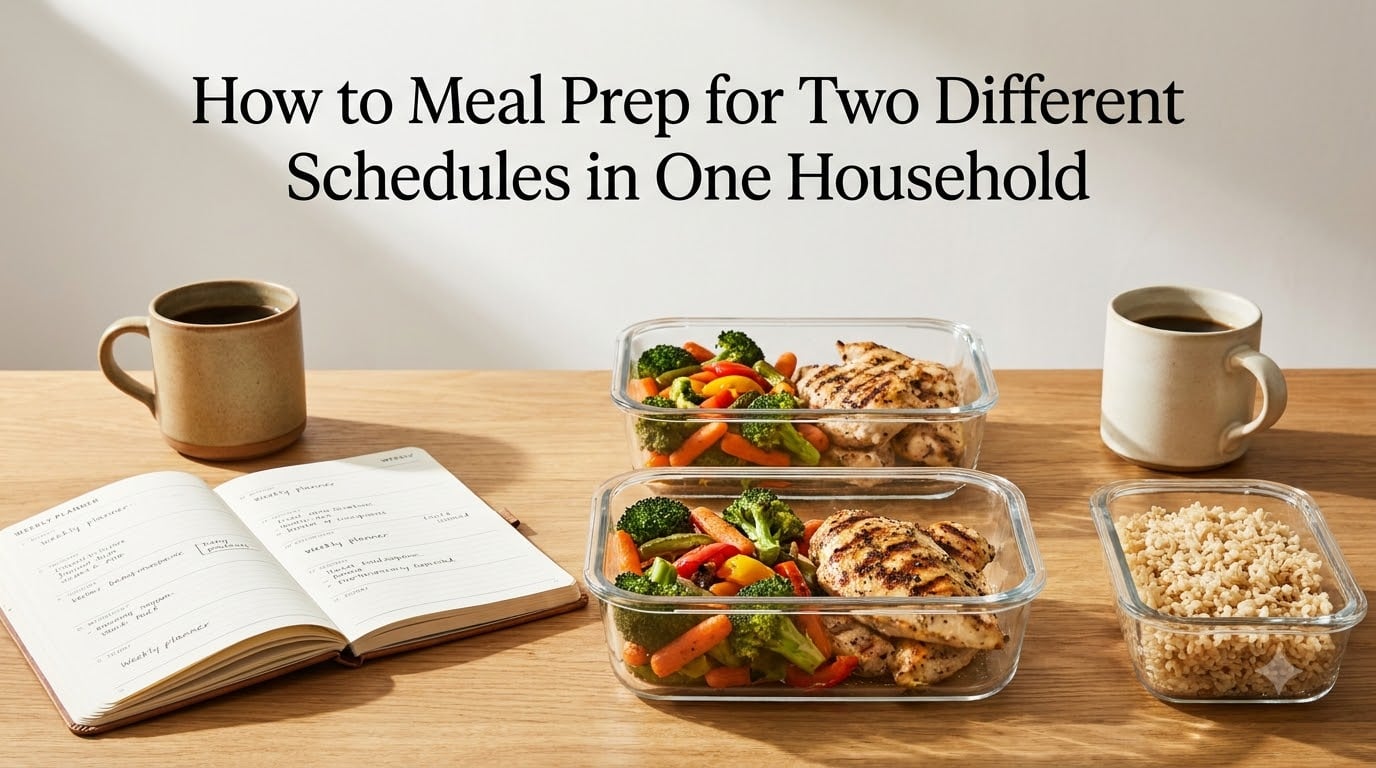
Meal prep for two different schedules in one household is a flexible system built on shared ingredients, scheduled prep windows, and meal components that each person can assemble on their own time. It works because you stop trying to eat the exact same meal at the exact same hour and start building a shared fridge of mix-and-match options.
Here’s the three-step framework our team uses when coaching couples through this exact problem:
- Identify the overlap. Find 60 to 90 minutes when both of you can prep together, plus one short solo prep session mid-week.
- Stock the shared fridge. Cook 4 to 6 base proteins, 3 to 4 roasted vegetables, 2 to 3 grains, and 3 to 4 sauces. These are the building blocks.
- Assemble on demand. Each partner builds their own plate or bowl when their schedule allows, using the prepped components.
This approach is sometimes called buffet-style meal prep, and it’s the single most effective strategy for couples whose schedules never quite match. The rest of this guide breaks down each piece.
Find Common Ground on Meals When Preferences Differ
The fastest way to fail at couples meal prep is to insist both of you love every dish. Real households have different tastes, and pretending otherwise just leads to resentment and extra takeout. The goal is finding enough common ground to share 70 to 80% of your prep work, not 100%.
Start With a Shared List of “Yes” Ingredients
Sit down together and write down proteins, vegetables, grains, and flavors you both genuinely enjoy. For my partner and me, that list looks like chicken, ground turkey, bell peppers, sweet potatoes, rice, tortillas, and anything with garlic. From that short list, we can build a week’s worth of meals that neither of us dreads.
Build Variety Through Sauces and Toppings
If one of you prefers mild flavors and the other wants heat, cook the same protein and keep three to four sauces on hand. A plain roasted chicken breast becomes five different meals depending on whether you top it with salsa, pesto, teriyaki, or tahini. This is the core idea behind flexible meal components, and it’s how you keep prep simple while keeping meals interesting.
Handle Allergies and Dietary Restrictions Without Doubling Work
If one partner is vegetarian and the other eats meat, prep shared bases (rice, roasted veggies, beans) and add separate proteins at the end. A burrito bowl for the vegetarian gets black beans and fajita veggies; the omnivore version adds shredded chicken. The shared work covers 70% of the meal, and you only cook two separate proteins instead of two separate meals.
Scheduling Strategies That Actually Work for Couples
Scheduling is where most couples throw in the towel. You assume you both have to be in the kitchen at the same time, and when that’s impossible, you skip meal prep entirely. There’s a better way.
Use the Twice-Weekly Prep Method
Instead of one massive Sunday cook, split prep into two shorter sessions. A 60-minute Sunday session covers the bulk of your proteins, grains, and roasted vegetables. A 30-minute Wednesday session tops up fresh items, washes produce, and preps snacks. This is the 3-3-3 rule of meal prep in action: 3 breakfasts, 3 lunches, and 3 dinners per prep session, repeated twice a week.
Block a Shared Calendar Window
Pick one recurring 90-minute block each week when both of you are home and reasonably awake. Sunday afternoon works for most couples, but Saturday morning or even a weeknight after dinner can work too. Put it on your shared calendar like any other appointment. Treat it as protected time, not optional.
Adapt for Opposite Shifts
If one partner works days and the other works nights, your prep window is probably the morning overlap, around 7 to 9 am, or the brief evening crossover. Keep one partner’s job during prep focused on hands-off tasks: chopping, marinating, loading the slow cooker. The other partner handles the stovetop and oven. Over time, this becomes muscle memory.
Use a Shared Prep Checklist
A physical or digital checklist keeps both of you on the same page. List the proteins, the vegetables, the grains, the sauces, and the snacks. When the checklist is shared, neither partner has to ask, “What’s for dinner this week?” It’s already answered on the fridge.
Portion Size Solutions for Different Appetites
One of you might need a 600-calorie lunch to power through a physical job. The other might be satisfied with 350. Cooking to two different portion sizes is one of the most common meal prep challenges for couples, and it’s easy to solve.
Prep in Standard 4-Ounce Protein Portions
Cook all your proteins in 4-ounce cooked portions, then let each person grab one or two depending on their appetite. This works for chicken, fish, tofu, tempeh, ground meats, and even beans. Nobody has to weigh anything at mealtime; they just count portions.
Use the “Base Plus Boost” Method
Build every meal around a consistent base (a grain, a green, a protein portion) and let the higher-appetite partner add calorie-dense boosters: an extra tablespoon of olive oil, a handful of nuts, half an avocado, or a slice of bread. Both people eat the same meal; one just adds more fuel.
Keep Dense Snacks Visible
For the partner who needs more calories, prep snack boxes: cheese cubes, trail mix, hard-boiled eggs, and fruit. These live at eye level in the fridge. The smaller-appetite partner can ignore them; the other can grab a box between meals without thinking about it.
Budget-Friendly Meal Prep for Two People
Cooking for two often feels expensive because you’re not getting the bulk discounts of a family of six. But with the right strategy, you can feed two adults on a tight grocery budget, and the meal prep for two different schedules approach actually helps you spend less.
Stock Up on Five Cheap Proteins
Eggs, dry beans, lentils, chicken thighs, and ground turkey are your budget workhorses. Each one costs less per serving than restaurant alternatives, holds up well in the fridge, and reheat cleanly. Build your weekly prep around two or three of these, not expensive cuts of beef or fish.
Buy Frozen Vegetables Without Shame
Frozen broccoli, peas, spinach, and mixed stir-fry blends are just as nutritious as fresh, often cheaper, and they don’t wilt by Thursday. Keep at least three bags in your freezer at all times. They’re the backbone of any budget meal prep for two.
Cook Once, Eat Three Times
One pot of soup, one tray of roasted vegetables, and one batch of grain should yield at least three servings each. When you plan meals around intentional leftovers, you’re essentially using the same grocery list to cover half your week. That’s how you feed two people on $100 a week without feeling deprived.
Shop Your Pantry First
Before you write your grocery list, take five minutes and look at what you already have. Pasta, canned tomatoes, rice, oats, peanut butter, and frozen produce can build dozens of meals. Skipping this step is one of the most common reasons couples overspend on groceries.
Storage and Leftover Management Tips
Even the best meal prep plan falls apart if food goes bad by Wednesday. Smart storage is what turns Sunday prep into Friday lunch.
Use Containers That Match Your Schedule
If one partner eats at home and the other takes lunch to work, invest in two container types: large glass containers for fridge storage and smaller leak-proof containers for portable meals. Glass lasts longer and doesn’t stain. Plastic is lighter and cheaper. Mix and match based on who eats where.
Label Everything With a Date
A piece of masking tape and a Sharpie is the cheapest meal prep tool you can buy. Label every container with the prep date and the contents. Most cooked food stays safe in the fridge for 3 to 4 days, so anything older goes in the freezer or the compost.
Freezer Meals Are Your Secret Weapon
Cook a double batch of chili, soup, stew, or sauce and freeze half. The freezer lets you build a backup library of meals for the nights when your schedule suddenly shifts or someone is too tired to cook. This is the 5-4-3-2-1 meal prep method in action: 5 dinners, 4 lunches, 3 breakfasts, 2 snacks, 1 backup meal in the freezer.
Compromise on the Leftovers-Hater
If your partner refuses to eat leftovers or microwaved food, don’t fight it. Prep fresh components they can quickly assemble: pre-washed greens, cooked grains, raw veggies, and a simple sauce. The 10-minute assembly is faster than cooking from scratch and feels like a fresh meal.
Flexible Meal Components: The Mix-and-Match Approach
Mix-and-match is the most powerful idea in couples meal prep. Instead of planning five separate dinners, you plan a small set of components that can be combined in many ways.
Here’s what a week of mix-and-match prep looks like for a household with two different schedules:
- Proteins: shredded chicken, baked tofu, hard-boiled eggs
- Grains: brown rice, quinoa, whole wheat tortillas
- Veggies: roasted sweet potatoes, sautéed kale, raw bell peppers
- Sauces: tahini dressing, salsa, peanut sauce
From these 11 components, you can build grain bowls, wraps, salads, breakfast hashes, and snack plates. The early-shift partner can throw together a breakfast wrap at 6 am. The late-shift partner can build a grain bowl at 9 pm. Same fridge, completely different meals.
Prep the Power Hour Style
Set a timer for 60 minutes. In that hour, your goal is to get one protein in the oven, one grain on the stove, one pot of vegetables steaming, and one sauce blended. Most of the cooking happens hands-off. The power hour method is how The Kitchn and other meal prep authorities have built week-long meal plans in a single Sunday session.
Use Your Appliances Strategically
The slow cooker, Instant Pot, and air fryer are built for households with different schedules. Toss something in the slow cooker before work, and it’s ready when the first partner gets home. The air fryer reheats prepped proteins in 4 minutes without making them soggy like a microwave can. Use each appliance for its strength and you’ll rarely stress about dinner again.
Communication Tips for Planning Meals Together
The technical stuff matters, but the real reason couples fall out of meal prep habits isn’t the food. It’s the planning conversation. A 10-minute weekly check-in solves more problems than any new container set.
Set a 10-Minute Sunday Check-In
Pick a time, make tea, and talk through the week ahead. What’s on each person’s calendar? Any late meetings, early shifts, or social events that change dinner plans? Any new cravings? Any ingredients one of you is sick of? This conversation is the foundation of household meal planning.
Own Your Preferences Without Judging Theirs
If you want lighter meals and your partner wants hearty comfort food, both are valid. The mix-and-match approach is built for this. Don’t try to convert your partner to your way of eating, and don’t expect them to suddenly love your kale salad. Just build a fridge full of options you can both choose from.
Plan for Schedule Surprises
Real life throws curveballs. Someone gets held late at work. Someone is too tired to cook. Build one “emergency meal” into each week: a frozen portion, a simple pasta, or a designated takeout night. The emergency meal prevents the all-or-nothing thinking that makes couples give up on meal prep entirely.
Frequently Asked Questions
What is the 3-3-3 rule for meal prep?
The 3-3-3 rule means preparing 3 breakfasts, 3 lunches, and 3 dinners in a single prep session. You repeat the session twice a week (usually Sunday and Wednesday) so you always have 6 to 9 days of flexible meals in the fridge without cooking every day.
What is the 5-4-3-2-1 meal prep method?
The 5-4-3-2-1 method breaks a week of prep into 5 dinners, 4 lunches, 3 breakfasts, 2 snacks, and 1 backup freezer meal. It’s a simple framework for planning a full week of meals in one or two prep sessions, especially helpful for couples with two different schedules.
How to feed 2 people on $100 a week?
Feed two people on $100 a week by building meals around eggs, dry beans, lentils, chicken thighs, and ground turkey. Buy frozen vegetables, cook grains in bulk, plan intentional leftovers, and shop your pantry before adding to your grocery list. Cook once and eat three times from the same ingredients.
How to divide meal prep?
Divide meal prep by assigning tasks rather than full meals. One partner handles proteins and oven work, the other handles grains, vegetables, and sauces. Use a shared checklist and prep together in a 60 to 90 minute window, then split the storage and labeling by container type.
How do you meal prep when partners have opposite shifts?
When partners have opposite shifts, use buffet-style prep: cook shared components like grains, proteins, and vegetables, then let each person assemble their own meals on demand. Prep during the brief window when both are home, label everything with dates, and keep emergency freezer meals for the nights that go off-script.
Final Thoughts on Meal Prepping as a Household
Perfect meal prep for two different schedules doesn’t really exist. What does exist is a system flexible enough to handle one partner’s late meeting, the other’s early commute, and a Wednesday night when neither of you wants to cook. The mix-and-match approach, twice-weekly prep sessions, and a short weekly check-in are the three habits that turn a chaotic kitchen into a calm one.
Start with one shared prep session this week. Pick 4 proteins, 3 vegetables, 2 grains, and 1 sauce. Label the containers, put them at eye level in the fridge, and let each of you build your own meals. That’s the whole idea behind meal prep for two different schedules, and it’s the version of cooking together that actually lasts.