
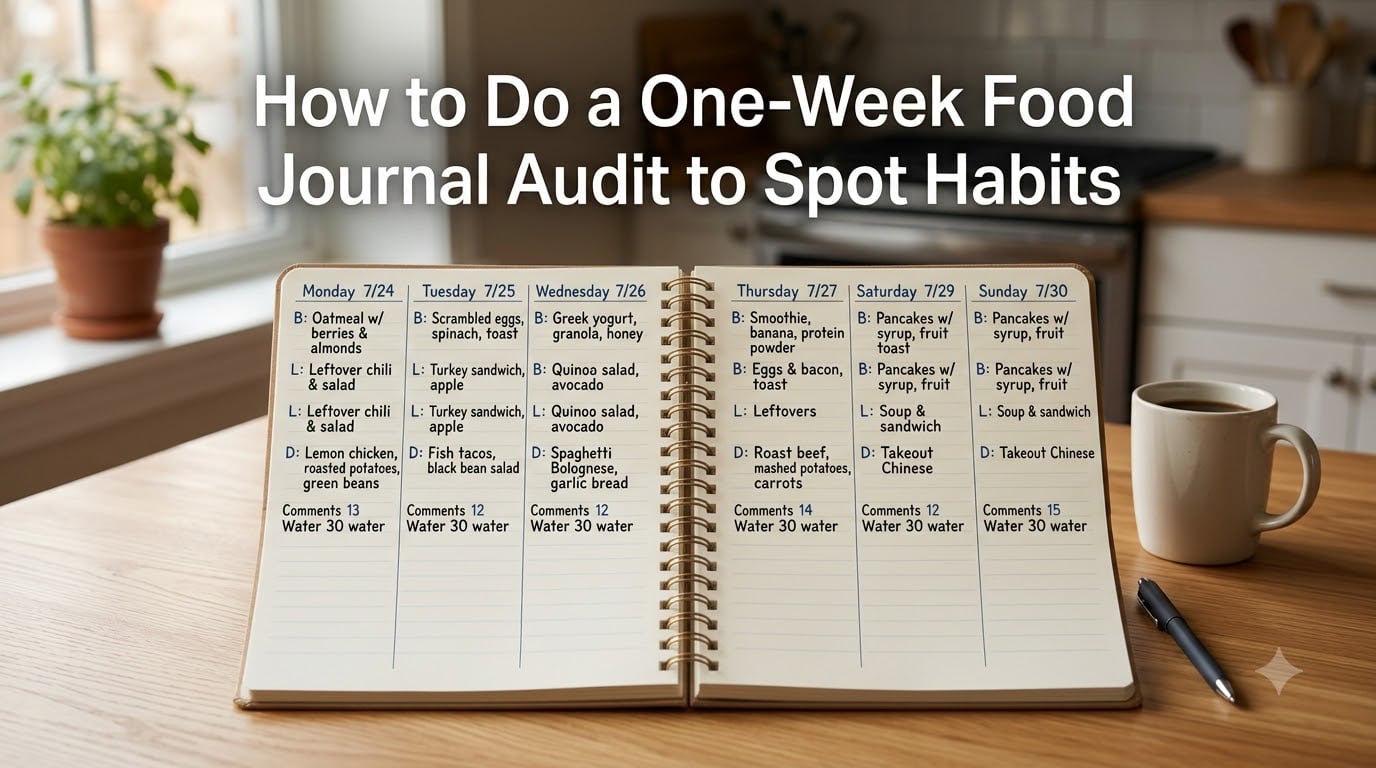
Most people think they eat pretty well. Then they track everything for seven days, and the results can be eye-opening in ways they never expected.
A one-week food journal audit is the fastest way to find hidden eating habits. It is a deliberate, time-boxed tracking window where you record what you eat, when you eat, how much you eat, and how you feel when you eat it. By the end of the week, you have real data, not assumptions, about your actual eating patterns. That is what makes it different from vague dieting or casual food logging.
I have run this audit myself twice, and the second time I caught habits I had missed for years. In this guide, I will walk you through the exact seven-day food journal audit process, what to capture on each day, and how to read your own data once the week is done. If you have ever wondered where your calories really go, this is the method that answers it.
Table of Contents
- What Is a One-Week Food Journal Audit?
- Why a One-Week Audit Reveals Habits Other Methods Miss
- What to Track During Your Audit Week
- How to Do a One-Week Food Journal Audit: A 7-Day Step-by-Step Process
- The Pattern Recognition Framework: How to Analyze Your 7 Days
- Common Patterns a Food Audit Reveals
- What to Do After Your Audit Week
- Common Mistakes to Avoid During Your Audit Week
- Frequently Asked Questions
- Final Thoughts on Running Your One-Week Food Journal Audit
What Is a One-Week Food Journal Audit?
A one-week food journal audit is a structured seven-day tracking window where you write down every single thing you eat and drink, along with context like time, portion size, hunger level, and mood. The purpose is not weight loss. The purpose is awareness.
Think of it like a financial audit for your kitchen. You are not judging the numbers yet. You are simply collecting them honestly so you can see the full picture of how you actually eat, including the meals you would never post on social media. Once you have a complete week of data, you sit down and look for patterns that explain why you feel, weigh, or eat the way you do.
What separates an audit from regular food tracking is the review at the end. Most people who track food in apps never look back at the data. An audit builds in that review step. You finish the week, then you spend 30 to 60 minutes asking your data specific questions, which is where the real insight lives.
Why a One-Week Audit Reveals Habits Other Methods Miss
Research on self-monitoring has consistently found that people underestimate their calorie intake by 20 to 50 percent. In one frequently cited study, participants eating at a research kitchen significantly under-reported what they consumed, even when they believed they were being honest. That gap between perception and reality is exactly where habits hide.
I noticed this the first time I ran an audit. I assumed my mid-afternoon snack was a small handful of almonds. When I actually measured it, I was eating closer to 500 calories worth of nuts most weekdays. The habit had been invisible because the action felt small.
The one-week timeframe is intentional. It is short enough to commit to, yet long enough to capture both weekdays and at least one full weekend, which is where most eating behavior actually shifts. Forum users frequently report that their audit revealed weekend habits that had been quietly undoing weekday efforts, things like all-day snacking, alcohol pairing, and restaurant portions that doubled at home.
What to Track During Your Audit Week
You do not need a fancy app or a twenty-field spreadsheet to run a useful audit. Six columns of data are enough.
For each eating or drinking occasion, capture:
- What you ate or drank. Be specific. “Salad” is not enough. “Chicken Caesar salad with croutons and creamy dressing” gives you something to analyze.
- Portion size or quantity. Use cups, ounces, tablespoons, or “about the size of my fist.” Exactness matters less than consistency.
- Time of day. This is where daily patterns start to show up.
- Hunger level before eating. Rate it 1 to 5, with 1 being starving and 5 being completely full.
- How you felt. Calm, stressed, bored, rushed, sad, happy. One or two words is fine.
- Where you were and who you were with. Kitchen, desk, car, with coworkers, alone, watching TV.
Do not worry about calories, macros, or nutrients during an audit. That is a different kind of tracking. An audit is about behavior, not nutrition math. You can always layer calorie counting on later, but it tends to crowd out the habit data if you start there.
If you want a simple physical system, a small notebook with seven date headings works perfectly. If you prefer digital, a notes app with bullet points per meal is just as good. I have used both and the data was equally useful when I reviewed it.
How to Do a One-Week Food Journal Audit: A 7-Day Step-by-Step Process
This is the core of the method. Each day has a purpose, so you are not staring at a blank page wondering what to write.
Step 1 – Day 1 (Setup Day): Pick your tracking format. Set a phone reminder for breakfast, lunch, dinner, and a final evening review. Write down your “why” at the top of the first page. Read it whenever you feel like skipping.
Step 2 – Day 2 (Easy Tracking Day): Log only what you ate and the time. Skip mood and hunger today. The goal is to build the habit of writing things down before adding any analysis.
Step 3 – Day 3 (Add Context): Continue tracking food and time, but now add the hunger rating and your location for each meal. You will start noticing patterns by dinner.
Step 4 – Day 4 (Full Audit Day): Track all six fields per meal: what, how much, time, hunger, feeling, and location. This is the most complete data day of the week.
Step 5 – Day 5 (Mid-Week Check-In): Glance back at days 2 through 4. Jot down one or two observations, even small ones like “snacked at 3 p.m. both days.” This trains your eye for the full review later.
Step 6 – Day 6 (Habit Watch Day): Track normally but pay extra attention to eating that does not feel like a meal. Drinks, bites, samples, and mindless kitchen visits all count.
Step 7 – Day 7 (Audit Day): Track the same as day 4, including at least one full weekend day. This day gives you the contrast points to see weekend versus weekday behavior.
Step 8 – End of Day 7 (Review Block): Block 30 to 60 minutes on your calendar. Sit with all seven days of notes and start asking the pattern questions covered in the next section.
That is the audit. Eight steps, one week, real data. If you have ever started a food log and quit by Wednesday, this structure is what fixes that. Each day has a specific job so you are not just staring at entries.
The Pattern Recognition Framework: How to Analyze Your 7 Days
Once your week is logged, the audit is only half done. The review is where habits become visible. I use the same ten questions every time, and they pull out patterns almost automatically.
Ask yourself:
- Did I eat at roughly the same times each day, or did my schedule drift?
- Where did most of my weekday calories actually come from?
- Which meals happened at unusual hunger levels (1 or 5)?
- What emotions showed up most often next to eating occasions?
- Where was I physically when I ate, and how often was the answer not the kitchen table?
- Did I snack when I was not actually hungry (low hunger plus strong emotion)?
- How did weekend eating compare to weekday eating in volume, frequency, and context?
- Which drinks added calories I never thought about, like juice, lattes, or alcohol?
- Did I eat any “free” foods more than once that I assumed I barely touched?
- What is the single change that would have the biggest impact on my week?
Write the answers in short sentences, not paragraphs. Over time, the answers start repeating themselves. That repetition is your habit signature, and once you see it clearly, deciding what to change becomes much easier.
Users in weight loss forums often say the same thing: the moment of insight came not from the tracking itself but from sitting down to actually read what they had written. Without the review block, the audit is just logging. With it, the data tells you what to do next.
Common Patterns a Food Audit Reveals
Over the years of running this and talking with others who have, the same handful of patterns show up again and again. Knowing them ahead of time helps you spot your own faster.
Weekend versus weekday drift. Most people eat very differently on Saturday and Sunday compared to Monday through Friday. Brunch calories, late-night snacks, social drinking, and larger restaurant portions can add 500 to 1,500 calories a day. The audit makes the gap visible because both behaviors are in the same log.
Calorie drinks. Lattes, juice, soda, kombucha, and alcohol often slip past the “food” filter. A single large coffee drink per weekday can easily total 1,000 calories across the week without ever feeling like eating.
Stress and boredom eating. When your log shows the same emotion attached to multiple snacks across multiple days, that is a stress or boredom pattern, not hunger. The hunger rating will usually be low (1 or 2) while the negative emotion is high.
Eating-on-the-go meals. If your location column is filled with “car,” “desk,” or “walking,” portions get harder to estimate and calories tend to climb. The audit exposes how often eating happens outside of a real meal moment.
Late-night grazing. Anything after 9 p.m. is worth a closer look. The audit often shows calories consumed in this window that exceed what was eaten for breakfast.
What to Do After Your Audit Week
An audit is only useful if it leads somewhere. Here is how to turn the data into changes you can actually stick with.
Pick the single biggest finding from your review. Not three findings, not five. One. That is the habit to address first. Trying to fix everything at once is the fastest way to fix nothing.
Set a small, specific experiment for the next seven days. For example, if late-night snacking was your biggest pattern, try a “kitchen closes at 9 p.m.” rule. If mindless coffee shop visits were the issue, try swapping two of them for homemade versions. One change, one week, then recheck.
Repeat the audit once a quarter. Most habits do not need weekly tracking forever. A quarterly audit keeps the same awareness without becoming an obsession. It is the system that keeps the system honest.
Common Mistakes to Avoid During Your Audit Week
Even a simple audit can go off the rails. These are the mistakes that show up most often in user reports and in my own experience.
Trying for perfection. You will forget a snack. You will under-measure something. The data is still useful as long as it is mostly honest. Perfectionism kills consistency, which kills audits.
Quitting mid-week when the data looks “bad.” The point of an audit is to see reality, including the parts you do not like. Stopping on day four means you never get the pattern review that makes the whole process worthwhile.
Adding calorie counting. Layering numbers on top of behavior data blurs both. Run a behavior audit first. Run a calorie audit another week if you really want both.
Judging every meal while logging. Notes written in shame tend to get edited or skipped. Keep your log neutral. The review is where interpretation happens, not the moment you eat the food.
Skipping the review block. Seven days of notes with zero review is just a record. The 30 minutes on day seven is what unlocks the insight.
Avoid these, and your audit will give you something genuinely useful, even after just one week.
Frequently Asked Questions
How do I start a food journal?
Pick one tracking format you will actually use (notebook, notes app, or spreadsheet), then log every meal and snack at the time you eat it. Start with just food and time, and add mood, hunger, and location after two or three days. The first week should be behavior tracking, not calorie counting.
What does a food journal reveal?
A food journal reveals the gap between what you think you eat and what you actually eat. Most people find unplanned snacks, hidden calorie drinks, weekend drift, and emotional eating patterns they did not realize were happening, often within five days of consistent tracking.
How long does it take to see patterns from food journaling?
Five to seven days is usually enough to spot your first clear patterns, especially if your week includes both weekdays and a weekend. After 14 days, the patterns are usually confirmed and stable enough to act on.
How do I identify emotional eating from a food diary?
Look for entries where your hunger rating was low (1 or 2) but a strong emotion (stress, boredom, sadness, anxiety) was logged at the same time. When that pairing shows up more than twice in a week, emotional eating is the most likely driver.
What is the best food tracking journal?
The best food tracking journal is the one you will actually use for seven full days. A simple notebook with date and meal columns works as well as a paid app for an audit. Choose based on your habits: paper if you want mindfulness, digital if you want speed and searchability.
Final Thoughts on Running Your One-Week Food Journal Audit
A one-week food journal audit is the simplest, fastest way to find out what your eating habits actually look like, not what you assume they look like. The structure is simple. Pick a format, log for seven days with at least one weekend included, and block time on day seven to review what you wrote.
Once you have your data, the ten-question pattern review turns the notes into insight. From there, pick one habit to address, run a small experiment, and audit again in a few months. That cycle is how awareness becomes change. If you have been guessing at why your eating is the way it is, this is the week that gives you answers.