
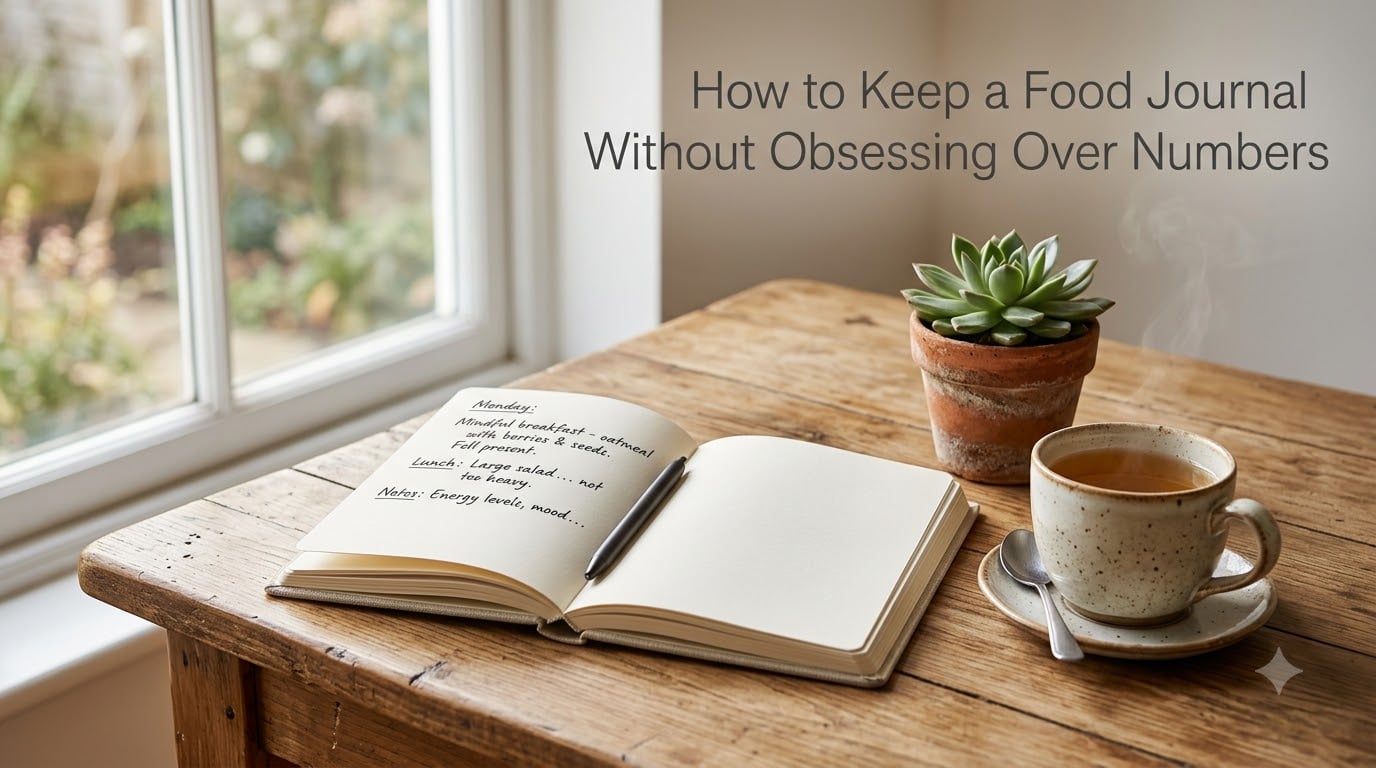
If you’ve ever opened a calorie tracker, closed it in frustration, and sworn off food journaling forever, you’re not alone. I hear the same story from readers every week: tracking started as a way to feel more in control of eating, and quickly became the source of guilt, anxiety, and binge cycles.
This guide is for anyone who wants to learn how to keep a food journal without obsessing over numbers. We’ll cover what to write instead of calories, the 3-3-3 rule that makes tracking feel lighter, and the warning signs that mean it’s time to put the journal down. No apps required. No math homework.
Table of Contents
- What a Food Journal Really Is (Beyond Calorie Counting)
- Why Food Journals Work: The Awareness Edge
- The Problem With Numbers: When Tracking Becomes Obsession
- How to Keep a Food Journal Without Obsessing Over Numbers
- The 3-3-3 Rule for Food Journaling
- Warning Signs: When Food Journaling Stops Helping
- Frequently Asked Questions
- A Final Word on Tracking Without the Weight
What a Food Journal Really Is (Beyond Calorie Counting)
A food journal is a record of what you eat, when you eat it, and how you feel before, during, and after. Its real job is to build awareness between your eating habits and your moods, not to add up points at the end of the day.
Think of it as a field notebook for your hunger cues, energy levels, and emotional patterns. The Cleveland Clinic describes it well: a living document that can be specific or general, depending on what you need. I think of mine as a low-pressure place to notice, not to judge.
The big difference between a food journal and a calorie counter comes down to one word: control. A calorie counter aims to restrict. A mindful food journal aims to understand.
Why Food Journals Work: The Awareness Edge
Food journals help because they create what I call an awareness edge. You start to notice the 3pm sugar crash, the way dinner gets larger on stressful Tuesdays, or how a glass of wine at night always comes with a second helping.
This kind of pattern recognition is one of the strongest predictors of sustainable habit change. When you log what you ate and how you felt, you stop eating on autopilot. You begin to connect cause and effect without anyone telling you what to cut out.
I have kept a food journal on and off for years. The weeks I track are the weeks I eat slower, notice when I’m full, and stop snacking without thinking. The weeks I don’t are the weeks I mindlessly graze through the pantry at 9pm.
The Problem With Numbers: When Tracking Becomes Obsession
Numbers turn food into a scoreboard. Once your day has a calorie total, every meal becomes a transaction. Did I earn that brownie? Can I afford an extra tablespoon of olive oil?
In forums like Reddit’s loseit and BingeEatingDisorder communities, I see the same pattern over and over. People start tracking to lose weight. After a few weeks, they cut too aggressively, feel deprived, and end up bingeing. The tracker then becomes the receipt for that binge, and the guilt starts the cycle again.
This is what researchers call dietary restraint theory. Restrictive tracking often backfires because it amplifies the very thoughts it’s supposed to quiet. The obsession isn’t a character flaw. It’s a predictable response to a number-driven approach to eating.
How to Keep a Food Journal Without Obsessing Over Numbers
Here is the step-by-step approach I use with readers and on myself. It is designed to build awareness without inviting the inner critic to the table.
Step 1: Pick a Format That Feels Light
Choose whatever feels easiest. A notes app on your phone, a paper notebook in your kitchen, or even voice memos. The format matters less than the consistency, and consistency matters less than whether it feels like punishment.
If a tracker app makes your stomach drop, that is useful information. Switch to a notebook. The point is to notice your habits, not to optimize them.
Step 2: Log Without Numbers
Instead of calories, try logging these non-numerical metrics:
- Hunger level before eating on a scale of 1 to 5
- How you felt when you decided to eat: bored, tired, sad, celebratory, actually hungry
- Energy after eating: energized, sluggish, foggy, satisfied
- Where and with whom you ate, since environment shapes habits
- Cravings that passed, which are the real wins
This kind of food awareness journal builds the same pattern recognition as a calorie log, without the scoreboard.
Step 3: Write in Real Time or Right After
Memory lies when it comes to food. Studies show people under-report what they ate by 30% or more, especially snacks. Capture the moment, even if it is just three words on a napkin.
If you wait until bedtime to fill in a tracker, you also turn journaling into a homework assignment. That is where guilt creeps in. A quick note in the moment keeps it light.
Step 4: Review Weekly, Not Daily
Daily reviews invite judgment. Weekly reviews invite curiosity. Pick one moment a week, like Sunday morning coffee, and skim for patterns. Did you snack more on busy days? Did certain meals leave you satisfied longer?
I find a five-minute Sunday scan is worth more than a nightly audit. The goal is to learn something, not to pass or fail.
The 3-3-3 Rule for Food Journaling
The 3-3-3 rule is a simple framework for what to log at each meal without obsessing over calories. It is one of the easiest ways to keep a food journal for mindful eating without slipping into number-counting mode.
At each meal, jot down three things in under three minutes, ideally within three bites of finishing:
- What you ate in plain words, like “chicken, rice, salad”
- How hungry you were before you started eating
- How you feel about the meal now: satisfied, still hungry, sluggish, good
That is it. The 3-3-3 rule takes the pressure off perfection. It works because it captures the three data points that actually matter: food, hunger, and satisfaction.
Warning Signs: When Food Journaling Stops Helping
Tracking can quietly become harmful. Here are the warning signs that mindful tracking has tipped into disordered territory. If any of these sound familiar, pause your journal and talk to someone you trust.
- You skip social events because you cannot log the food accurately
- You feel anxious or guilty when you miss a logging entry
- You avoid certain foods because they are hard to write down
- Your mood depends on the day’s numbers, even when you have stopped counting calories
- You weigh yourself multiple times a day alongside journaling
- You feel shame when eating, even when you do everything “right”
Food journaling should support your relationship with food, not threaten it. If the journal feels heavier than the food decisions it tracks, that is your cue to step back.
When to Stop and Seek Support
If you have a history of disordered eating, skip journaling entirely or work with a registered dietitian who supports intuitive eating. If your journal starts to feel compulsive, a therapist trained in eating disorders can help you build a healthier relationship with food tracking.
In the United States, you can reach the National Eating Disorders Association helpline at 1-800-931-2237. In the UK, Beat runs a helpline at 0808-801-0677. These are free, confidential resources for anyone worried about their relationship with food.
Frequently Asked Questions
What is the 3-3-3 rule for food?
The 3-3-3 rule is a simple food journaling framework. At each meal, log three things in under three minutes, ideally within three bites of finishing: what you ate, how hungry you were before, and how you feel about the meal now. It captures the data that matters most without inviting calorie obsession.
Does keeping a food journal really help?
Yes, when it is done mindfully. Research shows food journals help build healthy habits, identify food sensitivities, and support weight management by creating awareness around eating patterns. The benefit comes from noticing patterns, not from counting numbers.
How to stop obsessing over calorie counting?
Switch your journal away from numbers entirely. Track hunger levels, mood, satisfaction, and energy instead of calories. Use the 3-3-3 rule, review weekly instead of daily, and step away from tracking completely if it triggers guilt or binge cycles.
What is the 3-3-3 rule for meal prep?
The 3-3-3 rule for meal prep means preparing 3 proteins, 3 vegetables, and 3 grains or starches to mix and match throughout the week. It is a separate framework from the 3-3-3 food journaling rule and focuses on simplifying batch cooking rather than tracking what you eat.
A Final Word on Tracking Without the Weight
Learning how to keep a food journal without obsessing over numbers is really about choosing a tool that helps you notice instead of a tool that helps you restrict. The whole point is to make eating feel more conscious, lighter, and more connected to how you actually feel.
If you try the 3-3-3 rule this week, notice what comes up. You might be surprised how much you learn without ever adding a single calorie. And if the journal starts to feel heavy, remember that putting it down is also a form of mindful eating.