
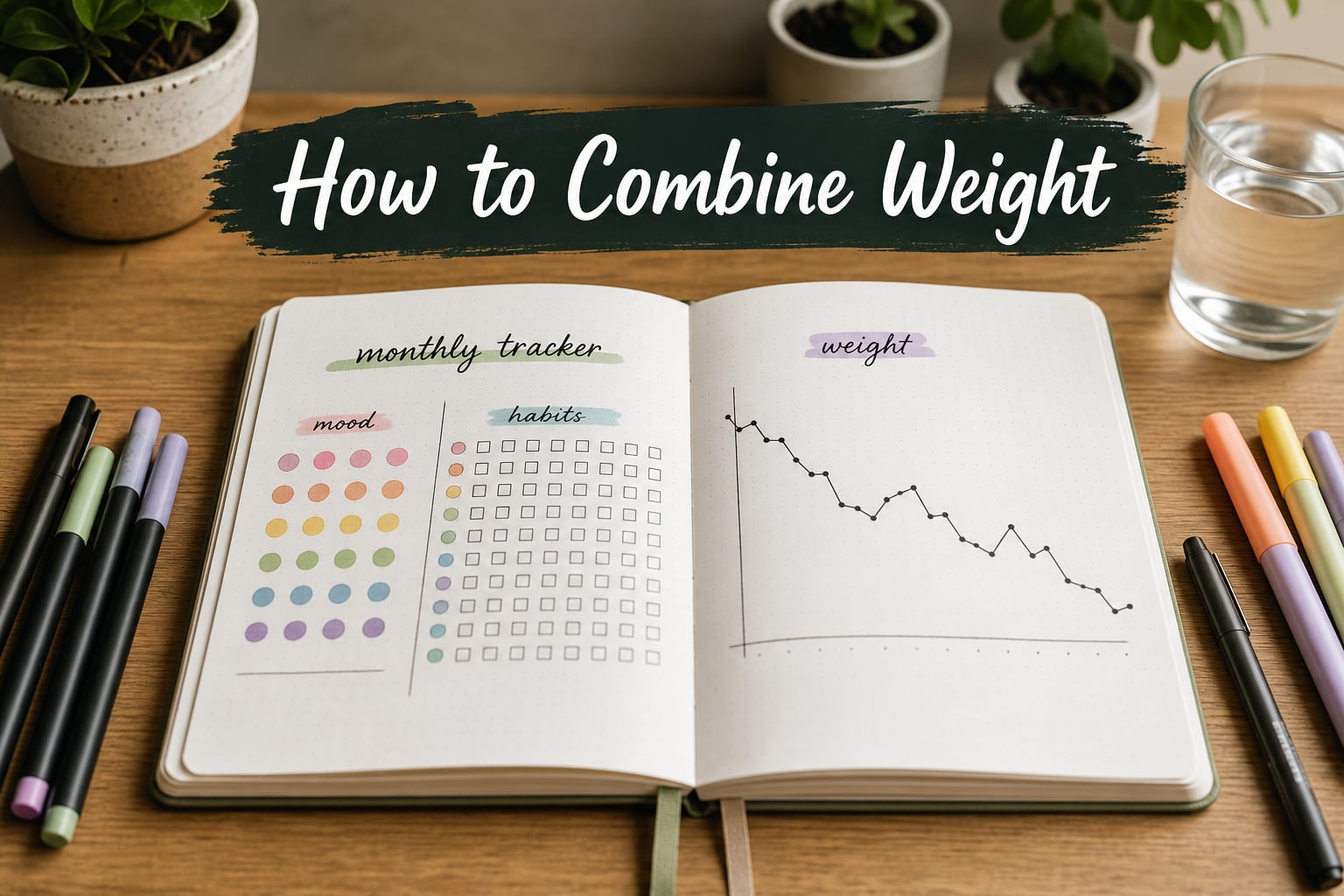
If you have ever jotted down your morning weight, checked off a habit box, and scribbled a mood note in three different places, you already know the problem. Your bullet journal starts to feel like a pile of disconnected data points that never tell a complete story.
I spent months running separate trackers for my weight loss journey. One page had my weight, another had my habits, and a third had little colored circles for my mood. Nothing connected. The breakthrough came when I put all three on a single spread and finally saw how my emotions were driving my eating habits and, ultimately, my weight.
Learning how to combine weight and habits bullet journal mood tracking on one page changed everything for me. Instead of flipping between scattered notes, I could look at a single spread and understand the full picture of my health. In this guide, I will walk you through exactly how to build your own combined tracker, which habits matter most for weight loss, how to read the patterns hiding in your data, and how to stay consistent without turning journaling into a chore.
Table of Contents
- What Is a Combined Weight, Habit, and Mood Tracker?
- Benefits of Combining Weight, Habits, and Mood Tracking
- What Habits to Track for Weight Loss
- How to Combine Weight and Habits Bullet Journal Mood Tracking: Step-by-Step
- Color Coding Systems for Mood Tracking
- How to Identify Patterns Between Mood and Weight
- Tips for Staying Consistent with Your Combined Tracker
- Common Mistakes to Avoid
- Frequently Asked Questions
- Conclusion
What Is a Combined Weight, Habit, and Mood Tracker?
A combined tracker is a single bullet journal spread that records your weight, daily habits, and emotional state side by side. Instead of dedicating separate pages to each category, you lay everything out on one surface so the relationships between them become visible.
Think of it as an all-in-one dashboard for your health. Your weight entry sits next to your mood rating, which sits next to your habit checkboxes. When you see a bad mood day lined up with a skipped workout and a weight spike, the connection becomes obvious.
This approach differs from traditional tracking because it prioritizes context over raw numbers. A weight number alone tells you nothing. A weight number paired with three hours of sleep, a stressful workday, and zero water intake tells a story you can actually act on.
Benefits of Combining Weight, Habits, and Mood Tracking
The biggest advantage I have found is pattern recognition. When your mood data sits right next to your habit and weight data, patterns jump out that would otherwise stay invisible. You might notice that every time your mood drops below a certain level, your water intake plummets and your weight ticks up a few days later.
Reddit users in the bullet journal community echo this. Many report that mood trackers specifically help them identify triggers for emotional eating. Seeing the pattern in ink makes it harder to ignore and easier to address.
Combining trackers also reduces overwhelm. Instead of maintaining three separate pages, you fill out one spread. This matters more than people realize. Forum users consistently say that having too many trackers is the number one reason they abandon bullet journaling altogether.
Here is what a combined approach gives you that separate trackers cannot:
- Emotional eating awareness: Spot the moods that lead to mindless snacking before they derail your progress.
- Accountability in one glance: A single spread forces you to confront the relationship between your choices and your results.
- Less time journaling: One page takes half the time to fill out compared to three separate ones.
- Motivation from visual progress: Seeing habit streaks alongside mood improvements and weight trends creates a feedback loop that keeps you going.
What Habits to Track for Weight Loss
Not all habits deserve space on your combined spread. Track too many and the page becomes cluttered and discouraging. Based on my experience and what the research community recommends, here are the five habits that have the biggest impact on weight loss and pair best with mood tracking.
Water intake is the foundation. Dehydration masquerades as hunger, wrecks your mood, and slows your metabolism. Track glasses or ounces, whichever feels natural. Even a simple checkmark for each glass works.
Sleep hours directly affect both your mood and your weight. Poor sleep increases hunger hormones, decreases willpower, and tanks your emotional resilience. Log the number of hours or use a quality rating from one to five.
Movement or exercise is non-negotiable on a weight loss tracker. This does not have to mean gym sessions. Walking, stretching, dancing in your kitchen, it all counts. A checkbox is plenty.
Mindful eating helps you slow down and notice when you are eating from boredom or stress rather than hunger. Track whether you ate without screens, stopped at satisfied rather than stuffed, or paused before reaching for seconds.
Stress management rounds out the list. Whether it is five minutes of deep breathing, a short walk, or journaling, tracking this habit alongside your mood reveals which practices actually move the needle on your emotional state.
How to Combine Weight and Habits Bullet Journal Mood Tracking: Step-by-Step
This is the core of the guide. I will walk you through building a combined spread from scratch, assuming nothing about your artistic ability or journaling experience.
Step 1: Choose Your Format
Decide whether you want a monthly spread or a weekly spread. Monthly spreads give you a bird’s-eye view of patterns over time, which is ideal for weight loss tracking since fluctuations happen across weeks, not days. Weekly spreads offer more detail and are easier to maintain if you are just starting out.
For a monthly spread, you will need space for 28 to 31 entries. A grid layout works well, with each row representing a day and columns for weight, mood, and each habit.
Step 2: Design the Mood Tracking Section
Pick a mood tracking method that feels effortless. The three most popular approaches are color-coded circles, emoji stamps, and gradient bars. I recommend starting with a simple five-point color scale because it captures enough nuance without slowing you down.
Draw a small circle or square next to each day’s row. Fill it with a color that represents your overall mood for that day. Assign five colors to a key, for example: dark blue for great, light blue for good, yellow for neutral, orange for low, and red for difficult.
Keep the categories broad. If you try to distinguish between ten different emotional states, you will spend more time debating colors than tracking data.
Step 3: Set Up the Habit Tracking Grid
Create a column for each habit you want to track, with a checkbox or dot for every day of the month. Limit yourself to five habits at most. More than that and the spread becomes a chore, which is the exact problem we are solving.
Use a simple dot system instead of full checkboxes. A filled dot means you completed the habit. An empty dot means you did not. This keeps the spread clean and fast to fill out.
Label each column clearly at the top. Abbreviations are fine if they make sense to you. Water, sleep, movement, mindful eating, and stress management are the five I recommend for weight loss.
Step 4: Add the Weight Tracking Element
Dedicate a narrow column or a small graph for weight. Two effective approaches are a simple number log or a line graph that visualizes trends.
If you use a number log, write your weight once a day or once a week, depending on your preference. If you use a graph, plot your weight on a simple coordinate system where the x-axis is the day and the y-axis is the weight range.
I prefer weighing in once a week rather than daily. Daily weigh-ins can create anxiety that throws off your mood data, which defeats the purpose of a combined tracker. But this is personal. Choose the frequency that keeps you calm and consistent.
Step 5: Create a Color Key and Legend
Your key ties the whole spread together. Place it in a corner of the page or on the opposite page. It should define every color, symbol, and abbreviation used on your spread.
Include mood colors and their meanings, habit abbreviations, and any special symbols like stars for milestone days or exclamation marks for emotional eating episodes. A clear key means you can interpret your data months later without guessing.
Step 6: Fill In Your First Week
Do not wait for a new month or a Monday. Start today. Fill in your current weight, today’s mood color, and check off any habits you have already completed. Getting ink on the page breaks the paralysis of perfection.
Expect the first week to feel a little awkward. You are learning a new system. By the second week, filling in your tracker will take under sixty seconds, and by the end of the month, you will have your first set of data to analyze.
Color Coding Systems for Mood Tracking
Choosing the right color system makes the difference between a tracker you actually use and one you abandon by week two. Here are the three systems that work best for combined weight and mood spreads.
The traffic light system uses green for positive moods, yellow for neutral, and red for difficult days. It is the simplest option and perfect for beginners. The downside is that three categories may not capture enough nuance.
The five-color spectrum is what I use. It adds two gradient steps between the extremes, giving you a smoother picture of your emotional landscape. Dark blue, light blue, yellow, orange, and red create a visual gradient that makes patterns easy to spot at a glance.
The emoji system replaces colors with simple faces. Draw or stamp a happy, neutral, or sad face for each day. This is popular in the bujo community for its simplicity and playfulness, especially for people who find color systems fussy.
Whichever system you pick, stick with it for at least a month before switching. Consistency in your color coding is what makes pattern recognition possible.
How to Identify Patterns Between Mood and Weight
Collecting data is useless if you never look at it. The real power of a combined tracker emerges when you sit down at the end of each month and read the story your spread is telling.
Block out fifteen minutes on the last day of every month for a review session. Look at your spread horizontally, scanning for days where your mood color shifted dramatically. Then check what happened with your habits and weight on those days and the two days that followed.
Here is a pattern I found in my own data. Every time my mood dropped to orange or red, my water intake column showed empty dots for the next two days, and my weight ticked up by one to two pounds within seventy-two hours. Once I saw this repeated three times, I built a specific response: on low-mood days, I set a phone reminder to drink water every two hours. The weight spikes stopped.
Common patterns to watch for include poor sleep followed by low mood and skipped workouts, high-stress days followed by mindful eating lapses, and positive mood streaks correlated with consistent habit completion and steady weight loss.
When you spot a pattern, write a note directly on the spread or in a separate reflection section. These notes become your personal playbook for handling emotional triggers without sabotaging your weight loss progress.
Tips for Staying Consistent with Your Combined Tracker
Consistency is the single biggest challenge bullet journal users face, especially with multi-category trackers. Forum users in the bujo community consistently report that simplicity beats complexity when it comes to long-term adherence.
Tie your tracking to an existing habit. Fill in your spread right after brushing your teeth at night, or while your morning coffee brews. Anchoring the tracker to something you already do every day removes the need for willpower or reminders.
Keep your spread within arm’s reach. If your journal lives in a drawer, you will forget it. If it sits open on your nightstand or desk, you will see it and fill it in without thinking.
Celebrate streaks, not perfection. Missing a day does not ruin your data. A streak of twelve days, a missed day, and a streak of nineteen days tells a richer story than a blank page born from the pressure of perfection.
If you have ADHD or struggle with executive function, simplify aggressively. Drop to three habits instead of five. Use emoji instead of colors. Track mood once a day instead of multiple times. The bujo community on Reddit is clear on this point: a simple tracker you actually use beats an elaborate one you abandon.
Set a weekly check-in with yourself. Every Sunday, glance at the past week and look for anything interesting. This takes two minutes and keeps you engaged with your data rather than just mechanically filling in boxes.
Common Mistakes to Avoid
Overcomplicating the design is the number one killer of combined trackers. Elaborate borders, hand-lettered headers, and decorative elements look beautiful on Instagram but add friction to daily use. Function comes first.
Tracking too many habits dilutes your focus and makes the spread overwhelming. Stick to five at most, and feel free to start with three.
Ignoring the data wastes the entire effort. If you never review your spread, you are just collecting numbers. The monthly review session is where the magic happens.
Being too hard on yourself turns a tool for self-awareness into a source of shame. Your tracker is a neutral observer, not a judge. Bad days are data points, not failures.
Frequently Asked Questions
What are some good moods to track in a bullet journal?
Track five mood categories: great, good, neutral, low, and difficult. Use a color or emoji for each one. Keep categories broad enough that you can assign one in under five seconds without overthinking your emotional state.
Is BuJo good for ADHD?
Yes, bullet journaling works well for ADHD when kept simple. Use minimal habits, emoji-based mood tracking, and tie journaling to an existing daily routine. The visual layout helps with working memory, and the single-page approach reduces task-switching overwhelm.
What are some good habit tracking ideas for a bullet journal?
For weight loss, track water intake, sleep hours, daily movement, mindful eating, and stress management. These five habits have the strongest direct and indirect impact on weight and pair well with mood data to reveal behavioral patterns.
What are some good ideas for using bullet journaling to track weight loss?
Use a weekly weigh-in log, a monthly line graph to visualize trends, and a combined spread that places weight next to mood and habit data. Track non-scale victories like energy levels, clothing fit, and workout consistency alongside the numbers.
How does mood affect weight loss?
Low mood often triggers emotional eating, reduces motivation to exercise, and disrupts sleep, all of which slow weight loss. Tracking mood alongside weight and habits reveals these connections so you can build targeted strategies, like setting water reminders on difficult days.
Conclusion
Learning how to combine weight and habits bullet journal mood tracking on a single spread is not about creating a perfect piece of art. It is about building a tool that reveals the hidden connections between your emotions, your daily choices, and your weight.
Start with three habits and a simple five-color mood scale. Give it thirty days. When you sit down for your first monthly review and spot a pattern that explains why your weight stalls on stressful weeks, you will understand why this approach works better than any single-category tracker ever could. Consistency beats complexity every time, so keep it simple and start today.