
I remember staring at my blank notebook three years ago, overwhelmed by Instagram-perfect bullet journal spreads and wondering if I needed to be an artist to track my health. Turns out, I didn’t. I just needed a system that worked for me, not someone else’s aesthetic.
If you’re here, you probably want to start a health-focused bullet journal from scratch but feel intimidated by where to begin. That’s completely normal. The good news is that bullet journaling was designed to be simple, customizable, and genuinely useful, not a second job.
In this guide, I’ll walk you through everything you need to know to build a wellness journal that actually sticks. We’ll cover what a health bullet journal is, the minimal supplies you need, step-by-step setup instructions, the best health tracking spreads, and how to avoid the burnout that makes most people quit within a month.
Whether you want to track habits, monitor your mental health, log symptoms, or support a weight loss journey, you’ll have a clear blueprint by the end. No drawing skills required.
Table of Contents
- What Is a Health-Focused Bullet Journal?
- Why Track Your Health in a Bullet Journal?
- Essential Supplies for Getting Started
- How to Start a Health-Focused Bullet Journal: Step-by-Step Setup
- Core Health Tracking Spreads to Build First
- Self-Care Categories to Include in Your Journal
- Weight Loss and Fitness Tracking Spreads
- Tips for Consistency: Avoiding Bullet Journal Burnout
- Common Mistakes to Avoid
- Frequently Asked Questions
- Conclusion
What Is a Health-Focused Bullet Journal?
A health-focused bullet journal is a customizable notebook system that combines habit tracking, mood monitoring, symptom logging, and self-care planning into one place. It uses the bullet journal method created by Ryder Carroll, which relies on rapid logging, an index system, and simple signifiers to capture information quickly.
The difference between a standard bullet journal and a health-focused one is intention. Instead of tracking just tasks and appointments, you create specific spreads dedicated to your physical and mental wellbeing. Think habit grids, mood trackers, sleep logs, water intake charts, and medication reminders, all living in one notebook.
What makes this approach powerful is that you own the format. Unlike a pre-printed planner that forces you into someone else’s structure, a health bullet journal bends to fit your life. You can start with three trackers, add more when you’re ready, and remove anything that feels like busywork.
The bullet journal method uses a few core concepts you’ll want to understand before diving in. Collections are themed pages or spreads grouped by topic, like your monthly health overview or a fitness goal tracker. Spreads are the two-page layouts where you track data. Signifiers are simple symbols, like a dot for a task or a heart for something meaningful, that help you log entries fast without writing full sentences.
Why Track Your Health in a Bullet Journal?
The biggest benefit of a health-focused bullet journal is pattern recognition. When you log your sleep, mood, food, and symptoms over weeks, you start seeing connections that would otherwise stay invisible. Maybe your headaches cluster on days you sleep less than six hours. Maybe your anxiety spikes when you skip meals.
I’ve talked with dozens of people in bullet journal communities who say the same thing: tracking helped them connect lifestyle choices to how they actually felt. One redditor in r/bulletjournal mentioned that after two months of mood and food tracking, they realized dairy was triggering their afternoon energy crashes. That’s the kind of insight a generic health app rarely surfaces.
A paper journal also removes friction. You don’t need to open an app, navigate menus, or deal with notifications. You just open your notebook and write. Many people find the physical act of writing by hand more grounding and mindful than tapping a screen, which matters when you’re tracking mental health.
Finally, a bullet journal gives you complete privacy. Your health data stays in your notebook, not on a server. For anyone managing sensitive health conditions, that peace of mind matters.
Essential Supplies for Getting Started
One of the most common questions from beginners is what supplies they actually need. The answer is refreshingly little. You can start a health-focused bullet journal with just two items.
The notebook. Any notebook works, but most bullet journalists prefer dotted grid notebooks because the dots act as faint guides for drawing layouts without being visually distracting. Look for one with at least 120 pages, a lay-flat binding, and paper thick enough that pens don’t bleed through. Popular options include the Leuchtturm1917 A5 dotted and the Nuuna notebooks, but a simple composition notebook works just as well.
The pen. A single black pen is all you need. Many beginners love the Sakura Pigma Micron or Pilot G2 because they write smoothly and don’t smudge. Avoid the temptation to buy twenty fancy markers before you’ve established a habit.
Those two items are enough. Everything else is optional. Here’s what you might add later, once you know your journaling style.
Optional supplies:
- Colored pens or fine-liners for color-coding trackers (Stabilo, Crayola Supertips)
- Washi tape for decorating page headers or marking important sections
- A ruler for drawing straight tracker grids
- Highlighters for emphasizing entries in your food or mood logs
- Sticky tabs to mark frequently visited pages like your current weekly spread
Here’s my honest advice based on what I’ve seen in journaling communities: do not overspend on supplies before you’ve journaled for a month. The people who buy everything upfront often feel pressured to create perfect spreads, which leads to burnout. Start simple, earn the upgrades.
How to Start a Health-Focused Bullet Journal: Step-by-Step Setup
Setting up your health-focused bullet journal from scratch takes about 30 minutes. Here’s the exact step-by-step process I recommend.
Step 1: Create your index. Reserve the first two to four pages of your notebook for an index. This is your table of contents. Every time you start a new spread, write the page number and a short title here. Number the rest of your pages if your notebook isn’t pre-numbered. The index is what makes a bullet journal searchable, so don’t skip it.
Step 2: Build your key. On the page after your index, write down your signifiers. Keep it minimal at first: a dot for tasks, an X for completed tasks, a right arrow for migrated tasks, a dash for notes, and a small circle for events. You can add health-specific symbols later, like a water drop for hydration or a moon for sleep. Write these symbols and their meanings clearly so you remember them.
Step 3: Set up a future log. The future log is a six-month or twelve-month overview where you write birthdays, doctor appointments, health goals with deadlines, and recurring events. Dedicate two pages, split each into sections for each month, and fill in what you already know.
Step 4: Create your first monthly spread. Pick the current month. On a two-page layout, draw a simple calendar or a vertical list of dates on the left page. On the right page, list your health goals for the month. Keep it to three to five goals so you don’t overwhelm yourself.
Step 5: Add your core health trackers. After your monthly spread, dedicate pages to the trackers you want to use. Start with just two or three. My recommendation for beginners: a daily habit tracker and a mood tracker. Draw simple grids where rows are days of the month and columns are the habits or moods you’re tracking.
Step 6: Set up your first daily log. After your trackers, start your daily log. Each day, write the date and use rapid logging (short bullet points with your signifiers) to capture tasks, notes, and health observations. This is where you’ll jot things like “slept 7 hours,” “drank 6 glasses of water,” or “felt anxious before the meeting.”
Step 7: Review and migrate. At the end of each day or week, take five minutes to review. Check off completed tasks, migrate unfinished ones to the next day, and look at your trackers for patterns. This reflection step is what turns raw data into actionable insight.
That’s your foundation. Everything else you add from here, whether it’s a gratitude page, a weight loss tracker, or a medication log, is built on top of this seven-step structure.
Core Health Tracking Spreads to Build First
Once your base setup is done, the fun begins: building your health tracking spreads. These are the pages that make your bullet journal specifically about wellness. Here are the core spreads I recommend starting with, based on what actually works for journalers.
Habit Tracker
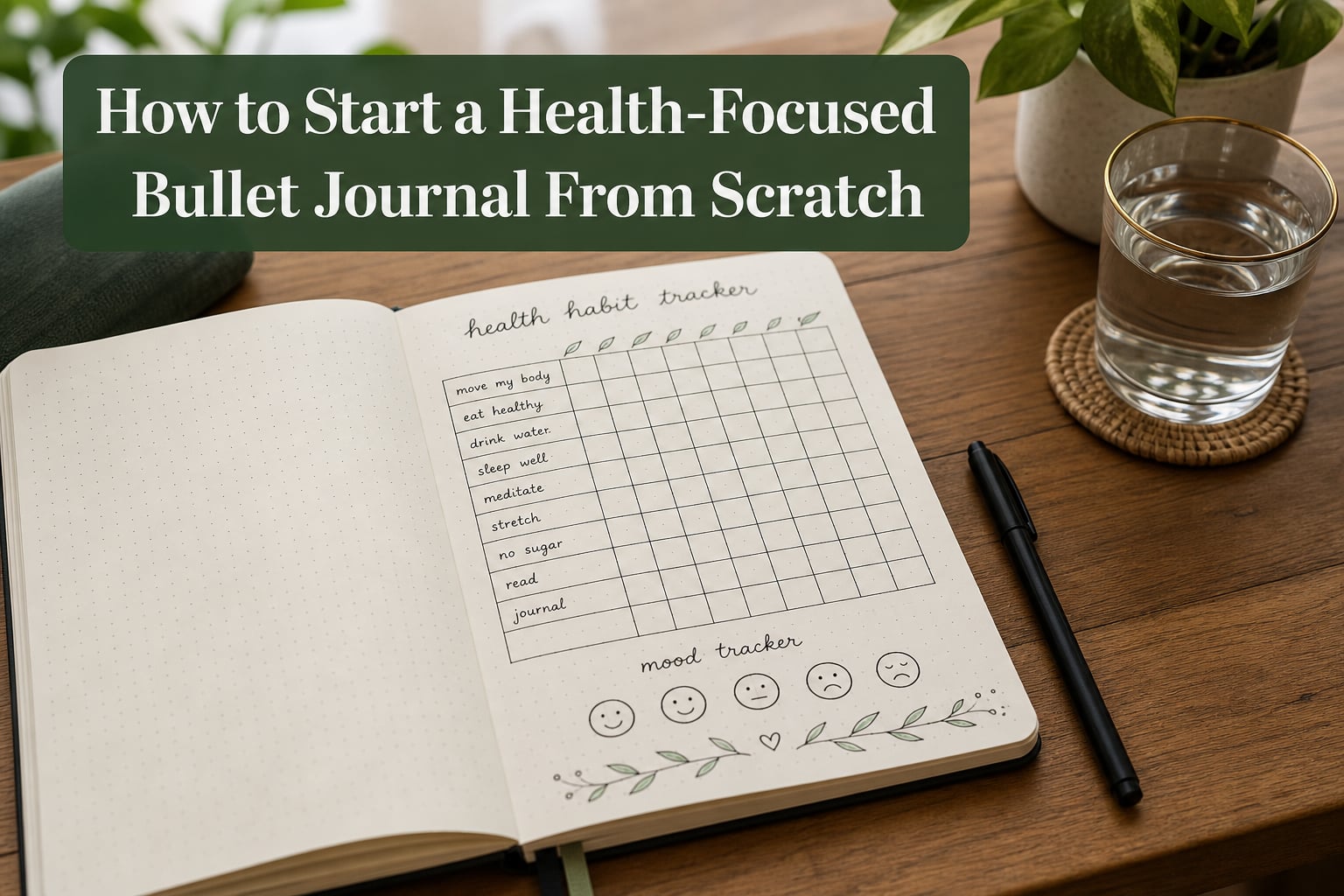
A habit tracker is a grid where you track daily behaviors you want to build or break. Down the left side, list your habits. Across the top, number the days of the month. Each day you complete a habit, fill in the corresponding square.
For health tracking, focus on habits that directly impact how you feel. Good starting habits include: drank 8 glasses of water, moved my body for 20 minutes, took medications or supplements, ate vegetables with lunch and dinner, stretched, and went to bed before 11 PM.
Keep your habit list to five to seven items. Forum users consistently report that habit trackers with 15 or more columns become unsustainable within weeks. Less is more here.
Mood Tracker
A mood tracker lets you record your emotional state each day so you can spot patterns over time. The simplest version is a monthly grid where each day gets a color or symbol representing your mood. Use a scale of three to five levels, from “great” to “struggling.”
Many people design creative mood trackers, like coloring in a different leaf on a drawn tree each day. If you enjoy that, go for it. If not, a plain grid with colored dots works just as well. The data matters more than the art.
Over time, cross-referencing your mood tracker with your habit tracker reveals powerful insights. You might notice your mood is consistently better on days you exercised, or worse on days you slept poorly.
Sleep Tracker
A sleep tracker records how much you slept and sometimes the quality. The simplest format is a monthly grid where you write the number of hours or use a simple rating like good, okay, or poor for each night.
If you want more detail, add a column for what time you went to bed and what time you woke up. Seeing your sleep patterns visually is eye-opening for many people, especially those who think they sleep more than they actually do.
Water and Nutrition Tracker
A water tracker is a simple visual where you mark off glasses or bottles of water each day. Some people draw eight small water glasses per day and shade them in. Others use a weekly grid with daily totals.
For nutrition, you don’t need to count every calorie. A food journal page where you jot down what you ate and how you felt afterward is enough to start spotting connections between your diet and your energy, mood, or digestive comfort.
Self-Care Categories to Include in Your Journal
Self-care isn’t just bubble baths and face masks. The most useful self-care bullet journals break the concept into categories so you can make sure you’re caring for yourself in multiple dimensions. I recommend adapting the eight-category framework popularized by the bullet journal community.
Physical self-care: Track exercise, sleep, hydration, nutrition, and medical appointments. This is where your habit tracker and sleep tracker live.
Emotional self-care: Include a mood tracker, a feelings log, and space to process emotions. A dedicated “rant page” where you freely vent frustrations can be surprisingly therapeutic.
Mental self-care: Add pages for journal prompts, a thought challenger where you write down anxious thoughts and counter them with evidence, and a learning or reading tracker.
Social self-care: Track time spent with people who energize you versus drain you. A simple weekly check-in asking “who did I connect with this week?” keeps relationships on your radar.
Spiritual self-care: Whether that’s meditation, prayer, time in nature, or simply sitting quietly, having a tracker or reflection page for this keeps you grounded.
Professional self-care: Log work boundaries, breaks taken, and professional goals. Burnout often starts here, and tracking helps you catch it early.
Environmental self-care: Note home organization tasks, decluttering, and creating spaces that feel good to be in.
Financial self-care: Track spending, savings goals, and budget check-ins. Financial stress directly impacts physical health.
You don’t need all eight categories on day one. Pick the two or three that feel most urgent, and add others as your journaling practice grows. Many people rotate focus monthly, highlighting different categories based on what life demands.
Weight Loss and Fitness Tracking Spreads
One area where most bullet journal guides fall short is weight-loss-specific tracking. Since you’re reading this on a site dedicated to weight loss planners, let’s go deeper than the competition.
A weight loss tracking spread should capture more than just the number on the scale. The scale fluctuates based on water retention, hormones, and time of day, so relying on it alone is discouraging. Instead, track multiple metrics that tell the full story.
Weekly measurement log: Measure your waist, hips, arms, and thighs once a week rather than weighing daily. Body composition changes often show up in inches before they show up on the scale. Create a simple grid with columns for each body part and rows for each week.
Exercise tracker: Log your workouts by type, duration, and how you felt. A weekly grid with columns for cardio, strength, flexibility, and rest days helps you see if your routine is balanced. Note intensity on a scale of 1 to 10 so you can track progressive overload.
Food journal with feelings: Instead of just logging what you ate, add a column for hunger level before eating (1 to 10) and satisfaction after. This simple addition helps you identify emotional eating patterns and mindless snacking triggers.
Goal milestones page: Break your weight loss goal into smaller milestones and celebrate each one. If your goal is to lose 40 pounds, create 5-milestone markers at 8-pound intervals. When you hit a milestone, write the date and how you feel. This page becomes your motivation on tough days.
NSV tracker: NSV stands for non-scale victories. Track moments like fitting into old jeans, walking up stairs without getting winded, or having more energy with your kids. These entries often matter more than any number.
Tips for Consistency: Avoiding Bullet Journal Burnout
The number one reason people abandon their bullet journal is that it becomes another source of stress instead of a tool for relief. This came up again and again in forum discussions across r/bulletjournal and r/basicbulletjournals. Here’s how to keep your practice sustainable.
Start with fewer trackers than you think you need. The temptation to build ten beautiful spreads on day one is real, and it’s the fastest path to overwhelm. Pick two or three trackers max for your first month. If you fill them in consistently, add one more the next month.
Embrace ugly pages. Your bullet journal does not need to look like the spreads on Instagram and Pinterest. The people in forum communities who stick with journaling longest are the ones using plain, functional layouts. A messy habit tracker you actually fill in beats a gorgeous one you’re afraid to write in.
Set a daily journaling time. Pair your journal check-in with an existing habit, a concept called habit stacking. Fill in your trackers right after brushing your teeth at night, or during your morning coffee. Having a set time removes the decision fatigue of “when should I journal?”
Give yourself permission to skip days. Missing a day doesn’t mean you failed. Leave the square blank, draw a line through it, or just move on. The forum users who journal for years all share this mindset: the journal is a tool, not a master.
Do a weekly review in five minutes. Every Sunday (or whatever day works), take five minutes to look at your trackers, note any patterns, and set a simple intention for the week ahead. This short ritual keeps you connected to your data without it becoming a chore.
Simplify when life gets busy. During stressful weeks, strip your journal down to just a daily log. Write one line about how you felt and what you did. You can always rebuild your full spread setup when things calm down. Consistency doesn’t mean doing everything every day; it means showing up in some way.
Common Mistakes to Avoid
After reading through hundreds of forum posts and community discussions, a few mistakes come up repeatedly. Learning from them now will save you frustration later.
Mistake 1: Copying someone else’s journal. Your bullet journal should fit your life, not an influencer’s. What works for a college student won’t work for a parent of three. Build spreads around your actual health goals and daily realities.
Mistake 2: Making trackers too granular. If your mood tracker has 12 different emotion options, you’ll dread filling it in. Three to five levels is enough. If your food tracker requires writing every ingredient, simplify to just main meals and a feelings note.
Mistake 3: Never reviewing your data. Tracking without reviewing is like taking photos without ever looking at them. The weekly review is where the magic happens. Patterns only become visible when you step back and look at the full picture.
Mistake 4: Starting a new journal every time you mess up. A crossed-out page is not a failure. It’s evidence you’re using your journal. Resist the urge to start over every time a page doesn’t look perfect. The messiest journals are often the most effective ones.
Mistake 5: Treating your journal as a diary only. A health bullet journal works best when it combines tracking with reflection. If you’re only writing about your feelings without logging habits, sleep, or symptoms, you miss the pattern-recognition power of the system.
Frequently Asked Questions
How can a beginner start a bullet journal?
A beginner can start a bullet journal by grabbing any notebook and pen, setting up an index on the first pages, creating a simple key with 4 to 5 signifiers, and starting a daily log. Add a monthly calendar and one or two health trackers once the daily habit feels natural. Start with minimal pages and build up gradually.
What is the 3-3-3 journaling method?
The 3-3-3 journaling method involves writing three things you are grateful for, three goals or priorities for the day, and three affirmations or positive reflections. It is a quick daily structure that takes about five minutes and works well as a morning or evening page in a health-focused bullet journal.
How do I make my own wellness journal?
To make your own wellness journal, start with a blank notebook and create pages for the health metrics that matter most to you: a habit tracker, a mood tracker, a sleep log, and a daily reflection page. Use simple grids and rapid logging rather than long paragraphs. Add a gratitude section and review your entries weekly to spot patterns.
What is the 3-2-1 method for journaling?
The 3-2-1 journaling method is an evening reflection practice where you write three good things that happened during the day, two things you are looking forward to, and one thing you want to improve tomorrow. It promotes gratitude, optimism, and self-awareness, making it a useful addition to a self-care bullet journal.
What should I track in a health bullet journal?
Start with five core items: daily habits like water intake and exercise, mood or energy level, sleep hours and quality, food highlights with a feelings note, and medications or supplements. Once those feel routine, add symptom tracking, body measurements, or a gratitude page depending on your specific health goals.
Conclusion
Starting a health-focused bullet journal from scratch doesn’t require artistic talent, expensive supplies, or hours of free time. It requires a notebook, a pen, and the willingness to show up consistently, even imperfectly.
Remember the core principle: build a system that serves you, not the other way around. Start with two or three trackers, review your data weekly, and add new spreads only when you’ve proven you can maintain the ones you have. The most effective health bullet journals are the ones that survive month three, not the ones that look pretty on day one.
Grab your notebook tonight, set up your index and key, and start your first daily log tomorrow morning. Your future self will thank you for the patterns you’re about to discover.