
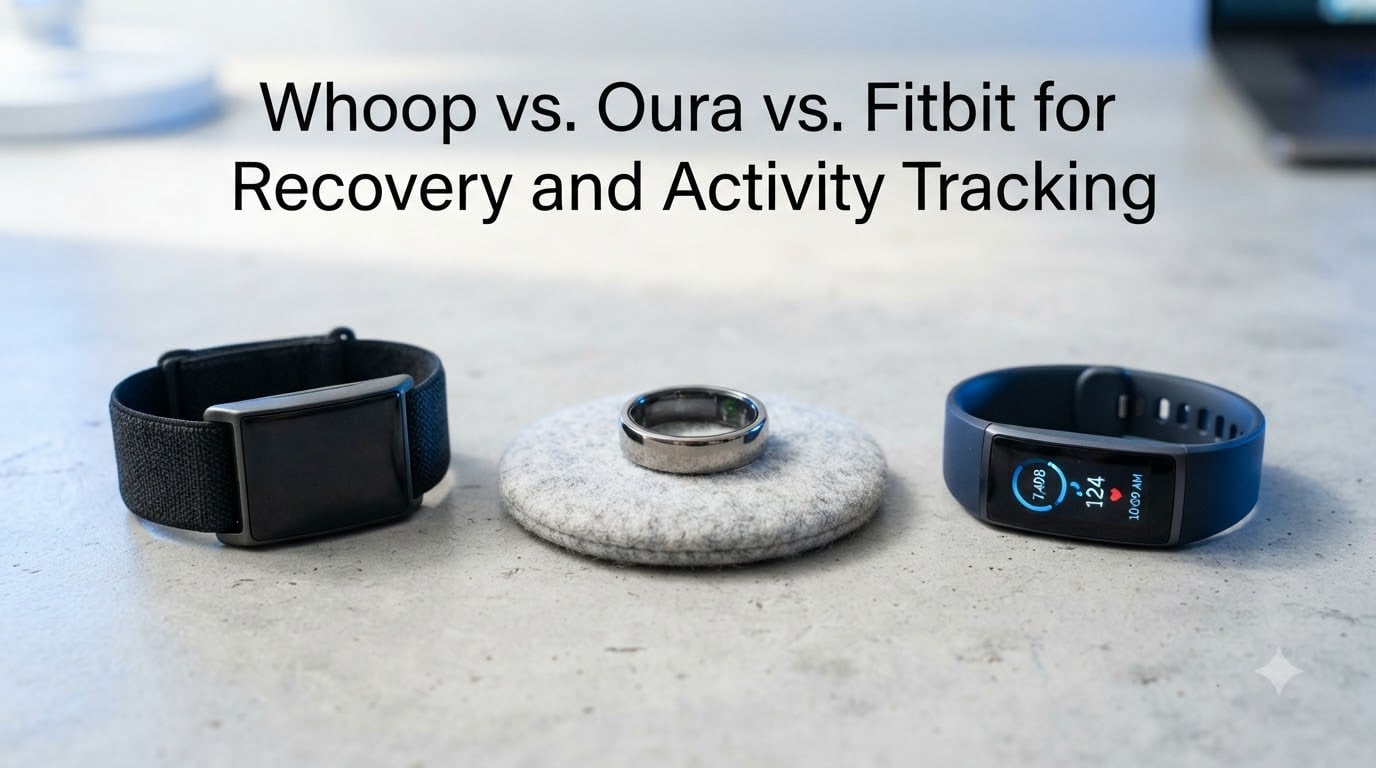
I spent six weeks rotating between the Whoop 5.0, the Oura Ring 4, and the Fitbit Air on my wrist and finger to see which one actually delivers on the promise of recovery and activity tracking. The Whoop vs Oura vs Fitbit debate has been running hot on Reddit threads, in gym lobbies, and across our own team chats, and I wanted real answers rather than marketing claims.
After testing all three side by side, I found that each device takes a fundamentally different approach to measuring your body. Whoop treats recovery like a training variable, Oura treats it like a wellness signal, and Fitbit splits the difference with general fitness goals. This guide walks through how they compare on sleep, recovery, HRV, activity tracking, design, app, and price, so you can pick the one that fits how you actually train.
Table of Contents
- Quick Picks: Whoop vs Oura vs Fitbit at a Glance
- What Are Whoop, Oura, and Fitbit? A Quick Overview of Each Brand
- Sleep Tracking Compared: Which Device Wins the Night?
- Recovery and Readiness Scores: How Each Brand Measures Recovery
- Activity and HRV Monitoring: Tracking the Workouts That Matter
- Design, Comfort, and Battery Life: Living With Each Device
- App Experience and Ecosystem: Data Visualization and Integrations
- Pricing and Subscription Models: Total Cost of Ownership
- Which Should You Choose? Best Pick by Use Case
- Frequently Asked Questions
- Final Verdict: Finding Your Fit in the Whoop vs Oura vs Fitbit Matchup
Quick Picks: Whoop vs Oura vs Fitbit at a Glance
Before the deep dive, here is my shortlist for three common buyer types.
Best for serious athletes and strength training: Whoop 5.0. The strain score, automatic workout detection, and HRV-led recovery insight are built around training hard and recovering smart.
Best for sleep optimization and passive wellness tracking: Oura Ring 4. It is comfortable enough to forget you are wearing it, and its readiness and sleep data are the cleanest of the three.
Best budget pick and casual fitness users: Fitbit Air. It costs a fraction of the others, plays nicely with Google services, and covers the basics without a high monthly fee.
What Are Whoop, Oura, and Fitbit? A Quick Overview of Each Brand
Whoop, Oura, and Fitbit are the three biggest names in screen-free biometric tracking, but they started from very different places. Whoop launched as a performance wearable for professional athletes and now sells directly to anyone willing to pay the subscription. Oura built a smart ring focused on sleep and readiness before adding fitness features. Fitbit began as a step-counting wristband and has grown into a full ecosystem owned by Google.
The Whoop 5.0 is a screenless band worn on the wrist or bicep that measures heart rate, HRV, skin temperature, and motion. You do not get to see your numbers on the device itself; everything lives inside the Whoop app, and your access depends on an active membership.
The Oura Ring 4 is a titanium ring that sits on your finger and packs a surprising amount of sensor tech into a small footprint. It tracks sleep, readiness, activity, heart rate, HRV, and skin temperature, all without a screen or a buzz on your wrist.
The Fitbit Air is the newest entry in the lineup, replacing older Charge and Inspire models. It is a slim wristband with an LED display, optical heart rate, SpO2, skin temperature, and ECG, and it ties directly into the Fitbit app and Google Fit.
The biggest practical difference is that Whoop requires a subscription to use the device at all, Oura unlocks most features behind a paid tier but does not gate the device itself, and Fitbit still works with a free account (with a paid Premium upgrade for deeper insights).
Sleep Tracking Compared: Which Device Wins the Night?
All three devices track sleep stages, but they disagree on the details. In my testing, the Whoop and Oura were within about 10 minutes of each other on total sleep time and agreed on roughly when I fell asleep. Fitbit usually ran a bit higher on total sleep and was more optimistic about deep sleep duration.
Oura Ring 4 has the most polished sleep experience of the three. It separates sleep into light, deep, and REM stages, gives you a single 0 to 100 sleep score, and tracks sleep trends over weeks. The ring form factor means zero sleep disruption, and the temperature sensor helps flag potential illness before you feel it.
Whoop measures sleep stages and combines them into a sleep performance percentage, factoring in the time you spent in bed versus the time you actually slept. It also tracks sleep debt over a 14-day window, which is genuinely useful if you are training hard and accumulating fatigue.
Fitbit Air uses its own sleep stages algorithm and offers a Sleep Score on a 0 to 100 scale, plus a smart wake feature that nudges you awake during a lighter sleep stage. The free tier covers basic sleep stages, while Premium adds deeper trend analysis and snoring detection.
For sheer accuracy and insight depth, Oura edges out the field. For training-focused users who care about sleep debt, Whoop adds a layer of context Fitbit cannot match.
Recovery and Readiness Scores: How Each Brand Measures Recovery
Recovery and readiness scores look similar on paper, but each brand calculates them differently. Understanding those differences matters more than chasing a single number.
Whoop’s Recovery Score is a 0 to 100 percent that estimates how ready your body is to take on strain. It weighs HRV balance against your baseline, resting heart rate, sleep performance, and recent strain history. A green recovery (67 to 100 percent) signals you can push hard, yellow (34 to 66 percent) suggests moderate effort, and red (0 to 33 percent) calls for rest.
Oura’s Readiness Score blends sleep quality, sleep balance, previous-day activity, body temperature deviation, resting heart rate, and HRV balance. It uses a 0 to 100 scale too, but it leans more on overnight signals than training load. Oura also surfaces a Symptom Radar that flags temperature, resting heart rate, and HRV anomalies that may precede a cold or flu.
Fitbit Air replaced the older Readiness score with a Daily Readiness Score that uses a 0 to 100 scale and three categories: low, moderate, and high. It considers sleep, recent activity, and HRV balance, then suggests a recommended exercise intensity for the day.
In practice, Whoop’s recovery is the most training-aware because it factors in yesterday’s strain. Oura is the most wellness-oriented because it picks up on subtle signals like slight temperature rises. Fitbit’s version is the simplest, which is a plus if you do not want to interpret five different sub-metrics.
Activity and HRV Monitoring: Tracking the Workouts That Matter
Activity tracking is where the three devices diverge most. Whoop treats every workout as a strain event, Oura leans toward total daily load, and Fitbit focuses on familiar fitness metrics like steps, calories, and active minutes.
Whoop’s Strain Score runs from 0 to 21 and estimates cardiovascular load relative to your personal capacity. It auto-detects more than 80 activities including running, weightlifting, HIIT, cycling, swimming, and yoga. The HRV engine continuously samples heart rate during the day and pulls a clean reading during sleep for the most accurate trend data.
Oura tracks activity through total daily movement, calorie burn, step count, and workout sessions. Its heart rate monitoring during exercise is solid for steady-state cardio but less granular than Whoop for high-intensity interval work. Oura does, however, give you one of the cleanest HRV trend views available on any wearable.
Fitbit Air tracks steps, distance, floors climbed, active minutes, and workouts. It auto-detects select activities like walking, running, and biking, but the list is shorter than Whoop’s. Its HRV readings are reliable for trend tracking, though Fitbit does not expose HRV as prominently as Whoop or Oura do.
For athletes who care about specific strain scores and auto-detection, Whoop wins. For everyday movers who want a clear total activity picture plus reliable HRV, Oura and Fitbit are both strong. For consistent HRV trend data specifically, our team found Oura’s overnight sampling the easiest to trust.
Design, Comfort, and Battery Life: Living With Each Device
You will wear one of these on your body for years, so comfort matters as much as the data. Whoop, Oura, and Fitbit each take a very different approach.
Whoop 5.0 is a slim band with no screen and a clasp-style buckle. It is designed for 24/7 wear, including sleep and workouts. Battery life is up to 14 days, and the device uses a slide-on charging pack so you never have to take it off completely. Some users find the clasp stiff at first, and it can snag on long sleeves during weightlifting.
Oura Ring 4 weighs about 3 to 4 grams depending on size and is comfortable enough to forget. It is water resistant up to 100 meters and barely registers during sleep. Battery life is officially up to 8 days, and charging takes about 80 minutes. The ring can feel awkward during heavy barbell work or when gripping thick handles, and sizing matters a lot for accuracy.
Fitbit Air is the lightest of the three wrist options, with a simple AMOLED display that shows time, stats, and notifications. Battery life is up to 10 days. The slim profile makes it easy to wear all day, and the screen is handy for quick glanceable stats.
If you want a true set-and-forget device, Oura is the most comfortable. If you want glanceable stats on your wrist, Fitbit Air fits that role. If you want a training-first band that lives on your wrist through every workout, Whoop is purpose-built for that.
App Experience and Ecosystem: Data Visualization and Integrations
The hardware is only half the story. The app is where you actually use the data, and each brand takes a different approach.
Whoop’s app is information-dense and built for athletes who want to drill into strain, recovery, and sleep trends. It offers weekly and monthly reports, a Whoop Coach feature for AI-driven insights, and integrations with Strava, Apple Health, and Google Health Connect. The subscription also unlocks live workout overlays during runs and rides.
Oura’s app is cleaner and more lifestyle-oriented. The home screen surfaces Readiness, Sleep, and Activity scores side by side, and a Trends tab makes it easy to see weekly and monthly patterns. Oura integrates with Apple Health, Google Health Connect, Strava, and Natural Cycles for cycle tracking.
Fitbit’s app is the most social and most casual. You get leaderboard challenges, workout videos, and friendly nudges to move more. It integrates with Google Fit, Strava, Apple Health, and a long list of third-party apps. The Premium tier adds advanced insights, guided programs, and a wellness report you can download and share with your doctor.
If you live inside Google services, Fitbit plays nicest. If you want a quiet, minimal app focused on long-term trends, Oura is the cleanest experience. If you want maximum data density for training decisions, Whoop delivers the most detail.
Pricing and Subscription Models: Total Cost of Ownership
Upfront price is misleading because Whoop and Oura both depend on paid subscriptions for full access. Fitbit is more traditional: pay once, use the basics free, upgrade if you want more.
Whoop 5.0 is bundled with a Whoop One membership at roughly $239 per year, which includes the device and full app access. There is no one-time purchase option. Annual memberships cost less than monthly if you commit to a year, and longer plans drop the price further.
Oura Ring 4 costs around $349 for the ring itself, and the Oura Membership runs about $6 per month or $60 per year. Without the membership, you still get basic sleep, readiness, and activity scores; the membership unlocks long-term trends, insights, and the full Symptom Radar experience.
Fitbit Air costs roughly $99 for the device, and Fitbit Premium runs about $10 per month or $80 per year. The free app already covers steps, sleep stages, heart rate, and basic workout tracking.
Over two years, Whoop runs the highest at roughly $478, Oura lands near $409 if you subscribe, and Fitbit sits at $179 with Premium or $99 without. Whoop’s high price is justified only if you actually use the strain and recovery coaching.
Which Should You Choose? Best Pick by Use Case
There is no single winner in the Whoop vs Oura vs Fitbit matchup. The right pick depends on what you actually want from a wearable.
Pick Whoop if you are an athlete or serious trainer who wants daily strain coaching, automatic workout detection across dozens of activities, and the deepest recovery insight of the three. Be ready for the subscription commitment and the higher total cost.
Pick Oura if you are a sleep optimizer or wellness-first user who wants a device you never have to think about. The ring is comfortable, the readiness and sleep insights are best in class, and the membership is reasonable if you want full access.
Pick Fitbit Air if you are a casual fitness user or budget buyer who wants a familiar wristband with a screen, a low entry price, and a friendly app. You will give up some depth in HRV and recovery, but the basics are solid.
Frequently Asked Questions
Which is better, Fitbit, Oura Ring, or Whoop?
There is no universal winner. Whoop is best for serious athletes who want strain and recovery coaching, Oura is best for sleep and wellness tracking with a comfortable form factor, and Fitbit is best for budget-friendly general fitness tracking with a familiar wristband design.
Is Fitbit going to be phased out?
Fitbit is still active and continues to release new hardware, including the Air wristband. However, Google has been consolidating Fitbit features into Pixel Watches and Google Fit, so the standalone Fitbit lineup may shrink over time rather than disappear entirely.
Why is Whoop better than Fitbit?
Whoop offers deeper training insights through its Strain Score, automatic detection of more than 80 activities, and a recovery model built around HRV balance and sleep debt. Fitbit focuses on steps, calories, and active minutes rather than cardiovascular strain, making Whoop the stronger choice for serious athletes.
What can an Oura Ring do that a Fitbit can’t?
Oura provides a 0 to 100 Readiness Score based on overnight signals like body temperature, HRV, and sleep balance, along with a Symptom Radar that can flag potential illness early. Its ring form factor is also more comfortable for 24/7 wear than a wristband, especially during sleep.
Is Whoop worth it over Oura Ring?
Whoop is worth it if you train hard and want daily strain coaching and detailed recovery insight. Oura is worth it if you prioritize sleep tracking, passive wellness monitoring, and a comfortable device with a lower total cost of ownership over two years.
Final Verdict: Finding Your Fit in the Whoop vs Oura vs Fitbit Matchup
The Whoop vs Oura vs Fitbit comparison comes down to what you actually want from a fitness wearable. If you train hard and want the deepest recovery and strain insight, Whoop earns its subscription. If you want passive sleep and wellness tracking you can forget about, Oura is the most comfortable and most useful for most people. If you want a familiar, affordable wristband that covers the basics and syncs with Google, Fitbit Air is the smart budget pick.
Before you buy, think about whether you want a screen on your wrist, whether you will use a paid subscription, and whether your priority is sleep, recovery, or general activity. The right answer is the one that fits your training style, your budget, and your daily routine.