
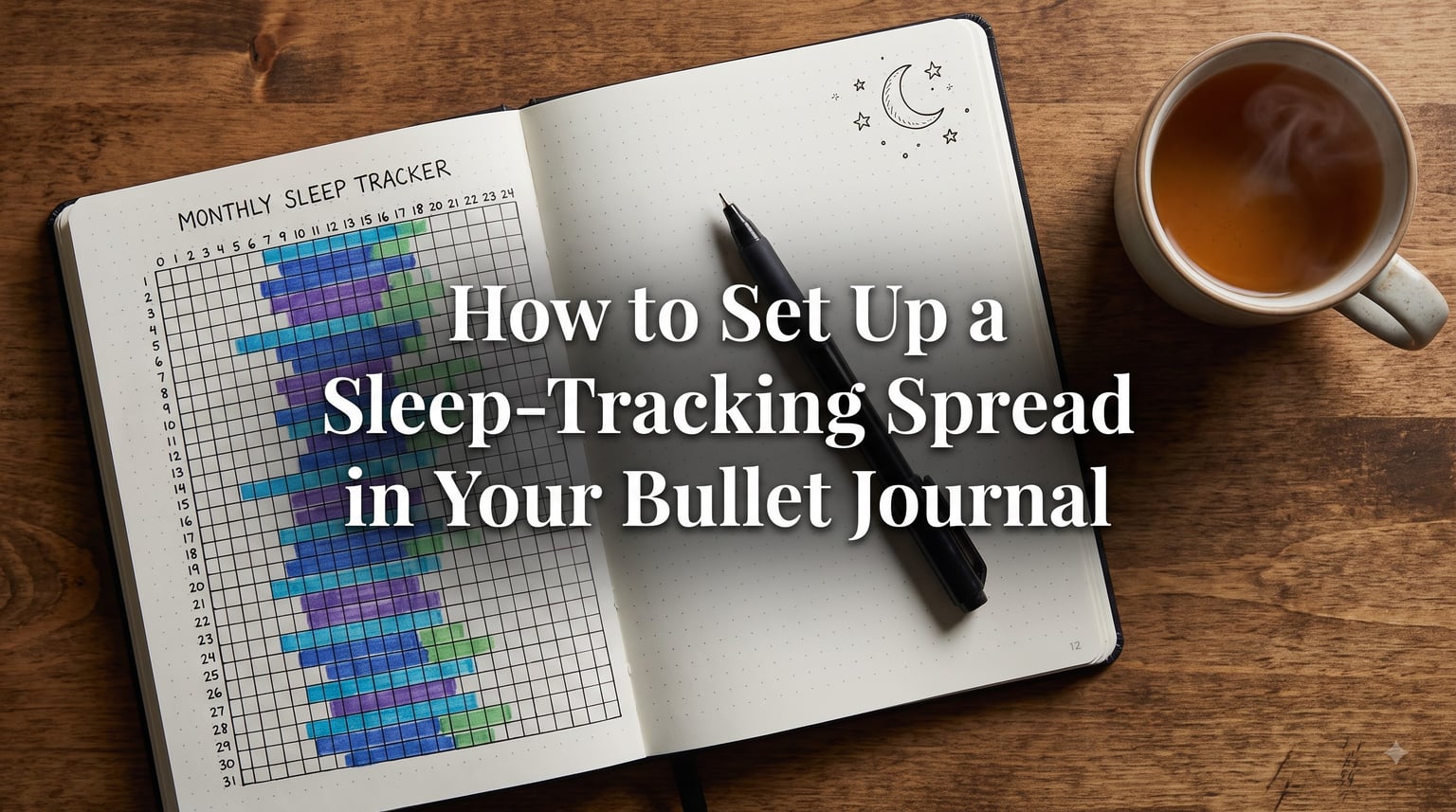
I used to wake up tired and have no idea why. Three months after I started tracking my sleep in a bullet journal, I could point to the exact habits wrecking my rest. If you want that kind of clarity, learning how to set up a sleep-tracking spread in your bullet journal is the single best first step you can take.
Manual sleep tracking beats a fitness watch in one important way: you control what you record. You can log how you felt, what you ate, and what was on your mind, not just your heart rate. In this guide, I will walk you through every part of building a sleep-tracking spread that actually sticks, from supplies to layouts to reading your data.
Table of Contents
- Why Track Sleep in Your Bullet Journal?
- What to Include in a Sleep-Tracking Spread
- Supplies You Need to Set Up a Sleep-Tracking Spread
- How to Set Up a Sleep-Tracking Spread in Your Bullet Journal: Step-by-Step
- Sleep Tracker Layout Options Compared
- How to Use Your Sleep Data
- Tips for Consistent Sleep Tracking
- Frequently Asked Questions
- Final Thoughts on Setting Up a Sleep-Tracking Spread
Why Track Sleep in Your Bullet Journal?
Your sleep drives almost everything else: mood, hunger, focus, willpower, and workout recovery. Yet most of us treat sleep as a vague feeling instead of data. A sleep log turns a fuzzy sense of “I slept badly” into something you can act on.
I have found three big wins from tracking sleep by hand. First, you spot patterns a watch cannot see, like the fact that you always sleep worse after a late cheese snack. Second, the act of writing forces a tiny nightly review, which builds self-awareness. Third, you start noticing the relationship between sleep and your other wellness goals, including weight loss, mood, and energy.
If you have ADHD, the case for sleep tracking is even stronger. Distraction and irregular routines make it hard to fall asleep at the same time, and the resulting fatigue makes ADHD symptoms worse. A sleep log gives you an external memory for patterns your brain keeps forgetting. The bullet journal community on Reddit is full of people who say a simple sleep tracker was the first habit that helped them stabilize their energy.
What to Include in a Sleep-Tracking Spread
Before you draw a single line, decide what you actually want to capture. The simplest spreads work best, especially when you are just starting out. I recommend tracking at least these four data points:
- Bedtime: the time you actually fell asleep, not when you got into bed.
- Wake time: the time you woke up for the day.
- Total hours slept: the simple math between the two.
- Sleep quality: a 1-5 rating you assign the next morning.
Once you have those basics down for a few weeks, you can add a second layer. Many bullet journalists track sleep supporters, things that helped them sleep (a walk, no caffeine after noon, magnesium, a cool room), and sleep opposers, things that hurt sleep (late meals, screen time, stress). This is where the real insight lives.
If you are focused on weight loss, add a quick note about hunger or cravings the next day. Sleep and appetite are tightly linked, and a one-word note like “snacky” or “satisfied” will start to reveal your own patterns within a month.
Supplies You Need to Set Up a Sleep-Tracking Spread
You do not need much. A dot grid notebook is the foundation because it makes grids, charts, and boxes effortless. Pair it with a black pen for structure, a colored pen or highlighter for filling in your sleep blocks, and a ruler if you want clean lines. That is the whole supply list.
I keep one designated pen just for sleep tracking. It sits on my nightstand so I can fill in the spread the moment my alarm goes off, before my phone tempts me away. This tiny ritual is what makes the habit stick.
How to Set Up a Sleep-Tracking Spread in Your Bullet Journal: Step-by-Step
Here is the exact process I use for a monthly grid spread. It takes about ten minutes to draw and about thirty seconds a day to maintain.
Step 1: Draw the grid. Spread open to a fresh two-page layout. Across the top, write the days of the month (1 through 30 or 31). Down the left side, write the hours in two-hour blocks: 10pm, 12am, 2am, 4am, 6am, 8am. That gives you six rows, which is plenty for most sleepers.
Step 2: Add a notes column. On the right edge of the right page, draw a tall narrow column labeled “Notes.” This is where you will jot your sleep quality rating and any one-word context.
Step 3: Set up a color key. Pick one color for “in bed but awake,” one for “asleep,” and one for the rare night you do not sleep in your own bed. Write the key in a small box at the bottom of the spread so you never forget what your colors mean.
Step 4: Track each morning. When you wake up, draw a colored bar across the row that matches the hours you slept. For example, if you fell asleep at 11:30pm and woke at 6:45am, fill from the 10pm row to the 6am row with your “asleep” color.
Step 5: Add the rating. In the Notes column, write your 1-5 sleep quality score and one context word (caffeine, stress, gym, travel).
That is the basic setup. It looks simple on paper, and that is the point. Complicated trackers die in week two.
Sleep Tracker Layout Options Compared
Once you have the basic grid down, you might want to try other styles. Each layout has strengths, so here is a quick comparison.
- Grid (hour-by-hour): Best for beginners. Shows exactly when you fell asleep and woke up. Easy to set up, easy to scan, but takes more time to fill in.
- Bar graph (one bar per night): A horizontal bar across each day’s row showing total hours slept. Fast to fill in and great for spotting weekly trends at a glance. Loses the specific bedtime and wake time detail.
- Line graph (total hours over the month): Plots total hours slept as a dot for each day, then connects them. Beautiful for spotting long-term trends and your personal ideal range. Requires a ruler and steady hand to draw.
- Pictorial tracker (moon icons or sleep masks): A creative option where you draw a small icon per night and color it by quality rating. Highly visual and fun, but slower to set up.
For most people, I recommend starting with the grid for one month, then switching to a bar graph in month two if you want faster tracking. Save the line graph for when you have three or four months of data and want to step back and see the big picture.
How to Use Your Sleep Data
A tracker is only useful if you actually look at it. Once a week, flip back to your spread and ask three simple questions. First, what was my average sleep time this week? Second, which nights scored lowest, and what did I have in common that day? Third, which nights scored highest, and what helped?
After a month, the patterns jump out. You might notice you sleep an hour less on days you drink coffee after 2pm, or that Sunday nights are always rough because of Monday anxiety. Once you see the pattern, you can run a small experiment: cut the afternoon coffee for two weeks and see if your scores change.
For weight loss specifically, sleep data is gold. Poor sleep raises ghrelin, the hunger hormone, and lowers leptin, the fullness hormone. If your cravings log shows more snacking on nights you slept six hours instead of eight, your bullet journal just handed you a powerful reason to protect your bedtime.
Tips for Consistent Sleep Tracking
Here are the mistakes I see most often, and how to avoid them.
- Tracking the wrong day. If you go to bed at 11pm on Monday and wake at 6am on Tuesday, log it under Monday. You sleep “after” the day, not “during” it. Pick a rule and stick with it.
- Making it too detailed. If your spread has twelve data points per night, you will quit by day four. Stick to four to five fields.
- Forgetting to fill it in. Keep the pen on your nightstand. Fill the spread before you touch your phone.
- Treating a missed day as failure. Just leave the box blank and move on. A blank is information too.
If you have ADHD, try pairing the tracker with another existing habit, like brushing your teeth or turning off your bedroom light. Habit stacking works better than willpower. Also consider combining your sleep log with a mood tracker on the same spread. That way you fill in both at once and you get a richer picture of how sleep affects how you feel.
Frequently Asked Questions
How to make a sleep tracker bullet journal?
To make a sleep tracker in your bullet journal, draw a two-page monthly spread with days across the top and two-hour time blocks down the side. Each morning, fill in a colored bar across the rows showing when you slept, then add a 1-5 quality rating in a notes column.
What are some common mistakes to avoid when bullet journaling?
Common bullet journaling mistakes include tracking too many data points at once, forgetting to leave room for flexibility, choosing overly complex layouts, and not reviewing the data you collect. Start with a simple grid, log only the essentials, and review weekly so the system actually informs your habits.
Is BuJo good for ADHD?
Yes, bullet journaling can be very helpful for ADHD. The external structure offloads working memory, the visual layout gives instant feedback, and the flexibility lets you adapt the system when motivation shifts. A sleep tracker is one of the highest-ROI spreads for ADHD brains because it makes invisible sleep patterns visible.
How do I layout my bullet journal?
Layout your bullet journal by starting with an index, then building monthly logs, daily logs, and custom collections like a sleep tracker. For a sleep tracker, the most popular layouts are the hour-by-hour grid, the bar graph, and the line graph. Choose based on whether you want fast tracking, easy visualization, or detailed bedtime data.
How do I track sleep when it spans two days?
Pick one rule and use it consistently. Most bullet journalists log sleep under the night you went to bed, not the morning you woke up. So a sleep from 11pm Monday to 6am Tuesday goes under Monday. This avoids confusion and keeps your monthly graph easy to read.
Final Thoughts on Setting Up a Sleep-Tracking Spread
Learning how to set up a sleep-tracking spread in your bullet journal is less about drawing the perfect chart and more about building a small, repeatable ritual. Pick a simple grid, keep the pen on your nightstand, and log your sleep in the same way every morning. Within a month, the data will start telling a story, and that story is the starting point for real change. Try it for thirty days and see what your sleep has been trying to tell you.