
I still remember the month I tried to build an elaborate wellness bullet journal with hand-drawn mandalas, watercolor headers, and a 14-tracker layout. By day four, I had abandoned it. By day ten, the guilt was worse than the stress I had been trying to track.
That is when I learned what actually makes a monthly wellness spread bullet journal work: it has to be simple enough to use on your worst days. In this guide, I will walk you through exactly how to build one that you will actually stick with, using the same system I have refined across three years of personal use and dozens of client setups.
You will learn what a wellness spread is, the trackers worth including, a step-by-step layout method, and strategies for ADHD, anxiety, and perfectionism-friendly tracking.
Table of Contents
- What Is a Monthly Wellness Spread in a Bullet Journal?
- Essential Supplies for Your Wellness Spread
- Wellness Trackers to Include in Your Monthly Spread
- Step-by-Step Guide to Building Your Monthly Wellness Spread
- ADHD-Friendly Wellness Journaling Strategies
- 8 Dimensions of Self-Care to Track
- Common Mistakes to Avoid with Wellness Spreads
- How to Stay Consistent with Your Wellness Tracking
- Frequently Asked Questions
- Conclusion
What Is a Monthly Wellness Spread in a Bullet Journal?
A monthly wellness spread in a bullet journal is a dedicated two-page layout that consolidates your physical, mental, and emotional health data into one visual overview for the entire month.
Unlike a standard calendar log, a wellness spread combines a date grid with health-specific trackers such as habit streaks, mood ratings, sleep hours, water intake, and self-care notes. The goal is pattern recognition: when you look back at 30 days on a single spread, you see correlations you would miss when data lives in a daily entry.
Wellness tracking works because externalizing data reduces the cognitive load of self-monitoring. Many of my clients report that writing down a 6 out of 10 mood score takes less energy than wondering all day if they feel anxious. The act of measurement itself becomes the mindfulness practice.
The difference between a regular bullet journal monthly log and a wellness spread comes down to intention. A regular log tracks tasks, events, and notes. A wellness spread tracks you: your sleep, your moods, your movement, your habits, and your intentions.
Essential Supplies for Your Wellness Spread
You do not need much. I have built effective wellness spreads with as little as one pen and a single blank notebook spread.
Here is the basic supply list I recommend for beginners:
- A dot-grid notebook (any size works, but A5 is most popular for spreads)
- A black fineliner pen, 0.3mm to 0.5mm
- A ruler or straight edge for clean grids
- A pencil for layout planning
- One colored pen or marker for emphasis (optional)
- Washi tape or stickers if you enjoy decoration (optional)
That is the entire starter kit. Resist the urge to buy brush pens, watercolors, or specialty stencils before you have used the basics for one full month. Most abandoned wellness journals die from supply overwhelm, not lack of artistic skill.
If you already use a digital bullet journal app like Notion or GoodNotes, the same spread principles apply. The medium matters less than the consistency of use.
Wellness Trackers to Include in Your Monthly Spread
The trackers you choose should reflect your actual wellness goals, not what looks pretty on Instagram. I run my clients through this question first: “What do you want to know about yourself at the end of the month?”
Their answers tell us which trackers matter. Here are the most useful options and what each one measures.
Habit Tracker
A habit tracker is a grid of days on one axis and habits on the other, with a small symbol or fill-in mark for each completed day.
I recommend tracking 3 to 7 habits maximum. Common choices include drinking water, taking medication, meditating, stretching, journaling, screen-free hours, and going outside. More than 7 habits and the tracker becomes a guilt list instead of a support tool.
Mood Tracker
A mood tracker uses color, number, or emoji to log one emotional data point per day. Most spreads use a 1-to-5 or 1-to-10 scale, sometimes paired with a color key.
For beginners, I suggest a simple daily number. After one month, you can experiment with mood wheels or emotion-specific keys. The point is to spot trends, not to create a new daily decision point.
Sleep Tracker
A sleep tracker usually captures bedtime, wake time, and total hours in a small daily column. Some people add a quality rating from 1 to 5.
Sleep data is one of the highest-leverage trackers you can keep. Mood, energy, and even hunger patterns start making sense once you see your sleep data alongside them.
Water and Exercise Logs
Water intake trackers are simple count-the-glasses grids. Exercise logs can be a checkbox, a written description, or a duration number.
Keep these side by side in your spread. Hydration and movement often correlate, and seeing them together helps you spot days when both dropped, which are usually your highest-stress days.
Gratitude and Self-Care Section
A small box or three lines at the bottom of your spread for daily gratitude or self-care notes adds a reflection element.
This is where the spread shifts from data collection to wellness practice. One sentence is enough. Some clients write a single word, others write a paragraph. The format is less important than the pause it creates.
Step-by-Step Guide to Building Your Monthly Wellness Spread
Below is the exact five-step method I use to build a monthly wellness spread in a bullet journal. The whole process takes 20 to 45 minutes once you are practiced.
Step 1: Plan Your Layout
Open to a fresh two-page spread. Before drawing anything, decide which trackers you are including and roughly how much space each gets.
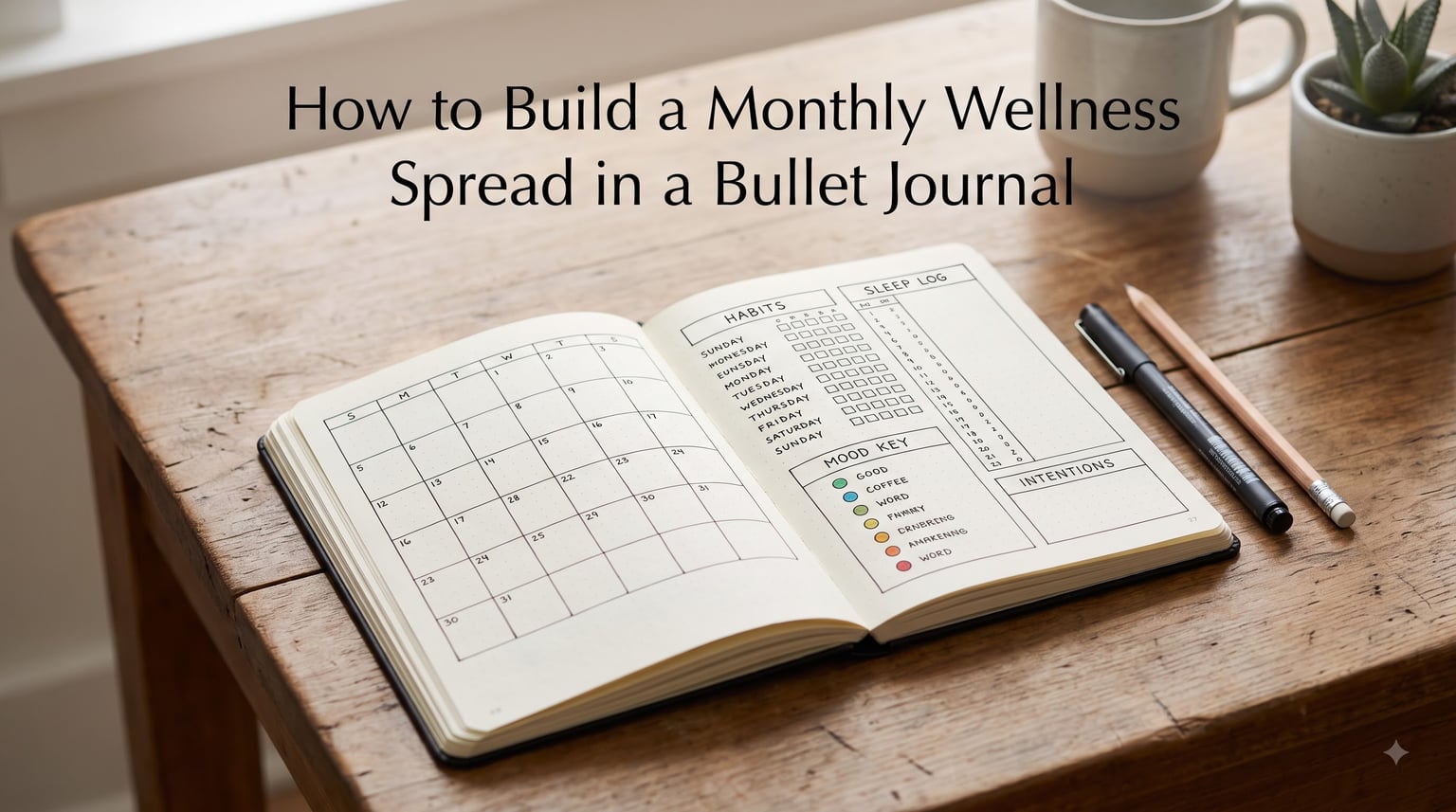
A balanced layout puts your monthly calendar grid on the left page (about two-thirds of the space) and your main trackers on the right page. Reserve a small area at the bottom of each page for notes or weekly reflections.
Step 2: Draw the Monthly Calendar Grid
Use your ruler and pencil to draw a 6-row by 7-column grid on the left page. This gives you 42 boxes, more than enough for any month’s worth of dates.
Write the day numbers in the top-left corner of each box, leaving the rest of the box open for your wellness marks. Once you are happy with placement, trace over your pencil lines with your fineliner.
Step 3: Add Your Wellness Trackers
On the right page, stack your chosen trackers vertically. Each tracker should have its own labeled section with consistent daily entry points.
Leave clear space between sections so you can add notes without crowding. If a tracker is going to use a color key, draw a small legend right below the title.
Step 4: Create Goals and Reflection Section
Add a “Monthly Intentions” box at the top of one page and a “Reflection” box at the bottom.
Intentions are 1 to 3 things you want to focus on this month. Reflection is where you write a quick summary at month end about what worked, what did not, and what you want to adjust. This is the most powerful part of the spread and the most skipped.
Step 5: Personalize and Decorate (Optional)
Add color, washi tape, doodles, or stickers only after the functional layout is complete.
Decoration should serve the spread, not the other way around. If you find yourself spending more than 20 minutes decorating, you have crossed from personalization into performance. Pull back, simplify, and save the artistic energy for next month.
ADHD-Friendly Wellness Journaling Strategies
Bullet journaling can work well for ADHD brains, but only if you design your spread around executive function limits instead of against them.
Here is what I have seen work for clients with ADHD or attention-related challenges.
Use pre-printed templates. Drawing a new grid every month burns working memory. Print or trace the same template each month and the cognitive cost drops dramatically.
Limit your trackers to 3 or fewer. More trackers means more decisions, which means more dropout. Pick the three that matter most this month and add more only after two months of consistency.
Batch your entries. ADHD clients who succeed tend to log data in batches, often morning and evening, rather than throughout the day. Two 3-minute sessions beat one impossible 30-minute goal.
Forgive missed days without abandoning. Missing a day is data, not failure. Skip the guilt spiral and just log the next day. The wellness spread is meant to support you, not judge you.
Avoid comparison. The Pinterest-perfect spreads you see online are made by people with hours of practice and often far less busy lives. Your functional, half-finished, scribbled-in spread is doing more for your wellness than any pristine grid.
8 Dimensions of Self-Care to Track
The Bullet Journal method officially recognizes 8 types of self-care. Mapping these to your monthly spread gives you a balanced view of wellness instead of over-focusing on one area like fitness or sleep.
The 8 dimensions are: physical, psychological, emotional, social, professional, environmental, spiritual, and personal care.
Here is how I suggest integrating them. Pick one quick checkmark per dimension at the bottom of your weekly section. A small weekly pulse across all 8 areas takes seconds but reveals which dimensions are getting neglected.
For example, you might realize your “professional” self-care (taking breaks, setting boundaries at work) is consistently zero while your “physical” tracker is full. That single insight can change how you plan the next month.
You do not need a separate tracker for each. One row of 8 boxes per week is enough to keep all dimensions visible.
Common Mistakes to Avoid with Wellness Spreads
I have made most of these mistakes myself, so I can save you the trouble. Here are the top five I see over and over.
Mistake 1: Tracking too many things. Twelve trackers across 31 days equals burnout. Start with 3 to 5 and grow slowly.
Mistake 2: Spending more time decorating than logging. If your spread takes an hour to set up, you will not want to use it. Function over form, always.
Mistake 3: Treating missed days as failure. Missed days are information about your habits, not a moral judgment. Log what you can and move on.
Mistake 4: Copying spreads that do not fit your goals. That beautiful fitness tracker does nothing for you if your real goal is stress reduction. Build for your life, not for the aesthetic.
Mistake 5: Never reviewing the data. A wellness spread you never reflect on is just a coloring book. Block 15 minutes at month end to look back, notice patterns, and set intentions for next month.
How to Stay Consistent with Your Wellness Tracking
Consistency is the entire game. A perfect spread used three days is worth less than a messy spread used every day. Here is how I help clients build the habit.
Stack it onto an existing habit. The easiest way to remember your spread is to attach it to something you already do. After your morning coffee, before brushing your teeth, right after your evening wind-down. Pair it with a non-negotiable routine anchor.
Do a weekly mini-review. Pick one day each week (Sunday works for most people) to flip back through the week and note patterns. Five minutes is enough. This keeps the data alive in your mind.
Simplify on hard weeks. When life gets intense, drop everything except your single most important tracker. Sleep, mood, water, whatever matters most. The goal is to keep the habit alive, even in stripped-down form.
Celebrate progress, not perfection. Look back at three months of spreads and you will see real movement. That visible progress is the deepest motivator and the reason the monthly wellness spread bullet journal method keeps paying off.
Frequently Asked Questions
What to put in a monthly bullet journal?
A monthly bullet journal should include a calendar grid for dates, a habit tracker for daily routines, a mood tracker for emotional patterns, a sleep log, and a small reflection or intentions section. Keep trackers to 3 to 5 to avoid overwhelm.
What to put in a bullet journal weekly spread?
A bullet journal weekly spread typically includes the week’s tasks, a habit checklist, a meal or movement section, mood or energy ratings per day, and a gratitude prompt. It serves as the detailed daily view that rolls up into your monthly spread.
Is BuJo good for ADHD?
Yes, bullet journaling can work well for ADHD when you keep layouts simple, batch your logging into 2 short sessions, pre-print templates, and limit yourself to 3 or fewer trackers. The key is reducing decision fatigue and forgiving missed days.
How to structure your bullet journal?
Structure your bullet journal with an index at the front, a future log, monthly logs, daily logs, and themed collections. For wellness tracking, add dedicated monthly wellness spreads that combine your calendar grid with health trackers.
What are the best wellness spreads for a bullet journal?
The best wellness spreads include habit trackers, mood trackers, sleep logs, water and exercise trackers, gratitude sections, and weekly reflections across 8 self-care dimensions. Choose trackers that match your personal goals.
Is bullet journaling good for wellness tracking?
Yes, bullet journaling is excellent for wellness tracking because it lets you customize trackers to your specific goals, visualize patterns over a month, and combine data with reflection. It externalizes self-monitoring and turns tracking itself into a mindfulness practice.
Conclusion
A monthly wellness spread bullet journal is one of the simplest, most flexible tools you can build for tracking your health and self-care. The real value comes not from how it looks but from how consistently you use it.
Start small with a calendar grid, two or three trackers, and a reflection box. Run it for one full month before adding anything new. Adjust what does not work and keep what does. By the end of 2026, you will have a real record of your wellness patterns and a system you actually want to use.