
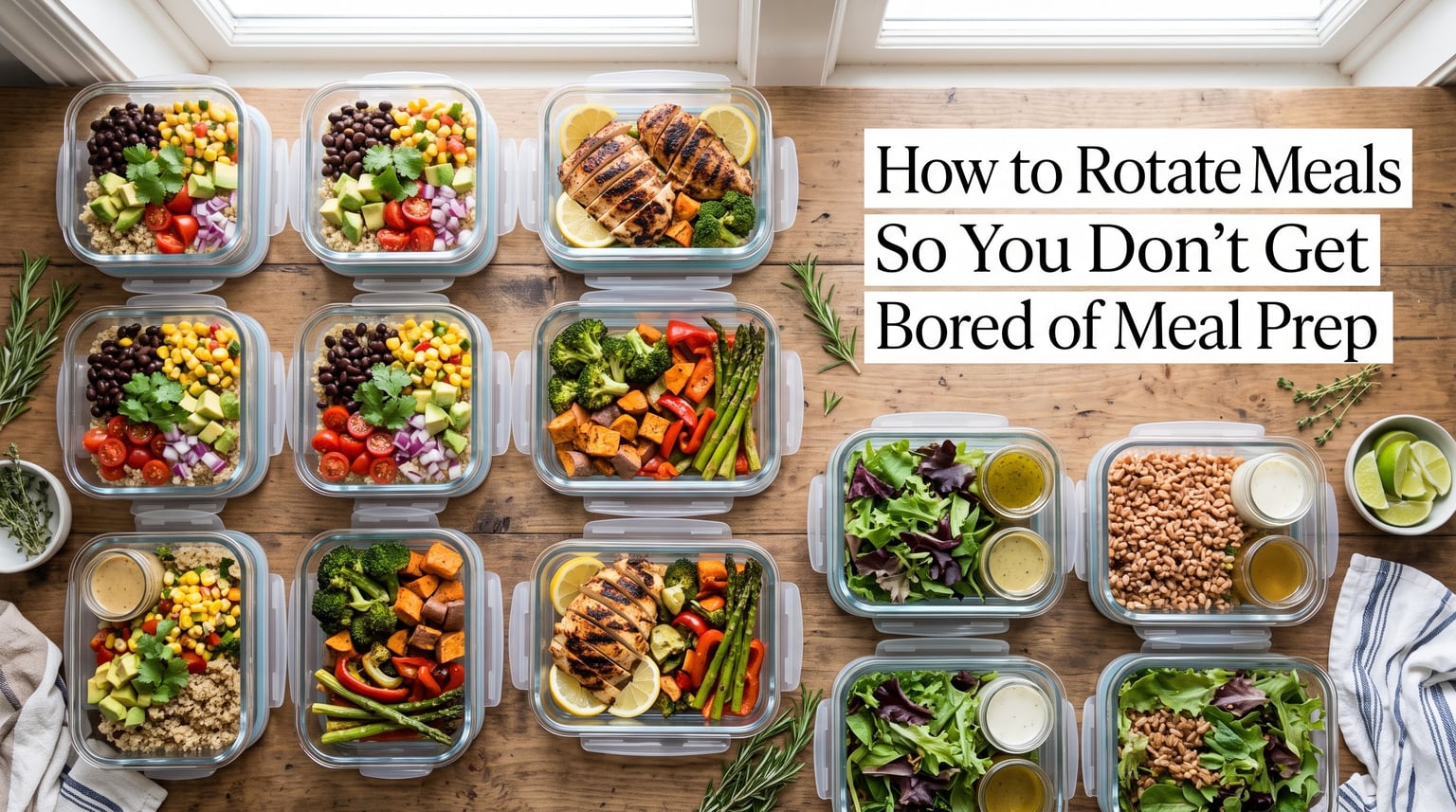
If you have ever opened a fourth identical container of chicken and broccoli by Wednesday and thought, “I cannot eat this again,” you are not lazy and you are not failing. You are experiencing meal prep burnout, and it is the single biggest reason people quit a healthy eating routine. The good news is that boredom is a solvable problem. This guide on how to rotate meals so you don’t get bored of meal prep will give you a real system, not just vague “switch things up” advice.
I started meal prepping to save time and lost the habit twice before realizing my issue was never discipline. It was repetition. Once I built a rotation framework around base components, sauces, and proteins, prepping became a habit I actually looked forward to. Below is the same approach, refined for 2026, with tips drawn from nutrition coaches, freezer-friendly cookbooks, and the meal prep community on Reddit.
Table of Contents
- What Is Meal Prep Burnout and Why Does It Happen
- The 2-3-3 Meal Rotation System Explained
- Simple Switches That Add Big Variety
- Batch Cooking Base Components Instead of Full Meals
- What to Freeze and How to Store for Rotation
- Making Prep Time Something You Actually Enjoy
- Frequently Asked Questions
- A Simple System Beats Motivation Every Time
What Is Meal Prep Burnout and Why Does It Happen
Meal prep burnout is the psychological and sensory fatigue you feel after eating the same prepared meals on repeat, often within just 2 to 3 days. Nutrition coaches also call it palate fatigue, and it is one of the leading reasons otherwise motivated people abandon their meal prep routine by the second week.
Three things drive it. First, our brains are wired to crave novelty, and repeating the exact same flavor profile registers as monotony even when the food is genuinely tasty. Second, meal prep containers often flatten texture, so every bite feels soft and identical. Third, the visual sameness of the same lid, the same color, the same portion shows up as a cue for your brain to disengage from eating.
Recognizing these triggers is important, because variety in meal prep is not about cooking more. It is about changing one or two variables per meal so your brain registers something new. That is the core idea behind every rotation strategy in this guide.
The 2-3-3 Meal Rotation System Explained
If you have ever wondered what the 3-3-3 rule for meal prep is, this is it. The rule simplifies the week by limiting how many dishes you actually cook while still creating enough variety to prevent boredom. Pick 2 breakfast options, 3 lunch options, and 3 dinner options for the week, then rotate through them.
- Pick 2 breakfast recipes. One quick (overnight oats, egg muffins) and one warm (breakfast burrito, savory oatmeal).
- Pick 3 lunch recipes. A grain bowl, a wrap or sandwich, and a soup or salad.
- Pick 3 dinner recipes. A sheet pan protein, a stir fry, and a slow cooker or freezer meal.
- Cook once on Sunday. Use the same cooking block for all three lunch and dinner options.
- Rotate on a 2-3 day cycle. This is the part that prevents palate fatigue.
The genius of this system is that you only plan 8 recipes for the entire week, but you still see 14 to 21 different meal combinations because of how you mix and match sides, sauces, and textures. Decision fatigue drops, and variety goes up.
Simple Switches That Add Big Variety
You do not need new recipes to make meal prep exciting. You need levers to pull. Below are the five switches I use every week to keep my prep interesting without adding cook time.
- Switch the sauce. A chicken breast with teriyaki tastes nothing like one with chimichurri. Make 3 to 4 sauces on prep day and your proteins do the rest of the work all week.
- Swap the protein. Rotate chicken, ground turkey, salmon, tofu, and eggs across the week so you never eat the same animal protein two days in a row.
- Change the grain. Move between brown rice, quinoa, farro, couscous, and sweet potato. Each one changes the entire feel of a bowl.
- Vary the texture. Add something crunchy on top: chopped nuts, seeds, crispy chickpeas, raw vegetables, or crushed pork rinds. Soft meals feel boring fast.
- Change the cooking method. The same chicken can be roasted, air-fried, grilled, or pan-seared on different days. Texture reset is a boredom reset.
If you only adopt one switch, make it sauce. Reddit meal preppers consistently credit bold sauces for being the single highest-impact change to fight food boredom.
Batch Cooking Base Components Instead of Full Meals
Full meal prep, where each container is a finished dish, is the most common path to burnout. Modular meal prep, where you batch ingredients separately and assemble at mealtime, is the cure. Cook your proteins, grains, and vegetables as bare components, then mix and match them at lunch and dinner.
This is why restaurants can serve a small menu and never get boring: the same five ingredients appear in dozens of dishes. Your kitchen can do the same thing. A tray of roasted vegetables can become a burrito bowl on Monday, a salad topping on Tuesday, and a soup starter on Thursday. All from one prep session.
Smart Storage for Modular Prep
Store ingredients separately in clear containers so you can see what you have. Keep grains at the bottom of the fridge, proteins in the middle, and vegetables on top. Sauces go in small 2-ounce containers or silicone cups so they never make anything soggy.
Invest in 3 to 4 sets of identical glass containers. Uniform containers stack neatly, speed up fridge access on busy mornings, and force you to think in terms of rotating stock rather than leftover chaos. Best Weight Loss Planners readers often pair this system with a simple weekly tracker to keep the rotation visible.
What to Freeze and How to Store for Rotation
Freezing is the ultimate rotation tool. A well-stocked freezer lets you pull a totally different meal in 5 minutes without a single extra grocery trip. The Reddit meal prep community consistently says that soups, chilis, casseroles, marinated proteins, and rice-based dishes like fried rice freeze and reheat best.
Freezer-Friendly Foods
- Soups, stews, and chilis in single-serve portions
- Cooked grains portioned into 1 cup servings
- Marinated raw proteins in freezer bags
- Breakfast burritos wrapped in foil
- Sauced pasta, rice bowls, and stir fry bases
Foods That Do Not Freeze Well
- Raw salad vegetables (lettuce, cucumber, radish)
- Hard-boiled eggs (texture turns rubbery)
- Dairy-based sauces (they separate when thawed)
- Crispy coatings (lose their crunch)
Label everything with the dish name and date using a piece of masking tape. Use a “first in, first out” rule: newer prep goes to the back of the freezer, older prep goes to the front. This single habit turns your freezer into a personal meal rotation library.
Making Prep Time Something You Actually Enjoy
Burnout is not just about what you eat. It is also about how you cook. If Sunday prep feels like punishment, no rotation system will save you. Trainers and meal prep veterans consistently recommend small environment changes to keep prep sustainable.
Play a podcast, a playlist, or a show you only watch while cooking. This creates a positive association with the act of prepping itself, so the habit feels rewarding rather than clinical. Invite a partner or a friend to cook alongside you, even if they are just chopping vegetables. Cooking with company turns a chore into a social hour.
Take breaks when needed. Skipping a week to rest is not failure. Going back to meal prep after a pause is far better than quitting entirely. Grace and flexibility are part of the system, not exceptions to it.
Frequently Asked Questions
What is the 3-3-3 rule for meal prep?
The 3-3-3 rule is a rotation system where you pick 3 breakfast options, 3 lunch options, and 3 dinner options for the week, then rotate through them on a 2 to 3 day cycle. It limits cooking to about 9 recipes while still giving you enough variety to avoid meal prep boredom.
How do I avoid food boredom when meal prepping?
Change one or two variables per meal instead of cooking new recipes. Rotate sauces, proteins, grains, textures, and cooking methods across the week. Batch components separately and freeze a few backup meals to pull when palate fatigue hits.
How to make meal prep not boring?
Make the prep itself enjoyable with music or company, store ingredients in separate containers so you can mix them differently each day, freeze 3 to 5 backup meals for emergency variety, and give yourself permission to take a break week without quitting the habit entirely.
How long does meal prep burnout usually last?
Most people hit noticeable meal prep burnout between day 3 and day 5 of eating the same dish. If you rotate sauces, proteins, or grains every 2 days and keep one freezer backup meal available, the fatigue usually fades and the habit becomes sustainable.
A Simple System Beats Motivation Every Time
Boredom is not a willpower problem. It is a design problem, and it is solvable. The complete approach to how to rotate meals so you don’t get bored of meal prep comes down to three habits: use a 2-3-3 or 3-3-3 rotation template, swap at least one variable per meal (start with sauce), and keep 3 to 5 frozen backup meals ready for the moments your brain demands novelty.
Start small this week. Pick two new sauces, swap your usual grain, and label your freezer. That is enough to break the burnout cycle and turn meal prep from something you endure into a system you can actually stick with for 2026 and beyond.