
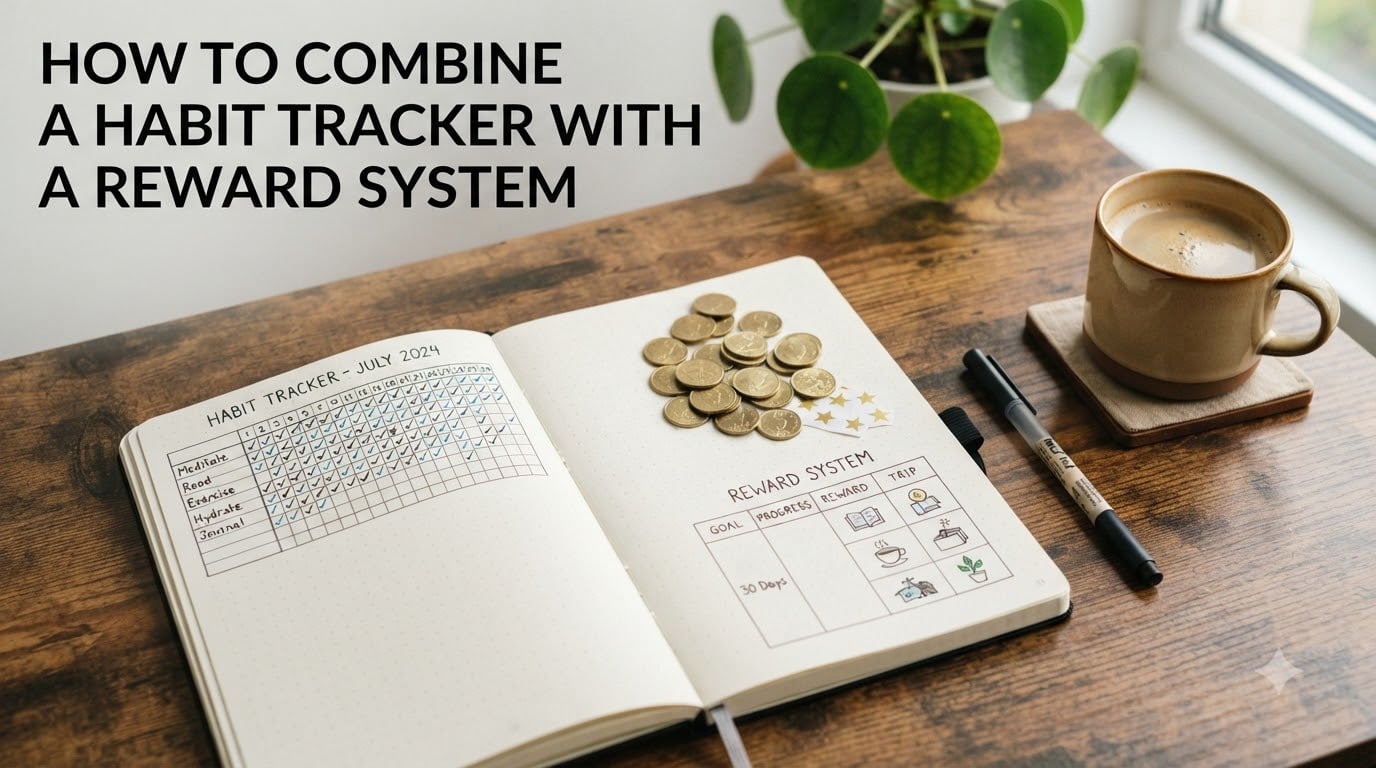
I built my first habit tracker in a cheap notebook. I drew a grid, picked three habits, and started crossing off days with a black pen. By day 12, I had quit. The grid felt lonely, and nothing happened when I did the work.
Six months later, I added a simple point system on the same notebook. Each completed habit earned me coins. After collecting 50 coins, I bought myself a paperback novel. I stuck with it for 90 days straight. The change was not motivation or willpower. It was the reward.
If you are reading this, you probably already understand the basics of habit tracking and want to know how to combine a habit tracker with a reward system in a way that actually works. In this guide, I will walk you through what the combined approach looks like, why it works better than tracking alone, and how to set up your own system step by step.
Table of Contents
- What Is a Habit Tracker With a Reward System?
- Why Combine a Habit Tracker With a Reward System
- How to Combine a Habit Tracker With a Reward System
- Types of Reward Systems for Habit Tracking
- Designing Rewards That Actually Motivate You
- Common Mistakes to Avoid
- Recovering When You Miss Days
- Adjusting Your System Over Time
- Frequently Asked Questions
- Bringing It All Together
What Is a Habit Tracker With a Reward System?
A habit tracker with a reward system is a behavioral setup where you measure each habit you complete and earn points, coins, or progress toward a reward for doing it. The tracker creates visual evidence of consistency. The reward adds immediate motivation. Together, they form a feedback loop that makes the habit stick.
A habit tracker is any tool that records whether you did a habit on a given day. The most common versions are paper calendars with X marks, printable grids, mobile apps like Habitica or Streaks, and bullet journal spreads. According to James Clear’s research on habit formation, the act of marking a completed day creates a visual cue your brain learns to repeat.
A reward system is a structured way to recognize effort. Instead of relying on the vague payoff of a healthier body six months from now, you give yourself something tangible now. Rewards can be virtual coins you redeem for real treats, tier badges that unlock new challenges, or points you bank toward larger prizes.
The combined approach links these two pieces. Every habit completion is recorded AND rewarded. The tracker gives you accountability. The reward gives you dopamine. Neither one alone is as effective for most people.
Why Combine a Habit Tracker With a Reward System
Habit trackers are great at showing long-term progress. They are terrible at giving you anything today. Reward systems are great at making today feel good. They are terrible at showing whether you actually did the work.
When you combine the two, you fix both problems at once. The tracker records the data. The reward gives you something to look forward to after each completed day. This is especially powerful for people who respond well to immediate feedback, including anyone with ADHD.
From behavioral psychology, the habit loop has three parts: cue, routine, reward. Most habit trackers only address the cue and routine. The reward stays vague. Adding an explicit reward system closes the loop and trains your brain to associate the habit with something good.
There is also a more practical reason. When you slip up on day 7 of a 30-day streak, you lose everything. That kind of all-or-nothing design punishes real life. A combined system with cumulative points lets you keep what you earned even when one day falls apart. You simply do not redeem that day’s points.
How to Combine a Habit Tracker With a Reward System
Setting up the combined system takes about 30 minutes once you know what you want. Here is the exact sequence I use with my clients.
Step 1: Pick Three Habits and Start Small
Choose no more than three habits to start. Pick ones that take less than five minutes each. The goal of step one is to build the system, not to overhaul your life. Common starting habits include drinking a glass of water first thing in the morning, doing ten bodyweight squats, writing three sentences in a journal, or taking a five-minute walk after lunch.
Step 2: Choose Your Tracking Method
Decide between paper and digital tracking. Paper works well if you enjoy writing things down and want a tactile experience. A simple bullet journal grid or printable habit tracker is enough. Digital works well if you want automatic statistics, reminders, and built-in reward systems. Apps like Habitica, Habitify, and Streaks all support reward features out of the box.
Pick the one you will actually use. The most powerful tracker is the one that fits your routine, not the one with the most features.
Step 3: Assign Point Values to Each Habit
Open your tracker and add a points column. Decide how many points each habit is worth. I recommend a simple scale: small habits earn 5 points, medium habits earn 10 points, and harder habits earn 20 points. For example, drinking water earns 5. Doing a 20-minute workout earns 20.
You can also create difficulty multipliers. Stretching earns 5 points on a regular day but 10 points on a day you really did not feel like it. This kind of multiplier makes the system more reflective of actual effort.
Step 4: Build Your Reward Menu
Make a list of rewards you genuinely want, and put a point cost on each one. Keep rewards varied across categories so you have options at different point levels. We will cover reward categories in detail later in this guide.
Step 5: Connect Tracking to Reward Redemption
Write down the rule for redeeming points. A common rule is one reward per week based on the total points you collected. Another rule is to redeem immediately whenever you hit a specific threshold. Pick the rule that fits your personality and write it on the same page as your tracker.
Step 6: Set a Weekly Review Time
Block 10 minutes every Sunday to add up points, redeem a reward if you earned one, and adjust the system if needed. The weekly review is what turns the system from a fun experiment into a long-term habit itself.
Types of Reward Systems for Habit Tracking
Not all reward systems work the same way. Here are the three most common designs and the trade-offs of each.
Point-Based Systems
You earn points for every habit completion. Once you reach a threshold, you redeem points for a reward. This is the most flexible option because every habit has a defined value and every reward has a defined cost. It is also the easiest to scale when you add new habits.
Tier and Level Systems
You move up levels or unlock badges as you complete more habits. Habitica uses this model with a role-playing game structure. Tiers work well if you enjoy gamification and visual progression, but they can feel vague if you cannot pinpoint what each tier unlocks.
Cumulative vs Streak-Based Rewards
This is the most important design choice, and it is the one Reddit users complain about most. Streak-based systems punish you for missing a single day. If your streak resets on day 27, you get nothing for those 27 days. Cumulative systems keep your points forever, so missing one day only means you lose the points for that one day.
For most adults, cumulative rewards work better. They match how life actually goes. You will miss days. The system should acknowledge what you did accomplish rather than erasing it.
One clever workaround I saw on the r/productivity subreddit was a shield system. You earn shields for consistency and spend them when life happens. A shield protects your streak from a missed day. After you run out of shields, you start fresh.
Designing Rewards That Actually Motivate You
The biggest mistake people make is choosing rewards that sound good in theory but feel hollow in practice. A reward has to be something you actually want right now, not something you think you should want.
Reward Categories for Adults
Most effective reward menus cover four categories. Self-care rewards include a face mask, a long bath, an early bedtime, or a yoga session. Entertainment rewards include a movie night, a new album, an hour of guilt-free gaming, or a bookstore trip. Experience rewards include a coffee shop visit, a museum trip, a hike, or dinner with friends. Purchase rewards include a small item you have been eyeing, a snack from your favorite store, or a subscription upgrade.
Sample Reward Menu With Point Values
Here is a sample menu to show how point costs should scale with effort. 25 points gets you an episode of your favorite show. 50 points gets you a coffee shop visit. 100 points gets you a paperback book. 200 points gets you a new video game. 500 points gets you a weekend day trip.
Notice how rewards are tied to time as much as money. Some of the best rewards cost nothing but protect your energy.
Rules for Effective Self-Rewards
Keep rewards visible. Write your menu on the same page as your tracker. Avoid food rewards that conflict with health goals. Make sure the smallest reward is achievable within a week, so you experience the system working early. Refresh your menu monthly so the rewards do not get stale.
Common Mistakes to Avoid
Most people abandon combined systems within the first month. Here are the patterns I see most often.
Starting with too many habits. Three is plenty. If you track 10 habits from day one, you will burn out by week two. Start with three, master them for 30 days, then add more.
Using rewards that undermine your goal. If you are trying to lose weight, do not use dessert as your reward. Pick rewards that support the life you want rather than pull you away from it.
Treating streaks as the only measure. Streaks are motivating until you miss one day. Then they become demoralizing. Build your system around cumulative points first, streaks second.
Setting reward thresholds too high. If you need 1000 points before you get anything, you will quit. Make sure the first reward is reachable within the first week so the system feels real.
Refusing to adjust. Your first menu will not be perfect. That is fine. Adjust point values, swap out rewards, change thresholds. The system should evolve with you.
Recovering When You Miss Days
Missing days is not failure. Missing days is part of the process. James Clear’s never-miss-twice rule is the simplest way to think about it. Missing once is human. Missing twice in a row is a pattern you need to address.
When you miss a day in your combined system, do not reset. Look at your points. You probably still have a balance. Decide whether you want to redeem a smaller reward or push toward your next goal. Either way, you have not lost everything.
If you missed two days in a row, ask why. Was the habit too hard? Was the time wrong? Was the reward not motivating enough? Adjust one variable and try again. The system is a tool, not a test.
Adjusting Your System Over Time
After 30 days of consistent use, your habits will start to feel easier. That is when you can raise point thresholds, swap in bigger rewards, or drop the reward entirely for habits that have become automatic. Many people keep a small reward for a year or longer simply because they enjoy the ritual.
Every quarter, review which habits still feel rewarding and which have become chores. Move stale habits to maintenance mode with lower point values, and bring new challenges into the active rotation. The system should grow with you.
Frequently Asked Questions
What is the 3-3-3 rule for habits?
The 3-3-3 rule is a simple way to start building new habits. You pick 3 habits, do each one for 3 minutes, and do them 3 times per day. It lowers the barrier to entry so you can build the habit of showing up before worrying about intensity. Once consistency is locked in, you can extend the duration and frequency.
How can I create a reward system for myself?
Start by listing 8 to 12 rewards you genuinely want across categories like self-care, entertainment, experiences, and small purchases. Assign a point cost to each reward based on how much you want it. Then decide how you earn points, whether by completing habits, hitting milestones, or finishing projects. Pick the smallest reward first so you can experience the system working within a week.
How do I use a habit tracker?
Open your tracker each day and mark off every habit you completed. Be honest. The point of the tracker is to capture real data, not to feel good about lies. At the end of the week, review your marks, calculate your points if you have a reward system attached, and adjust any habits that are not sticking.
Is it okay to miss a day on a habit tracker?
Yes. Missing one day is normal and expected. The goal of habit tracking is to capture what actually happened, including gaps. In a combined reward system, missing one day usually only costs you the points for that day. The cumulative progress you already earned stays intact.
Should rewards be daily or cumulative?
Cumulative rewards work better for most adults. Daily rewards can feel arbitrary and they do not teach patience. Cumulative rewards let you save up for something meaningful while still allowing small, frequent redemptions. A good system offers both, with low-cost rewards redeemable any week and higher-cost rewards requiring a full month of points.
What is the habit loop?
The habit loop is the three-part cycle every habit follows: cue, routine, reward. The cue triggers the behavior, the routine is the behavior itself, and the reward trains your brain to repeat the cycle. A habit tracker combined with a reward system strengthens the reward portion of the loop, which makes the habit more likely to stick.
Bringing It All Together
Learning how to combine a habit tracker with a reward system is really about closing the habit loop. The tracker handles the data. The reward handles the motivation. When you wire them together with clear point values and a visible reward menu, you give yourself a setup that works with how your brain is wired.
Start with three habits, pick a tracker you enjoy, assign 5 to 20 points per habit, and write down a reward menu this week. Run the system for 30 days. Adjust what does not work. By day 31, you will have a tool that turns behavior change from a chore into something you look forward to.