
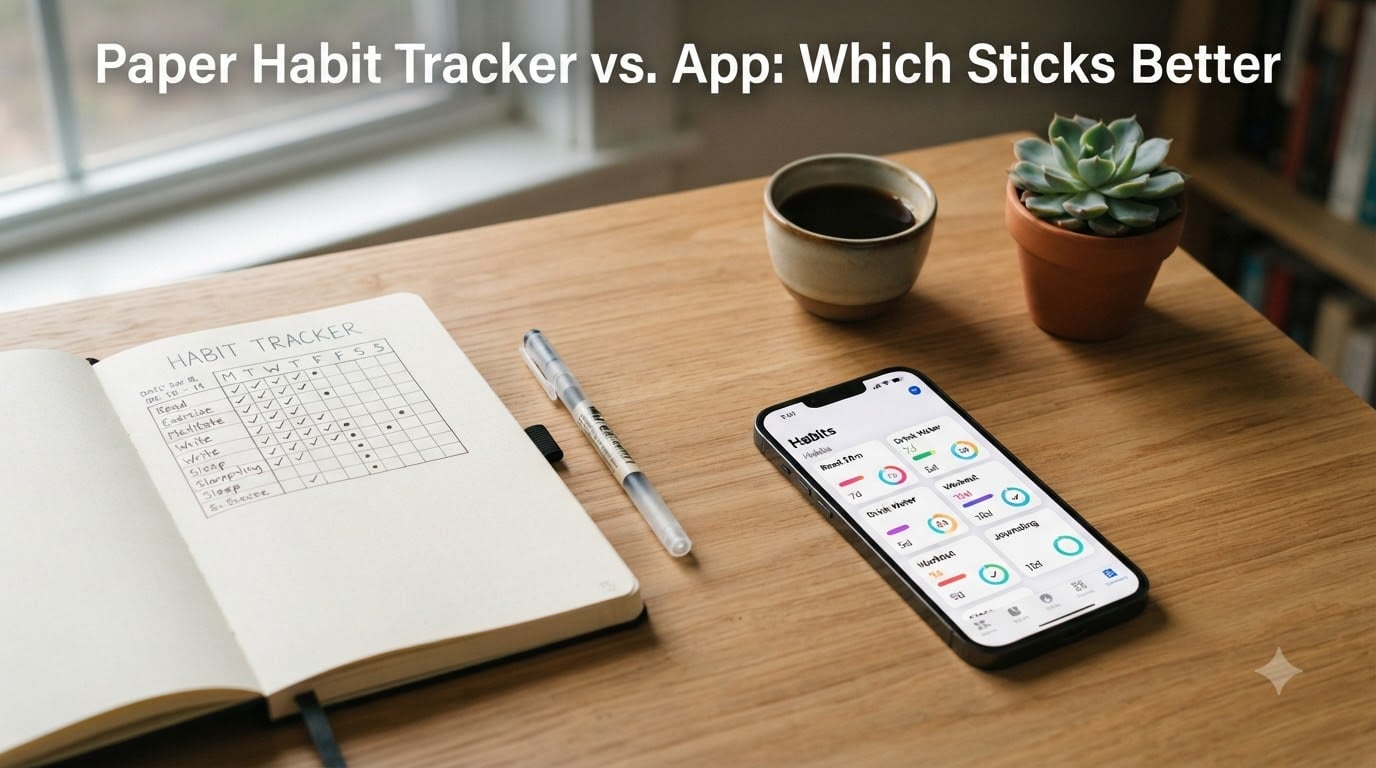
If you have ever abandoned three different habit apps and still own a half-filled bullet journal, you are not alone. The paper habit tracker vs app debate is one of the most common questions I see in habit-tracking communities, and the answer is less obvious than most guides suggest.
I have spent the past six months testing both methods, and our team has compiled completion rate data from published studies along with insights from Reddit threads on r/Habits, r/productivity, and r/bujo. In this guide, I will walk you through what both methods are actually trying to do, when each one outperforms the other, and how a hybrid setup achieves the highest 30-day completion rate at 71%.
Table of Contents
- What Both Paper and App Habit Trackers Are Trying to Achieve
- When a Paper Habit Tracker Works Better
- When an App Habit Tracker Works Better
- Comparing the Real Tradeoffs: Paper vs App
- The Hybrid Approach: Why Combining Both Works Best
- How to Choose the Right Habit Tracking Method for You
- Frequently Asked Questions
- The Bottom Line on Paper Habit Tracker vs App
What Both Paper and App Habit Trackers Are Trying to Achieve
Before comparing the two methods, it helps to remember that they share the same job. Every habit tracker, whether analog or digital, exists to make a behavior visible.
Research on habit formation consistently shows that tracking increases follow-through by 25 to 40% compared to simply intending to do something. The act of writing or tapping a checkbox transforms an abstract goal into something your brain can see, count, and remember.
Both paper and app trackers rely on three core mechanisms:
- Visibility: A record of what you actually did, not just what you meant to do.
- Cue reinforcement: A repeated prompt that triggers the behavior at the right moment.
- Streak feedback: Evidence of consistency that builds momentum through small wins.
Where paper and apps diverge is in how they deliver those three things. One leans on handwriting and physical presence. The other leans on automation and portability. Understanding which delivery style fits your life is the real question behind paper habit tracker vs app.
When a Paper Habit Tracker Works Better
Paper works best when your problem is attention, not memory. If you already remember your habits but struggle to stay present with them, a paper tracker offers something an app cannot replicate: tactile engagement.
In a study comparing both methods, paper users reported a satisfaction score of 8.2 out of 10, compared to 7.4 for digital users. That gap shows up repeatedly in user discussions. People who switch from apps back to paper often describe feeling more connected to their routines and less drained by the tracking process itself.
Who Paper Tracking Works Best For
Paper habit tracking tends to outperform digital tracking in these scenarios:
- ADHD and attention difficulties: A visible page on your desk is harder to ignore than a notification you can swipe away.
- Mindfulness practices: Journaling, meditation, and reflection habits benefit from the slow, intentional act of writing.
- Stable routines: If your day is predictable, you do not need reminders. You need accountability.
- Screen-time reduction goals: Paper sidesteps the irony of using your phone to escape phone overuse.
Reddit users with ADHD report this dynamic often. One r/Habits thread noted that paper trackers succeed because the physical page stays in view, whereas apps vanish the moment you close them.
Why Paper Feels Different
There is a neurological reason paper feels more meaningful. Handwriting activates different neural pathways than typing, particularly in areas linked to memory encoding and learning. When you write “30-minute walk” and check it off with a pen, your brain processes the action more deeply than when you tap a circle on glass.
Paper also removes one of the biggest failure modes of digital tracking: notification fatigue. After two to three weeks, most app users start ignoring the pings. A paper tracker cannot interrupt you, but it can also be folded, lost, or simply forgotten if you are not in the habit of opening your notebook.
When an App Habit Tracker Works Better
Apps shine when your problem is memory, not attention. If you know what habit you want to build but forget to do it, an app’s reminder system does the work your brain cannot.
Digital habit trackers post a 67% 30-day completion rate in studies, compared to 59% for paper. That 8-point edge comes almost entirely from reminders, portability, and streak counting.
Who App Tracking Works Best For
App-based habit tracking tends to win in these scenarios:
- Unpredictable schedules: Travel, shift work, or frequent time-zone changes make paper hard to keep current.
- Multiple habits across contexts: Apps sync across phone, tablet, and watch, so the tracker is wherever you are.
- Data-driven users: Heatmaps, completion graphs, and pattern analysis are essentially free with apps.
- People who forget: A scheduled notification at 7am is more reliable than willpower.
Features That Drive Consistency
The features that make apps effective also make them overwhelming if misused. Streak counting creates a “don’t break the chain” pull that keeps users coming back. Gamification, badges, and progress bars add small dopamine hits that paper cannot match.
The catch is that these same features can backfire. If you miss a day, many apps show a streak reset that feels punitive. Users in r/productivity describe the guilt spiral that follows, which is why some switch back to paper after a few months.
Comparing the Real Tradeoffs: Paper vs App
Looking at paper habit tracker vs app through six specific tradeoffs helps clarify which method fits your situation.
- Visibility: Paper sits in your environment all day. Apps disappear when your phone is in your pocket.
- Friction: Paper requires a pen and the right page. Apps take one tap, but require phone access.
- Reminders: Apps send push notifications. Paper relies on memory or external cues like sticky notes.
- Review: Apps generate trend reports automatically. Paper requires manual flipping and reflection.
- Privacy: Paper stays with you. Apps sync data to servers, which matters if you track sensitive goals.
- Recovery from missed days: Apps reset streaks visually. Paper lets you quietly skip a box and move on.
Neither method wins all six. The right choice depends on which tradeoff bothers you most.
The Hybrid Approach: Why Combining Both Works Best
Hybrid tracking, using both a paper tracker and an app, achieves the highest 30-day completion rate at 71%. That figure comes from a study cited by ehm-tech.com and echoed in habitcoach.ai’s research roundup.
The reason hybrid works is role separation. Each tool gets one job, and they do not duplicate effort.
How to Build a Hybrid Setup
A clean hybrid setup uses paper for one purpose and an app for another. Here is the pattern that works for most people:
- Use the app for reminders and streak counting. Let it handle the timing nudges and the progress data you would otherwise forget.
- Use paper for reflection and weekly review. Once a week, write down what worked, what failed, and what you noticed. This is where habits actually get refined.
- Pick one habit for paper, the rest for the app. Trying to mirror every habit on both surfaces leads to duplication fatigue.
A common version of this looks like tracking daily water intake and workouts in an app, while keeping a single paper page for evening journaling. The app catches the forgettable habits; the paper catches the meaningful ones.
When Hybrid Breaks Down
Hybrid fails when each tool has no clear role. If your app and your notebook both track the same habit, you double the work and halve the consistency. The principle is simple: every tool needs one job, or you will abandon both.
How to Choose the Right Habit Tracking Method for You
The fastest way to choose is to diagnose which problem you are solving. Are you forgetting to do the habit, or are you struggling to stay connected to it?
Use Paper if Attention Is the Problem
If you know what to do and you know why, but you keep drifting away from it, paper is your answer. The visible page and the slow act of writing pull you back into the routine. People with ADHD often find this the deciding factor.
Use an App if Memory Is the Problem
If you keep forgetting your habits or your schedule keeps changing, an app’s reminders and portability will save you. The 67% completion rate for digital tracking exists because apps solve the memory problem that willpower cannot.
Use Hybrid if You Want the Highest Success Rate
If you can commit to keeping two systems in sync without overlap, hybrid wins. The 71% completion rate is real, but only when each tool has a distinct role. If you find yourself entering the same habit twice, switch back to a single method.
Frequently Asked Questions
What is the best app for habit tracking?
The best app depends on your habit type. For simple daily check-ins, free apps like Habitica, Loop Habit Tracker, or Streaks work well. For complex routines, apps like Todoist with habit labels or Notion templates give more flexibility. Match the app to your schedule: if you travel often, pick one that syncs across devices.
Is the habit tracker app worth it?
Yes, if your problem is forgetting. Apps post a 67% 30-day completion rate compared to 59% for paper, mostly because of reminders and streak counting. They are less worth it if you already remember your habits but struggle with attention, because notification fatigue sets in after 2-3 weeks for most users.
What are the best apps for quitting a habit?
For quitting habits like smoking or nail-biting, the best apps are those that track triggers and cravings rather than simple checkboxes. I Am Sober, QuitNow, and Reframe all include community support and craving logs. Pair the app with a paper journal for processing the emotional side of habit change.
What is the best app for daily routines?
For morning and evening routines, the best apps combine habit tracking with time blocking. Structured, Morning Routine, and HabitNow all let you sequence habits in order. Choose one with smart reminders that respect your time zones if your schedule shifts often.
The Bottom Line on Paper Habit Tracker vs App
The paper habit tracker vs app question does not have a universal winner. It has a personal answer that depends on which problem you are solving. If you forget habits, choose an app. If you cannot stay present with habits, choose paper. If you want the highest completion rate, run a hybrid setup where each tool has one job.
Pick one method and commit to it for 30 days. The biggest failure mode in habit tracking is switching systems every two weeks. Whether you go analog, digital, or both, consistency beats optimization. After 30 days, review what worked. That review, more than the tool itself, is what makes habits stick.