
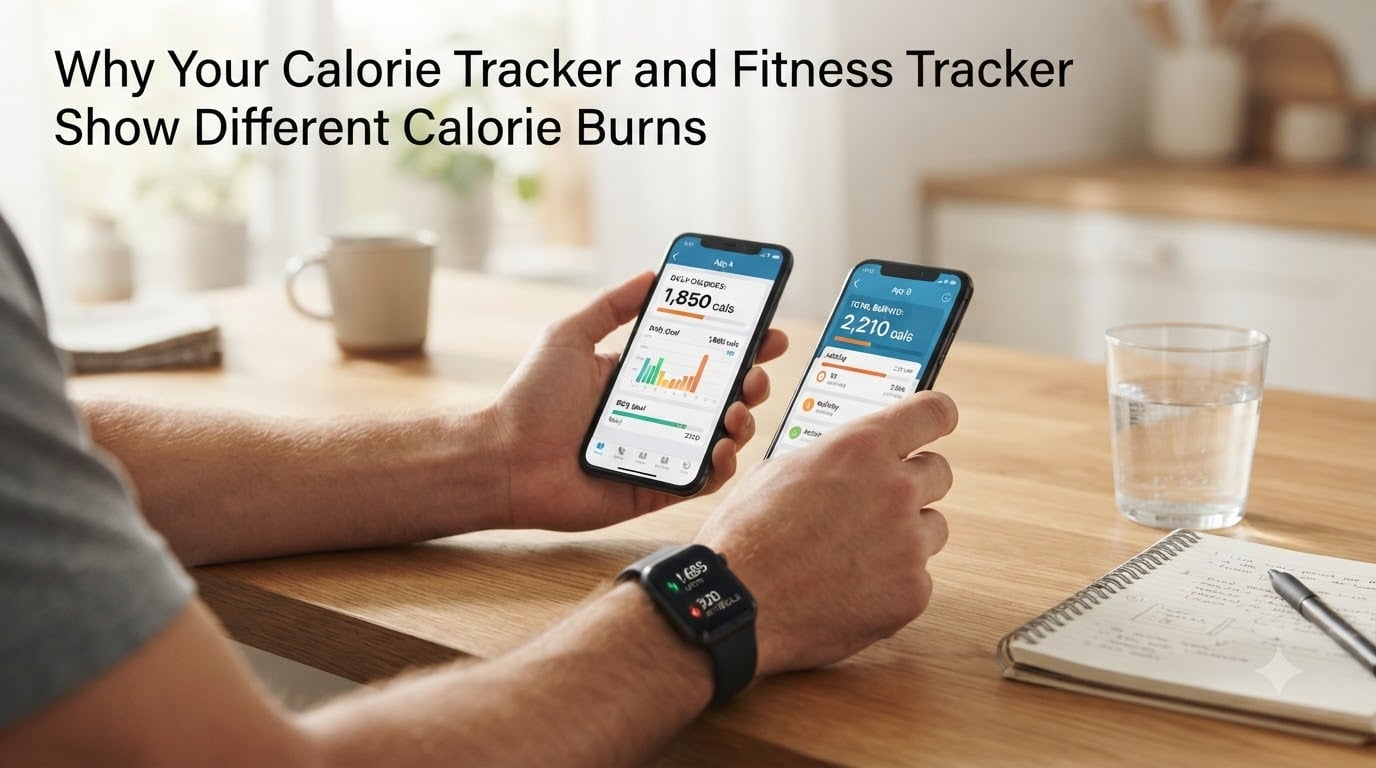
If you’ve ever compared your fitness watch to your calorie counting app and wondered why the numbers don’t match, you’re not alone. The gap between what your Fitbit says and what MyFitnessPal logs is one of the most common frustrations in weight loss tracking. Research published in 2017 found that fitness trackers can be off by 27% to 93% when estimating calorie burn, meaning the same walk could show up as 200 calories on one device and 400 on another.
I dug into the science, talked to the research, and pulled apart how these tools actually work. In this guide, I’ll explain why your calorie tracker and fitness tracker show different calorie burns, what’s really going on under the hood, and what you should track instead if your goal is real, lasting progress.
Table of Contents
- Why Calorie Trackers and Fitness Trackers Show Different Numbers
- How Fitness Trackers Calculate Calories Burned
- How Calorie Counting Apps Calculate Calories
- Key Factors That Cause Calorie Burn Discrepancies
- What Research Says About Fitness Tracker Accuracy
- The Constrained Energy Expenditure Problem
- What You Should Track Instead of Calorie Counts
- Practical Tips for Weight Loss Without Precise Tracking
- Frequently Asked Questions
- Final Thoughts
Why Calorie Trackers and Fitness Trackers Show Different Numbers
The short answer: they measure completely different things. Your calorie counting app (like MyFitnessPal or Lose It) tracks what you eat based on a food database. Your fitness tracker (like a Fitbit, Apple Watch, or Garmin) estimates what you burn based on movement and heart rate data. These two numbers are supposed to meet in the middle to create a calorie deficit, but neither input is precise.
Fitness trackers don’t actually measure calorie burn. They estimate it using algorithms built on population averages, not your personal metabolism. A 2017 Stanford study tested seven popular fitness trackers and found that none of them provided reliable calorie estimates, with error rates ranging from 27% to 93%. Devices consistently overestimated calorie burn during exercise and underestimated it during rest.
When you log a 30-minute run as “300 calories burned” in your food app and your watch says “450 calories burned,” you’re not seeing a contradiction. You’re seeing two different estimation systems that were never designed to agree with each other.
How Fitness Trackers Calculate Calories Burned
Fitness trackers use a multi-step process to estimate your calorie burn. First, the device estimates your Basal Metabolic Rate (BMR), the calories you’d burn lying in bed all day. Most devices use formulas like the Harris-Benedict equation, which factors in your age, sex, height, and weight to predict your resting metabolism.
Then the tracker adds activity calories on top of that BMR baseline. It does this by combining data from two main sensors: an accelerometer that detects movement and an optical heart rate sensor (PPG) that measures your pulse using light against your skin. The device takes these inputs and runs them through a proprietary algorithm to estimate energy expenditure.
MET values (Metabolic Equivalent of Task) play a key role here. A MET is a rough measure of how many calories an activity burns compared to resting. Running might be a MET value of 9, while walking is around 4. The tracker applies these standardized values to your movement data, but the catch is that MET values are based on averages, not your specific body. Two people running at the same pace can burn very different amounts of energy depending on their fitness level, muscle mass, and running economy.
How Calorie Counting Apps Calculate Calories
Calorie counting apps work from a completely different angle. They don’t measure your body at all. They track what you eat by matching your food entries to a database of nutritional information. When you log a banana, the app pulls up the average calorie count for a medium banana and adds it to your daily total.
Apps like MyFitnessPal use the Mifflin-St Jeor equation to estimate your Total Daily Energy Expenditure (TDEE), then let you log exercise manually. The exercise calories you enter come from generic activity lists, not from your actual physiology. So even within a single app, the “calories in” and “calories out” numbers are based on entirely different databases and assumptions.
This is why you can see wildly different estimates for the same workout. Your watch might say 400 calories burned based on your heart rate, while the app’s exercise database says 250 for “30 minutes of running.” Neither is wrong. They’re just answering different questions with different tools.
Key Factors That Cause Calorie Burn Discrepancies
Several biological and technical factors make consistent calorie estimation nearly impossible for current wearable technology.
Individual Metabolic Variation
Your metabolism is uniquely yours. Two people with identical stats can have BMRs that differ by 300 calories or more due to muscle mass, genetics, hormone levels, and gut microbiome. Since trackers use population averages, they can’t account for your personal baseline. Users in fitness forums regularly report RMR estimates ranging from 1,600 to 2,100 calories for the same body type, which is a huge gap when you’re trying to hit a calorie deficit.
Heart Rate Limitations
Heart rate seems like it should be a reliable indicator, but it has major limitations. Your heart rate can spike from stress, caffeine, illness, or dehydration, none of which mean you’re burning more calories. Optical heart rate sensors also struggle with accuracy during high-intensity interval training, weight lifting, and activities involving wrist flexion (like cycling or push-ups). Skin tone, tattoo ink, and even watch position can affect the readings.
Metabolic Adaptation
Your body is smarter than any algorithm. As you exercise more, your body adapts by becoming more efficient at the same movements. This is called metabolic adaptation or adaptive thermogenesis. A runner who burns 400 calories on a 5-mile run today might burn 380 next month because their body has improved its running economy. Your tracker doesn’t know this is happening, so it keeps applying the same MET values, leading to overestimation over time.
Exercise Economy
Exercise economy refers to how efficiently your body uses oxygen during a given activity. Fitter people have better exercise economy, meaning they burn fewer calories for the same work. Your tracker assumes the same calorie cost for everyone doing the same activity, which is one reason why fitter users often see their trackers overestimate their burn.
Thermic Effect of Food
Newer research is shedding light on the thermic effect of food, the energy your body uses to digest what you eat. Protein, for example, requires significantly more energy to process than fats or carbs. Some advanced trackers are beginning to factor this in, but most still don’t, which can throw off daily totals by 100-200 calories.
What Research Says About Fitness Tracker Accuracy
The Stanford study from 2017 remains the gold standard for fitness tracker accuracy research. Scientists measured energy expenditure using a clinical-grade metabolic cart and compared it to readings from seven popular wrist-worn trackers. The results were sobering: across all devices, the average error rate was around 27% for activities like walking and running, but jumped as high as 93% for lower-intensity activities like cleaning or light cycling.
Brand-specific patterns have emerged from later studies. Apple Watch tends to overestimate calorie burn during workouts, sometimes by 20-30%. Garmin devices generally perform better, particularly for cycling and running, but can underestimate calories during strength training. Fitbit sits somewhere in the middle but has been criticized for inconsistent heart rate readings during interval training. Polar chest straps remain the most accurate heart rate option, though they’re less convenient than wrist-based sensors.
Harvard SEAS researchers took a different approach, developing OpenMetabolics, a system that uses machine learning and leg motion data (from a phone in your pocket) to estimate calorie burn. Their 2026 study showed this method achieved roughly double the accuracy of commercial smartwatches, though it’s not yet built into consumer devices.
The Constrained Energy Expenditure Problem
One of the most important findings in recent exercise science is the constrained energy expenditure model. Research published in 2021 and expanded since suggests that your body has a built-in limit on how many calories it will burn per day, even during intense exercise.
The idea is that your body compensates for extra activity by reducing energy spent on other processes, like digestion, immune function, or even fidgeting. This means a hard workout might only add 100-200 calories to your daily total, not the 400-500 your tracker shows. Over time, this compensation gets stronger, which is partly why some people hit weight loss plateaus despite increasing their workout intensity.
This doesn’t mean exercise is useless for weight loss. It means the calorie numbers on your tracker are upper estimates, not guaranteed totals. Your real burn could be much lower than what’s displayed.
What You Should Track Instead of Calorie Counts
If you can’t trust the calorie numbers, what should you actually track? Based on user feedback from fitness communities and what the research supports, here are five metrics that give you more useful information than any calorie estimate.
1. Your Weight Trend (Weekly Averages)
Daily weight fluctuates wildly due to water, sodium, and digestion. But your weekly average tells you the real story. Weigh yourself daily, same time, same conditions, and calculate the weekly average. If it’s trending down over 2-3 weeks, you’re losing fat. If it’s flat or trending up, you need to adjust your intake. This is the most reliable progress metric available, and it’s free.
2. Body Measurements
Track your waist, hips, chest, and thighs monthly. Inches lost are real progress, even when the scale doesn’t move. Many users in weight loss forums report that switching to measurements broke through plateaus that calorie counting couldn’t explain.
3. Performance Metrics
Are you getting faster, lifting heavier, or lasting longer in your workouts? Performance improvements are a clear sign of progress and they don’t require any calorie math. If your mile time is dropping or your squat weight is climbing, you’re building fitness regardless of what your tracker says about calories.
4. Energy Levels and Hunger
How do you feel throughout the day? Are you hitting the afternoon wall, or are you steady? Are you constantly hungry or satisfied? These subjective markers often tell you more about whether your nutrition is on track than any calorie number can.
5. Photos and How Clothes Fit
Visual progress is real progress. Take progress photos in the same lighting and pose every 2-4 weeks. Notice how your clothes fit. These qualitative measures often catch changes that the scale and the tracker both miss.
Practical Tips for Weight Loss Without Precise Tracking
If you want to lose weight without obsessing over every calorie, here’s what actually works. Focus on protein intake first, aiming for 0.7-1 gram per pound of body weight. Protein is the most satiating macronutrient and helps preserve muscle during weight loss. Fill the rest of your plate with vegetables and whole foods. Use your tracker for directional feedback, not exact numbers. If it says you burned 400 calories, assume the real number is somewhere between 200 and 400.
Treat your calorie burn as unknowable, a useful assumption rather than a fact. Use the same tracker consistently so you learn its biases. Track trends over weeks, not days. And remember that weight loss is primarily driven by what you eat, not what you burn. Even the most accurate calorie tracker can’t fix a nutrition gap.
Frequently Asked Questions
Are fitness trackers accurate for calories burned?
Fitness trackers are not highly accurate for calorie burn. A 2017 Stanford study found error rates ranging from 27% to 93%, depending on the activity. Trackers are best used for tracking trends over time, not for precise calorie counts. They consistently overestimate calorie burn during exercise and underestimate it during rest.
What happens if I eat 1000 calories and burn 1000 calories?
If you eat 1000 calories and burn 1000 calories, you would theoretically be at maintenance. However, because fitness trackers and calorie apps both have significant error margins, the real numbers could be off by 200-400 calories in either direction. This is why tracking weight trends over weeks is more reliable than daily calorie math.
Is burning 230 calories in 30 minutes good?
Burning 230 calories in 30 minutes is a reasonable estimate for moderate exercise like jogging or cycling for many people. However, the actual number depends on your weight, fitness level, and exercise intensity. Since fitness trackers can be off by 27-93%, the real burn could be anywhere from about 115 to 345 calories.
Why does my Apple Watch say I only burn 300 calories a day?
If your Apple Watch shows only 300 calories burned during activity, it likely means your BMR (resting calorie burn) is being counted separately. Total daily burn typically includes BMR (1,200-1,800 calories for most people) plus activity calories. If your activity calories are consistently low, your watch may be underestimating movement or your workouts may be lower-intensity than you think.
Final Thoughts
Your calorie tracker and fitness tracker show different calorie burns because they’re built on different data, different assumptions, and different measurement methods. Neither one is giving you the truth. They’re both giving you estimates that can be off by hundreds of calories per day. The 27-93% error range from the Stanford study isn’t a bug; it’s a fundamental limitation of estimating metabolism from outside the body.
Stop chasing precise calorie numbers. Start tracking what you can actually measure: weekly weight trends, body measurements, workout performance, and how you feel. These are real, observable signals that don’t depend on flawed algorithms. Your scale doesn’t lie about whether your weekly average is going down, and that’s the only number that matters for weight loss in 2026.