
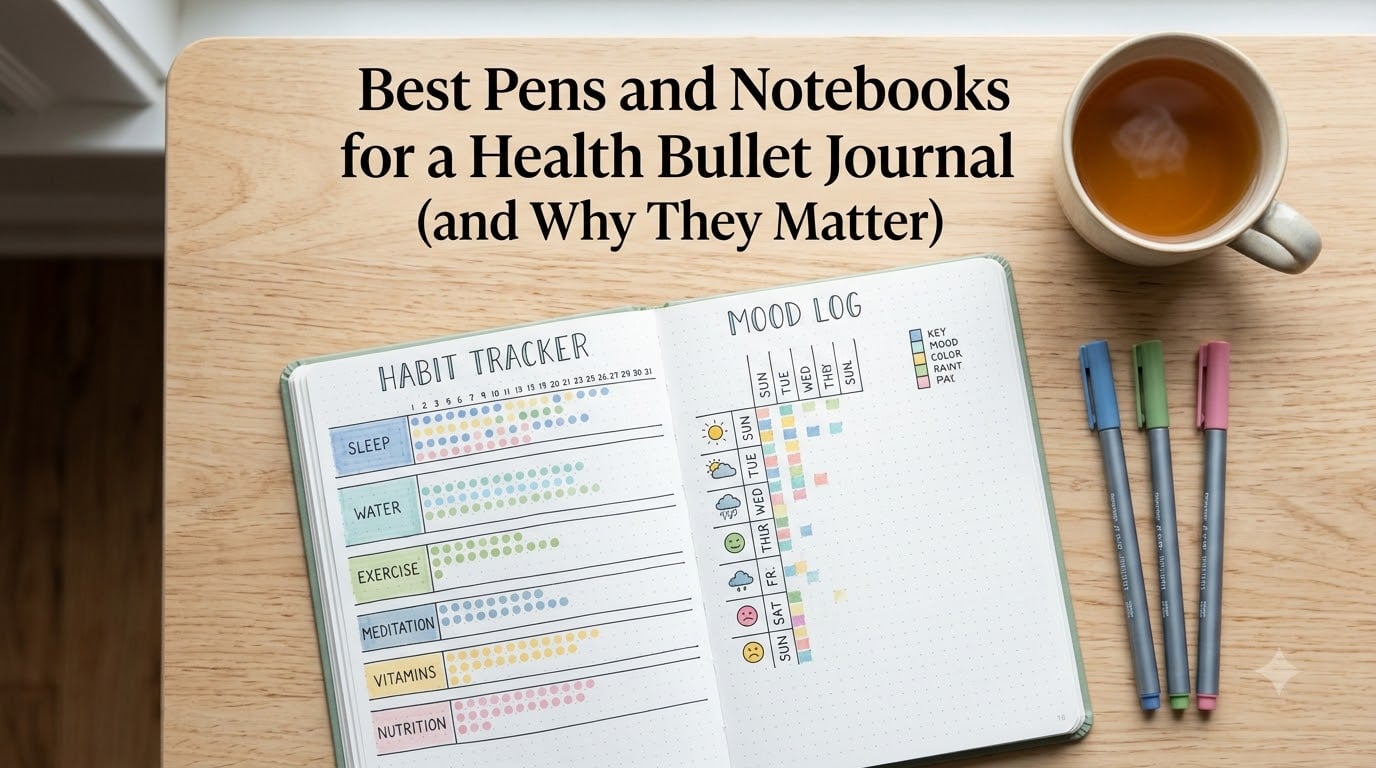
If you have ever started a health bullet journal and abandoned it two weeks later, your supplies might be partly to blame. A pen that bleeds through the page or a notebook whose ink smears every time you close it creates friction, and friction kills habits. The best pens and notebooks for a health bullet journal are the ones that disappear into your routine, so you focus on tracking your wellness instead of fighting your tools.
I have spent years testing journaling supplies, and I can tell you that quality matters more than quantity. When you are logging sleep hours, medication times, mood ratings, or daily symptoms, you need ink that behaves and paper that holds up. A single bleeding marker on a weekly habit tracker can make an entire spread unreadable.
In this guide, we will cover the pen types that work best for health journaling, the notebook specifications that actually matter, and why these choices affect your ability to stick with wellness tracking long-term. Whether you are building your first health bujo or upgrading from a setup that frustrated you, this article will help you choose supplies that support your goals.
Table of Contents
Understanding Pen Types for Bullet Journaling
Not all pens are created equal when it comes to health bullet journaling. Each pen type serves a specific purpose, from writing daily logs to creating decorative headers for your mood tracker. Understanding these differences helps you build a kit that covers every journaling task without waste.
Fineliners
Fineliners are the backbone of most bullet journal setups. These pens use a plastic or felt tip that produces consistent, precise lines ranging from 0.2 mm to 0.8 mm in thickness. They dry quickly, rarely bleed through quality paper, and are perfect for writing daily logs, numbering pages, and drawing habit tracker grids.
The Sakura Pigma Micron is the gold standard that Reddit communities consistently recommend, and for good reason. Its archival-quality pigmented ink is waterproof and fade-resistant, meaning your health data stays legible for years. A 0.3 mm or 0.4 mm tip size covers most daily journaling needs without being too fragile for quick writing.
For budget-conscious journalers, fineliners are also the most cost-effective category. A single pen lasts months of daily use and costs less than a fancy coffee.
Gel Pens
Gel pens deliver smooth, vibrant ink that makes writing feel effortless. They are beloved for daily logging because the ink flows so freely that your hand does not tire during longer journaling sessions. The Pentel Energel and Zebra Sarasa are two models that Reddit users praise again and again for their no-smudge performance.
The trade-off is that gel ink takes longer to dry than fineliner ink. Left-handed journalers especially struggle here, since their hand drags across freshly written lines. If you are left-handed or just a fast writer, look for quick-drying gel formulations specifically labeled as such.
Gel pens also tend to show more ghosting on thinner paper. If your notebook is under 100 GSM, test a gel pen on the back of the last page before committing it to your health tracker spreads.
Brush Pens
Brush pens feature a flexible tip that creates varying line widths based on pressure. They are the go-to tool for hand-lettered headers on your monthly health overview, medication schedule, or fitness tracker. The Tombow Dual Brush Pen is the community favorite, offering a brush tip on one end and a fine-line marker on the other.
Brush pens require some practice to control, but the payoff is worth it. A well-lettered header makes your health spread feel intentional and polished, which increases the likelihood that you will actually open the journal every day. For beginners, I recommend starting with a smaller brush tip, which is more forgiving than a large one.
One thing to watch: brush pens lay down a lot of ink. They will bleed through paper below 120 GSM. Reserve them for dedicated header pages or use them only on thicker notebook paper.
Markers
Markers bring color to your health bullet journal, which is especially useful for color-coding symptoms, mood ratings, or medication types. A green marker might indicate a good symptom day, while an orange one flags a flare-up. This visual system helps you spot patterns at a glance during monthly and weekly reviews.
For light coloring and highlights, water-based markers work well on quality paper. For heavier coverage, alcohol-based markers deliver bold color but will almost certainly bleed through anything under 160 GSM. Always place a scrap sheet behind your page when using markers to protect subsequent pages.
Highlighters deserve special mention here. Many health journalers use them to emphasize critical data points like medication changes or unusual symptoms. Look for mild or pastel highlighters, which are less likely to overpower your handwritten notes and tend to ghost less aggressively than neon options.
Notebook Essentials for Health Tracking
Your notebook is the foundation of your health journaling practice. A great pen cannot compensate for paper that feathers, ghosts, or falls apart after three months of daily use. Here are the specifications that genuinely matter for health tracking.
Paper Weight (GSM) Explained
GSM stands for grams per square meter, and it measures paper thickness. This single number tells you more about how a notebook will perform than any other spec. Standard copy paper is around 75 GSM, and most entry-level bullet journal notebooks use 80 to 100 GSM paper.
For health bullet journaling, I recommend paper that is at least 120 GSM. This weight handles fineliners and gel pens with zero bleed-through and minimal ghosting. If you plan to use markers, brush pens, or highlighters regularly, look for 160 GSM or higher.
Higher GSM means each page is thicker, which also means fewer pages fit in the same notebook. A 160 GSM notebook might have 120 pages where a 100 GSM one has 200. For health tracking, I would rather have fewer pages that perform well than more pages that frustrate me.
Dot Grid vs Lined vs Blank
The dot grid is the most popular choice for bullet journaling, and it is what I recommend for health tracking. Dots provide subtle guidance for drawing straight lines and grids without the visual noise of full ruled lines. When you draw a weekly medication tracker or a 30-day mood grid, dots help you keep everything aligned.
Lined notebooks work if you primarily write text-based daily logs and rarely draw layouts. Blank notebooks offer maximum creative freedom but make it harder to create the structured grids that health tracking usually requires.
Dot grid spacing also matters. The standard 5 mm spacing works for most people, but if you write large or want more room for detailed health metrics, look for wider spacing options.
Binding and Durability
Health journaling is a daily practice, and your notebook needs to withstand constant opening, carrying, and writing. Hardcover notebooks protect pages better and provide a firm writing surface when you are journaling on the go. Soft covers are lighter and more portable but offer less protection.
For binding, I strongly prefer thread-bound (also called Smyth-sewn) notebooks for daily use. They lay flat, pages do not fall out, and the spine holds up over months of heavy use. Glue-bound notebooks can separate over time, especially in hot or humid environments.
Look for notebooks with numbered pages and an index section. Numbering saves you from doing it yourself, and an index helps you track where each month’s health data lives, which becomes essential after six months of entries.
What to Look for in a Journaling Pen
Knowing pen types is half the battle. The other half is evaluating whether a specific pen will work for your journaling style. Here are the four factors that matter most for health bullet journaling.
Bleed-Through and Ghosting
Bleed-through happens when ink soaks all the way through the paper and becomes visible on the reverse side. Ghosting is milder, where a shadow of your writing shows through but does not fully saturate the page. Both problems make the back side of each page harder to use, effectively cutting your usable notebook space in half.
Fineliners are the safest bet for avoiding both issues. Gel pens are moderate risk. Markers and brush pens are the biggest offenders. When in doubt, test any new pen on the last page of your notebook and check the reverse before using it on a spread you care about.
Health trackers are especially vulnerable to bleed-through because you often write on both sides of a page. A weekly symptom grid on the front of a page and a daily log on the back means you need ink that stays put.
Smudge Resistance
Smudging happens when ink has not fully dried and your hand drags across it. This is the number one complaint from left-handed journalers, but right-handed writers smudge too when writing quickly. Quick-drying ink is essential if you journal in a hurry, which many people do in the morning when logging sleep data or medication times.
Pigmented fineliner ink dries fastest. Gel ink takes longer but some newer formulations dry significantly faster than older ones. If smudging has been a problem for you, look for pens specifically marketed as quick-drying or smear-resistant.
Comfort and Grip
Health journaling sessions can last anywhere from two minutes to thirty minutes depending on your layout. A pen that cramps your hand after five minutes will make you want to journal less, which defeats the entire purpose. Look for pens with rubberized grips or slightly thicker barrels that reduce hand strain.
The way a pen balances in your hand also matters. Top-heavy pens force your fingers to grip harder, causing fatigue. Pens with a balanced weight distribution let you write longer without discomfort.
If you journal at night in bed or on the couch, consider pen weight more carefully. A heavy metal pen that feels great at a desk can become uncomfortable when writing at an awkward angle.
Dry Time
Dry time is the seconds between writing and the ink becoming smudge-proof. For fast journalers, anything over three seconds feels like an eternity. Fineliners typically dry in under two seconds, gel pens in three to five, and brush pen ink can take ten or more seconds depending on ink volume.
If you close your notebook immediately after writing, dry time is critical. Ink that has not dried will transfer to the facing page, creating mirror-image smudges that obscure both pages. Give yourself a moment, or simply slow down when using ink-heavy pens.
Pen Compatibility with Different Paper Types
Matching your pen to your paper is the single most effective way to avoid journaling frustrations. A pen that performs beautifully on 160 GSM paper might bleed straight through 80 GSM sheets. Here is how different ink types interact with different paper weights.
On 80 to 100 GSM paper, stick to fineliners and ballpoint pens. Gel pens will work but expect some ghosting. Avoid markers, brush pens, and highlighters entirely, as they will bleed through and damage the reverse page.
On 120 GSM paper, you gain more flexibility. Fineliners perform flawlessly, gel pens work well with minimal ghosting, and mild highlighters are usually safe. Brush pens should be tested first, as some colors bleed while others do not.
On 160 GSM and above, you can confidently use nearly any pen type. Markers, brush pens, and even light watercolor washes are all viable. This is the paper weight I recommend for journalers who love decorative spreads alongside their health data.
One practical tip: if you love a particular notebook but the paper is too thin for your favorite pens, use every other page. Write on the right-hand page and leave the left blank, or insert a blank sheet behind your current page as a bleed-through barrier. This wastes some space but preserves the integrity of your health records.
Why Journaling Supplies Matter for Health Tracking
This is where most guides stop, and it is exactly where the conversation should deepen. The connection between your journaling supplies and your actual health outcomes is real, and understanding it can change how you approach your bullet journal.
Health tracking only works if you do it consistently. A habit tracker, a symptom log, or a medication schedule provides value only when you fill it in day after day. When your pen skips, your ink smears, or your pages bleed through, you experience micro-frustrations that accumulate over time. Each one makes you slightly less likely to open your journal tomorrow.
Research on habit formation consistently shows that reducing friction is one of the most effective ways to build a lasting routine. Good supplies reduce friction. A pen that always works and paper that always looks clean remove the small obstacles that derail consistency. When your tools feel good to use, journaling becomes something you look forward to rather than a chore.
Color-coding is a specific health journaling technique that depends heavily on supply quality. Many health journalers assign colors to symptoms, mood levels, or medication types. If your markers bleed through or your highlighters ghost badly, your carefully designed color system becomes a muddy mess. Thicker paper and well-behaved ink preserve the visual clarity that makes color-coding effective for spotting health patterns.
There is also a psychological component. A beautiful notebook and a smooth pen signal that your health matters to you. When you invest in quality supplies, you are telling yourself that your wellness tracking is worth the effort. This mindset shift might sound minor, but it plays a real role in sustaining long-term journaling habits.
For people managing chronic conditions, mental health challenges, or recovery programs, this consistency is not a luxury. It is a tool for understanding your body and communicating accurately with healthcare providers. A health journal filled with legible, well-organized data becomes a medical resource, and that requires supplies you can rely on.
Common Mistakes to Avoid
After years of observing health journalers, I see the same mistakes repeated. Here are five to watch for, along with how to fix them.
Mistake 1: Buying too many pens at once. A starter kit of one fineliner, one gel pen, and one colored marker covers 90 percent of health journaling needs. Buying a 20-pen set before you know your style leads to decision paralysis every time you open your journal. Start small and expand only when you identify a genuine gap.
Mistake 2: Choosing a notebook based on looks alone. A beautiful cover means nothing if the paper ghosts with every pen you own. Always check GSM before buying. If the spec is not listed, assume the paper is thin and proceed with caution.
Mistake 3: Using alcohol markers on thin paper. This is the fastest way to ruin a health tracker spread. Alcohol ink bleeds through almost everything below 200 GSM. Save these markers for dedicated art pages or invest in thick artist-grade notebooks.
Mistake 4: Ignoring dry time. Closing your notebook before ink dries creates transfer smudges on facing pages. Build a five-second pause into your routine, or keep a piece of blotting paper handy. This small habit saves pages that would otherwise be unreadable.
Mistake 5: Overcomplicating your layout. Intricate spreads with twelve pen colors and hand-lettered headers look impressive online but are exhausting to maintain daily. For health tracking, simple layouts you can complete in five minutes outperform complex ones you abandon after a week. Match your supply choices to layouts you can realistically sustain.
Frequently Asked Questions
What are the best pens for bullet journaling?
The best pens for bullet journaling are fineliners like the Sakura Pigma Micron for precise daily writing, gel pens like the Zebra Sarasa or Pentel Energel for smooth logging, and brush pens like the Tombow Dual Brush for decorative headers. Fineliners are the most versatile starting point because they resist bleeding and smudging on most paper types.
What is the best notebook for bullet journaling?
The best notebook for bullet journaling has dot grid pages, paper weight of at least 120 GSM to prevent bleed-through, thread binding that lays flat, numbered pages, and a durable cover. Look for specifications that match your pen choices, especially if you plan to use markers or brush pens that require thicker paper.
What are the best markers for a bullet journal?
The best markers for a bullet journal are water-based markers and mild highlighters for color-coding health data, as they ghost less than alcohol-based alternatives on standard journal paper. For richer color, use alcohol markers only on paper rated 160 GSM or higher, and always place a protective sheet behind your page.
What are the best brush pens for bullet journaling?
The best brush pens for bullet journaling are the Tombow Dual Brush Pen for its dual-tip convenience, and smaller-tip brush pens for beginners who want more control. Brush pens are ideal for lettering headers on health spreads but require paper of at least 120 GSM to avoid bleed-through.
Choosing the best pens and notebooks for a health bullet journal comes down to matching ink behavior to paper weight, selecting tools that reduce daily friction, and investing in quality that supports long-term consistency. Start with a reliable fineliner, a notebook with 120 GSM or higher dot grid paper, and a simple layout you can maintain daily. Your health data is only useful if you can read it three months from now, so choose supplies that keep every entry clear, legible, and organized. The right tools will not journal for you, but they will remove every excuse not to.