
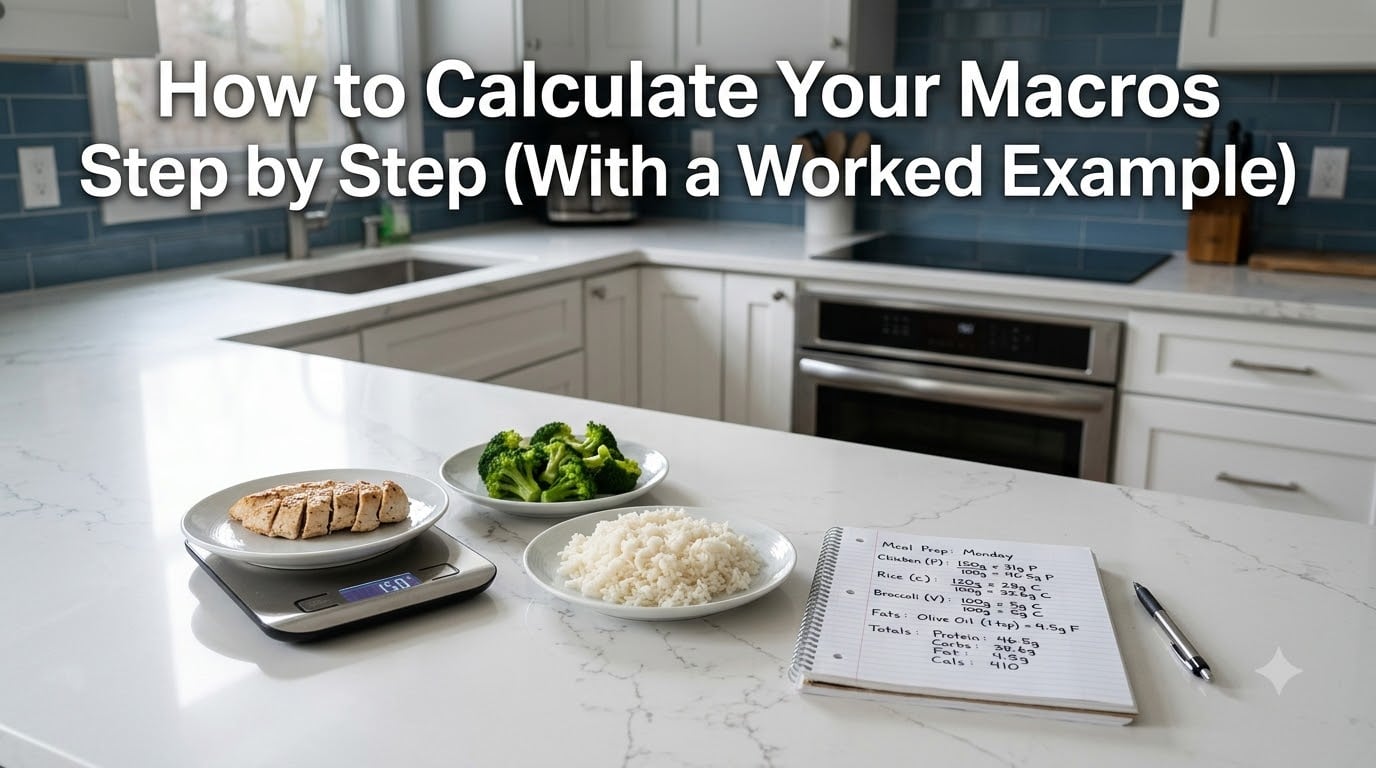
Learning how to calculate macros changed the way I approach nutrition entirely. Instead of obsessing over a single calorie number, I started thinking about what those calories were made of, and my results improved almost immediately.
If you have ever wondered why two people eating the same number of calories can look completely different, the answer usually comes down to macronutrient balance. Getting your protein, carbs, and fats dialed in means you are not just losing weight but losing the right kind of weight.
This guide walks you through every step of the macro calculation process with a complete worked example using real numbers. By the end, you will know exactly how to calculate your macros for weight loss, muscle gain, or maintenance without relying on a generic online calculator.
I have spent years refining this process both for myself and for people I have coached through body recomposition. The method below is the same one I use every time someone asks me to help them figure out their nutrition from scratch.
Table of Contents
- What Are Macros?
- How to Calculate Your Macros Step by Step
- Choosing the Right Macro Ratio
- Worked Example: Calculating Macros From Start to Finish
- How to Track Your Macros
- Common Mistakes to Avoid
- Tips for Long-Term Success
- Frequently Asked Questions
- How do I calculate what my macros should be?
- What is the 30/30/40 rule macro?
- What is a good macro for losing weight?
- How can a beginner learn to count macros?
- What is the 40/40/20 rule for macros?
- Is a 40/30/30 macro split good for building muscle?
- How many grams of protein should I eat per pound of body weight?
- Conclusion
What Are Macros?
Macros, short for macronutrients, are the three nutrients your body needs in large amounts to function: protein, carbohydrates, and fat. Every food you eat is made up of some combination of these three, and each plays a distinct role in your body.
Protein builds and repairs muscle tissue, supports your immune system, and keeps you feeling full. Carbohydrates are your body’s preferred energy source, fueling everything from your brain to your workouts. Dietary fat regulates hormones, helps absorb vitamins, and provides long-lasting energy.
Here is the number that matters most for calculations: protein and carbohydrates each provide 4 calories per gram, while fat provides 9 calories per gram. This is known as the 4-4-9 rule, and it is the foundation of every macro calculation you will ever do.
So if a meal contains 40 grams of protein, 50 grams of carbs, and 15 grams of fat, you multiply each by its calorie value. That gives you 160 calories from protein, 200 from carbs, and 135 from fat, for a total of 495 calories. Understanding this conversion is what separates people who count macros from people who just count calories.
Why Macro Tracking Beats Calorie Counting Alone
Two meals can have identical calorie counts but completely different effects on your body. A 500-calorie bowl of oatmeal with peanut butter gives you sustained energy, quality protein, and healthy fats. A 500-calorie pastry gives you almost no protein, a blood sugar spike, and a crash an hour later.
When you count macros, you are essentially quality-controlling your calories. You make sure you get enough protein to preserve muscle during a deficit, enough carbs to fuel your training, and enough fat to keep your hormones functioning properly. Calorie counting alone tells you nothing about whether your nutrition is actually balanced.
This is why people who switch from simple calorie counting to macro tracking often see better body composition changes even at the same total calorie intake. The structure forces better food choices.
How to Calculate Your Macros Step by Step
The process of calculating your macros comes down to five sequential steps. Each one builds on the previous, so work through them in order and write your numbers down as you go.
Step 1: Calculate Your BMR (Basal Metabolic Rate)
Your BMR is the number of calories your body burns at complete rest, just keeping you alive. Even if you stayed in bed all day, your body would still burn this many calories handling breathing, circulation, and cell repair.
The most widely used and validated formula is the Mifflin-St Jeor equation. Here is how it works:
For men: BMR = (10 x weight in kg) + (6.25 x height in cm) – (5 x age) + 5
For women: BMR = (10 x weight in kg) + (6.25 x height in cm) – (5 x age) – 161
To convert pounds to kilograms, divide your weight by 2.2. To convert inches to centimeters, multiply by 2.54. This formula was developed in the 1990s and is considered more accurate than older equations like Harris-Benedict, especially for modern populations.
Step 2: Determine Your Activity Level and Calculate TDEE
Your Total Daily Energy Expenditure, or TDEE, is your BMR multiplied by an activity factor. This accounts for everything you do beyond lying in bed, including exercise, walking, and even digesting food.
Here are the standard activity multipliers:
- Sedentary (little to no exercise, desk job): BMR x 1.2
- Lightly active (light exercise 1-3 days per week): BMR x 1.375
- Moderately active (moderate exercise 3-5 days per week): BMR x 1.55
- Very active (hard exercise 6-7 days per week): BMR x 1.725
- Extra active (very hard exercise plus a physical job): BMR x 1.9
This is where I see most people go wrong. They overestimate their activity level and end up eating too many calories. If you work a desk job and work out three times a week for 45 minutes, you are lightly active, not moderately active. Be honest with yourself here, because this single number affects everything downstream.
Step 3: Adjust Calories for Your Goal
Your TDEE represents your maintenance calories, the amount you need to stay at your current weight. Now you adjust based on what you want to achieve.
For fat loss, subtract 10 to 20 percent from your TDEE. A 15 percent reduction is a solid starting point for most people, creating a moderate deficit without crashing your energy. Going more aggressive than 20 percent often leads to hunger, muscle loss, and rebound eating.
For muscle gain, add 5 to 10 percent to your TDEE. This slight surplus gives your body the extra energy needed to build new tissue without piling on excess fat. Anything beyond a 10 percent surplus typically just accelerates fat gain.
For maintenance, keep your calories at your full TDEE. Simple as that.
Step 4: Set Your Protein Target First
Always start with protein, because it is the most important macro for body composition. The general recommendation is 0.8 to 1 gram of protein per pound of body weight for most people. If you are significantly overweight, use your target weight instead of your current weight to avoid an inflated protein number.
So a 160-pound person would aim for 128 to 160 grams of protein per day. Multiply your protein grams by 4 to get the calories from protein.
Step 5: Split Remaining Calories Between Carbs and Fat
Take your total daily calorie target, subtract the calories from protein, and divide what remains between carbohydrates and fat based on your preference and goals.
A moderate-fat approach allocates 25 to 30 percent of total calories to fat, with the rest going to carbs. This works well for most people. If you prefer a lower-carb approach, you can push fat higher and carbs lower. Remember to divide fat calories by 9 and carb calories by 4 to convert back to grams.
That is the complete five-step process. Now let me show you exactly how it works with real numbers.
Choosing the Right Macro Ratio
Macro ratios, also called macro splits, describe the percentage of your total calories that comes from each macronutrient. While the step-by-step method above gives you personalized numbers, ratio guidelines help you sanity-check your results and choose a starting framework.
Here are the most common macro splits based on goals:
- Balanced (40% carbs, 30% protein, 30% fat): A solid all-purpose split that works for general fitness and body recomposition. This is the classic 40/30/30 ratio.
- Weight loss (40% protein, 30% carbs, 30% fat): Higher protein preserves muscle during a deficit while keeping carbs moderate for energy. Also written as 30/30/40 depending on whether carbs or protein gets the larger share.
- Muscle gain (40% carbs, 30% protein, 30% fat): Higher carbohydrate intake fuels intense training and supports recovery, which is essential when building muscle in a surplus.
- Low carb or keto (5-10% carbs, 20-25% protein, 70-75% fat): For those who feel better on fewer carbs or are specifically following a ketogenic approach.
The 40/40/20 split (40% protein, 40% carbs, 20% fat) is sometimes used by bodybuilders during cutting phases who want very high protein intake. It can work short-term but leaves fat quite low, which may affect hormone levels over extended periods.
Which Ratio Should You Pick?
If you are unsure, start with a balanced 40/30/30 split and adjust from there. The truth is that your exact ratio matters far less than hitting your total calorie target and your protein minimum. I have seen people get great results on everything from high-carb to keto, as long as those two variables are dialed in.
Pick a ratio you can stick with comfortably. The best macro split is the one you can follow consistently for weeks and months without feeling miserable.
Worked Example: Calculating Macros From Start to Finish
Let me walk you through a complete macro calculation using a real person. Meet Sarah, a 30-year-old female who weighs 160 pounds, is 5 foot 5 inches tall, works a desk job, and does moderate exercise (a gym class or strength training session) 3 to 4 times per week. Her goal is fat loss.
Step 1: Sarah’s BMR
First, convert her measurements to metric. Her weight is 160 divided by 2.2, which equals 72.7 kg. Her height is 65 inches times 2.54, which equals 165 cm.
Using the Mifflin-St Jeor equation for women: BMR = (10 x 72.7) + (6.25 x 165) – (5 x 30) – 161
That works out to: 727 + 1031.25 – 150 – 161 = 1447.25. Rounding up, Sarah’s BMR is approximately 1,447 calories.
Step 2: Sarah’s TDEE
She works a desk job but exercises 3 to 4 times per week, which puts her in the lightly active category. We use the 1.375 multiplier.
TDEE = 1,447 x 1.375 = 1,990 calories. So Sarah burns roughly 1,990 calories per day with her current activity level.
Many people in Sarah’s situation would mistakenly use the 1.55 multiplier for moderate activity and end up with 2,243 calories. That 250-calorie difference would significantly slow her fat loss progress, which is why honest activity assessment matters.
Step 3: Adjust for Fat Loss
For a moderate fat loss deficit, we subtract 15 percent from her TDEE. Fifteen percent of 1,990 is about 299 calories.
Target calories = 1,990 – 299 = 1,691 calories per day. Let’s round to 1,690 for simplicity.
Step 4: Set Protein
Sarah is not significantly overweight, so she uses her current body weight. At 0.9 grams per pound (a good middle ground in the 0.8 to 1 gram range):
Protein = 160 x 0.9 = 144 grams of protein per day.
Protein calories = 144 x 4 = 576 calories from protein.
Step 5: Calculate Fat and Carbs
Remaining calories after protein: 1,690 – 576 = 1,114 calories to split between carbs and fat.
Using a moderate fat approach of 25 percent of total calories from fat: Fat calories = 1,690 x 0.25 = 423 calories from fat.
Fat grams = 423 divided by 9 = 47 grams of fat per day.
Everything else goes to carbs. Carb calories = 1,114 – 423 = 691 calories from carbs.
Carb grams = 691 divided by 4 = 173 grams of carbs per day.
Sarah’s Final Macro Targets
Here is the complete breakdown for Sarah on her fat loss plan:
- Protein: 144g (576 calories)
- Carbs: 173g (691 calories)
- Fat: 47g (423 calories)
- Total: 1,690 calories per day
That is roughly a 34% protein, 41% carb, 25% fat split. Notice how it naturally falls close to the balanced range even though we prioritized protein first. This is the method I recommend because it produces individualized numbers rather than forcing a one-size-fits-all ratio.
How to Apply These Numbers Daily
Sarah now has her daily targets. She can spread these across 3 to 4 meals however she likes. A typical day might look like 40 grams of protein at breakfast, 35 at lunch, 40 at dinner, and 29 from snacks. The exact distribution matters less than hitting the total by the end of the day.
If she trains in the morning, she might shift more carbs toward breakfast and post-workout. If she trains in the evening, more carbs go to dinner. The flexibility is one of the biggest advantages of macro tracking over rigid meal plans.
How to Track Your Macros
Calculating your macros is only half the battle. To actually hit those numbers, you need a reliable tracking system. Here are the methods that work best, from most to least precise.
Use a Tracking App
A macro tracking app does the heavy lifting for you. You log what you eat, and it calculates your running totals for protein, carbs, and fat. Among the communities I trust, Cronometer comes up repeatedly as the most accurate option because its food database is heavily curated and less prone to user-entered errors.
MyFitnessPal is the most popular option and has the largest food database, but its entries can be inaccurate since many are user-submitted. If you use it, double-check entries against the nutrition label whenever possible. Either app will work, but Cronometer gives you better data quality.
Weigh Your Food
A digital food scale is non-negotiable if you want accurate tracking. Measuring cups are notoriously inaccurate, and people consistently underestimate portions when eyeballing. A scale removes the guesswork entirely.
One tip that trips up almost every beginner: weigh your meat raw, not cooked. Cooking drives off water weight, so 4 ounces of raw chicken becomes roughly 3 ounces after cooking. If you log cooked weight as raw, you are undercounting your protein and calories. Most food databases list both raw and cooked entries, so pick the one matching how you weighed it.
Simplify with the Hand Portion Method
If weighing everything feels overwhelming, the hand portion method gives you a practical alternative. Developed and popularized by Precision Nutrition, it uses your hand as a measuring tool:
- One palm-sized portion of protein = approximately 20-30 grams of protein
- One cupped hand of carbs = approximately 20-30 grams of carbohydrates
- One thumb of fat = approximately 7-12 grams of fat
- One fist of vegetables = roughly 5 grams of carbs (negligible for most tracking)
For Sarah’s targets, a day might include 5 to 6 palm-sized protein portions, 6 cupped hands of carbs, and 4 thumbs of fat. It is not as precise as weighing, but it gets you within 10 to 15 percent of your targets, which is close enough for most people starting out.
I recommend starting with the hand portion method for your first two weeks to build the habit of tracking. Then switch to a food scale once you are comfortable with the routine. Accuracy improves over time.
Build Simple Meals
One strategy that makes tracking dramatically easier is sticking to simple meals with 5 ingredients or fewer. A meal of chicken breast, rice, broccoli, olive oil, and seasoning has 5 ingredients and takes about 60 seconds to log. A complex recipe with 15 ingredients takes 10 minutes to track accurately.
People in the fitness communities I follow consistently report that simplifying their meals is the single biggest factor in sticking with macro tracking long-term. You do not need to eat boring food, but limiting complexity pays off.
Common Mistakes to Avoid
After helping many people work through macro calculations, the same errors come up again and again. Here are the ones that derail progress most often.
Overestimating Activity Level
This is the number one mistake I see. Someone works out 3 times a week for 45 minutes and selects “very active” because they feel like they exercise a lot. In reality, those 3 sessions add roughly 200 to 300 calories to your weekly burn, which barely moves the needle from sedentary.
If you have a desk job, your baseline is sedentary or lightly active regardless of your workouts. Adding the activity multiplier on top of an honest baseline is how you get a number that actually reflects your lifestyle.
Using Total Weight When You Are Significantly Overweight
Protein recommendations of 0.8 to 1 gram per pound assume a relatively lean individual. If you weigh 280 pounds but your target weight is 190, calculating protein at 1 gram per pound of current weight gives you 280 grams, which is unnecessary and difficult to eat.
Use your target weight or lean body mass instead. This gives you enough protein to preserve muscle during a deficit without forcing you to choke down unreasonably high amounts.
Not Adjusting When Progress Stalls
Your metabolism adapts as you lose weight. A calorie intake that produces fat loss at 180 pounds will not produce the same rate at 165 pounds, because your smaller body burns fewer calories. If you hit a plateau for two or more weeks, it is time to recalculate.
Typically you either reduce calories by 100 to 150 or add a bit more activity. Never slash calories dramatically, because that accelerates metabolic adaptation and makes long-term adherence harder.
Trusting App Database Entries Blindly
User-submitted food entries in popular apps are frequently wrong. I have seen entries listing chicken breast at 400 calories per ounce when the real value is about 46. Always verify suspicious entries against the USDA food database or the nutrition label on the package.
Tips for Long-Term Success
Calculating your macros once is easy. Sticking with the process and adjusting over time is where most people fall off. These strategies will help you stay consistent.
Recalculate Every 4 to 6 Weeks
As your weight changes, your calorie needs change too. A good rule of thumb is to recalculate your macros every 4 to 6 weeks, or after every 5 to 10 pounds of weight change. This keeps your targets aligned with your current body and activity level.
If the scale has not moved for two weeks despite consistent tracking, recalculate and make a small adjustment. A 100-calorie reduction or one extra workout session per week is usually enough to restart progress.
Take Progress Photos
The scale is a notoriously unreliable progress marker. Water retention, glycogen storage, and hormonal fluctuations can shift your weight by 3 to 5 pounds in a single day without any real change in body composition.
Take a photo every week under the same lighting, same time of day, and same pose. When you compare week 1 to week 8 side by side, the visual changes will often be dramatic even when the scale barely moved. Users across fitness communities consistently report that progress photos are far more motivating than scale weight.
Focus on Consistency Over Perfection
You do not need to hit your macros exactly every single day. Aiming for within 5 to 10 grams of each target is more than sufficient for steady progress. Obsessing over single-digit accuracy leads to burnout and an unhealthy relationship with food.
If you go over one day, do not compensate by undereating the next. Just return to your normal targets. Consistency over weeks and months is what produces results, not one perfect day.
Plan Ahead for Social Situations
Eating out is the biggest challenge for most people tracking macros. Before going to a restaurant, look up the menu and estimate your meal as best you can. If you cannot find exact macros, use a similar entry from your app as an approximation.
Some people prefer to eat lighter during the day to save calories and protein for a dinner out. This flexible approach works well as long as you do not use it as an excuse to abandon tracking entirely on social days.
Frequently Asked Questions
How do I calculate what my macros should be?
Calculate your BMR using the Mifflin-St Jeor equation, multiply it by your activity level to get your TDEE, adjust that number for your goal (subtract 10-20% for fat loss or add 5-10% for muscle gain), set your protein at 0.8-1 gram per pound of body weight, then split the remaining calories between carbs and fat.
What is the 30/30/40 rule macro?
The 30/30/40 rule is a macro split where 30% of your calories come from protein, 30% from fat, and 40% from carbohydrates. It is commonly used for weight loss because the higher protein percentage helps preserve muscle during a calorie deficit while keeping carbohydrate intake moderate.
What is a good macro for losing weight?
A good weight loss macro split prioritizes protein at 30-40% of total calories, keeps fat at 25-30% for hormone health, and allocates the remainder to carbohydrates. A common starting point is 40% protein, 30% carbs, and 30% fat, or alternatively 30% protein, 40% carbs, and 30% fat depending on your carb preference.
How can a beginner learn to count macros?
Start by calculating your macro targets, then download a tracking app like Cronometer or MyFitnessPal. Buy a digital food scale and log everything you eat for one full week without changing your diet to build the habit. Use the hand portion method if weighing feels overwhelming at first, and focus on hitting your protein target before worrying about perfect carb and fat numbers.
What is the 40/40/20 rule for macros?
The 40/40/20 rule allocates 40% of calories to protein, 40% to carbohydrates, and 20% to fat. This split is sometimes used during cutting phases by bodybuilders who want very high protein intake. It can be effective short-term but the low fat percentage may affect hormone function if followed for extended periods.
Is a 40/30/30 macro split good for building muscle?
Yes, a 40/30/30 split with 40% carbohydrates, 30% protein, and 30% fat is effective for building muscle. The higher carbohydrate intake fuels intense training sessions and supports glycogen replenishment, while adequate protein provides building blocks for new muscle tissue and sufficient fat supports hormone production.
How many grams of protein should I eat per pound of body weight?
Most people should aim for 0.8 to 1 gram of protein per pound of body weight. If you are significantly overweight, use your target weight rather than current weight to avoid an unnecessarily high protein target. This range supports muscle preservation during fat loss and muscle building during a surplus.
Conclusion
Knowing how to calculate your macros gives you a framework for nutrition that is far more effective than simple calorie counting. The five-step process, calculate BMR, find your TDEE, adjust for your goal, set protein, and split the rest, works for any body type and any objective.
Start with the worked example as a template and plug in your own numbers. Track consistently for two weeks, take progress photos, and adjust from there. The numbers are your starting point, not a life sentence, and they will evolve as your body changes.
Your next step is simple. Grab a calculator, work through the five steps with your own stats, and log your first day of food. That first day of tracking is always the hardest, and everything after it gets easier.