
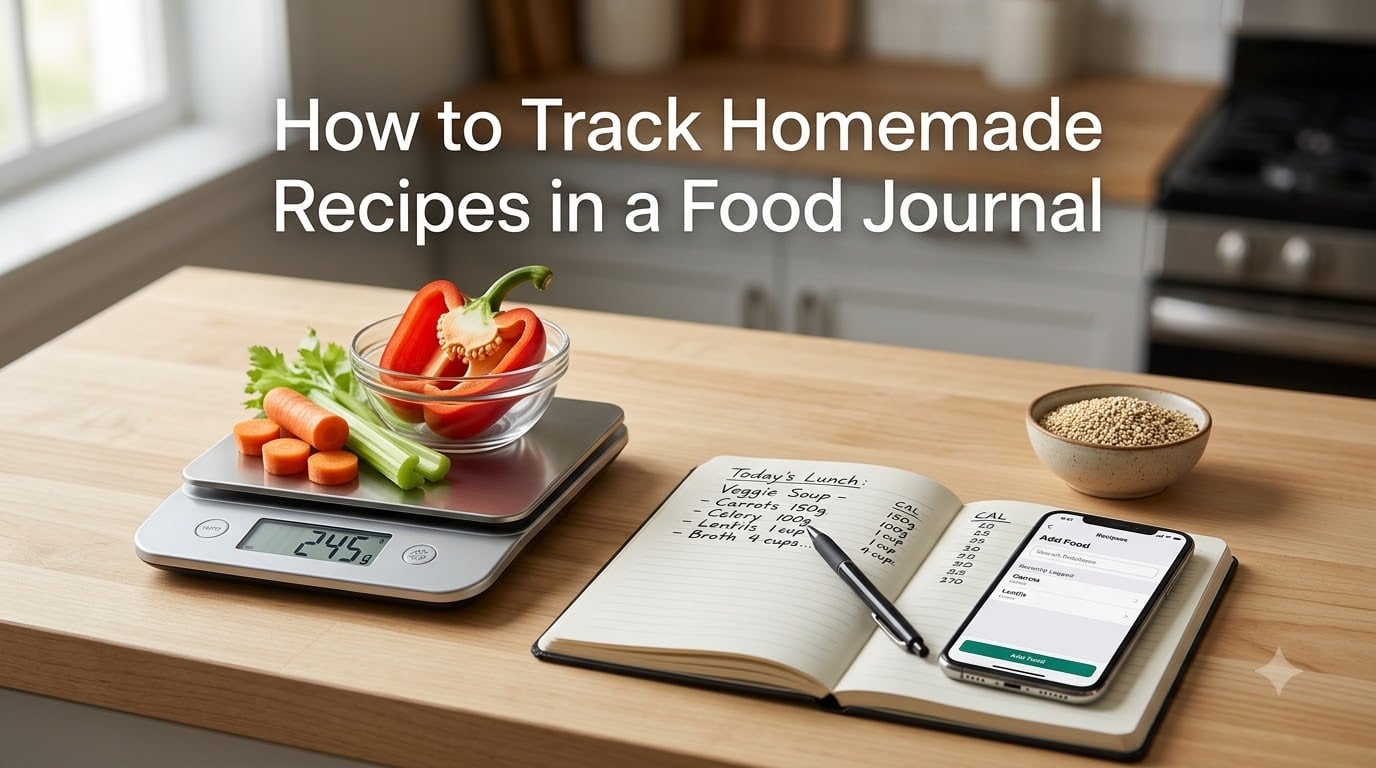
Tracking store-bought food is easy because the nutrition label does the work for you. But when you cook from scratch, there is no barcode to scan and no label to read. That is exactly why so many people give up on tracking homemade recipes.
If you have ever stared at a pot of chili or a sheet pan of roasted vegetables wondering how to log it, you are not alone. This guide breaks down exactly how to track homemade recipes in a food journal using a simple, repeatable method anyone can follow.
I have spent years testing different food tracking approaches, from paper notebooks to recipe builder apps, and the process below is what actually works. Whether your goal is weight loss, muscle gain, or simply understanding what you eat, you will have a clear system by the end of this article.
Here is everything you need to know about how to track homemade recipes in a food journal for 2026.
Table of Contents
- What Is a Food Journal?
- Why Track Homemade Recipes?
- How to Track Homemade Recipes in a Food Journal
- How to Calculate Calories in Homemade Food
- Weighing vs Measuring: Which Method Works Best
- How to Track One-Pot Meals and Casseroles
- Best Apps for Tracking Homemade Recipes
- Tips for Accurate Tracking
- Common Mistakes to Avoid
- How to Track Family Meals
- Frequently Asked Questions
- Conclusion
What Is a Food Journal?
A food journal is a record of everything you eat and drink throughout the day, including homemade meals, snacks, and beverages. You can keep one on paper, in a spreadsheet, or using a tracking app on your phone.
Most food journals capture the food name, portion size, calories, and macronutrients like protein, carbs, and fat. Some people also track mood, hunger levels, or physical symptoms to identify patterns over time.
The hard part is not writing things down. The hard part is figuring out the nutrition information when there is no label. That is the gap this guide fills.
Why Track Homemade Recipes?
Tracking homemade recipes gives you full visibility into what goes into your body. When you cook your own food, you control every ingredient, which means you can also track every ingredient with precision.
For weight loss, this matters because homemade meals are often denser in calories than people realize. A splash of olive oil adds 120 calories. A handful of cheese on top of a casserole adds another 100. Without tracking, those additions disappear.
Tracking homemade recipes also helps you identify food sensitivities. If you journal what you eat alongside how you feel, patterns emerge that would otherwise stay hidden. Bloating after certain meals, energy crashes in the afternoon, or skin flare-ups can all link back to specific ingredients.
Finally, once you log a homemade recipe once, you never have to calculate it again. Most apps let you save recipes, so the work is front-loaded and reusable.
How to Track Homemade Recipes in a Food Journal
Tracking homemade recipes comes down to seven straightforward steps. Follow them once and the process becomes second nature.
Step 1: Gather Your Ingredients and Tools
Before you start cooking, lay out every ingredient you plan to use along with a kitchen scale and your food journal or tracking app. Having everything within arm’s reach prevents you from forgetting an ingredient mid-cook.
A digital kitchen scale that measures in grams is the single most important tool for accurate tracking. Measuring cups work in a pinch, but they introduce error because ingredient density varies.
Step 2: Weigh Each Ingredient Raw
Weigh every ingredient in its raw, uncooked state and write down the weight in grams. Use the tare function on your scale to reset between ingredients so you can weigh directly in your cooking bowl.
Raw weights are more accurate because cooking changes the weight of food. Meat loses moisture and shrinks. Vegetables lose water too. Rice and pasta absorb water and gain weight. If you weigh raw, you get consistent numbers every time.
Step 3: Log Each Ingredient in Your App or Journal
Enter each ingredient and its weight into your food tracking app or write it in your journal. If you are using an app, most have a recipe builder feature where you can add all ingredients at once and save the full recipe.
Search for each ingredient in the app’s food database, select the raw version, and enter the gram weight. The app calculates calories and macros automatically.
Step 4: Cook the Recipe
Cook your recipe as you normally would. You do not need to change anything about how you prepare food. The tracking happens on the front end with raw ingredients.
Make note of any additions during cooking that you did not weigh initially, such as an extra drizzle of oil or a pinch of sugar. Weigh those too and add them to your recipe log.
Step 5: Weigh the Total Cooked Output
After cooking, weigh the entire batch of food. Place your empty serving dish on the scale, tare it, then transfer the cooked food and record the total weight in grams.
This total cooked weight is the number you will use to calculate portion sizes. It accounts for all the moisture loss and gain that happened during cooking.
Step 6: Divide Into Servings
Decide how many servings the recipe makes based on the total cooked weight. For example, if your batch of chili weighs 800 grams and you want four servings, each serving is 200 grams.
To find the nutrition per serving, divide the total recipe calories and macros by the number of servings. If the total recipe is 1,600 calories and you made four servings, each serving is 400 calories.
Step 7: Log the Serving in Your Daily Food Journal
When you eat, weigh your individual portion on the scale to confirm it matches your planned serving size. Then log that serving in your daily food journal or app.
If you saved the recipe in your app, you can simply select it and enter the number of servings. The app does the math for you from that point forward.
Example: Say you make a stir-fry with 300g chicken breast (495 calories), 200g broccoli (68 calories), 150g rice (195 calories), and 15g olive oil (120 calories). The total recipe is 878 calories. After cooking, the batch weighs 550g. If you eat 275g (half), you log 439 calories. Simple once you see the math.
How to Calculate Calories in Homemade Food
The most reliable way to calculate calories in homemade food is the total weight method. Add up the calories of every raw ingredient to get the total recipe calories, then divide by the number of servings.
Here is how the math works. If your recipe has five ingredients, you look up the calorie value per gram for each one using your app or a nutrition database. Multiply each ingredient’s calorie-per-gram by its weight in grams, then add all five results together. That gives you the total recipe calories.
For per-serving nutrition, divide total calories by the number of servings. If you prefer to track by cooked weight instead of servings, divide total calories by total cooked grams to get calories per gram. Then multiply by the weight of your portion.
A common question is whether to weigh food before or after cooking. The answer is to weigh raw ingredients before cooking for your recipe log, then weigh the cooked output to determine portions. Raw weights give you accurate nutrition data. Cooked weights give you accurate portion sizes.
If you only have cooked weight and did not weigh raw ingredients, you can work backward by using cooked nutrition entries in your app. This is slightly less accurate but still far better than guessing.
Weighing vs Measuring: Which Method Works Best
Weighing ingredients on a kitchen scale in grams is always more accurate than using measuring cups and spoons. This is a point nearly every experienced food tracker on community forums agrees on.
The problem with cups is density. One cup of flour can range from 120 to 150 grams depending on how tightly it is packed. One cup of shredded cheese varies depending on how finely it is shredded. These differences add up across a whole recipe.
Measuring cups and spoons are acceptable for liquids and for ingredients where small variations do not matter much, like a splash of broth. But for anything calorie-dense like oils, nuts, cheese, and grains, always weigh.
How to Track One-Pot Meals and Casseroles
One-pot meals, soups, casseroles, and stir-fries are the recipes people struggle with most. The ingredients all mix together, making it hard to separate portions.
The solution is the total cooked weight method described above. Weigh each raw ingredient, cook everything together, then weigh the entire batch. Divide the total calories by the total cooked grams to get a calorie-per-gram value. Multiply that by the weight of however much you serve yourself.
For soups, weigh the pot of soup after cooking and record the total. Each bowl you serve is a fraction of that total based on weight. The same approach works for casseroles, pasta bakes, and any mixed dish.
This method is popular in fitness communities because it handles every type of recipe without needing to separate ingredients on the plate.
Best Apps for Tracking Homemade Recipes
The right app makes recipe tracking dramatically easier. Most popular food journaling apps now include a recipe builder feature designed specifically for homemade meals.
MyFitnessPal has one of the largest food databases and a recipe builder that lets you enter raw ingredients, set the number of servings, and save the recipe for future use. Once saved, you can log a serving with one tap. Forum users consistently recommend this feature, though many note it is underused.
Cronometer is praised for its accuracy and recipe import functionality. It pulls nutrition data from verified databases rather than user-submitted entries, which means fewer errors. If you care about micronutrients like vitamins and minerals, Cronometer tracks those in detail.
Lose It and MacroFactor also offer recipe building with solid interfaces. The best app is whichever one you will actually use consistently.
If you prefer analog, a paper food journal works fine. Write down each ingredient, its weight, and look up calorie values using a printed nutrition reference or a quick online search. The method is the same. Only the tool changes.
Tips for Accurate Tracking
Accuracy comes down to habits, not math. These practical tips come straight from people who track homemade food daily.
Keep a small notebook or open your tracking app on the counter while you cook. Logging ingredients as you add them prevents forgetting items later.
Use the tare function on your scale constantly. Place a bowl on the scale, tare to zero, add an ingredient, record the weight, tare again, and add the next ingredient. This lets you weigh multiple ingredients in one bowl without dirtying extra dishes.
Always track cooking oils and fats. A tablespoon of oil is 120 calories and is the most commonly forgotten ingredient in homemade recipes. Weigh the oil or measure the bottle before and after cooking to see how much you used.
Save every recipe in your app once you calculate it. The first time you log a recipe takes the most effort. After that, logging takes seconds.
When in doubt, overestimate slightly rather than underestimate. A small buffer keeps you honest, especially if your goal is weight loss.
Common Mistakes to Avoid
Even experienced trackers make these errors. Knowing them ahead of time saves you from skewed data.
Forgetting cooking oils. Oil is calorie-dense and easy to overlook. Always weigh or measure what goes into the pan.
Eyeballing portions. A serving of pasta that looks like one cup might actually be two cups. Weigh your portion to know for sure.
Not weighing the cooked output. Without the total cooked weight, you cannot accurately divide the recipe into portions. Always weigh the finished dish.
Using incorrect database entries. Apps have user-submitted entries that are sometimes wrong. Choose verified entries or USDA-sourced data when available.
Skipping the recipe builder. Many people log each ingredient separately every single time they eat a meal. This is exhausting. Use the recipe builder once and save yourself the repetition.
How to Track Family Meals
Cooking for a family adds a layer of complexity because you are not portioning everything individually. The total weight method handles this perfectly.
Cook the full recipe, weigh the total cooked output, and calculate the calorie-per-gram value as described earlier. When you serve yourself, weigh just your portion on a plate and multiply by the calorie-per-gram number.
For meals prepared by someone else, such as a family member cooking dinner, you have two options. Ask them what ingredients and amounts they used, then log the recipe yourself. Or estimate based on a similar recipe already in your app’s database and adjust the portion size to match what is on your plate.
Estimating is less accurate but still useful for spotting broad patterns. A close estimate logged consistently beats a perfect plan abandoned after three days.
Frequently Asked Questions
How do you track homemade meals?
To track homemade meals, weigh each raw ingredient in grams, log them in a food tracking app or journal, cook the recipe, weigh the total cooked output, then divide by the number of servings. Use the recipe builder feature in apps like MyFitnessPal or Cronometer to save the recipe for quick logging later.
What is the best free app for keeping a food journal?
MyFitnessPal is the most popular free food journaling app and includes a recipe builder for homemade meals. Cronometer offers a free tier with highly accurate nutrition data and recipe import features. Lose It also has a free version with recipe tracking. Choose the app whose interface you find easiest to use consistently.
How to track food journal?
To keep a food journal, record everything you eat and drink each day including portion sizes. For homemade recipes, weigh raw ingredients, calculate total recipe nutrition, divide by servings, and log each serving. Track consistently at the same time each day, either after each meal or once in the evening, for the most accurate results.
How can I track my recipes?
You can track recipes by using the recipe builder feature in food tracking apps like MyFitnessPal or Cronometer. Enter each ingredient with its weight, set the number of servings, and the app calculates nutrition per serving automatically. Save the recipe so you can log it with one tap whenever you make it again.
How to count calories in homemade food without labels?
To count calories in homemade food without labels, weigh each raw ingredient in grams, look up the calorie value per gram for each one using a nutrition database or tracking app, and multiply by the weight. Add all ingredients together for the total recipe calories, then divide by the number of servings to get calories per portion.
Conclusion
Learning how to track homemade recipes in a food journal comes down to one core method: weigh raw ingredients, calculate total recipe nutrition, weigh the cooked output, and divide by servings. Once you internalize that process, every homemade meal becomes trackable.
The biggest hurdle is simply starting. Pick one recipe this week, grab your kitchen scale, and walk through the seven steps. Use the recipe builder in your preferred app so the work pays off every future time you cook that meal.
Tracking homemade food takes a little effort upfront, but the payoff is enormous. You gain control over your nutrition, understand exactly what you are eating, and build a library of recipes that makes logging faster every single day.