
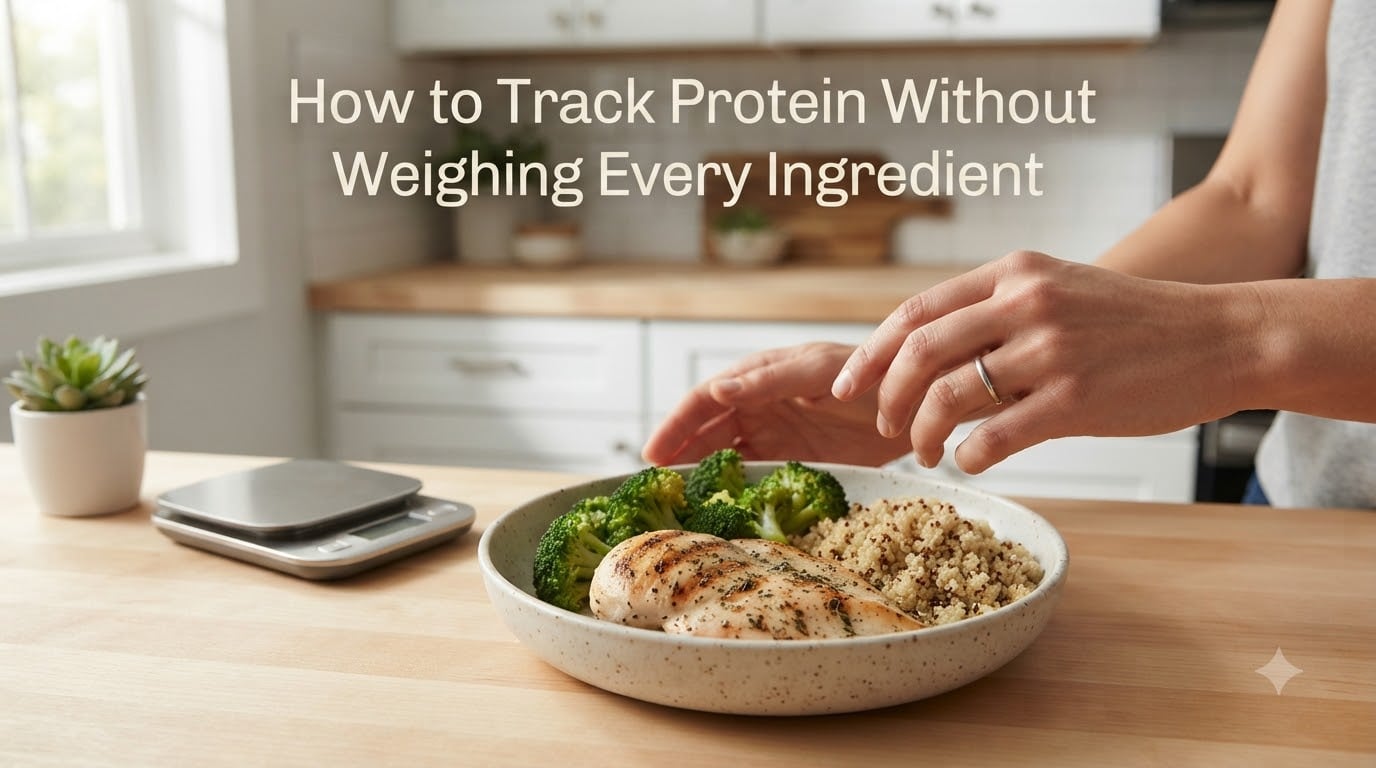
I used to think I had to weigh every chicken breast, every scoop of Greek yogurt, every handful of almonds. Then I hit tracking burnout in about three weeks. The scale lived on my counter, the food diary lived in my head, and both of them made meals feel like math homework.
That experience taught me something I now share with everyone who asks about protein tracking. You do not need a food scale to hit your protein goals. Research from Precision Nutrition shows hand portion estimation lands within 95% accuracy of weighed tracking, and that 5% gap matters far less than whether you keep tracking for months instead of weeks.
This guide on how to track protein without weighing every ingredient walks you through the methods I have tested personally and seen work for hundreds of readers. You will learn the hand portion system, visual comparisons that anchor your eye, and a phased approach that keeps tracking sustainable for the long haul.
Table of Contents
- Why Tracking Protein Without a Scale Works
- The Hand Portion Method: Your Built-In Measuring Tool
- Visual Comparisons Using Everyday Objects
- Calibrating Your Eye With a Brief Weighing Phase
- Restaurant and Homemade Meal Strategies
- The 3-3-3 Protein Rule and Other Quick Frameworks
- Common Mistakes to Avoid When Estimating Protein
- Apps and AI Photo Tracking for Hands-Free Logging
- Frequently Asked Questions
- Final Thoughts on Tracking Protein Without Weighing Every Ingredient
Why Tracking Protein Without a Scale Works
Weighing every ingredient is the gold standard for accuracy, but gold standards make for terrible daily habits. Most people quit tracking because the ritual of pulling out a scale, zeroing it, plating food, and logging grams exhausts them before the food does.
Hand portion estimation delivers around 95% of the accuracy of a digital scale while taking a fraction of the mental energy. Your hand is always with you, it scales naturally with your body size, and it requires zero cleanup. For the 1-2% of cases where precision matters (competition prep, medical protocols), the scale still has its place.
Here is the mindset shift that makes it click. Consistency beats precision. Hitting your protein target within 10 grams fifty times this month will change your body composition more than hitting it exactly right three times and quitting from frustration.
The Hand Portion Method: Your Built-In Measuring Tool
The hand portion method turns your hand into a portable, body-scaled measuring cup. Precision Nutrition popularized this approach, and it works because larger hands generally belong to larger bodies that need more food.
Palm-Size Portion for Protein
Your palm (without fingers) represents roughly 3-4 ounces of cooked meat, fish, or tofu. That serving delivers about 20-30 grams of protein depending on the source. Chicken breast, salmon, lean beef, tempeh, and seitan all fit this estimate.
For women, one palm per meal is a reasonable protein anchor. For men or larger-framed individuals, aim for two palm-sized servings per main meal. I aim for 4-5 palm portions spread across the day when my goal is around 160 grams of protein.
Fist, Cupped Hand, and Thumb for Carbs and Fats
Your closed fist equals about one cup of cooked grains, pasta, rice, or starchy vegetables. A cupped handful represents roughly half a cup of berries, chopped fruit, or cooked vegetables. Your whole thumb equals about a tablespoon of fats like olive oil, butter, nut butter, or mayonnaise.
These hand measurements are not perfect science, but they remove the guesswork from your plate. A fist of rice, a palm of chicken, a cupped hand of broccoli, and a thumb of olive oil covers a complete balanced meal with no scale required.
Visual Comparisons Using Everyday Objects
When hands feel too abstract, anchor portions to common objects you already recognize. These visual benchmarks stick in your memory faster than abstract numbers.
A deck of cards matches 3 ounces of cooked meat, which is about 21 grams of protein. A tennis ball matches one cup of cooked grains or chopped vegetables. A golf ball represents about two tablespoons of nut butter or hummus. A computer mouse matches a medium baked potato or similar starch serving.
Two dice represent about an ounce of hard cheese. A tennis ball halved is roughly a tablespoon of fats. A baseball matches one cup of pasta or rice. A checkbook equals about 3 ounces of fish.
Pick three or four of these anchors that resonate with you. I use deck of cards for protein, tennis ball for carbs, and thumb for fats. Those three references cover 90% of my meals without any weighing.
Calibrating Your Eye With a Brief Weighing Phase
The fastest way to train accurate estimation is to spend two to three weeks weighing everything you eat. Do not weigh forever. Weigh just long enough to build a mental library of portion sizes.
During this calibration phase, weigh your usual proteins, your typical carb servings, and the fats you cook with most often. Notice that 4 ounces of raw chicken becomes about 3 ounces after cooking. Notice that a “handful” of almonds you thought was one ounce is actually closer to half an ounce if you count carefully.
After two or three weeks of deliberate weighing, put the scale away. Your brain now has internal references that will serve you for years. This is the same approach competitive eaters and professional chefs use to develop portion intuition without the kitchen equipment.
Restaurant and Homemade Meal Strategies
Restaurants are where most tracking plans fall apart. Portions are hidden, ingredients are mixed, and asking the kitchen for specifics feels awkward. Here is what actually works.
Use your hand as the anchor. A restaurant chicken entrée typically contains one to two palm-sized portions. A pasta dish usually contains one to two fists of noodles. Estimate the protein source and double it mentally, since restaurant portions skew generous.
For homemade family meals where you did not cook, the strategy is different. Identify the protein anchor on your plate and estimate from there. A chicken thigh roughly equals a palm. A scoop of casserole usually contains one to two ounces of meat mixed in. A ladle of soup might contain 5-10 grams of protein depending on the recipe.
When you cook family meals yourself, weigh your protein ingredients one time to learn the cooked yield. Five ounces of raw ground beef cooks down to about three and a half ounces. That single measurement teaches you the conversion for every future taco night.
The 3-3-3 Protein Rule and Other Quick Frameworks
The 3-3-3 protein rule is a simple framework for distributing protein across your day. Eat 30 grams of protein at three separate meals, ideally spaced 3-4 hours apart. This approach keeps muscle protein synthesis stimulated throughout the day.
For a 150-pound active woman, 3-3-3 delivers around 90 grams of protein daily. For a 200-pound man, it lands closer to 120 grams. Adjust the per-meal target up or down based on your body weight and goals, but keep the three-meal structure consistent.
The 30/30/40 rule is a related macro framework where 30% of calories come from protein, 30% from fat, and 40% from carbohydrates. It works well for active individuals but is less protein-dense than 3-3-3 for muscle-building goals.
Another quick framework is the “protein first” rule. Build every meal around a protein source, then add vegetables and carbs around it. This single habit does more for hitting protein targets than any tracking method.
Common Mistakes to Avoid When Estimating Protein
Cooking oils add calories but zero protein, yet people often forget to account for them. Two tablespoons of olive oil adds 240 calories to a meal that might feel light because the food volume did not change. Track fats with your thumb method.
Liquid calories hide in smoothies, coffee drinks, and protein shakes. A homemade smoothie can easily contain 40+ grams of protein if you include Greek yogurt, protein powder, and milk, but it might also contain 500 calories from fruit and nut butter. Liquids do not trigger satiety the same way solids do.
Portion distortion creeps in over time. The plates you use today are likely larger than the plates you used ten years ago. Use smaller plates deliberately. A palm of chicken looks bigger on a salad plate than on a dinner plate, and your brain registers that visual cue.
Finally, do not forget about protein in unexpected places. Vegetables like broccoli, spinach, and peas contain meaningful protein. Grains, nuts, and seeds add small amounts that compound across the day. Bread contributes about 3-4 grams per slice. These hidden sources help you hit targets without obsessing over the main protein anchor.
Apps and AI Photo Tracking for Hands-Free Logging
Apps make hand portion tracking even easier. MyFitnessPal and Cronometer both allow you to log foods in common serving sizes (cups, ounces, palm-sized) without ever touching a scale. Cronometer is particularly useful for protein-focused trackers because it shows complete amino acid profiles.
If you want zero-typing tracking, AI photo tracking is now viable. Apps like Bitesnap, SnapCalorie, and Lose It use your phone camera to estimate calories and macros from a single photo. Independent testing shows these tools land within 10-15% accuracy for most meals, which matches hand estimation.
The best app is the one you will use consistently. I rotate between Cronometer for precision runs and simple mental tracking for everyday meals. Neither approach requires a scale.
For a complete planning workflow that pairs with protein tracking, a structured meal planner helps you build protein-forward meals ahead of time. Pre-planning eliminates the “what is for dinner” decision fatigue that derails most tracking efforts.
Frequently Asked Questions
What is the 3-3-3 protein rule and how does it work?
The 3-3-3 protein rule means eating 30 grams of protein at each of three meals, spaced roughly 3-4 hours apart. It keeps muscle protein synthesis stimulated throughout the day and delivers around 90-120 grams of protein depending on body size.
What is the easiest way to track protein without weighing?
The easiest method is the hand portion system. One palm equals 3-4 ounces of cooked protein (20-30g). One fist equals one cup of carbs. One thumb equals one tablespoon of fats. This approach is about 95% as accurate as weighing and requires no equipment.
Is there a protein tracker app that does not track calories?
Cronometer allows you to focus on specific macros including protein while hiding calorie totals if desired. You can also use simple notes apps or a basic spreadsheet to log palm-sized protein portions at each meal without any calorie tracking.
How accurate is hand portion estimation compared to weighing?
Research from Precision Nutrition shows hand portions land within 95% accuracy of weighed tracking. The 5% gap matters far less than the consistency benefit, since most people quit weighing after a few weeks but can sustain hand estimation for months or years.
How do I track protein in homemade family meals?
Identify the protein anchor on your plate and estimate from there. Weigh the raw protein ingredient once to learn its cooked yield, then use that reference for future meals. A ladle of soup typically contains 5-10g of protein depending on the recipe.
Final Thoughts on Tracking Protein Without Weighing Every Ingredient
You do not need a food scale to hit your protein goals. The hand portion method, visual anchors, and brief calibration phase give you 95% of the accuracy with a fraction of the effort. Pick one method from this guide and practice it for two weeks before adding anything else. Your protein intake will stay consistent, your tracking fatigue will disappear, and your results will speak for themselves.