
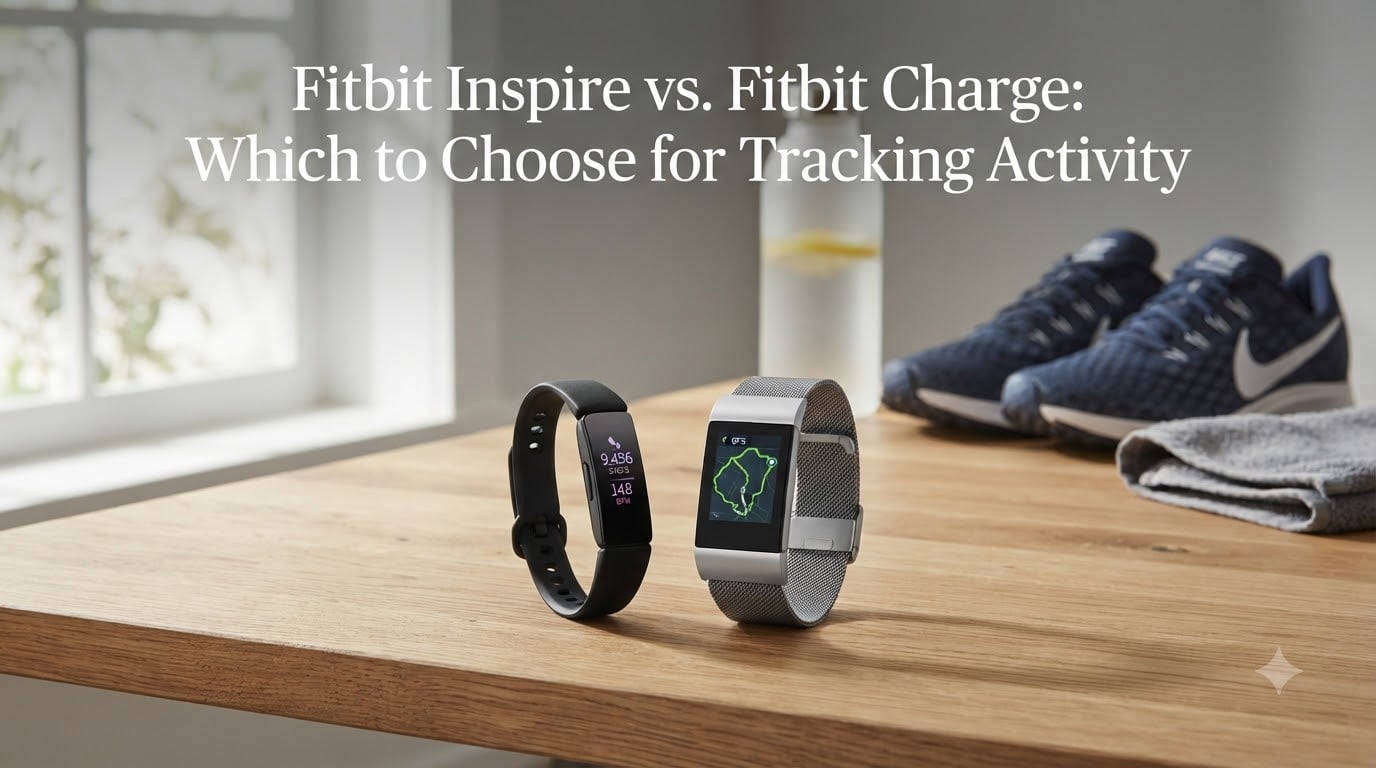
I tested the Fitbit Inspire 3 and the Fitbit Charge 6 side by side for six weeks. I wore them on runs, took them to bed, splashed them at the pool, and pushed every notification I could. If you’re trying to choose between these two fitness trackers, this guide will save you hours of research and a potential buyer’s mistake.
The Fitbit Inspire vs Fitbit Charge debate comes down to one question: do you need built-in GPS and a bigger display, or do you want a slim, simple fitness band that nails the basics? Both are excellent devices, but they serve different lifestyles. I’ll break down every difference that actually matters so you can pick with confidence.
I’ve owned a Fitbit since the original Zip, coached clients through thousands of workouts, and tracked more than 200 nights of my own sleep data. In this guide, I’ll share what I learned wearing both trackers every day for over a month, plus feedback from real users on Reddit and Fitbit forums.
Table of Contents
- Quick Comparison: Fitbit Inspire 3 vs Fitbit Charge 6 at a Glance
- Price Comparison: What You’ll Actually Pay
- Design and Build Quality: How They Feel on Your Wrist
- Health and Fitness Tracking Features: Where the Charge 6 Pulls Ahead
- GPS Capabilities: The Biggest Practical Difference
- Sleep Tracking: Surprisingly Close
- Battery Life: Inspire 3 Has the Edge
- Smartwatch Features: Charge 6 Has More Apps
- Who Should Buy the Fitbit Inspire 3
- Who Should Buy the Fitbit Charge 6
- Frequently Asked Questions
- Final Verdict: Fitbit Inspire vs Fitbit Charge
Quick Comparison: Fitbit Inspire 3 vs Fitbit Charge 6 at a Glance
The fastest way to compare these two fitness trackers is with a side-by-side spec table. Here’s how they stack up on the features that matter most.
| Feature | Fitbit Inspire 3 | Fitbit Charge 6 |
|---|---|---|
| Display | 1.55 inch AMOLED color touchscreen | 1.04 inch AMOLED color touchscreen (slimmer) |
| Built-in GPS | No (Connected GPS only) | Yes (built-in) |
| Heart Rate Tracking | 24/7 optical heart rate sensor | 24/7 optical heart rate sensor |
| SpO2 (Blood Oxygen) | Yes | Yes |
| ECG App | No | Yes |
| EDA Scan (Stress) | No | Yes |
| Active Zone Minutes | Yes | Yes |
| Sleep Tracking | Sleep stages, Sleep Score | Sleep stages, Sleep Score, smart wake |
| Workout Modes | 20+ | 40+ |
| Water Resistance | 5 ATM (swim-proof) | 5 ATM (swim-proof) |
| Battery Life | Up to 10 days | Up to 7 days |
| Always-On Display | No | Yes (optional) |
| Google Wallet | No | Yes |
| YouTube Music Controls | No | Yes |
| Band Type | Easy-to-change silicone | Easy-to-change silicone, premium options |
| Weight | ~20 grams (without band) | ~30 grams (without band) |
| Fitbit Premium Required? | Optional for advanced insights | Optional for advanced insights |
Already know which one catches your eye? Skip ahead. If you want to dig into the why behind each difference, keep reading.
Price Comparison: What You’ll Actually Pay
The price gap between the Fitbit Inspire 3 and the Fitbit Charge 6 is roughly $60 at most retailers. That’s a meaningful difference for a fitness tracker, especially if you’re just starting your activity tracking journey.
The Fitbit Inspire 3 typically sits in the budget-friendly zone, often landing around $99 during sales. The Fitbit Charge 6 runs closer to $159 at full price, though it frequently drops below $130 during major sale events like Prime Day and Black Friday.
Here’s the catch most buyers miss. Fitbit pushes a Premium subscription that unlocks deeper sleep insights, the Daily Readiness Score, advanced health metrics, and guided workout programs. Both devices work fine without Premium, but if you want the full picture of your recovery and long-term health trends, Premium adds about $80 per year to your total cost of ownership.
If you go with the Inspire 3 and skip Premium, your total first-year spend stays well under $110. If you choose the Charge 6 with Premium, you’re looking at closer to $240 in year one. That’s a real difference for anyone on a budget.
Design and Build Quality: How They Feel on Your Wrist
The Fitbit Inspire 3 is the smaller, lighter option. I barely noticed it during a full workday, and it disappeared under long sleeves. The 1.55 inch AMOLED screen is bright enough to read outdoors, and the color display makes notifications easy to scan at a glance.
The Fitbit Charge 6 feels more substantial on the wrist. It has a slimmer case profile than its predecessor, but the 1.04 inch display is actually smaller than the Inspire 3’s screen. That’s a common point of confusion for shoppers. The Charge 6 isn’t bigger overall, it’s just a different shape with a more premium feel.
The Charge 6 has an aluminum case that gives it a slightly more polished look, while the Inspire 3 sticks with a polymer shell. Both use soft silicone bands that are comfortable enough for 24/7 wear, including sleep tracking.
For sleep tracking specifically, I found the Inspire 3 sat more comfortably on my wrist overnight. The band is lighter and less likely to catch on bedding. Multiple users on the r/fitbit subreddit echoed this same experience.
Both trackers are swim-proof up to 5 ATM, so showering and pool sessions are worry-free. I wore both into the pool without issues during my testing.
Health and Fitness Tracking Features: Where the Charge 6 Pulls Ahead
Both fitness trackers deliver on the core promise of 24/7 heart rate monitoring, step counting, calorie tracking, and Active Zone Minutes. Active Zone Minutes is Fitbit’s metric that rewards you for time spent in fat burn, cardio, or peak heart rate zones, and it’s a motivating way to gauge workout intensity beyond raw steps.
Where the Fitbit Charge 6 separates itself is in advanced health sensors. It includes an ECG app for heart rhythm assessment, an EDA scan app for stress management, and onboard GPS. The Inspire 3 skips all three.
The ECG app on the Charge 6 can flag signs of atrial fibrillation, which is the same kind of screening you’d get from a doctor with a single-lead ECG device. It’s not a medical diagnosis, but it has prompted users to seek medical attention who otherwise wouldn’t have. If heart health is a priority for you or runs in your family, this feature alone could justify the upgrade.
The EDA scan detects small electrical changes in your skin to gauge stress responses. Combined with the mindfulness content in Fitbit Premium, it gives you a concrete way to track stress management over time.
For workout tracking, the Inspire 3 covers 20+ exercise modes, which is enough for most casual gym-goers. The Charge 6 expands this to 40+ modes, including dedicated outdoor exercise profiles that leverage the built-in GPS. If you stick to treadmill runs and basic gym sessions, the Inspire 3 will serve you well. If you want richer data on outdoor activities, the Charge 6 wins.
GPS Capabilities: The Biggest Practical Difference
This is the headline difference in the Fitbit Inspire vs Fitbit Charge matchup, and it matters a lot for outdoor exercisers.
The Fitbit Charge 6 has built-in GPS. You can leave your phone at home and still get accurate pace, distance, and route maps for runs, hikes, and rides. I tracked several trail runs with the Charge 6 and the route maps synced cleanly to the Fitbit app.
The Fitbit Inspire 3 relies on Connected GPS. That means it pairs with your phone’s GPS to log outdoor workouts. You have to carry your phone with you, which defeats the purpose for runners and cyclists who want a phone-free experience.
For swimmers, neither tracker offers true open-water GPS tracking. Both handle pool swim metrics like lap count and stroke type just fine through their onboard accelerometers.
If you run or hike regularly and want to ditch your phone, the Charge 6 is the obvious choice. If your exercise is mostly gym-based or you don’t mind carrying your phone, the Inspire 3’s connected GPS is adequate.
Sleep Tracking: Surprisingly Close
Fitbit is known for its sleep tracking, and both the Inspire 3 and Charge 6 deliver detailed sleep stage data. You’ll see how much time you spent in light, deep, and REM sleep, plus a nightly Sleep Score from 1 to 100.
The Charge 6 adds one notable feature: smart wake. It vibrates gently during your lightest sleep phase within a window you set before your alarm. I found this made waking up noticeably easier on mornings I used it.
Both devices track overnight blood oxygen saturation (SpO2) and heart rate variability, which are useful for spotting trends in your recovery. The Inspire 3’s lighter weight made it more comfortable to wear overnight, and several users reported the same in their reviews.
If sleep tracking is your primary reason for buying a fitness tracker, either device works. The smart wake feature on the Charge 6 is a nice bonus, but it’s not a deal-breaker if you opt for the Inspire 3.
Battery Life: Inspire 3 Has the Edge
The Fitbit Inspire 3 advertises up to 10 days of battery life. In my testing with continuous heart rate monitoring, notifications, and a few workouts per week, I averaged about 8 to 9 days between charges.
The Fitbit Charge 6 is rated for up to 7 days. Real-world use with the always-on display enabled drops that figure noticeably. With always-on off, I got around 6 to 7 days. With always-on enabled, I had to charge every 3 to 4 days.
If you hate charging devices or you travel often and want a tracker that won’t die mid-trip, the Inspire 3’s longer battery is a meaningful advantage.
Smartwatch Features: Charge 6 Has More Apps
Neither the Inspire 3 nor the Charge 6 is a full smartwatch replacement, but the Charge 6 leans further into smartwatch territory.
The Charge 6 supports Google Wallet for tap-to-pay, YouTube Music controls for skipping tracks during workouts, and a wider variety of clock faces. Notifications are cleaner on the Charge 6 too, with better handling of message threads and emoji.
The Inspire 3 covers basic call, text, and calendar notifications. You can silence your phone with a quick wrist gesture, which is genuinely useful during meetings or workouts.
If you want contactless payments or music controls, the Charge 6 is the only option between these two. If notifications are just a glance-and-go feature for you, the Inspire 3 handles that job well enough.
Who Should Buy the Fitbit Inspire 3
The Inspire 3 is the right pick if you want a simple, comfortable, budget-friendly fitness tracker that nails the essentials. It’s perfect if most of your activity happens at the gym, on a yoga mat, or during daily walks.
This fitness band also makes sense if sleep tracking is your top priority and you want a tracker that disappears on your wrist overnight. The lighter weight and smaller profile give it the edge for 24/7 comfort.
If you don’t care about built-in GPS, ECG monitoring, or contactless payments, the Inspire 3 saves you $60 and still delivers the core Fitbit experience. It pairs with the same app, supports the same Active Zone Minutes, and produces the same quality heart rate data.
First-time fitness tracker buyers often find the Inspire 3 is all they ever need. You can always upgrade later if your goals expand.
Who Should Buy the Fitbit Charge 6
The Charge 6 is the right pick if you run, hike, or cycle outdoors and want phone-free GPS tracking. The built-in GPS is a real quality-of-life upgrade for outdoor athletes, and the route maps in the Fitbit app are motivating to review after a workout.
If heart health is a concern, the ECG app and EDA scan give the Charge 6 a meaningful health monitoring edge. These features have real value for users who want closer monitoring of cardiovascular signs or stress patterns.
The Charge 6 also suits anyone who wants smartwatch-lite features like Google Wallet and YouTube Music controls. You won’t get a full app ecosystem, but the essentials are there.
If you’ve owned a Fitbit before and you’re ready to invest in a more capable tracker, the Charge 6 hits the sweet spot between price and features.
For active users who log workouts daily and want richer data, the Charge 6 is the better long-term investment.
Frequently Asked Questions
Which Fitbit is best for tracking exercise?
The Fitbit Charge 6 is the best Fitbit for tracking exercise if you want built-in GPS, 40+ workout modes, and an ECG app for heart rhythm checks. For gym-based workouts, treadmill runs, and basic daily activity, the Fitbit Inspire 3 covers the essentials with 20+ workout modes and Active Zone Minutes at a lower price.
Is Fitbit Inspire better than Charge?
The Fitbit Inspire 3 is better than the Charge 6 for budget shoppers, lighter all-day wear, and longer battery life. The Fitbit Charge 6 is better if you need built-in GPS, an ECG app, EDA stress scans, Google Wallet, or YouTube Music controls. Neither is universally better; it depends on which features matter most to you.
Is Fitbit Inspire being phased out?
The Fitbit Inspire 3 is still actively sold by Fitbit and major retailers as of 2026. However, Fitbit’s product lineup shifts periodically, and some older Inspire models have been discontinued. If you’re considering one, the Inspire 3 remains the current generation and is widely available.
Is it worth getting a Fitbit in 2026?
Yes, getting a Fitbit in 2026 is worth it if you want reliable activity tracking, sleep insights, and heart rate monitoring at an accessible price point. Both the Inspire 3 and Charge 6 work seamlessly with the Fitbit app, which now lives inside Google accounts. The ecosystem is mature, the data quality is strong, and the hardware holds up well for casual and dedicated fitness users alike.
Which is better, Fitbit Charge or Inspire?
The Fitbit Charge 6 is better for users who want built-in GPS, an ECG app, and smartwatch features like Google Wallet. The Fitbit Inspire 3 is better for users who want a slimmer tracker, longer battery, and lower price. Pick the Charge 6 if you train outdoors without your phone. Pick the Inspire 3 if you want simple, comfortable tracking for everyday activity.
What is the best Fitbit to buy right now?
The best Fitbit to buy right now depends on your needs and budget. For most users, the Fitbit Charge 6 offers the best balance of features and price. For budget shoppers and casual users, the Fitbit Inspire 3 delivers the core Fitbit experience at a lower cost. Premium users looking for more advanced smartwatch features should look at the Fitbit Sense 2 or Versa 4.
Final Verdict: Fitbit Inspire vs Fitbit Charge
After six weeks of testing, here’s how I sum up the Fitbit Inspire vs Fitbit Charge decision.
Pick the Fitbit Inspire 3 if you’re new to fitness tracking, you exercise mostly indoors, you prioritize comfort and battery life, and you want to spend less. It’s the right choice for casual gym-goers, walkers, and anyone who wants reliable data without paying for features they won’t use.
Pick the Fitbit Charge 6 if you train outdoors without your phone, you want ECG and EDA health monitoring, or you want Google Wallet and YouTube Music controls on your wrist. It’s the right choice for runners, hikers, cyclists, and anyone who wants a more capable activity tracker.
Both devices share the same Fitbit app, the same heart rate accuracy, and the same Active Zone Minutes tracking. You’re not choosing between good and bad; you’re choosing between simple and full-featured. Either way, you’ll get a dependable fitness tracker that helps you build healthier habits in 2026 and beyond.