
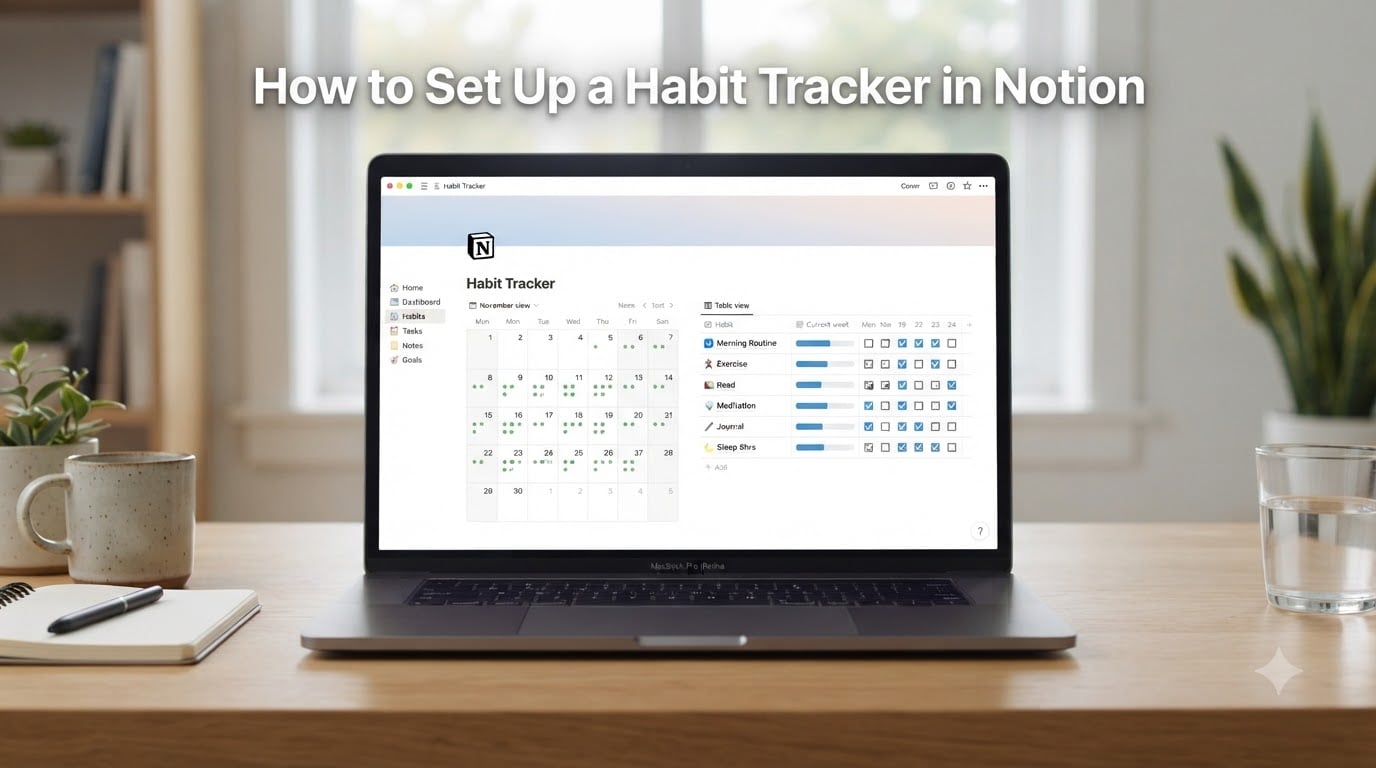
I built my first Notion habit tracker in 2026, gave up after two weeks, and deleted the page. The database was too complex. The formulas broke every time I added a new habit. And I had to manually uncheck the same boxes every single morning.
When I rebuilt it in 2026, I kept it simple. One database, five habits, checkbox properties, and a calendar view. I am still using it 14 months later. The difference was not motivation. It was a setup that did not fight me.
That is the goal of this guide. I will walk you through exactly how to set up a habit tracker in Notion, from a blank page to a working system with progress bars and streak tracking. You will get a free template structure, the exact property types to use, and the mistakes I made so you can skip them.
By the end, you will have a habit tracker you actually open every day. Not one that lives buried in your sidebar.
Table of Contents
- Why Notion Works for Habit Tracking
- How to Set Up a Habit Tracker in Notion: Step-by-Step Guide
- Property Types Explained for Habit Tracking
- Create a Habit Tracker Calendar View in Notion
- Set Up Streak Tracking and Day Scores
- ADHD-Friendly Habit Tracking Tips That Actually Work
- Mobile Optimization: Track Habits on Your Phone
- Common Mistakes to Avoid When Building a Notion Habit Tracker
- Choosing the Right Notion Habit Tracker Setup for Your Goals
- Frequently Asked Questions
- Final Thoughts on Building Your Notion Habit Tracker
Why Notion Works for Habit Tracking
Habit tracking is mostly a logging problem. You need to write down what you did, when you did it, and see the pattern over time. Notion handles all three in a single workspace.
The real power is the database. Each row is a day. Each column is a habit. Checkboxes, dates, formulas, and relations all live in one place. You can view the same data as a table, a calendar, or a gallery, and switch with one click.
Other tools work too. But if you already use Notion for notes, tasks, or your planner, adding a habit tracker means one fewer app to open. That friction matters more than any feature.
A 2023 study from the European Journal of Social Psychology found that automaticity in habit formation takes an average of 66 days. So your tracker needs to survive at least two months. A setup that requires five clicks per entry will not make it.
How to Set Up a Habit Tracker in Notion: Step-by-Step Guide
Here is the exact process I use. It takes about 20 minutes from a blank page to a working tracker. You will need a free Notion account.
Step 1: Create a New Database in Notion
Open Notion and create a new page. Type the slash command /database and select Database – Full page. Name it Habit Tracker or whatever you prefer.
This database is your foundation. Every habit, every day, every formula you add will live here. Keep it top-level in your workspace so it is easy to find.
You now have a blank table with one default property called Name. Leave that for now. We will add the rest in the next step.
Step 2: Configure Date and Checkbox Properties
The second property should be a Date property. Click the plus icon next to Name, name it Date, and select Date as the type. This property will mark which day each row represents.
Now you will add one Checkbox property per habit. Start with five or fewer. Add one, name it after a specific habit (like Drink Water or Read 10 Pages), and set the type to Checkbox.
Examples of habits to track: – Drink 8 glasses of water – Exercise 30 minutes – Read 10 pages – Meditate 5 minutes – No phone after 9 pm
Specific habits beat vague ones. “Exercise” is hard to check off. “Walk 20 minutes” is clear.
Step 3: Add Your Habits and Customize Columns
Before logging days, brainstorm your habit list in a separate Notion list or on paper. Aim for five to seven habits. More than that and the daily check-in becomes a chore.
Each habit should be: – Actionable (something you do, not something you avoid) – Specific (measurable by the end of the day) – Realistic (fits your current life, not your ideal life)
Once your list is ready, add each as a checkbox column in the database. Drag the columns to reorder them so your most important habits are on the left.
Step 4: Use a Template Button for Daily Tracking
This is the step that makes the system stick. Click the dropdown arrow next to the blue New button in your database. Select + New template.
A template is a pre-filled row. Edit it so the Date property is set to today’s date and all checkbox properties are unchecked. Name it Today or Daily Entry.
Now when you click New, Notion creates a row with today’s date and empty checkboxes. One click, ready to track.
If you want automatic daily entries, you can set the template to repeat. Click the template’s dropdown, select Repeating template, and choose Daily. Notion will generate a new row every day automatically.
Step 5: Add Progress Bars and Formulas for Streaks
Progress bars give you visual feedback. They turn abstract checkboxes into a streak you can see grow.
Add a new Formula property called Daily Score. Paste this formula:
prop("Drink Water") + prop("Exercise") + prop("Read") + prop("Meditate") + prop("No Phone")
Replace each property name with your actual column names. This formula counts how many habits you completed on a given day.
For a percentage, add another formula property called Completion %:
(prop("Daily Score") / 5) * 100
Notion will render this as a number. To turn it into a progress bar, open the formula property’s settings, scroll to Number format, and select Progress bar.
Streak tracking requires a more complex formula. If you want a full streak counter, search for “Notion habit streak formula” and copy one from the Notion subreddit. Be warned: these formulas break easily if you rename a property.
Property Types Explained for Habit Tracking
Notion has 11 property types. You only need four for habit tracking. Here is what each one does and when to use it.
Checkbox is for yes/no habits. Did you meditate today? Yes or no. This is the most common property for habit tracking.
Date marks when a row was created. For habits, this is the day you are logging. Skip this and you lose the timestamp that makes progress possible.
Formula calculates values from other properties. Use it for daily scores, completion percentages, and streak counts. Formulas are powerful but fragile. Rename a property and the formula breaks.
Select works for habits with multiple states. Use it for “Mood” (Great, OK, Bad) or “Workout Type” (Cardio, Strength, Rest). Avoid it for simple yes/no habits.
Skip Number, Email, Phone, and URL for habit tracking. They serve other purposes and add clutter.
Create a Habit Tracker Calendar View in Notion
The table view is fine for logging. But a calendar view makes progress visible at a glance.
Click the + icon next to your current view name at the top of the database. Select Calendar. Set the Date property as the date source.
You now have a monthly calendar where each day shows a card with your checkboxes. Completed days look full. Skipped days look empty. The pattern is obvious.
Add a filter to show only the current month. Click Filter, add a rule where Date is is within the past 1 month. This keeps the view clean.
For a heatmap effect, group your calendar by week. Each completed day pops visually. Incomplete days fade. You can see your consistency without reading a single number.
Set Up Streak Tracking and Day Scores
Streaks turn small wins into momentum. A 7-day streak feels different from a single check.
To track streaks, you need a formula that counts consecutive days. Here is a simplified version for a single habit called Read:
if(prop("Read") and dateBetween(now(), prop("Date"), "days") <= 1, 1, 0)
For a full streak counter that survives gaps, you need a more complex formula using lets() and toNumber() functions. Thomas Frank has a detailed walkthrough if you want to go deep.
Realistic warning: streaks are motivating until you miss a day. Then they feel like failure. Build in a “grace day” mental model. Missing one day resets the streak but not the habit. The goal is consistency over weeks, not perfection over days.
A Day Score is easier than a streak and often more useful. It tells you how many habits you completed on a given day, not how long you have kept going. A day score of 4 out of 5 is a good day. Treat it that way.
ADHD-Friendly Habit Tracking Tips That Actually Work
Notion is ADHD-friendly in the same way a gym is athletic-friendly. The tool is there. Whether it helps depends on how you set it up.
For ADHD brains, the biggest risk is friction. If opening your tracker takes three clicks, you will not open it. Reduce friction ruthlessly.
Use the Notion mobile app and pin the habit tracker to your home screen. On iPhone, open the page in Safari, tap share, then Add to Home Screen. On Android, Chrome offers the same option in the menu.
Limit habits to three or fewer. ADHD working memory is limited. Five habits feels like fifty. Three feels doable.
Pair new habits with existing ones. Do your meditation right after brushing your teeth. Habit stacking works because the trigger is already wired in.
Skip streak tracking if it stresses you out. A day score or simple checkmark is enough. The point is the habit, not the data.
Build a “low effort” mode. Some days you will not have the energy to check five boxes. On those days, count opening the tracker as a win. Notion cannot track that. But you can.
Mobile Optimization: Track Habits on Your Phone
Most habit check-ins happen on your phone. If your Notion setup is not phone-friendly, you will not use it.
Open the Notion mobile app and navigate to your habit tracker. The default table view is hard to use on a phone. Switch to the calendar view. Each day becomes a tappable card.
Tap a day to check off your habits. The boxes are large enough for thumbs. The experience is closer to a native app than the desktop table.
For fastest access, add a Notion widget to your phone’s home screen. On iPhone, long-press the home screen, tap the plus, and search for Notion. You can pin the habit tracker directly. On Android, use the Notion widget from the widget picker.
Toggle the offline mode in Notion settings. The habit tracker will load even without internet. This matters when you are at the gym or in a coffee shop with bad Wi-Fi.
Common Mistakes to Avoid When Building a Notion Habit Tracker
I made every mistake below. Learn from them.
Tracking too many habits at once. Start with three. Add more only after two weeks of consistent logging. New habits compete for attention. Fewer habits win.
Using complex formulas on day one. Start with a simple checkbox database. Add formulas after you have 30 days of data. The data tells you what to measure, not the other way around.
Ignoring the mobile experience. Your tracker needs to work on your phone. If it does not, switch to a calendar view or use a widget. Desktop-only trackers die fast.
Forgetting to log weekly. Looking at your data weekly keeps you honest. Pick a Sunday morning review. Open the calendar view. Note what worked. Adjust what did not.
Chasing streak perfection. Missing one day is not failure. It is data. A habit tracker that punishes you for being human gets abandoned.
Building a beautiful template and never using it. I have a folder of gorgeous Notion templates I never opened. The best template is the one you actually use. Keep it simple.
Choosing the Right Notion Habit Tracker Setup for Your Goals
Not every habit tracker needs the same setup. Match the system to your goal.
If you want to track 2-3 daily habits and stay consistent, use a simple database with checkbox properties and a calendar view. No formulas. Skip the streak tracking. Just check the boxes. This is the lowest-friction setup and works for most people.
If you want completion percentages and visual progress, add a Day Score formula and a Progress Bar property. This setup shows you consistency over time without complex streak math. Good for visual learners.
If you want full streak tracking and analytics, add a streak formula and a separate analytics database that pulls daily data. This is the most complex setup. It rewards the data-hungry user but adds friction. Use it only after a month of basic tracking.
If you want a gamified system, add a separate Points database and a relation property. Award points for streaks. Build a level system. This works for some ADHD brains but adds maintenance overhead. Try it only if basic tracking feels boring.
For weight loss habits specifically, pair this habit tracker with a meal logging system. The habit tracker logs the routine. A separate log captures the data. Combining them in one database gets cluttered fast.
Frequently Asked Questions
How can I build a habit tracker in Notion?
Create a new database, add a Date property and one Checkbox property per habit, then create a daily template button. For visual progress, add a Formula property that calculates completion percentage and render it as a progress bar. The full setup takes about 20 minutes and requires no coding.
Is Notion ADHD friendly?
Yes, but only with a low-friction setup. Limit habits to three or fewer, use the mobile app, pin the tracker to your home screen as a widget, and skip streak tracking if it causes stress. A simple checkbox database works better for ADHD than a complex formula-driven one. The goal is consistency, not data perfection.
How do I create my own habit tracker?
Start with a notebook or paper log for one week to confirm you want to track the habit. Then move to Notion with a simple database: one Date property, one Checkbox property per habit, and a calendar view. Add formulas only after 30 days of consistent data. The best tracker is the one you actually use daily.
Can ChatGPT make a Notion template?
Yes, ChatGPT can generate Notion formulas, database structures, and even full template descriptions. However, you still need to build the database manually in Notion. ChatGPT is useful for writing streak formulas and calculating completion percentages, but cannot create a working Notion page directly. Copy the output and paste it into a Notion Formulas 2.0 window.
Final Thoughts on Building Your Notion Habit Tracker
You now have everything you need to set up a habit tracker in Notion. The whole process is one database, four property types, and about 20 minutes.
Start simple. Five habits, checkbox properties, a calendar view. Use it for two weeks. Then add formulas, progress bars, and streak tracking only if you want them.
The best habit tracker is the one you open every morning. Not the one with the most features. Build for consistency first. Optimize later.
Open a new Notion page right now. Type /database. You have 20 minutes. I will see you on the other side.