
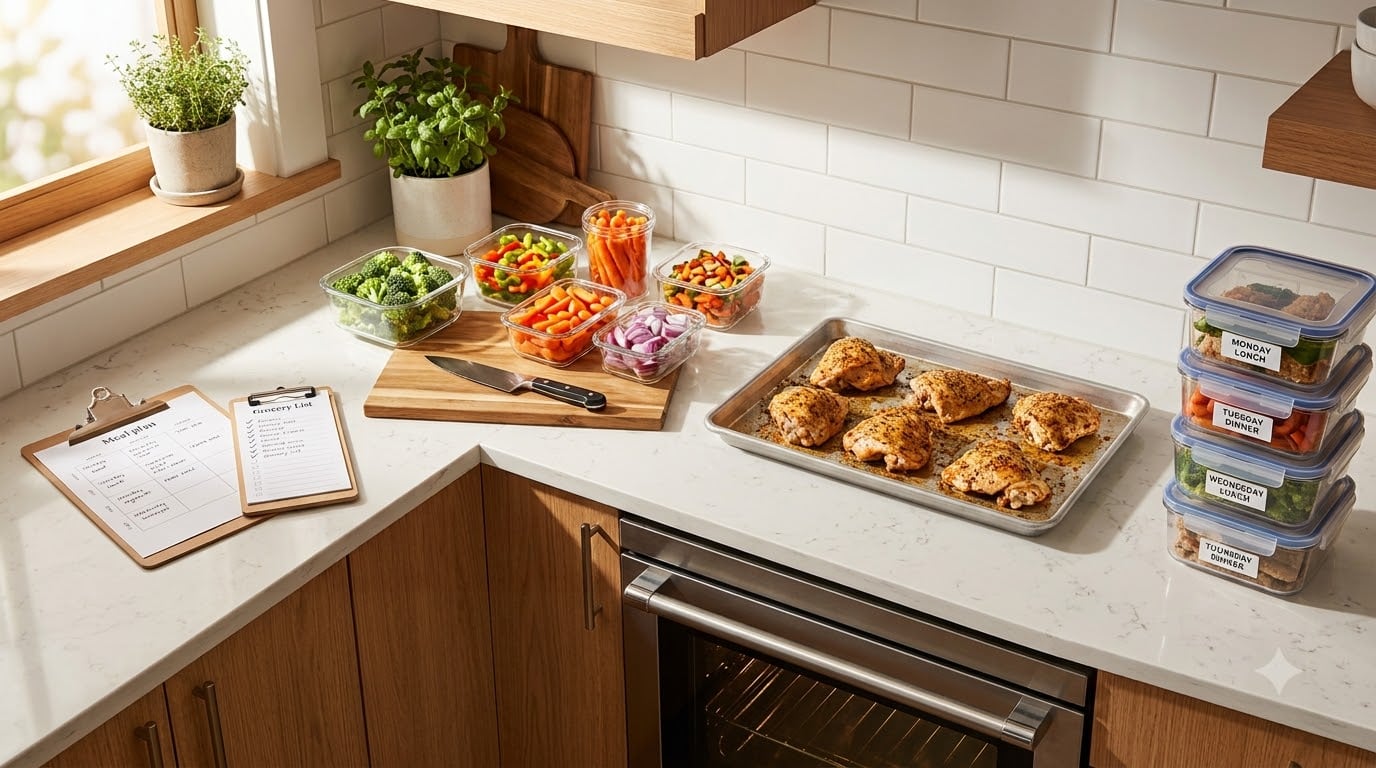
I have lost entire Sundays to meal prep more times than I want to admit. Six hours in, dishes piled high, and I am too tired to enjoy the rest of the day. That is exactly why I built a structured Sunday meal prep workflow instead of winging it each week.
A reliable Sunday meal prep workflow is the difference between a peaceful morning and an exhausting chore day. In this guide, I will walk you through the five phases I have refined over two years of testing with my own family. You will get specific timing, real portion targets, and the small details that keep the session under three hours.
By the end, you will have a repeatable system you can use every week in 2026 without burning out or staring into the fridge on Wednesday wondering what to eat.
Table of Contents
- Phase 1: Meal Planning and Strategy
- Phase 2: Grocery List Creation and Shopping
- Phase 3: Prep Day Organization and Setup
- Phase 4: Batch Cooking and Assembly
- Phase 5: Storage, Labeling, and Weekly Execution
- Time Management Tips for the Workflow
- Common Mistakes to Avoid
- Frequently Asked Questions
- Final Thoughts
Phase 1: Meal Planning and Strategy
Phase 1 is where every successful Sunday meal prep workflow begins, and skipping it is the single biggest mistake I see. Planning is not glamorous, but it is the reason the rest of the day runs on rails instead of derailing at 2 PM.
I start by choosing five weekday dinners and two breakfast options. Five dinners means I have a buffer for eating out, leftovers, or a true zero-cook night. For each dinner, I pick one protein, one starch, and one vegetable. This component-first approach is the secret to avoiding the boredom that kills 40 percent of meal preppers within the first month, according to community surveys on Reddit’s r/MealPrepSunday.
Write the plan down on paper, in a notes app, or in a dedicated planner. The act of writing is what reduces decision fatigue during the week. When Wednesday rolls around and someone asks “what is for dinner,” you have an answer ready in two seconds instead of staring blankly for ten minutes.
Here is my go-to weekly template:
- Monday: Lemon herb chicken, quinoa, roasted broccoli
- Tuesday: Turkey tacos, brown rice, black beans
- Wednesday: Salmon, sweet potato, green beans
- Thursday: Stir fry with tofu, jasmine rice, mixed peppers
- Friday: Pasta night with ground turkey and marinara
Rotate three or four base recipes and you never have to plan from scratch. A few of my family favorites include sheet pan chicken, slow cooker pulled pork, and a simple baked salmon. Each takes about 30 minutes of active prep, which fits cleanly into the workflow.
Build a master recipe list
Keep a running list of 12 to 15 tested recipes in one place. I keep mine in a single note on my phone. When I plan a new week, I pick five from the list rather than searching the internet. This single habit has saved me an hour every Sunday.
Phase 2: Grocery List Creation and Shopping
Phase 2 turns your meal plan into a shopping list you can complete in under 45 minutes. A good grocery list is grouped by store layout so you walk the aisles once instead of three times. I have learned this the hard way.
Go through each recipe and list ingredients by category: produce, proteins, dairy, pantry, frozen. Double-check your pantry before adding staples like olive oil, rice, and spices. Buying duplicates you already own is the fastest way to blow your grocery budget.
The 5-4-3-2-1 grocery rule is a helpful guideline when you are building a list for a single person. For families, scale up: aim for 5 proteins, 4 vegetables, 3 fruits, 2 starches, and 1 flavor-building ingredient like fresh herbs or citrus. This keeps variety high without overwhelming your prep day.
Shopping strategy matters as much as the list. Shop on Saturday evening or early Sunday morning to avoid the 11 AM rush. Use self-checkout if your store has it. Most importantly, stick to the list. Impulse buys are how a 60-dollar grocery trip becomes 110 dollars.
Smart shopping shortcuts
Buy pre-chopped vegetables for your busiest weeks. Yes, it costs more, but it can shave 20 minutes off Phase 3 and 4. Rotisserie chicken is another cheat code. I pick one up and shred it for tacos, salads, and grain bowls across the week.
If your store runs sales on proteins, buy extra and freeze. Frozen chicken thighs and ground turkey keep for three months and are perfect for batch cooking.
Phase 3: Prep Day Organization and Setup
Phase 3 is what separates a three-hour session from a six-hour slog. Most people underestimate setup time, then wonder why they are still cooking at 4 PM. Your Sunday meal prep workflow needs a clean, organized station before you turn on a single burner.
Start by clearing your counters completely. Pull out every container, cutting board, knife, sheet pan, and pot you will need. Set out your grocery bags. Turn on music or a podcast. Set a visible timer. The first time I did this, I finished 90 minutes earlier than my previous attempts.
This is the “mise en place” principle from professional kitchens. Everything has a place before you start cooking. You will not be searching for a lid while something burns.
Here is what I pull out for a standard week:
- Three sheet pans and one large pot
- Two cutting boards and a chef’s knife
- Glass containers in three sizes
- Aluminum foil and parchment paper
- A label maker or masking tape and marker
Chop first, cook second
Chop every vegetable before you start cooking. Onions, peppers, broccoli, sweet potatoes, whatever your week calls for. Store raw chopped veg in airtight containers and pull them out as each protein finishes. This chop-first approach is the backbone of the 3-2-1 system used by many working parents.
I typically spend 30 minutes on chopping alone. That sounds like a lot, but it cuts cooking time in half because everything is ready to throw in the pan.
Phase 4: Batch Cooking and Assembly
Phase 4 is where the magic happens. The goal is to cook multiple components simultaneously so the oven, stovetop, and rice cooker are all working at once. This is real batch cooking, not cooking one thing, washing the pan, then cooking the next.
Start with whatever takes longest. If you have a whole grain like brown rice or quinoa, get that going first. While it simmers, get proteins into the oven or onto sheet pans. Vegetables roast at 425 degrees for 20 to 25 minutes, so they go in last.
A typical timing for me looks like this:
- 0:00 – Start rice or grains on the stovetop
- 0:05 – Season and oven proteins at 400 degrees
- 0:25 – Chop vegetables while proteins cook
- 0:40 – Add vegetables to sheet pan with proteins
- 1:00 – Pull proteins, let rest, start a second protein on the stovetop
- 1:30 – Cook vegetables on stovetop or steam
- 2:00 – Begin assembly into containers
- 2:45 – Clean as you go, label containers
Most proteins cook in 25 to 35 minutes at 400 degrees. Chicken breasts need an internal temperature of 165 degrees Fahrenheit. Salmon is done at 145 degrees. Ground proteins are safe at 160 degrees. A simple instant-read thermometer removes all guesswork and prevents the overcooking that dries out weeknight meals.
Component prep is the key difference between meal prep that excites you and meal prep that makes you dread lunch. Instead of five identical chicken-and-rice containers, you build a “bar” of ingredients. Three proteins, two starches, and one or two vegetables. Mix and match each day. Tuesday lunch can be chicken with sweet potato. Wednesday dinner can be the same chicken wrapped in a tortilla with peppers. Same ingredients, zero boredom.
Cook once, eat five ways
The 3-2-1 system is built around this principle. Three proteins cooked on Sunday can become six different meals when paired with different starches and sauces. A simple change of sauce transforms Tuesday’s teriyaki chicken into Wednesday’s buffalo chicken wrap.
Keep a small shelf of sauces and seasonings: soy sauce, salsa, hot sauce, tahini, pesto, Italian dressing. These low-cost flavor swaps make prepped food feel freshly cooked.
Phase 5: Storage, Labeling, and Weekly Execution
Phase 5 protects the four hours you just invested. Improper storage ruins more meal prep than bad recipes. I lost a whole week of containers to sogginess before I learned the right way.
First, cool food completely before sealing. Putting hot food in a sealed container creates condensation and accelerates bacterial growth. The USDA recommends cooling food to room temperature within two hours of cooking.
Second, store components separately. Sauces go in small containers, not poured over grains. Crispy items like roasted potatoes or tortillas sit on top with a paper towel to absorb moisture. Leafy greens wait in their own container and get assembled the morning of.
Third, label every container with the contents and date. A piece of masking tape and a Sharpie works fine. This is the step that prevents the “what is this mystery container” problem on Friday.
Refrigerated meal prep lasts three to four days safely. Beyond that, freeze it. Most cooked grains, proteins, and vegetables freeze well for two to three months. Your fridge should stay at or below 40 degrees Fahrenheit for safe storage, according to FDA food safety guidelines.
Glass containers hold up better than plastic for repeated reheating and they do not stain. If you are on a budget, any BPA-free plastic container works. Just avoid microwaving plastic to prevent chemical leaching.
The Wednesday mini-prep
About 20 minutes on Wednesday, wash and chop fresh vegetables for the back half of the week. This is not full meal prep. It is a small refresh that keeps Friday’s dinner from feeling like a science experiment. A quick salad kit, a pre-cut melon, or a batch of fresh herbs makes the second half of the week feel intentional.
Many preppers on r/budgetfood report that this small mid-week habit is what keeps them consistent for months instead of quitting after three weeks.
Time Management Tips for the Workflow
The goal of the Sunday meal prep workflow is to finish in three hours, not five or six. Here are the time-management habits that keep the session tight.
Set a hard start time and stick to it. I begin at 9 AM and finish by noon. Having a visible clock creates gentle pressure that prevents the slow drift into afternoon.
Use parallel cooking, not sequential. The oven, stovetop, and rice cooker should all be running at once for at least 60 percent of the session. Most beginners cook one thing at a time, which doubles the total time. Once you start stacking tasks, the workflow feels effortless.
Clean as you go. Wash a cutting board while something bakes. Load the dishwasher while rice rests. By the time the last container is sealed, the kitchen is already 80 percent clean.
Skip perfection. Your first three weeks will not be pretty. That is fine. Each week gets faster. After a month of practice, you will be done in 2 hours and 15 minutes without thinking about it.
If life gets busy, prep for three days instead of five. A 90-minute session covering Monday through Wednesday still beats takeout. Many beginners quit because they try to prep the full week on day one. Start with three days and scale up as your confidence grows.
Common Mistakes to Avoid
Even with a strong workflow, certain mistakes will derail your prep day. Here are the five I see most often, and how to dodge each one.
Mistake one is planning too many new recipes. Stick to two new recipes per week max, and lean on your tested list the rest of the time. New recipes take 50 percent longer and often flop on the first try.
Mistake two is skipping the grocery list. Shopping without a list leads to forgotten ingredients and emergency store runs mid-cook. Always, always write the list.
Mistake three is overcooking proteins in the name of food safety. A meat thermometer removes all guesswork. Chicken is safe at 165 degrees and stays juicy if you pull it at 162 and let it rest. Anything above 170 degrees is going to be dry.
Mistake four is mixing everything into one container. Sauces and greens wilt grains and proteins fast. Keep components separate and assemble when you plate.
Mistake five is ignoring your own schedule. If your Sundays are packed, do Saturday afternoon prep or a Tuesday reset. The best Sunday meal prep workflow is the one you actually do. Adapt the phases to fit your real life, not the other way around.
Frequently Asked Questions
What is the 3-3-3 rule for meal prep?
The 3-3-3 rule is a simple framework: prepare 3 proteins, 3 vegetables, and 3 starches or grains on prep day. You then mix and match them across the week for variety without extra cooking. It is similar to the 3-2-1 system but includes three components in each category for more flexibility.
What are the 5 basic steps of meal planning?
The five basic steps of meal planning are: (1) decide on your weekly dinners and breakfasts, (2) write out ingredients for each recipe, (3) build a categorized grocery list, (4) schedule your prep day and block time on the calendar, and (5) plan for leftovers and mid-week refreshes. These five steps form the foundation of every successful Sunday meal prep workflow.
How long does meal prep food last in the fridge?
Most cooked meal prep food stays safe in the refrigerator for 3 to 4 days when stored at or below 40 degrees Fahrenheit in airtight containers. Cooked grains last 3 to 4 days, cooked proteins last 3 to 4 days, and most cooked vegetables last 3 to 5 days. For longer storage, freeze portions and use within 2 to 3 months for best quality.
What should I prep on Sunday for the week?
On Sunday, prep your proteins (chicken, turkey, fish, tofu), your starches (rice, quinoa, sweet potatoes), and your harder vegetables (broccoli, peppers, onions). Leave leafy greens, fresh herbs, and delicate vegetables for a mid-week refresh so they stay crisp. Build a sauce rotation with 4 to 6 condiments to keep meals interesting.
How do I avoid meal prep burnout?
Avoid meal prep burnout by rotating 12 to 15 tested recipes instead of searching for new ones each week. Use the component-based approach so the same ingredients create different meals. Keep sessions under 3 hours, do a small Wednesday mini-prep, and allow yourself one takeout or leftover night per week without guilt.
Final Thoughts
A reliable Sunday meal prep workflow is less about cooking skill and more about having a repeatable system. The five phases I have walked you through, planning, shopping, setup, batch cooking, and storage, are the same every week. The recipes change, the timing stays the same.
Start with three days of prep instead of five. Build your master recipe list over a month. Do a small Wednesday refresh. Before long, your Sunday meal prep workflow will feel as automatic as brushing your teeth, and you will wonder how you ever managed the week without it.
Here is to a calmer, healthier 2026. Pick a Sunday, run through the five phases, and let me know how it goes.