
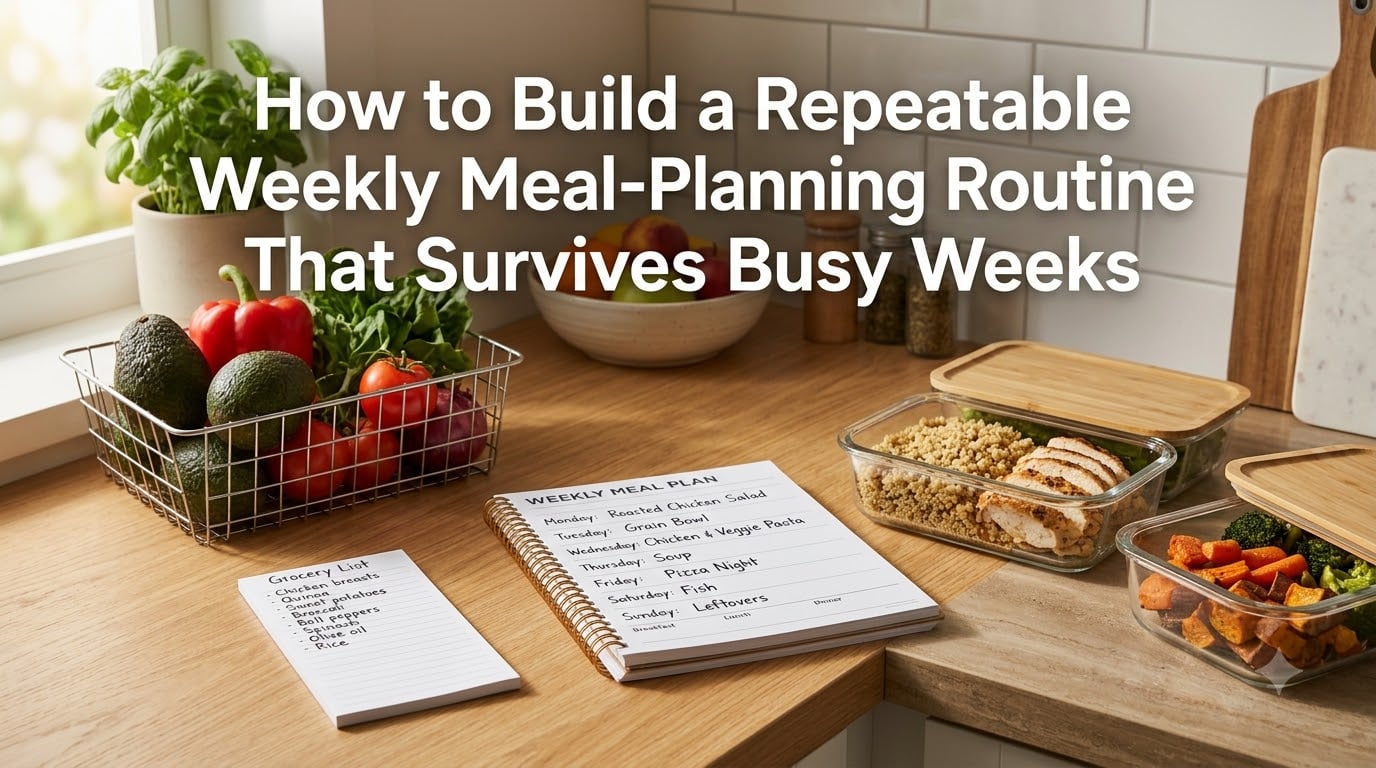
Every Sunday night, I used to stare at the fridge and ask myself the same dreaded question: “What’s for dinner this week?” That loop of guilt, takeout apps, and wasted groceries ended the day I built a repeatable weekly meal planning routine. A repeatable routine isn’t a rigid schedule. It’s a flexible system you can fall back on even when work explodes, kids get sick, or your energy runs out.
In this guide, I’ll walk you through the five-step system that finally stuck for me and that hundreds of readers on Reddit’s r/mealprep swear by. You’ll get realistic time estimates, a 4-week rotation example, and the backup strategies that keep the routine alive on the busiest weeks of 2026.
Table of Contents
- Step 1: Choose Your Planning Day and Time
- Step 2: Create a Flexible Template, Not a Rigid Schedule
- Step 3: Build a Rotation System for Meals
- Step 4: Prep Ahead Without Burning Out
- Step 5: Handle Disruptions Gracefully
- Common Pitfalls and How to Avoid Them
- Tools and Templates That Make the Routine Stick
- FAQs
- Start Your Repeatable Weekly Meal Planning Routine Today
Step 1: Choose Your Planning Day and Time
A repeatable weekly meal planning routine starts with a trigger: a specific day, a specific time, and a non-negotiable 30 to 45 minutes on your calendar.
The most popular options are Sunday afternoon (around 4 to 6 PM) or Friday evening once the week’s chaos has settled. Pick whichever time you can protect from interruptions. If you have young kids, that might mean Friday after bedtime. If your weekends are packed, Sunday morning with coffee works just as well.
Here’s what to do during your planning block:
Open your calendar for the upcoming week and mark every dinner commitment, late meeting, or social event.
Check the fridge, freezer, and pantry for ingredients you already have.
Write down 5 to 7 dinner ideas, leaving 1 to 2 slots open for leftovers or eating out.
Build a grocery list grouped by store section.
Order groceries for delivery or pickup, or schedule a 20-minute store trip.
Tip: I set a recurring phone reminder labeled “Meal Plan in 10 Min.” Once the reminder hits, I drop everything and start. After four weeks, my brain treated it like brushing my teeth. The routine survived even when motivation didn’t.
Step 2: Create a Flexible Template, Not a Rigid Schedule
The fastest way to abandon a meal planning routine is to demand perfection. Instead of writing seven brand-new recipes, build a flexible template with theme nights and decision rules.
The 3-3-3 rule is a great starting framework: pick 3 breakfasts, 3 lunches, and 3 dinners, then repeat. It cuts planning time in half, slashes grocery lists, and removes the daily “what now?” decision.
Theme nights make the template even easier. Some reader favorites from r/Cooking include:
Monday: Pasta night (rotating sauces)
Tuesday: Taco or wrap night
Wednesday: Sheet pan dinner
Thursday: Soup, stew, or slow cooker meal
Friday: Pizza or “fend for yourself” night
Saturday: Try something new or eat out
Sunday: Roast chicken with leftovers for the week
The 5-4-3-2-1 grocery method pairs perfectly with this template: 5 vegetables, 4 proteins, 3 fruits, 2 starches or grains, and 1 treat or “fun” ingredient per week. This rule keeps your cart balanced without overbuying and dramatically cuts food waste.
The goal of a flexible template is simple: lower the activation energy. When Tuesday arrives and the template says “Taco night,” your brain skips straight to execution instead of re-deciding dinner from scratch.
Step 3: Build a Rotation System for Meals
Decision fatigue kills consistency. A rotation system solves it by giving you a built-in library of 12 to 15 go-to meals per category that you cycle through automatically.
Here’s a sample 4-week dinner rotation you can adapt:
Week 1: Sheet pan chicken, lentil soup, turkey tacos, stir-fry, homemade pizza
Week 2: Slow cooker beef stew, baked salmon, fajita bowls, pasta primavera, breakfast-for-dinner
Week 3: Meatloaf, chickpea curry, shrimp tacos, chicken caesar wraps, quesadillas
Week 4: Roasted veggie grain bowls, pulled pork, salmon burgers, soup and sandwiches, takeout night
After four weeks, the rotation restarts. You can swap one or two meals each cycle to keep things fresh, or rotate seasonally: chili in October, salads in May, sheet pan dinners in winter.
One Reddit user described their system perfectly: “I keep a list of 15 meals taped inside a cabinet door. Each week I pick 5. When something gets old, I retire it and add a new one.” That single practice removes the planning paralysis that derails most routines.
To go deeper, build mini-rotations for breakfast (oatmeal Monday, eggs Tuesday, smoothie Wednesday) and lunch (grain bowls, wraps, leftovers). The more decisions you pre-make, the smoother your week runs.
Step 4: Prep Ahead Without Burning Out
Meal prep doesn’t mean cooking 14 dishes on Sunday. The most sustainable approach is a “power hour” of strategic component prep.
During your power hour, focus on ingredients that show up in multiple meals. Wash and chop vegetables, cook a pot of grains, roast a tray of proteins, and portion out snacks. These building blocks transform Tuesday’s 45-minute dinner into a 15-minute assembly job.
Three prep levels to choose from based on your week:
Minimal prep (15 minutes): Wash produce, hard-boil eggs, marinate proteins for tomorrow.
Moderate prep (45 to 60 minutes): Add a cooked grain, chopped veggies, and one batch-cooked protein.
Full prep (90+ minutes): Portion full meals into containers, prepare freezer meal starters, cook two proteins.
Freezer meal starters are the secret weapon for chaotic weeks. A big batch of shredded chicken, meatballs, cooked beans, or tomato sauce can become five different meals later. The Plan to Eat blog calls these “meal starters,” and they save my week when everything else falls apart.
Storage matters too. Most cooked proteins stay good for 4 days refrigerated. Grains last 5 days. Cooked vegetables are best at 3 days. Label containers with the prep date so nothing gets lost in the back of the fridge.
Step 5: Handle Disruptions Gracefully
No routine survives every week. The difference between a routine that lasts and one that crumbles is how you handle disruption. Plan for failure on purpose.
Reserve at least one slot per week as a “wildcard” night. When a meeting runs late or a kid has a fever, the wildcard becomes a backup meal like scrambled eggs, a frozen burrito, or a simple sandwich. Without a wildcard, you end up ordering takeout and feeling defeated, which is what really kills the routine.
Many meal planners on r/EatCheapAndHealthy follow a simple weekly rhythm: 4 real meals, 1 easy night (cereal, eggs, leftovers), 1 fend-for-yourself night, and 1 eating-out or leftovers night. This rhythm accepts that life happens and gives you built-in permission to relax.
When your routine does fall apart for a week, don’t restart from scratch. Run a “reset protocol”:
Clear expired food from the fridge on your next planning day.
Pick just three dinners for the week ahead.
Keep prep minimal until you feel momentum returning.
You didn’t fail. You just took a one-week pause. The next planning session starts a fresh cycle.
Common Pitfalls and How to Avoid Them
Most meal planning routines fail for predictable reasons. Knowing them in advance keeps you ahead of the curve.
Pitfall 1: Over-planning. Trying to plan every meal, snack, and lunch for 14 days in detail burns you out by Wednesday. Stick to 5 to 7 dinners and rotate the rest.
Pitfall 2: Ignoring preferences. A plan full of meals no one in your house enjoys gets abandoned fast. Keep a running list of “house favorites” so your rotation always includes at least 3 crowd-pleasers.
Pitfall 3: Skipping the inventory check. Forgetting what’s already in your pantry leads to duplicate purchases and waste. Spend 3 minutes scanning shelves before you write the grocery list.
Pitfall 4: All-or-nothing thinking. Missing one planning day doesn’t mean abandoning the system. Two planning sessions a month still beats none. Lower the bar to lower the drop-off rate.
Tools and Templates That Make the Routine Stick
You don’t need fancy software to maintain a meal planning routine, but the right tool can shave 10 to 15 minutes off your weekly block.
For digital planners, apps like Paprika, Plan to Eat, and Mealime let you save recipes, build grocery lists, and sync everything to your phone. If you prefer paper, a simple notebook with one page per week is more than enough.
AI assistants like ChatGPT can absolutely create a meal plan. Just paste in your rotation list, dietary preferences, and the number of dinners you need, and ask for a customized weekly plan. It’s a great way to break out of a food rut without spending an hour scrolling recipes.
For bestweightlossplanners.com readers who track macros or calories, pairing a meal planner with a simple tracking app keeps your routine aligned with your goals. The point is to pick one tool and use it consistently, not to chase the perfect system.
FAQs
How long does a meal planning routine take each week?
Expect to spend 30 to 45 minutes on your first planning session. After three to four weeks, most people cut that down to 15 to 20 minutes because the rotation and grocery list are already familiar.
What is the 3-3-3 rule for meals?
The 3-3-3 rule means picking 3 breakfasts, 3 lunches, and 3 dinners, then repeating them throughout the week. It simplifies decisions, reduces grocery lists, and keeps variety without daily planning.
What is the 5-4-3-2-1 rule for groceries?
The 5-4-3-2-1 grocery rule means buying 5 vegetables, 4 proteins, 3 fruits, 2 starches or grains, and 1 treat per week. It balances nutrition, controls spending, and reduces food waste.
Can ChatGPT create a meal plan?
Yes. ChatGPT can build a weekly meal plan when you share your dietary preferences, household size, and any ingredients you want to use. It’s especially helpful for breaking out of a recipe rut or generating new rotation ideas.
How do I stop meal planning burnout?
Prevent burnout by keeping your rotation small (12 to 15 meals), reusing theme nights, and accepting that one or two meals per week will be repeats or takeout. Lower the bar to keep the routine alive.
Start Your Repeatable Weekly Meal Planning Routine Today
A repeatable weekly meal planning routine that survives busy weeks isn’t about willpower. It’s about having a flexible template, a rotation of meals you love, and a graceful plan for the days that go sideways. Choose your planning day, write down 5 dinners using theme nights, and protect 30 minutes this week to start.
By 2026, you’ll have a system that runs itself, even when life gets loud. Try it for four weeks and watch the “what’s for dinner” stress quietly disappear.