
I spent two years rotating between three meal prep systems before I realized the one I kept abandoning was simply the wrong fit for my schedule. That experience taught me something most guides skip over: there is no single “best” meal prep system. The right one depends on your household size, your goals, how much variety you crave, and how much freezer space you actually have.
In this guide, I’ll walk you through batch cooking, ingredient prep, and buffet-style prep in plain language. You’ll see exactly how each system works, where it shines, where it falls short, and how to choose between them based on the life you actually live. By the end, you’ll have a clear decision framework instead of another generic meal prep checklist.
Table of Contents
- What Is Batch Cooking and How Does It Work?
- What Is Ingredient Prep (Component Prep)?
- What Is Buffet-Style Meal Prep?
- Batch Cooking vs. Ingredient Prep vs. Buffet-Style Prep: Side-by-Side Comparison
- Pros and Cons of Each Meal Prep System
- Which Meal Prep System Fits Your Life?
- Realistic Time Investment for Each System
- Common Mistakes and How to Avoid Them
- Can You Combine Methods? The Hybrid Approach
- Frequently Asked Questions
- Choosing the Right Meal Prep System for Your Life
What Is Batch Cooking and How Does It Work?
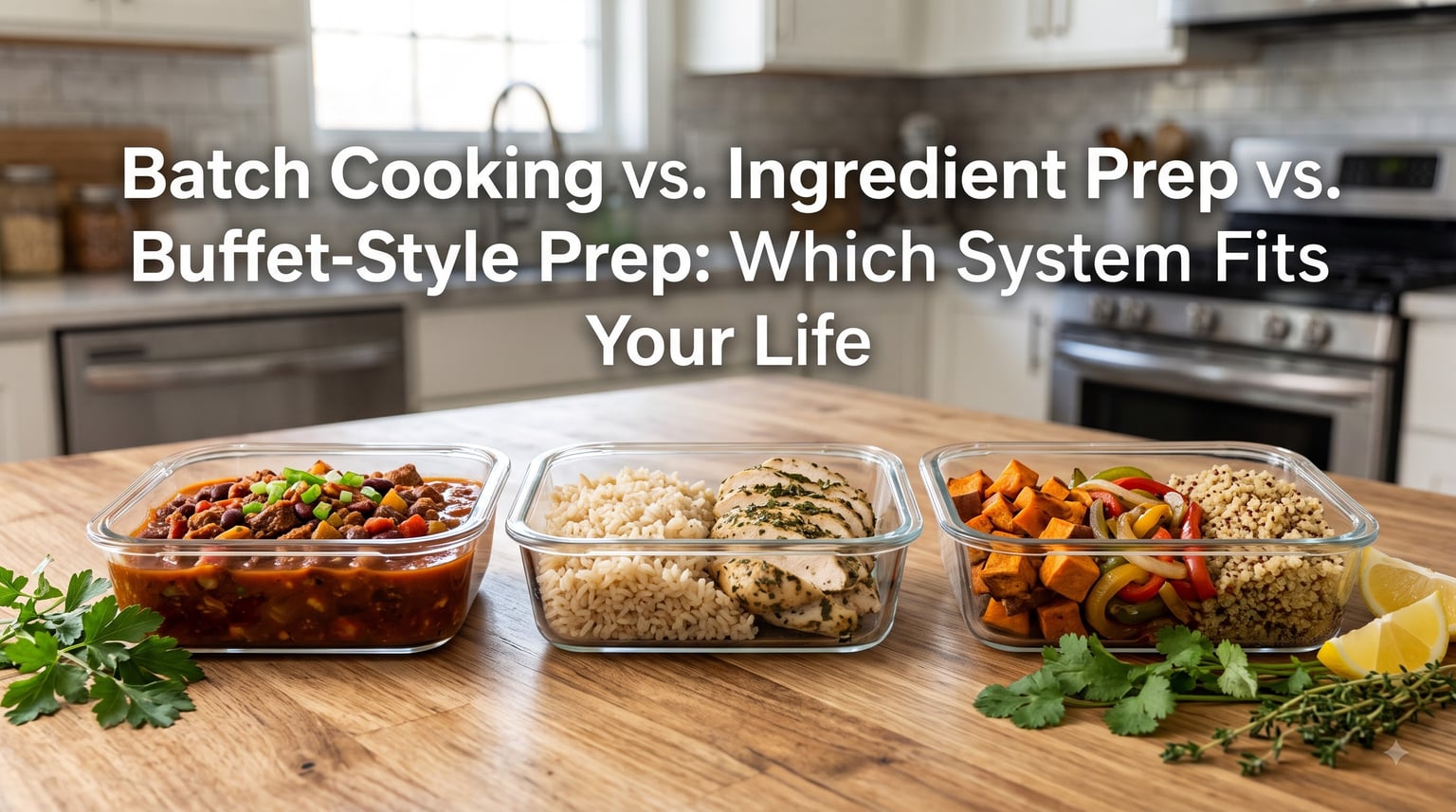
Batch cooking means preparing large quantities of complete, ready-to-eat meals at once. You cook a big pot of chili, four trays of baked chicken, or two pans of casserole, then portion everything into individual containers for the week.
The defining feature is that the meal is finished when it goes into the container. You don’t assemble anything later. You reheat and eat. This makes batch cooking the simplest system for true grab-and-go convenience.
A typical batch cooking session runs 2-4 hours on a Sunday and yields 10-15 individual meals. Most people freeze portions they won’t eat within 3-4 days and pull them out as needed. Foods that hold up especially well include soups, stews, chilis, casseroles, pasta sauces, and grain bowls with sturdy proteins.
Batch cooking works best when you enjoy eating the same meal two or three times in a week. It also works best when you have a chest freezer, because relying on the refrigerator alone caps you at about four days of meals before quality drops.
What Is Ingredient Prep (Component Prep)?
Ingredient prep (also called component prep) means cooking individual building blocks separately so you can mix and match them throughout the week. You roast a tray of chicken breast, steam a pot of rice, roast vegetables, and hard-boil eggs. Nothing is combined into a finished meal until you’re ready to eat.
This system gives you flexibility without starting from scratch each night. On Tuesday, you might build a rice bowl with chicken and broccoli. On Wednesday, the same chicken becomes a wrap with salsa and greens. The components stay the same, but the meals feel different.
Ingredient prep typically takes 1.5-3 hours per week. The trade-off is that you still spend 10-15 minutes assembling each meal. For people who hate eating identical lunches, that extra few minutes is worth it.
Component prep shines for fitness-focused eaters tracking macros, because you can dial in protein, carbs, and vegetables for each meal without committing to one recipe. It also works well for families where everyone wants something slightly different.
What Is Buffet-Style Meal Prep?
Buffet-style prep is a hybrid approach designed to fight flavor fatigue. You prepare several proteins (two or three options), a variety of vegetables (three or four options), and a couple of grains or starches. Everything is stored separately and laid out buffet-style when it’s time to eat.
Instead of one chili on Monday and the same chili on Tuesday, you might have grilled chicken, shredded pork, and black beans ready to go. Pair any protein with any vegetable and any grain, and you’ve got a new meal in under five minutes.
This system takes the longest to prep (usually 3-4 hours) because you’re cooking multiple proteins and vegetables. But it produces the most variety from the same prep window. Members of online meal prep communities consistently rank buffet-style prep as the most sustainable long-term system for that reason.
Buffet-style prep is especially helpful for households with picky eaters, since everyone assembles their own plate. It’s also the go-to method for people who track macros but get bored eating the same chicken-and-rice combination four days in a row.
Batch Cooking vs. Ingredient Prep vs. Buffet-Style Prep: Side-by-Side Comparison
| System | Prep Time | Daily Assembly | Variety | Best For |
|---|---|---|---|---|
| Batch Cooking | 2-4 hours | None (reheat only) | Low | Singles, busy weeks, freezer cooking |
| Ingredient Prep | 1.5-3 hours | 10-15 minutes | Medium | Fitness goals, varied lunches, families |
| Buffet-Style Prep | 3-4 hours | 5 minutes | High | Picky eaters, macro tracking, fighting boredom |
All three systems use similar containers and storage principles. The differences come down to how much variety you want, how much daily assembly time you can tolerate, and how much freezer space you have.
Pros and Cons of Each Meal Prep System
Each system has real strengths and real drawbacks. Here’s an honest breakdown based on what actually happens when people use these methods week after week.
Batch Cooking: Pros and Cons
The biggest advantage is zero daily effort once the cook session is done. You heat, eat, and clean one container. It’s also the cheapest per meal because you buy ingredients in bulk and use them efficiently.
The biggest drawback is flavor fatigue. By Wednesday, eating the same chicken and rice gets old fast. Texture changes are common too: pasta gets mushy, vegetables get soggy, and proteins dry out after reheating three or four times.
Batch cooking also requires freezer space. Without it, you’re limited to meals that hold up well for three or four days in the fridge, which rules out many batch-friendly recipes.
Ingredient Prep: Pros and Cons
You get real variety without starting from scratch. A single prep session yields a week of meals that feel different. Components also stay fresh longer than fully assembled meals, because vegetables and grains are stored separately from sauces and dressings.
The downside is the daily assembly step. When you’re genuinely exhausted after work, 10-15 minutes of building a meal feels like a lot. Ingredient prep also requires more containers and more fridge real estate, since each component lives in its own vessel.
Buffet-Style Prep: Pros and Cons
Variety is the headline benefit. You can build dozens of meal combinations from one prep session. It’s also the most flexible system for households with different preferences or dietary needs.
The drawback is upfront time investment. Cooking three proteins and four vegetables takes longer than batch cooking one big pot. Food waste is also a risk if you over-prep components nobody ends up using.
Which Meal Prep System Fits Your Life?
Instead of a one-size-fits-all recommendation, here’s how to match each system to common lifestyles and goals. Think about which scenario sounds closest to your week.
If you’re a busy professional working 50+ hour weeks, batch cooking is your friend. You can prep on Sunday, freeze portions, and never think about food during the week. For weight loss specifically, ingredient prep gives you the most control over portion sizes and macros without sacrificing variety.
If you’re cooking for a family with picky eaters, buffet-style prep wins. Everyone builds their own plate, which dramatically cuts the “I don’t want that” complaints at dinner. For fitness enthusiasts tracking protein and carbs, ingredient prep offers the precision you need with the flexibility to keep meals interesting.
If you’re cooking for one or two people, batch cooking can be tricky because recipes are often designed for four or six servings. Either halve recipes or commit to the freezer, because eating the same chili six nights in a row gets old fast.
If you’re on a tight budget, batch cooking produces the lowest cost per meal because you buy ingredients in bulk and use them efficiently. Ingredient prep is the runner-up.
If you travel for work or have a schedule that changes week to week, batch cooking with a heavy freezer emphasis is most reliable, because you can pull a meal out whenever you need it without any prep work.
Realistic Time Investment for Each System
Time estimates in meal prep guides often undersell the work. Here’s what to actually expect.
Batch cooking sessions realistically run 2.5-4 hours including shopping, cooking, cooling, portioning, and cleanup. The cleanup is where most people underestimate. Five pots, two sheet pans, and a cutting board add up.
Ingredient prep runs 2-3 hours for a complete weekly setup with two proteins, two grains, and three or four vegetables. Daily assembly adds another 10-15 minutes per meal, which works out to roughly 70-90 extra minutes across the week.
Buffet-style prep is the most labor-intensive at 3-4.5 hours for a full setup with three proteins, four vegetables, and two starches. Daily assembly is the fastest at around 5 minutes per meal.
Across a full week, all three systems take roughly the same total time. The difference is when that time happens. Batch cooking front-loads everything onto one day. Ingredient and buffet-style prep spread the work across the week.
Common Mistakes and How to Avoid Them
I’ve made most of these mistakes myself. Here’s what trips people up, and how to fix it.
Mistake 1: Prepping foods that don’t reheat well. Avoid pasta (gets mushy), raw leafy greens (wilt), and fried foods (lose their crispness). Stick to sturdy proteins, roasted vegetables, grains, and soups.
Mistake 2: Not labeling containers. By Wednesday, three identical-looking containers become a guessing game. Use painter’s tape and a marker, or get a set of reusable labels. Include the date.
Mistake 3: Over-prepping without freezer space. If your freezer is small, batch cooking will backfire because you’ll run out of room fast. Measure your freezer before committing to a system.
Mistake 4: Ignoring food safety guidelines. Cooked food should be refrigerated within 2 hours of cooking. Reheat to an internal temperature of 165°F. Don’t keep cooked meals longer than 4 days in the fridge or 3 months in the freezer for best quality.
Mistake 5: Choosing a system that doesn’t match your household. This is the biggest one. A family of four trying to do strict batch cooking will burn out fast. Match the system to your real life, not the one you wish you had.
Can You Combine Methods? The Hybrid Approach
Yes, and many experienced meal preppers do exactly this. The most popular hybrid is what I’d call “batch the staples, prep the variety.”
You batch-cook two or three staples that hold up well in the fridge (a big pot of grains, a tray of roasted vegetables, a slow cooker full of shredded chicken). Then you add fresh components throughout the week (greens, fresh herbs, sauces, cheese) that take two minutes to throw on top.
This hybrid gives you the convenience of batch cooking with the variety of ingredient prep. It’s also the easiest system to sustain long-term, because a small fresh addition each day makes leftovers feel new.
If you’re just getting started, this hybrid is the safest entry point. You can dial up the batch cooking or the variety over time as you figure out what your week actually looks like.
Frequently Asked Questions
What is the 3-3-3 rule for meal prep?
The 3-3-3 rule is a simple starter framework: cook 3 proteins, prep 3 vegetables, and prepare 3 grains or starches during one session. You then mix and match these components throughout the week for variety without daily cooking. It’s a lightweight version of buffet-style prep designed to prevent flavor fatigue.
What are the disadvantages of batch cooking?
The main disadvantages of batch cooking are flavor fatigue from eating the same meals repeatedly, texture changes after reheating, the need for substantial freezer space, and limited variety. It also tends to front-load your weekend with 3-4 hours of cooking and cleanup.
What is buffet style meal prep?
Buffet-style meal prep means cooking multiple proteins, vegetables, and grains separately, then storing them so you can assemble a different meal each day by combining any protein with any vegetable and any grain. It produces the most variety from one prep session and works well for households with picky eaters or anyone tracking macros who wants to avoid boredom.
Which meal prep system saves the most time?
Batch cooking saves the most daily time because meals are fully assembled and only require reheating. Across a full week, however, all three systems take roughly the same total time. Batch cooking front-loads the work onto one day; ingredient prep and buffet-style prep spread smaller assembly steps across the week.
What meal prep system is best for weight loss?
Ingredient prep (component prep) is generally best for weight loss because it gives you the most control over portion sizes, protein amounts, and macros. You can adjust each meal precisely without committing to a finished recipe. Buffet-style prep is a close second if you want more variety while still tracking portions.
Choosing the Right Meal Prep System for Your Life
Batch cooking, ingredient prep, and buffet-style prep each solve a different problem. Batch cooking solves the “I have no time to cook during the week” problem. Ingredient prep solves the “I get bored eating the same thing” problem. Buffet-style prep solves the “my family won’t eat the same meals” problem.
Pick the system that matches your real week, not your ideal one. If you have freezer space and a brutal schedule, start with batch cooking. If you track macros or cook for a varied household, try ingredient prep. If you want maximum variety and don’t mind a longer prep session, go with buffet-style prep. And if you can’t decide, the hybrid approach of batch-cooking staples while adding fresh components throughout the week is the most sustainable starting point for most people.
The best meal prep system is the one you’ll actually stick with. Test one for two to three weeks before deciding. Your freezer, your schedule, and your taste buds will tell you quickly whether it’s a fit.