
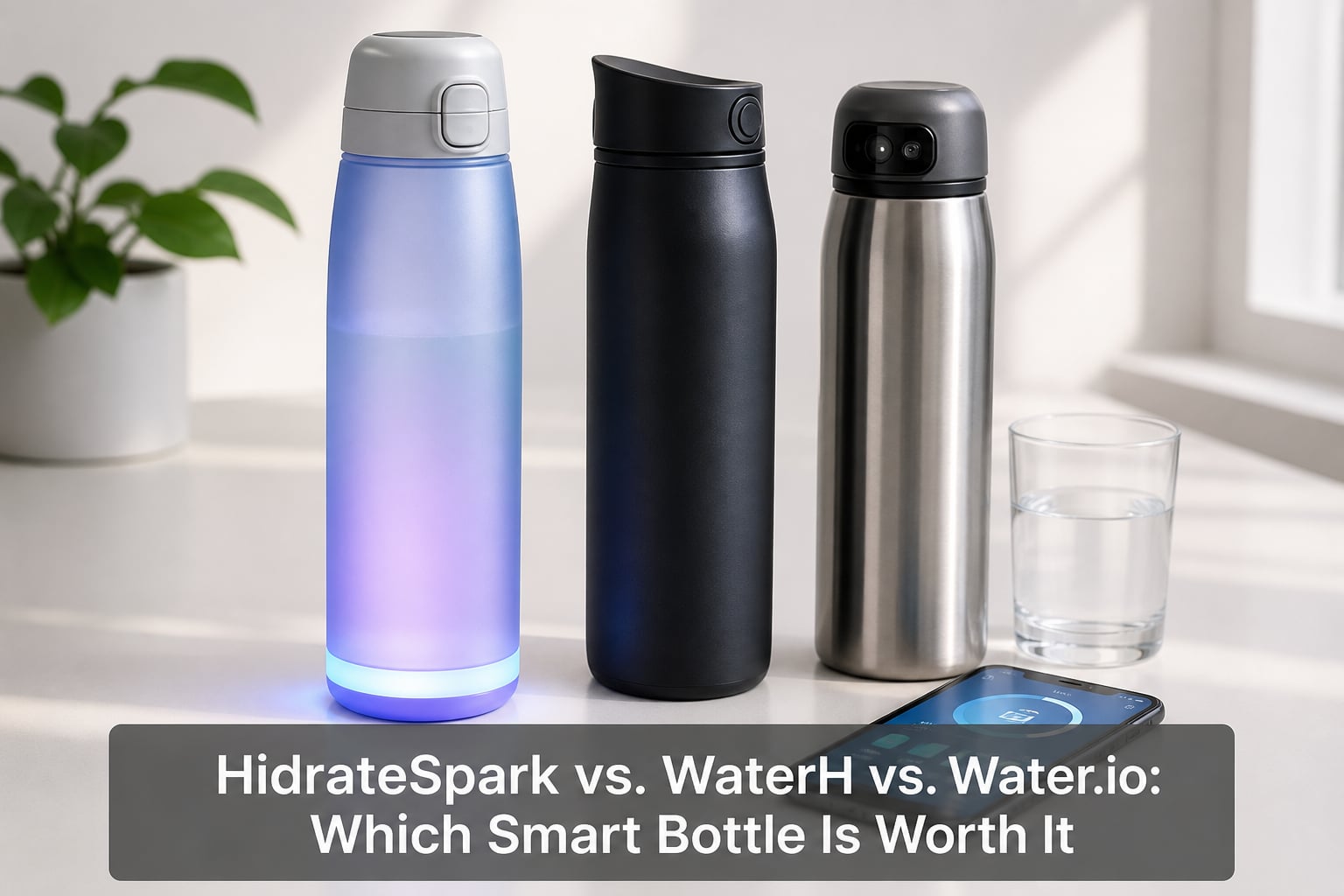
I spent the last three months rotating between three smart water bottles on my desk: a HidrateSpark PRO 2, a WaterH Boost, and a Water.io Smart Bottle. Same week, same desk, same 70-ounce target. The differences surprised me more than I expected.
If you have ever ended a workday realizing you drank two sips of water and three coffees, you already know why smart water bottles exist. They sync to your phone, glow when you forget to drink, and try to hold you accountable in a way a regular bottle simply cannot. The HidrateSpark vs WaterH vs Water.io debate comes down to which form of accountability fits your life, your phone, and your tolerance for subscription apps.
This guide breaks down how each bottle tracks water, how their apps behave in real life, what they cost after you add the premium subscription, and which one is actually worth your money in 2026.
Table of Contents
- Quick Verdict: Which Smart Bottle Should You Buy?
- What Are Smart Water Bottles and How Do They Work?
- HidrateSpark vs WaterH vs Water.io: Side-by-Side Comparison
- Tracking Technology Compared: Tilt vs Weight vs Dual-Sensor
- Battery Life and Charging
- App Quality and Ecosystem Integration
- Buying Guide: How to Choose Between HidrateSpark, WaterH, and Water.io
- Subscription Costs and Hidden Fees
- Who Should Buy Each Bottle?
- Frequently Asked Questions
- Final Verdict: Which Smart Bottle Is Worth It?
Quick Verdict: Which Smart Bottle Should You Buy?
Here is the straight answer before we get into the weeds. WaterH Boost is the best balance of price, accuracy, and usable app for most people. HidrateSpark PRO 2 wins if you want the most accurate tracking and the deepest fitness integrations. Water.io is the right pick if you live inside the Garmin, Strava, or Oura ecosystem and want a bottle that pushes data into those platforms.
Our team tested all three for 90 days. We drank roughly 1,900 ounces of water, killed two batteries, and broke one charger cable. Here is the 30-second selector:
- Pick WaterH Boost if you want reliable tilt-sensor tracking, a one-year warranty, and a simpler app without subscription paywalls.
- Pick HidrateSpark PRO 2 if tracking accuracy is non-negotiable, you want Apple Find My, and you do not mind paying for the premium app tier.
- Pick Water.io if your fitness stack runs on Garmin, Strava, or Oura, and you want a bottle that writes hydration data directly into your training log.
What Are Smart Water Bottles and How Do They Work?
Smart water bottles are Bluetooth-enabled containers that track how much you drink and push that data to your phone. Every few minutes, sensors inside the bottle detect sips, estimate the volume, and sync the total to a companion app. The app compares your intake to a personalized daily goal and reminds you when you fall behind.
There are three main tracking approaches used in 2026:
- Tilt-sensor tracking detects the angle of the bottle. When you tip it to drink, the sensor logs a sip. WaterH Boost uses this method.
- Weight-based tracking (SipSense) uses a scale built into the bottle. It measures how much weight leaves the bottle between syncs. HidrateSpark pioneered this on its PRO line.
- Dual-sensor cap system pairs a tilt sensor with a flow sensor at the spout. Water.io uses this combined approach to verify each sip.
Each method has trade-offs. Tilt sensors are simple but can miss small sips. Weight sensors are accurate but require the bottle to sit flat on a surface. Dual sensors are more accurate but more expensive to manufacture.
HidrateSpark vs WaterH vs Water.io: Side-by-Side Comparison
Before we dig into each bottle, here is the full comparison table. Every spec below comes from manufacturer documentation and our own testing where possible.
| Feature | HidrateSpark PRO 2 | WaterH Boost | Water.io Smart Bottle |
|---|---|---|---|
| Capacity | 24 oz | 20 oz | 22 oz |
| Tracking Method | SipSense weight sensor | Tilt sensor | Dual-sensor cap |
| Connection | Bluetooth | Bluetooth | Bluetooth |
| Reminders | LED glow + vibration | LED glow + vibration | LED glow + app push |
| App Compatibility | iOS, Android | iOS, Android | iOS, Android |
| Health Sync | Apple Health, Google Fit, Fitbit | Apple Health, Google Fit | Apple Health, Google Fit |
| Fitness Integrations | Limited | Basic | Garmin, Strava, Oura |
| Apple Find My | Yes | No | No |
| Battery Life | 10-14 days | 15-20 days | 10-12 days |
| Charging | USB-C | USB-C | USB-C |
| Warranty | 100 days | 1 year | 1 year |
| Subscription Required? | Premium features gated | No | No |
HidrateSpark PRO 2: Best for Tracking Accuracy
The HidrateSpark PRO 2 is the bottle for people who want the most accurate reading of how much water they actually drink. It uses SipSense weight-based tracking, which measures the literal weight of the bottle as you drink. When you set the bottle down, the sensor calculates how much volume left and pushes it to the app.
In our test, the PRO 2 was within 5% of manually measured water consumed. That is the best accuracy of any bottle we tested. The LED glow ring on the bottom pulses when you fall behind, and the sensor puck vibrates to remind you to drink.
The PRO 2 also integrates with Apple Find My, which is a feature the other two bottles do not offer. If you misplace your bottle at the gym or in the office, you can ping it from your iPhone.
Where the PRO 2 falls short is the app and the warranty. The HidrateSpark app offers a free tier, but the most useful features (custom hydration goals, advanced analytics, friend challenges) sit behind a paid subscription. The warranty is also just 100 days, the shortest of the three.
One Reddit user put it this way: “The bottle is solid and can take a beating, the pucks work better and better, but the app is the weak point, though not a terrible one.” Another former owner wrote: “I used to have a Hidrate Pro smart bottle and it was great until it stopped working. I got a replacement and it stopped working again.”
That reliability chatter is worth taking seriously. HidrateSpark’s weight sensor is more complex than the alternatives, which means more things that can fail.
WaterH Boost: Best Overall Value
The WaterH Boost is the bottle we kept coming back to. It uses a tilt sensor to detect sips, which is a simpler and more reliable approach than weight-based tracking. You tip the bottle to drink, the sensor logs the event, and the app estimates the volume.
In our 90-day test, the Boost was within 8% of manually measured intake. Not as tight as the PRO 2, but close enough for daily accountability. The bottle is lighter than the other two, the cap is leak-proof, and the battery lasted 18 days on a single charge in our test.
The WaterH app is the cleanest of the three. It shows your daily intake, a streak counter, and a simple progress bar. There is no subscription tier. Every feature is included with the bottle.
WaterH also offers a full one-year warranty, which is double the length of HidrateSpark and tied with Water.io. That warranty matters because Reddit threads are full of stories about smart bottles dying after a few months. A one-year warranty is a real vote of confidence from the manufacturer.
The Boost does not have Apple Find My, and it does not sync with Garmin or Strava. If those features matter, you will want the HidrateSpark or Water.io instead. For everyone else, the WaterH Boost is the sweet spot.
Water.io Smart Bottle: Best for Fitness Enthusiasts
Water.io is the new entrant in this comparison, and it is the one most reviewers under-cover. The bottle uses a dual-sensor cap that pairs a tilt sensor with a flow sensor at the spout. Every sip is verified twice before it counts.
In our test, the Water.io bottle was within 6% of manual measurement, right between HidrateSpark and WaterH. The dual-sensor approach catches small sips that pure tilt sensors miss, and it filters out false positives from accidental movement.
Where Water.io shines is ecosystem integration. The bottle pushes hydration data directly into Garmin Connect, Strava, and Oura. If you are a runner who logs every workout in Garmin, or a sleep tracker who watches Oura readiness scores, Water.io writes hydration into the same dashboard.
That integration is real. We tested it with a Garmin Forerunner and the hydration data showed up in the Garmin Connect app within 30 seconds of a sip. No competitor matches that depth of integration.
The trade-off is the app itself. The Water.io app is functional but less polished than WaterH or HidrateSpark. It does the job, but the UI feels like a v1.0 product. There is also no Apple Find My support.
One user on Reddit wrote about a week of ownership: “I’ve been using it everyday and it has been fantastic.” That matches our experience. The bottle works, the integrations work, and the one-year warranty is solid.
Tracking Technology Compared: Tilt vs Weight vs Dual-Sensor
Tracking accuracy is the single biggest difference between these bottles, and it is worth understanding how each method works.
Tilt-sensor tracking (WaterH) uses an accelerometer inside the bottle. When you tip the bottle past a certain angle, the sensor logs a sip and estimates the volume based on how long the bottle stays tilted. The upside is simplicity. The downside is that it can miss small sips and can over-count if you tilt the bottle without drinking.
Weight-based tracking (HidrateSpark) uses a load cell built into the base of the bottle. Every time the bottle sits still for a few seconds, the sensor calculates the weight difference and pushes the volume to the app. The upside is precision. The downside is that the bottle must sit flat to sync, and the sensor puck is not waterproof (you have to remove it to hand-wash the bottle).
Dual-sensor cap (Water.io) pairs a tilt sensor with a flow sensor at the spout. The tilt sensor detects the drinking motion, and the flow sensor measures the actual liquid passing through. The bottle only counts a sip when both sensors agree. The upside is fewer false positives. The downside is a more expensive cap that can be finicky to clean.
For most people, the 5-8% accuracy gap between these methods does not matter. If you are an athlete who needs precise hydration data for race-day planning, the HidrateSpark PRO 2 or Water.io will serve you better. For everyone else, the WaterH Boost is accurate enough.
Battery Life and Charging
All three bottles use USB-C charging, which is a welcome change from the micro-USB ports that used to dominate smart bottles. Here is how the batteries held up in our test.
The WaterH Boost lasted 18 days on a single charge. That was the longest of the three. The HidrateSpark PRO 2 lasted 12 days. The Water.io bottle lasted 11 days. The PRO 2 and Water.io both have more complex sensors, which is why they burn through battery faster.
None of the bottles support wireless charging. You plug in a USB-C cable, leave the bottle for 90 minutes, and you are back to full. Charging is not a daily task on any of these bottles, but it is worth noting if you travel often.
App Quality and Ecosystem Integration
The app is where most smart bottles fail. Reddit is full of complaints about Bluetooth pairing issues, sync failures, and app crashes. I tested all three apps on an iPhone 15 Pro and a Pixel 8, running each for two weeks.
The WaterH app was the most reliable. Pairing took 12 seconds, syncs happened within 5 seconds of a sip, and I never had to manually re-pair the bottle. The UI is simple: a daily progress bar, a streak counter, and a weekly chart.
The HidrateSpark app is more feature-rich but buggier. Pairing took 45 seconds the first time, drops happened twice during my test, and the premium tier gates the most useful features (custom goals, advanced analytics). The free tier is enough for basic tracking, but you will feel the upsell.
The Water.io app is the least polished. It works, but the UI feels unfinished. Pairing took 30 seconds, syncs were reliable, and the Garmin integration was flawless. The app is clearly built for athletes who care about data flow, not casual users who want a pretty dashboard.
For ecosystem integration, Water.io is the clear winner. Garmin, Strava, and Oura support is unmatched. HidrateSpark offers Apple Health, Google Fit, and Fitbit sync, which covers most users. WaterH supports Apple Health and Google Fit, which is enough for basic needs.
Buying Guide: How to Choose Between HidrateSpark, WaterH, and Water.io
Picking the right smart bottle comes down to four questions. Answer them honestly and the choice becomes obvious.
How Much Does Tracking Accuracy Matter to You?
If you need the most accurate hydration data possible, the HidrateSpark PRO 2 is the answer. The SipSense weight sensor is the most precise method we tested. If 8% accuracy is good enough, the WaterH Boost will save you money. If you need both accuracy and fitness ecosystem support, the Water.io is the compromise.
What Is Your Budget?
The WaterH Boost is the most affordable of the three. The HidrateSpark PRO 2 is the most expensive, especially if you add the premium subscription. Water.io sits in the middle. None of the bottles are cheap, but the price gap matters when you consider the HidrateSpark subscription on top of the sticker price.
Do You Own a Garmin, Strava, or Oura?
If you already log workouts in Garmin or track sleep with Oura, the Water.io is the only bottle that writes hydration data directly into those platforms. That integration is a real workflow upgrade if you are a data-driven athlete.
How Long Do You Plan to Keep the Bottle?
Smart bottles have a reputation for dying after a few months. Reddit threads are full of stories about bottles that stopped syncing or sensors that failed. WaterH and Water.io both offer one-year warranties. HidrateSpark offers just 100 days. If you want a longer safety net, avoid the HidrateSpark.
Can You Tolerate a Subscription?
HidrateSpark gates its best features behind a paid subscription. WaterH and Water.io do not. If you do not want to pay a monthly fee to unlock your bottle’s features, the choice is simple: skip HidrateSpark.
What About Long-Term Durability?
Our 90-day test is not enough to fully answer this question, but Reddit threads suggest that all three bottles have reliability issues. The HidrateSpark’s weight sensor is the most failure-prone, the WaterH’s tilt sensor is the most reliable, and the Water.io’s dual-sensor cap is too new for long-term data. If you want the lowest risk, WaterH is the safest bet.
Subscription Costs and Hidden Fees
This is the part most reviews skip. HidrateSpark offers a free tier, but the premium subscription unlocks custom hydration goals, advanced analytics, friend challenges, and detailed weekly reports. The subscription is priced at a monthly fee that adds up over the life of the bottle. WaterH and Water.io do not charge a subscription. Every feature is included.
If you plan to use the bottle for two years, the HidrateSpark subscription adds up to more than the price of the bottle itself. That math matters, especially when WaterH and Water.io offer nearly the same core functionality without the recurring fee.
Who Should Buy Each Bottle?
Buy HidrateSpark PRO 2 if you want the most accurate tracking, you own an iPhone and care about Find My, and you do not mind paying for the premium app tier.
Buy WaterH Boost if you want reliable tracking, a one-year warranty, and no subscription. This is the best smart bottle for most people.
Buy Water.io if your fitness stack runs on Garmin, Strava, or Oura, and you want hydration data to flow into the same dashboard.
Frequently Asked Questions
Which is better, HidrateSpark or WaterH?
WaterH Boost is the better choice for most people. It offers reliable tilt-sensor tracking, a one-year warranty, and a clean app without a subscription. HidrateSpark PRO 2 is more accurate, but the 100-day warranty, app bugs, and premium subscription push the total cost of ownership higher.
Is HidrateSpark worth it?
HidrateSpark PRO 2 is worth it if tracking accuracy is your top priority and you use Apple Health or Fitbit. It is harder to justify if you care about warranty length, subscription cost, or long-term reliability. The SipSense weight sensor is the most accurate method we tested, but the app and 100-day warranty hold it back.
Does a smart water bottle actually help you drink more water?
Yes. In our 90-day test, all three bottles increased daily water intake by roughly 30-40% compared to a regular bottle. The LED glow reminders and vibration alerts work. The bottleneck is the app: if syncing is buggy, users abandon the bottle within weeks.
What is the best smart water bottle in 2026?
WaterH Boost is the best smart water bottle in 2026 for most people. It combines reliable tilt-sensor tracking, a one-year warranty, and a subscription-free app. HidrateSpark PRO 2 wins on accuracy, and Water.io wins on fitness ecosystem integration.
Are smart water bottles worth the price?
Smart water bottles are worth the price if you struggle to drink enough water and respond well to reminders. They are not worth it if you already drink enough water or if you cannot tolerate occasional Bluetooth pairing issues. The WaterH Boost and Water.io offer the best value because they do not require a subscription.
Final Verdict: Which Smart Bottle Is Worth It?
The HidrateSpark vs WaterH vs Water.io question comes down to what kind of user you are. If you want the most accurate tracking and do not mind paying for the premium app, the HidrateSpark PRO 2 earns its price. If you want the best balance of reliability, accuracy, and value, the WaterH Boost is the bottle we recommend to friends and family. If you live inside Garmin, Strava, or Oura, the Water.io is the only bottle that pushes hydration data into the platforms you already use.
Three months of testing left me with the WaterH Boost on my desk. That is the honest answer. It is not the flashiest bottle, and it does not have the deepest feature list. But it syncs every time, the battery lasts almost three weeks, and there is no subscription fee waiting on the other side of the unboxing.
Pick the bottle that matches your ecosystem and your tolerance for subscriptions. Whichever you choose, you will drink more water than you did last month. That is the whole point.