
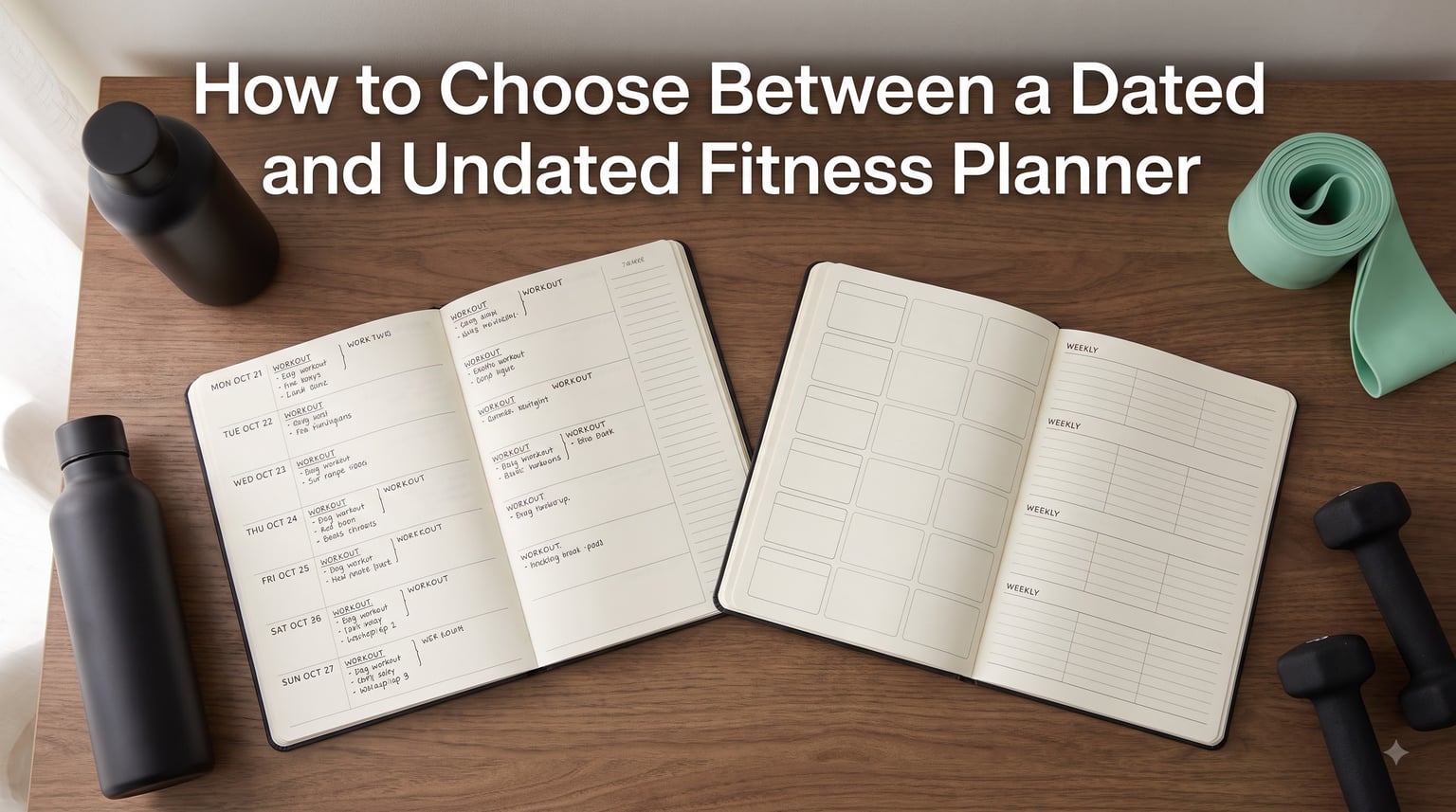
Choosing the wrong planner can quietly sabotage your fitness consistency. I learned this the hard way after abandoning two dated planners in one year, then switching to an undated version and finally sticking with it. The difference wasn’t motivation; it was fit. This guide walks you through how to choose between a dated and undated fitness planner, what each style does well, and how to match the format to your actual training life rather than your ideal one.
A dated fitness planner has pre-printed dates throughout its pages, while an undated fitness planner provides blank pages you fill in with your own dates. That single distinction decides how you plan, how you recover from missed days, and how long your planner actually lasts.
By the end of this article, you will understand the real-world tradeoffs of each type, see how fitness routines change the decision, and have a clear framework for picking the planner that matches your schedule, training style, and personality.
Table of Contents
- What Is a Dated Fitness Planner?
- What Is an Undated Fitness Planner?
- Key Differences Between Dated and Undated Fitness Planners
- Benefits of Dated Fitness Planners
- Benefits of Undated Fitness Planners
- Who Should Choose Each Type?
- How to Date an Undated Fitness Planner in 5 Steps
- Real User Experiences: What the Planner Community Says
- Fitness-Specific Considerations for Your Choice
- Tips for Staying Consistent With Either Planner
- Frequently Asked Questions
- The Right Fitness Planner Comes Down to Fit
What Is a Dated Fitness Planner?
A dated fitness planner is a planner with pre-printed dates baked into every page. You open it to January 1 and the date is already there, mapped to a specific weekday with a monthly spread, weekly spread, and daily slots already laid out.
Most dated planners run on a fixed cycle. They either follow the calendar year (January through December) or an academic-style year (July through June). Each page corresponds to a specific date, so you cannot rearrange or skip weeks without leaving gaps on the page.
For fitness use, dated planners often include built-in workout templates, daily meal slots, habit trackers, and progress charts keyed to specific dates. When you log a 5K on March 14, the planner already has that date printed, and your progress line ties to a fixed point on the calendar.
The dated format works like a ready-made calendar. You sit down, the date is there, and you start writing your workout or meal plan within seconds. For people who thrive on routine, that built-in structure removes decision fatigue.
What Is an Undated Fitness Planner?
An undated fitness planner is sometimes called a blank planner, perpetual planner, or undated journal. It contains all the same layouts and fitness templates as a dated version, but every date field is empty. You fill it in as you go.
The structure is identical in spirit to a dated planner. You still get weekly spreads, habit trackers, meal logs, and workout sections. What changes is the calendar: nothing is pre-printed, so you write the day, month, and year yourself.
For fitness users, this blank canvas approach is powerful. You can start on a Monday that aligns with your training cycle instead of forcing yourself to begin on January 1. You can skip recovery weeks, travel days, or off-season months without leaving blank pages staring back at you.
Undated planners also let you pace yourself through the year. If you only train four days a week, a 12-month dated planner may last you 18 months in real life, and an undated planner simply absorbs that pace naturally.
Key Differences Between Dated and Undated Fitness Planners
The two formats look almost identical on the shelf, but they behave very differently in daily life. Here is a side-by-side view of the factors that actually matter for fitness planning.
- Setup time: Dated planners require zero setup; you open and write. Undated planners take 30 to 90 seconds per spread to date the pages yourself.
- Start date: Dated planners are pinned to a calendar year. Undated planners let you start any day of the year without wasting pages.
- Skipping days: Dated planners show every skipped day as a visible blank. Undated planners let you skip weeks quietly and return when ready.
- Habit trackers: Dated planners key each habit to a fixed calendar date. Undated planners key it to your personal day count.
- Travel and recovery weeks: Dated planners force you to fill or skip pages. Undated planners adapt to your real schedule.
- Lifespan: Dated planners expire when the year ends, even with blank pages. Undated planners can last several months to a couple of years depending on use.
- Cost over time: Dated planners cost more per year of use. Undated planners spread their cost across however long they actually last.
Most competition in the dated vs undated planner debate reduces to structure versus flexibility. Dated formats give you a calendar you cannot argue with. Undated formats give you permission to plan around your life instead of planning around a date.
Benefits of Dated Fitness Planners
Dated planners shine when you want built-in accountability. The dates act as a gentle prompt, and you open the planner knowing exactly where today falls in the bigger picture.
Immediate use. You do not have to date a single page. On day one, you write today’s date already there and get straight to logging your workout, meals, or water intake.
Built-in accountability. Seeing April 12 sitting there on the page makes it harder to skip a workout. The date itself becomes part of the commitment.
Visual continuity. When every page maps to the calendar, you can scan months at a glance and spot patterns like a missed Tuesday run or a stretching habit that fell off after week three.
Habit tracking tied to real weeks. Monthly habit trackers in dated planners give you a clean visual of every day of the month, including weekends, holidays, and recovery weeks.
Goal-setting templates. Most dated fitness planners include quarterly or 90-day goal pages keyed to the calendar year, which helps with New Year resets and program-based goals.
If you crave structure and want a planner that nudges you back on track, the dated format does most of the heavy lifting for you.
Benefits of Undated Fitness Planners
Undated planners are built around the reality that life is rarely consistent. They hand you the structure of a planner without tying it to a specific calendar.
No planner anxiety. Skipping a week is not visible guilt. The next spread simply becomes the next day you decide to start again. The Gentleman Stationer blog highlighted this as the primary reason undated formats work for many users.
Start any day. You can begin training in March, July, or November without wasting 60 pages of January and February. Most fitness goals are personal, not calendar-based.
Vacation and travel friendly. Skip a two-week trip and pick back up exactly where you stopped. No blank pages mocking you from the previous month.
Flexible training cycles. Block periodization, push-pull-legs splits, and 5×5 strength programs do not always fit cleanly into monthly calendar pages. Undated planners adapt to the cycle you design.
Longer usable lifespan. An undated planner used four days a week might last 14 to 18 months. You pay once and keep planning until the pages run out.
Reduced waste. Fewer blank pages means less paper discarded. For environmentally minded planners, this is a tangible plus, especially since most planner paper is not yet recyclable curbside.
If your schedule shifts between busy and quiet months, or if you simply dislike seeing blank pages, undated formats remove that friction.
Who Should Choose Each Type?
Choosing between a dated and undated fitness planner comes down to your training style and planning personality. Use this framework to match the format to your real life.
Choose a dated fitness planner if you:
- Train on a fixed weekly schedule like Monday, Wednesday, Friday
- Like the accountability of seeing today’s date pre-printed
- Want a planner you can start using the same day you buy it
- Track habits against the actual calendar (sleep, water, steps)
- Prefer visual continuity across months and quarters
- Set goals tied to specific dates (10K by June, wedding by September)
Choose an undated fitness planner if you:
- Have an irregular schedule or shift work
- Skip weeks for travel, illness, or work crunches
- Want to start your planner on a Monday instead of January 1
- Train in cycles like 8-week blocks or seasonal sports
- Feel discouraged by blank pages or falling behind
- Plan to use one planner across multiple calendar years
If you sit between these lists, the undated format is usually safer. You give up a few seconds of dating pages and gain flexibility that compounds over months.
How to Date an Undated Fitness Planner in 5 Steps
One of the top PAA questions for this topic is how to date an undated fitness planner. Here is a simple method that takes about 60 seconds per spread.
- Pick your start date. Choose the day you actually want to begin, ideally a Monday so weekly spreads align.
- Open to the first weekly spread. Write the month, day, and year in the top corner using a fine-tip pen so it stays legible.
- Date each weekday. Write Mon, Tue, Wed, Thu, Fri across the spread without filling in the specific numbers yet.
- Add daily numbers. Going day by day, write the number 1, 2, 3 across each day and stop at the end of the week.
- Confirm and move on. Double-check the day-of-week alignment, then begin logging your workout, meal plan, or habit goals.
Once you have the rhythm, dating a weekly spread becomes muscle memory. Users in r/planners report that after week two, the extra steps fade into the background and the flexibility more than makes up for the effort.
Real User Experiences: What the Planner Community Says
Forum threads on Reddit and beyond reveal patterns that competitors’ articles rarely touch. Here is what real users consistently report.
ADHD and dating pages. Many users with ADHD say that individually dating every page feels excruciating. For them, a dated planner removes a barrier to actually using the planner, even if the format sacrifices flexibility.
Planner anxiety. Other users experience what the planning community calls planner anxiety. Seeing unused pages from missed days creates guilt that builds over time. Undated planners largely eliminate this feeling.
Skipping vacations. Users traveling for work or pleasure appreciate skipping entire weeks in an undated planner without leaving visual evidence on the page.
Mid-year starts. People who buy planners in March, June, or September consistently prefer undated formats so they do not waste two to nine months of pre-printed dates.
Boredom and novelty. Users who get bored easily say undated planners let them change their planning style mid-stream, such as switching from daily logs to weekly logs, without breaking the calendar.
The consensus is consistent: undated planners win on flexibility, dated planners win on structure, and the right choice depends on how you react to missed days.
Fitness-Specific Considerations for Your Choice
Fitness planning has unique traits that change how you should think about dated versus undated formats. Mainstream planner articles rarely cover these angles, which is where you can pick a planner that truly fits.
Training cycles. Strength athletes often run 8 to 12-week blocks. Running an undated planner across block phases keeps the calendar aligned with your program. A dated planner forces each block to start wherever the calendar says, which may not be a Monday or a deload week.
Recovery and deload weeks. Planned recovery weeks are normal in fitness. Undated planners let you skip the active logging without leaving blank pages that look like you fell off the wagon.
Meal planning. Weekly meal prep cycles look identical Monday to Monday, regardless of the calendar. An undated planner reinforces the meal prep rhythm, while a dated planner locks meals to fixed dates.
Progress photos and measurements. Monthly measurements (weight, waist, lifts) read more meaningfully when aligned to your training blocks. Undated formats let you track month one of your program, month two, and so on, with continuity.
Race and event dates. If you train for a specific race or competition on a known date, a dated planner makes those milestones visible on the page. For races that shift (postponed marathons, rescheduled meets), undated formats adjust more easily.
Accountability partners. If you check in weekly with a coach or trainer, both formats work, but dated planners make shared calendar references easier.
For most fitness users, the deciding factor is whether your training schedule is calendar-tied (date-specific events, monthly challenges) or cycle-tied (block periodization, season-based sports). Cycle-tied training tends to favor undated formats.
Tips for Staying Consistent With Either Planner
Whichever format you choose, the planner only works if you actually use it. A few practices help turn any planner into a consistency tool.
Pair it with a daily trigger. Open the planner right after a fixed habit like your morning coffee or post-workout shower. Linking the planner to an existing habit makes it automatic.
Log the minimum. Aim to write at least one thing each day, even if it is just a single workout note or habit checkmark. Small entries keep the streak alive.
Review weekly. Every Sunday, spend five minutes scanning the week and noting what worked. This review turns the planner into a feedback tool rather than a passive log.
Pre-block your training. At the start of each block, write your planned sessions in pencil so the week ahead is sketched, leaving space for adjustments.
Be honest about miss days. If you miss three days, log a short note explaining why. Honest reflection beats pretending the gap never happened.
Pick a planner you enjoy opening. Cover design, paper quality, and binding matter more than people admit. You will use a planner that feels good in your hands.
One small environmental note: if sustainability matters to you, look for planners printed on FSC-certified paper or made by companies with recycling programs. Both dated and undated formats exist in eco-friendly versions, so your choice does not have to compromise your values.
Frequently Asked Questions
Are undated planners worth it for fitness?
Yes. Undated fitness planners are worth it for most users because they let you start any day, skip recovery or travel weeks without wasting pages, and adapt to non-calendar training cycles like block periodization. The only real tradeoff is a minute or two of dating pages each week.
How do I date an undated fitness planner?
Pick your start date, open to the first weekly spread, and write the month, day, and year in the top corner. Then add daily numbers for each weekday, confirm the day-of-week alignment, and start logging your workouts or habits.
What is a planner without dates called?
A planner without dates is most commonly called an undated planner, but it may also be marketed as a blank planner, perpetual planner, or undated journal. The pages contain the same layouts as a dated planner with empty date fields.
What’s the difference between dated and undated fitness planners?
Dated fitness planners have pre-printed dates on every page and a fixed calendar year. Undated fitness planners have blank date fields you fill in yourself, so you can start any day and skip weeks without leaving blank pages. Dated planners offer structure and immediate use; undated planners offer flexibility and longer lifespan.
The Right Fitness Planner Comes Down to Fit
Deciding how to choose between a dated and undated fitness planner really comes down to three questions: do you train on a fixed schedule, do you mind blank pages, and does your training align to the calendar or to your own program cycles?
If you answered yes to all three, a dated planner will serve you well and save you the small effort of dating pages. If you answered no to any of them, an undated planner removes those pain points and gives you a tool that adapts to your training rather than the other way around.
Start by writing down your last 30 days of training and look at the patterns. If your workouts cluster around specific weekdays or dates, go dated. If they shift with work, travel, or recovery, go undated. Either way, the best planner is the one you actually open and use.