
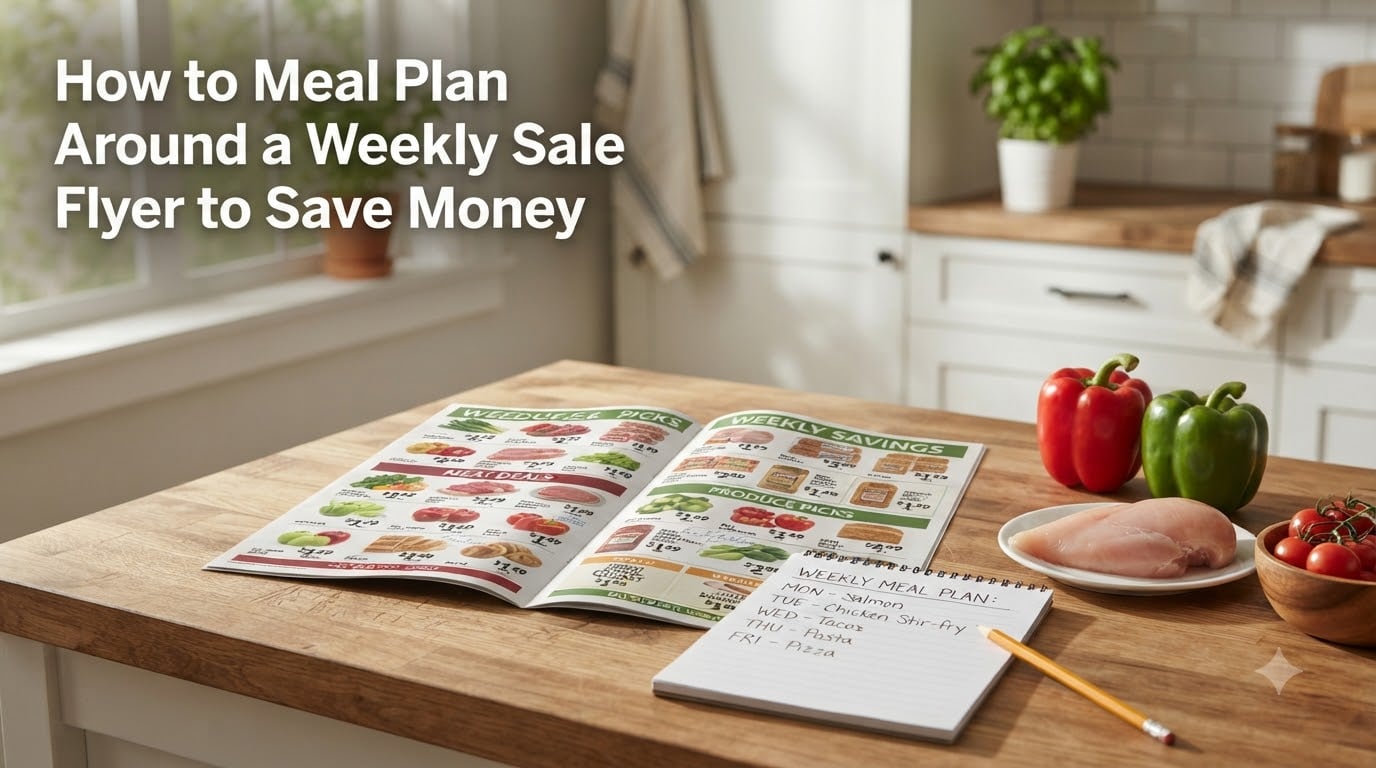
Grocery bills keep climbing, but most people shop backwards. They pick recipes first, then buy ingredients at full price. When you flip that process and learn how to meal plan around a weekly sale flyer to save money, you can cut your grocery bill by 20 to 25 percent without changing what you eat.
One Reddit user shared that by building meals around their local store’s weekly ad, they spent about $75 and got at least 28 servings. That kind of savings adds up fast. Over a year, trimming $40 a week puts more than $2,000 back in your pocket.
This guide walks you through the exact system, step by step. You will learn how to read a sales flyer, identify genuine deals, match ingredients to those deals, and build a shopping list that keeps you out of the impulse aisle.
Table of Contents
- How to Meal Plan Around a Weekly Sale Flyer to Save Money
- Step 1: Check Your Pantry and Fridge First
- Step 2: Gather and Scan the Weekly Sales Flyers
- Step 3: Focus on Sale Proteins (Meat, Poultry, Fish)
- Step 4: Match Produce and Side Dishes to Those Proteins
- Step 5: Build Your Grocery List and Stick to It
- Step 6: Stock Up on Freezer-Friendly Sale Items
- Practical Tips to Save Even More
- Sample Week: A Real Flyer-Based Meal Plan
- Common Mistakes to Avoid
- FAQs
- Conclusion
How to Meal Plan Around a Weekly Sale Flyer to Save Money
The core idea is simple. Instead of deciding what to cook and then paying whatever the store charges, you let the flyer tell you what is cheapest this week. Then you build your meals around those items. Protein is usually the biggest line item in a grocery budget, so when chicken breasts drop from $4.39 to $1.79 per pound, that sale should drive your entire menu.
Here is the step-by-step process our team has refined over years of budget meal planning.
Step 1: Check Your Pantry and Fridge First
Before you even look at a flyer, take inventory of what you already own. Open the pantry, freezer, and refrigerator. Write down every protein, grain, sauce, and vegetable you have on hand.
This step does two things. First, it prevents you from buying duplicates of items you forgot about. Second, it gives you a foundation to build meals on. If you already have rice, canned tomatoes, and half a bag of frozen corn, you only need a sale protein to make a full dinner.
Many people skip this step and end up with three open jars of pasta sauce and no plan to use them. A five-minute pantry scan saves that waste.
Step 2: Gather and Scan the Weekly Sales Flyers
Most grocery stores release new ads every Wednesday, and they typically run for seven days. Collect flyers from every store within a reasonable driving distance. You can find them in your mailbox, on store websites, or through grocery store apps.
As you scan each flyer, look for what the industry calls loss leaders. These are items a store sells at or below cost to get you through the door. A loss leader might be ground beef at $2.99 per pound when the normal price is $5.49. The store is not making money on that beef, but they expect you to fill your cart with full-price items while you are there.
Here is how to spot the best deals quickly:
Look at the front page of the flyer first. Stores put their deepest discounts there to grab attention. Circle anything that is 40 percent or more off the regular price.
Compare the sale price to what you normally pay. One experienced forum shopper noted that sometimes items appear in the flyer at only 20 to 30 cents below shelf price. That is not a real sale. A genuine deal should represent meaningful savings per unit.
Write down the top three to five deals from each store. You do not need to visit every store. Pick the one or two with the strongest overall discounts.
Step 3: Focus on Sale Proteins (Meat, Poultry, Fish)
Protein is the single most expensive category in most grocery budgets. When you plan around sale proteins, you attack the biggest cost first.
Look at the protein deals you circled in Step 2. Let us say boneless skinless chicken breasts are $1.79 per pound, pork loin is $1.99 per pound, and ground turkey is $2.49 per pound. Those three proteins can anchor your entire week of dinners.
Think about how many meals each protein can cover. Two pounds of chicken breasts might give you three dinners for a family of four: one night as baked chicken with sides, one night shredded in tacos, and one night cubed in a stir-fry. Stretching one protein across multiple meals is where the real savings happen.
Do not ignore meatless options either. If beans, lentils, or eggs are well-priced, plan one or two meatless dinners that week. A pot of lentil soup costs a fraction of what a chicken dinner costs, and it freezes beautifully.
Many experienced meal planners follow a natural rotation. As one Reddit user described it, their store rotates proteins weekly: pork one week, chicken the next, beef mixed in. Once you recognize your store’s pattern, you can predict which weeks are best for stocking up.
Step 4: Match Produce and Side Dishes to Those Proteins
Now that you have your proteins locked in, fill in the rest of the plate. Go back to the flyer and find which vegetables, fruits, and grains are on sale.
In-season produce is almost always the cheapest and freshest option. If asparagus is $3.99 per pound in August, it might drop to $1.49 in spring when it is peak season. Build your side dishes around whatever produce the flyer is discounting heavily.
Here is a quick example of matching meals to flyer deals:
If chicken is on sale and bell peppers, onions, and rice are also discounted, you have the makings of chicken stir-fry with rice. If pork loin is the deal and potatoes and carrots are cheap, a roasted pork and vegetable dinner is an obvious choice. Let the flyer do the recipe brainstorming for you.
Keep your side dish strategy flexible. If the flyer has a great deal on sweet potatoes, you can serve them roasted, mashed, or as fries alongside whatever protein you chose. The protein stays the same, but the sides adapt to what is cheapest.
Also consider what you already identified in your pantry inventory during Step 1. If you have pasta and sauce but the flyer has a deal on ground beef, spaghetti with meat sauce is a natural match that uses what you own plus one sale item.
Step 5: Build Your Grocery List and Stick to It
You now have your proteins, your produce, and your side dish plan. Convert that menu into a specific shopping list organized by store section.
Write down exactly what you need for each meal, plus any pantry staples you are running low on. Be specific about quantities. If you planned three chicken dinners and each needs roughly one pound, put three pounds of chicken on the list. This precision keeps you from overbuying.
Once the list is done, treat it as a contract with yourself. The flyer and your meal plan already determined what you need. If something is not on the list, it does not go in the cart.
This is where impulse purchases kill your savings. Stores are designed to tempt you with end-cap displays, buy-one-get-one offers on items you do not need, and checkout-line snacks. A shopper who goes in with a flyer-based list and sticks to it will consistently spend 20 to 25 percent less than someone who shops without a plan.
One tip from long-time meal planners: eat before you shop. Going to the store hungry makes every impulse item look appealing and undermines the list you carefully built.
Step 6: Stock Up on Freezer-Friendly Sale Items
Some weeks the flyer will have a deal too good to pass up. When chicken drops to $1.79 per pound or pork loin hits $1.99, buy more than you need for this week and freeze the rest.
Freezer stocking is the secret weapon of budget meal planners. It smooths out the weeks when no proteins are on deep discount. If you bought extra chicken last week at a great price, you can skip buying protein this week and still eat well.
Here is how to do it right:
Portion the meat before freezing. Wrap each meal-sized portion separately in freezer paper or freezer bags. Label everything with the item and date so nothing gets lost in the back of the freezer for six months.
Freeze blanched vegetables when they are on sale and in season. Fresh green beans at 99 cents per pound in summer can be blanched and frozen for winter use when the same item costs three times as much.
Keep a freezer inventory list on the door. Note what you have and when you put it in. This prevents the common problem of buying more because you forgot what was already frozen.
Practical Tips to Save Even More
Once you have the basic six-step system down, these additional strategies help you squeeze even more value out of every sales flyer.
Use Store Brands Over Name Brands
Store brands typically cost 20 to 40 percent less than name brands, and the quality is often identical because they are made by the same manufacturers. When a store brand item is also on sale in the weekly flyer, the savings compound. Always check the store brand price before reaching for the name brand.
Stack Loyalty Card Bonuses and Digital Coupons
Most grocery chains offer free loyalty programs that unlock additional discounts. Many stores now attach digital coupons directly to your loyalty account through their app. You can clip coupons digitally, and they apply automatically at checkout when you scan your card. These digital coupons often stack with the flyer sale price, meaning an item already discounted in the ad gets even cheaper.
Check your store’s app before each shopping trip. The savings from digital coupons alone can add $5 to $15 per week to your total discount.
Use Mobile Apps to Track Sales
Instead of waiting for flyers to arrive in the mail, use apps to track sales across multiple stores at once. Flipp is one popular option that digitizes weekly flyers and lets you search for specific items across all local stores. You can quickly see who has the cheapest chicken or milk without flipping through pages.
Some apps also match digital coupons to current sales and show you the final price after all discounts. This takes the guesswork out of deal hunting and saves 15 to 20 minutes of manual comparison.
Spot Real Sales Versus Fake Sales
Not everything in a flyer is actually discounted. Stores sometimes feature items at regular price in the ad to create the impression of a sale. Here is how to tell the difference.
Know the regular price of your top 20 purchased items. If you see ground beef featured in the flyer at $4.49 per pound and you know the normal price is $4.29, that is not a deal. A genuine sale should be at least 30 percent off the regular shelf price for proteins and 40 percent off for produce.
Watch for size tricks. Sometimes a sale item comes in a smaller package than usual, making the per-unit price higher even though the total looks cheaper. Always check unit pricing, which is the cost per ounce or pound printed on the shelf tag.
Consider the Weather When Planning Meals
This sounds odd, but it works. If the forecast shows a heat wave, plan cold meals like salads and sandwiches that do not require turning on the oven. If a cold snap is coming, soups and stews using sale root vegetables feel satisfying and cost very little to make.
Weather also affects produce prices. A freeze in Florida can spike citrus prices for weeks. Planning around what is abundant and well-priced this week means you naturally avoid weather-driven price spikes.
Sample Week: A Real Flyer-Based Meal Plan
To make this concrete, here is what a sample week looks like when you follow the six-step system.
Imagine the flyer shows chicken breasts at $1.79 per pound, pork loin at $1.99 per pound, bell peppers at three for $1, rice at $2 for a two-pound bag, and sweet potatoes at 49 cents per pound.
Your pantry already has olive oil, spices, canned black beans, and tortillas. Here is the meal plan that falls out of those deals:
Monday: Roasted chicken breasts with sweet potatoes and a side salad. Tuesday: Chicken and bell pepper stir-fry over rice. Wednesday: Pork loin roast with roasted sweet potatoes. Thursday: Pulled pork tacos with black beans and rice. Friday: Lentil soup using pantry staples plus leftover vegetables. Saturday: Leftover buffet from the week. Sunday: Breakfast for dinner with eggs and pancakes using pantry items.
That menu uses two sale proteins stretched across four dinners, one meatless dinner from pantry staples, and two leftover days. The grocery list for the week might total $60 to $75 for a family of four, depending on the region and store. That is well below the $150 to $200 many families spend without a plan.
Common Mistakes to Avoid
Even with a solid system, a few pitfalls can undermine your savings.
Do not plan more meals than you will actually cook. If you plan seven elaborate dinners but only have time to cook four, the extra ingredients go bad. Plan realistically based on your schedule.
Do not chase sales at multiple stores if the gas and time cost more than the savings. One Reddit user noted that driving to three different stores for a total savings of $4 is not worth it. Pick the store with the best overall deals and do your shopping there.
Do not buy a sale item you have no plan for. A great price on salmon does not help if nobody in your household likes fish. Sale shopping only saves money when you actually use what you buy.
FAQs
What is the 3-3-3 rule for meal prep?
The 3-3-3 rule means cooking three proteins, three sides, and three sauces or flavor bases that you mix and match throughout the week. For example, you might cook chicken, ground beef, and beans, then pair them with rice, roasted vegetables, and pasta, and finish with teriyaki, salsa, and marinara. This gives you dozens of meal combinations from just nine components.
What is the 5 4 3 2 1 rule for groceries?
The 5-4-3-2-1 rule is a grocery shopping formula: 5 vegetables, 4 fruits, 3 proteins, 2 grains or starches, and 1 treat. It keeps your cart balanced and prevents overspending on snack foods while making sure you have enough variety for a full week of meals.
How do I make a budget friendly meal plan for a week?
Start by checking your pantry for ingredients you already own. Then scan the weekly sales flyer for the best protein and produce deals. Build five to seven dinners around those sale items, make a specific shopping list, and stick to it at the store. Most budget meal planners spend 30 to 45 minutes on this process and save 20 to 25 percent on groceries.
Is $100 a week too much for groceries?
For a single person, $100 a week is on the higher end unless you live in a very expensive region. For a family of four, $100 a week is quite lean and requires disciplined sale-flyer planning. The USDA estimates a thrifty food plan for a family of four at roughly $150 to $180 per week, so anything below that already represents strong budget management.
Conclusion
Learning how to meal plan around a weekly sale flyer to save money is one of the highest-impact budget changes you can make. The system takes about 30 minutes per week and routinely cuts grocery bills by 20 to 25 percent. Start with a pantry check, scan the flyers, anchor your meals on sale proteins, fill in with discounted produce, build a strict list, and stock the freezer when deals are exceptional. Do this for a month and the savings will speak for themselves.