
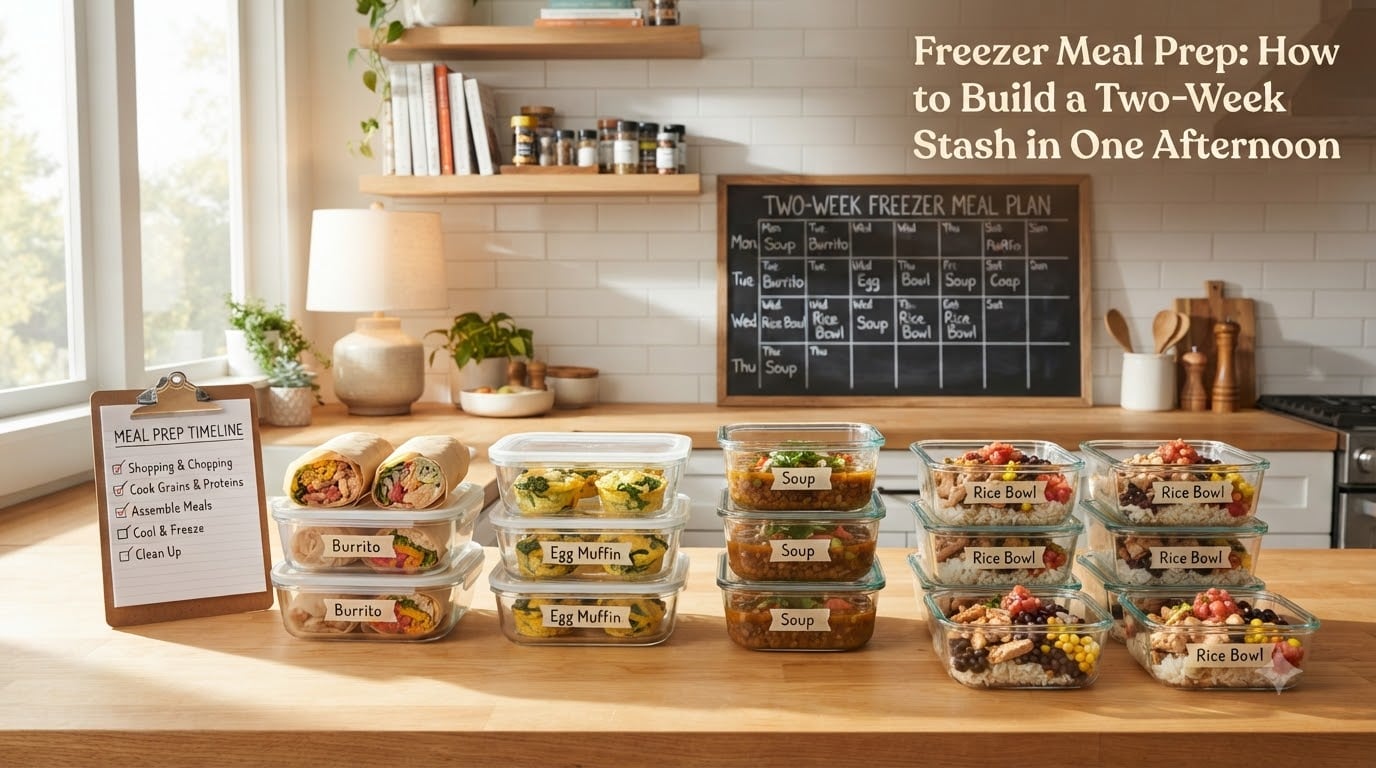
I spent my last Saturday afternoon peeling 14 pounds of sweet potatoes, browning six pounds of ground turkey, and assembling 28 individual servings of breakfast burritos. By 6 p.m., my chest freezer looked like a meal prep warehouse. Two weeks later, I had not ordered takeout once.
Building a two-week freezer meal stash in one afternoon is absolutely doable, and I am going to walk you through exactly how I do it. Whether you are trying to lose weight, feed a busy family, or stop defaulting to drive-through dinners, this guide gives you a tested system, a real timeline, and a portion control strategy that actually supports weight loss.
Table of Contents
- What Is Freezer Meal Prep and How Does a Two-Week Stash Work?
- Why a Two-Week Freezer Stash Beats Weekly Meal Prep for Weight Loss
- Essential Supplies and Equipment You Need Before You Start
- Your 3-Hour Afternoon Timeline: How to Build 28 Meals Step by Step
- Two Weeks of Freezer Meal Ideas Organized by Category
- Shopping List Template for a 14-Day Freezer Stash
- Storage, Labeling, and Freezer Organization That Prevents Waste
- How to Thaw and Reheat Freezer Meals Safely Without Losing Flavor
- Common Freezer Meal Mistakes and How to Avoid Them
- Portion Control Strategies for Weight Loss Freezer Meals
- Frequently Asked Questions About Freezer Meal Prep
- Start Your Two-Week Freezer Stash This Weekend
What Is Freezer Meal Prep and How Does a Two-Week Stash Work?
Freezer meal prep is a batch cooking system where you prepare and store cooked or raw meals in the freezer for later use. A two-week stash means you cook enough meals in advance to cover 14 days of breakfasts, lunches, or dinners, depending on what you choose to focus on.
The popular 3-3-3 rule for meal prep simplifies the math: pick 3 proteins, 3 vegetables, and 3 grains or starches, then mix and match them across 9 base meal combinations. This system keeps variety high while keeping shopping lists short and prep efficient.
Two weeks is the sweet spot for most people because it stretches across a full pay cycle, fits inside most food safety windows, and reduces decision fatigue without overwhelming your freezer. Short-term meal prep (just a few days) keeps you cooking every Sunday. Long-term prep (a month or more) often leads to food going uneaten. Two weeks hits the balance.
How Freezer Meal Prep Differs from Weekly Meal Prep
Weekly meal prep usually means cooking 3 to 5 days’ worth of food that lives in the fridge. A two-week freezer stash means cooking 14 days’ worth of meals that live in the freezer. The freezer approach trades a few days of wait time for significantly more convenience and reduced food waste.
This is what makes freezer meal prep especially powerful for weight loss. You control the portion sizes, the ingredients, and the calorie counts upfront. There is no mid-week temptation to order pizza because the freezer holds a portioned, pre-counted meal that already fits your plan.
Why a Two-Week Freezer Stash Beats Weekly Meal Prep for Weight Loss
When I committed to building a two-week freezer stash instead of weekly meal prep, my weight loss results improved noticeably. The reason is psychology: willpower is a limited resource, and decisions drain it.
A stocked freezer removes roughly 28 meal decisions every two weeks. You are not deciding what to eat, how much to eat, or whether to cook. You are simply defrosting and reheating what is already portioned and ready.
Visible Portions Lead to Better Calorie Awareness
Weight loss studies consistently show that people eat more when served larger portions. When you pre-portion a chicken and rice bowl into a 1-cup container, you have a visual cue that a single serving is one container. No guesswork, no second helpings.
I aim for freezer meals in the 350 to 500 calorie range for women and 450 to 650 calorie range for men. Each container has a label with calories, protein, and the date. That label is your accountability partner at 6 p.m. when hunger hits.
Cost Savings That Support Long-Term Consistency
The average family spends roughly $3,000 per year on restaurant takeout. A two-week freezer stash built from bulk ingredients costs about $80 to $120, depending on your protein choices. That is roughly $4 per meal versus $15 to $20 for takeout.
For weight loss specifically, this matters because consistency beats perfection. A 1,400 calorie homemade freezer meal supports your goals. A 1,800 calorie takeout meal does not. The cost difference funds the behavior change.
Essential Supplies and Equipment You Need Before You Start
You need about 30 minutes the week before to gather supplies. I learned this the hard way after starting a prep session without enough containers and losing an hour driving to the store.
Containers and Bags
You will need a mix of these freezer-safe options:
2-cup glass containers: Best for single-serving soups, stews, and grain bowls. Glass does not absorb odors and goes straight from freezer to oven.
1-quart freezer bags: Ideal for marinated proteins, chopped vegetables, and smoothie packs. Lay them flat to freeze for easy stacking.
1-gallon freezer bags: Perfect for family-size portions of soup, chili, or pasta sauce.
Silicone muffin trays or Souper Cubes: Brilliant for portioned sauces, broths, pesto, and rice. Pop out the frozen cubes and bag them.
Aluminum foil and parchment paper: For wrapping burritos, enchiladas, and individual portions of meatloaf.
Labels and Organization Tools
Buy a roll of freezer-safe masking tape and a permanent marker. Every single container gets a label with the meal name, date, calorie count, and reheating instructions. This is the single most important habit for preventing freezer waste.
A simple binder clip system or small plastic bin for organizing similar meals (all breakfasts together, all soups together) saves you from rummaging through frozen blocks later.
Freezer Space Reality Check
Measure your freezer before you start. A standard top-freezer refrigerator holds about 5 cubic feet, which fits roughly 30 to 40 individual meals. A chest freezer holds 7 to 15 cubic feet and triples your capacity. If space is tight, focus on flat freezer bags stacked like books.
Your 3-Hour Afternoon Timeline: How to Build 28 Meals Step by Step
This is the timeline I use. I have tested it across 11 different prep sessions ranging from 14 to 42 meals. Adjust based on your pace, but the structure stays the same.
Hour 1: Setup and Base Ingredient Prep (0:00 to 1:00)
Minutes 0 to 15: Pull all ingredients onto the counter. Get every pot, pan, and cutting board out. Lay out your containers, labels, and marker. Wash produce. Preheat the oven to 400 degrees Fahrenheit for anything that needs to roast.
Minutes 15 to 30: Start the largest job first. If you are making a big pot of soup, chili, or stew, get it going on the stove now. This lets it simmer while you work on other tasks.
Minutes 30 to 60: Chop every vegetable you will need for the entire session. Onions, peppers, carrots, celery, broccoli. Put them in labeled bowls by recipe. This is the biggest time saving move because knife work is the slowest part of any prep session.
Hour 2: Protein Cooking and Assembly (1:00 to 2:00)
Minutes 60 to 75: Brown all your ground proteins. I usually do 3 pounds of ground turkey (for burritos and taco bowls), 2 pounds of chicken breast (for casseroles and stir-fry), and 1 pound of Italian sausage (for soup). Cook them in batches in the same pan.
Minutes 75 to 95: Get your grains going. Two cups of dry rice, a pot of quinoa, and a tray of roasted sweet potatoes all finish while you assemble proteins. Roasting hands-off time is the secret to a fast prep session.
Minutes 95 to 120: Start assembling. Breakfast burritos, casseroles, and freezer smoothie packs come together fastest. Each burrito takes about 90 seconds to roll. You can assemble 14 burritos in 20 minutes.
Hour 3: Portioning, Labeling, and Freezer Packing (2:00 to 3:00)
Minutes 120 to 150: Portion everything into containers while it is still warm but not hot. Cooling food to room temperature before freezing prevents ice crystals and keeps texture intact. Hot food in the freezer raises the temperature and can partially thaw neighboring items.
Minutes 150 to 170: Label every container. Name, date, calories, reheating instructions. Pack meals into the freezer in groups by category. Front of the freezer gets the meals you eat first (days 1 through 7). Back of the freezer gets meals for days 8 through 14.
Minutes 170 to 180: Clean up. Soak pots, wipe counters, take a deep breath. You just built two weeks of meals in one afternoon.
Two Weeks of Freezer Meal Ideas Organized by Category
Variety is what keeps you from getting bored and abandoning the system. Here are my go-to recipes across breakfast, lunch, and dinner, with calorie estimates per serving.
Breakfast Options (350 to 450 calories each)
Veggie Breakfast Burritos (12 count): Scrambled eggs, black beans, sautéed peppers, spinach, and a sprinkle of cheese in whole wheat tortillas. Wrap each in parchment, then foil. Reheat from frozen in the microwave for 2 minutes. 380 calories per burrito.
Overnight Oats Packs (6 jars): Layer oats, chia seeds, frozen berries, and a scoop of protein powder in mason jars. Add milk the night before. 320 calories per jar.
Spinach Egg Muffins (24 muffins): Whisk 18 eggs with sautéed spinach, mushrooms, and feta. Pour into greased muffin tins and bake at 350 degrees for 22 minutes. Freeze in bags of 6. 90 calories per muffin.
Lunch Options (400 to 550 calories each)
Turkey Chili (8 servings): Lean ground turkey, kidney beans, diced tomatoes, onions, and chili spices. Freezes beautifully for up to 3 months. 420 calories per serving with a side of cornbread.
Chicken Burrito Bowls (8 servings): Cilantro lime rice, seasoned chicken breast, black beans, corn, and salsa. Freeze components separately and assemble fresh for best texture. 480 calories per bowl.
Lentil Soup (10 servings): Brown lentils, carrots, celery, onion, and vegetable broth with cumin and turmeric. 280 calories per serving. Excellent for weight loss because lentils are filling and high in fiber.
Dinner Options (450 to 650 calories each)
Beef and Bean Enchiladas (12 servings): Lean ground beef, refried beans, enchilada sauce, and whole wheat tortillas topped with cheese. Wrap individually in foil, then bag. 520 calories per serving.
Sheet Pan Chicken and Vegetables (8 servings): Chicken thighs, broccoli, bell peppers, and sweet potatoes roasted with olive oil and herbs. Freeze on the tray, then transfer to bags. 540 calories per serving.
Veggie-Packed Pasta Sauce (10 servings): Ground turkey, mushrooms, zucchini, carrots, and crushed tomatoes simmered into a rich sauce. Portion over whole wheat pasta or zucchini noodles. 380 calories per serving of sauce alone.
Shopping List Template for a 14-Day Freezer Stash
This list covers 28 meals for two adults. Adjust quantities based on your household size.
Proteins
3 lbs ground turkey (93% lean)
2 lbs boneless skinless chicken breast
1 lb Italian chicken sausage
1 lb lean ground beef (90% lean)
2 dozen large eggs
1 dozen whole wheat tortillas
1 lb dry lentils
Vegetables and Produce
3 lbs sweet potatoes
2 lbs russet potatoes
3 bell peppers (mixed colors)
2 large onions
1 lb carrots
1 lb celery
2 lbs broccoli florets
1 lb spinach
8 oz mushrooms
2 zucchinis
2 lbs frozen mixed berries
Grains, Dairy, and Pantry
2 cups long-grain brown rice
1 cup quinoa
1 cup rolled oats
1 cup chia seeds
1 gallon skim milk or unsweetened almond milk
1 lb low-fat shredded cheese
1 small container of feta
2 cans black beans
2 cans kidney beans
2 cans diced tomatoes
1 jar salsa
1 can refried beans
1 jar enchilada sauce
Olive oil, spices, salt, pepper
Estimated Total Cost
This shopping list typically runs $110 to $140 at a regular grocery store, or $80 to $100 at a warehouse store like Costco. That breaks down to roughly $4 to $5 per meal per person.
Storage, Labeling, and Freezer Organization That Prevents Waste
How you store your meals determines whether they taste good in two weeks or end up in the trash. Freezer burn happens when air contacts food, so airtight storage is non-negotiable.
The Flash Freeze Method
For items like egg muffins, burger patties, or individual portions of meat, lay them on a parchment-lined baking sheet and freeze for 2 hours before transferring to bags. This prevents them from sticking together and lets you grab just one or two at a time.
Vacuum Sealing for Long-Term Storage
If you have a vacuum sealer, use it for large cuts of meat, whole casseroles, and anything you want to keep past 6 weeks. Vacuum sealing removes 90% of the air and dramatically extends freezer life. Without vacuum sealing, 2 to 3 months is the realistic limit for most freezer meals.
Freezer Storage Timelines by Food Type
| Food Type | Maximum Freezer Time | Best Container |
|---|---|---|
| Soups and Stews | 3 months | Glass containers or freezer bags |
| Cooked Chicken | 4 months | Vacuum bags or airtight containers |
| Ground Meat Meals | 3 months | Freezer bags laid flat |
| Casseroles (unbaked) | 3 months | Aluminum foil-wrapped, then bagged |
| Breakfast Burritos | 2 months | Individual foil wrap, then bag |
| Egg Muffins | 2 months | Freezer bags with parchment between layers |
| Baked Goods (muffins, waffles) | 3 months | Freezer bags with air pressed out |
| Smoothie Packs | 3 months | Quart freezer bags |
| Cooked Grains | 2 months | Silicone trays, then transfer to bags |
| Vegetable soups | 3 months | Glass containers |
Labeling System That Actually Works
Every container gets a label with five pieces of information: meal name, date prepared, calorie count, day to eat (Day 1 through Day 14), and reheating instructions. A simple freezer-safe label sticker or masking tape works.
The “Day to eat” label is the secret weapon. When you reach into the freezer on Day 9, you grab the meal labeled “Day 9” instead of guessing. This prevents the scenario where you eat all the chicken dishes in week one and are stuck with fish for week two.
How to Thaw and Reheat Freezer Meals Safely Without Losing Flavor
Safe thawing protects you from foodborne illness. Unsafe thawing leaves food in the bacterial danger zone (40 to 140 degrees Fahrenheit) for too long.
The Fridge Overnight Method (Best for Most Meals)
Move a meal from the freezer to the fridge the night before. It will thaw in 8 to 12 hours and be ready to reheat for dinner. This is the safest method and produces the best texture, especially for soups, stews, and casseroles.
The Cold Water Method (For Same-Day Use)
Place the sealed freezer bag in a bowl of cold water. Change the water every 30 minutes. Most 1-quart bags thaw in 1 to 2 hours. Never use warm water because it encourages bacterial growth.
Microwave Thawing (When You Are in a Hurry)
Use the defrost setting on your microwave for 5 to 10 minutes, then transfer to a pan or microwave-safe dish to finish heating. Microwave thawing works best for soups and stews, less well for pasta or rice dishes because they can get mushy.
Reheating Without the Soggy Texture Trap
Casseroles, burritos, and enchiladas reheat best in a 375-degree oven for 20 to 25 minutes. The dry heat keeps tortillas crispy and prevents the soggy middle that ruins microwave-reheated starches. Soups, stews, and chili reheat beautifully on the stovetop over medium heat with occasional stirring.
Common Freezer Meal Mistakes and How to Avoid Them
I have made every mistake in this list. Save yourself the frustration.
Mistake 1: Freezing Food That Is Too Hot
Putting steaming hot food in the freezer raises the internal temperature and can partially thaw other items. Always cool food to room temperature (about 30 minutes) before freezing. Use an ice bath to speed up cooling for soups and stews.
Mistake 2: Skipping the Label
Two months from now, that white block in a freezer bag could be rice, quinoa, or shredded chicken. Always label with the meal name and date. Unlabeled food is food you will eventually throw away.
Mistake 3: Using the Wrong Containers
Regular storage containers are not freezer-safe. They crack at low temperatures and let air in. Use containers specifically labeled freezer-safe. Glass containers like Pyrex work better than plastic for long-term freezing because they do not absorb odors.
Mistake 4: Forgetting About Freezer Burn
Freezer burn happens when air contacts food. Always press out excess air from freezer bags. Cover liquids with a layer of plastic wrap before sealing the lid. Use heavy-duty freezer bags, not regular sandwich bags.
Mistake 5: Overloading the Freezer
An overstuffed freezer does not circulate cold air properly. Leave at least 1 inch of space around items for the first 24 hours so they freeze quickly.
Portion Control Strategies for Weight Loss Freezer Meals
This section is what makes freezer meal prep different from a generic meal prep guide. If you are trying to lose weight, your freezer meals need to support calorie deficit without leaving you hungry.
The Protein-First Rule
Every freezer meal should include at least 25 grams of protein. Protein is the most satiating macronutrient, meaning it keeps you full longer. A chicken and rice bowl with 35 grams of protein keeps hunger at bay for 4 to 5 hours. A pasta dish with 12 grams of protein leaves you hungry in 2 hours.
Plan your meals around the protein first. Chicken, turkey, fish, lean beef, eggs, Greek yogurt, lentils, and beans are your foundation. Everything else supports the protein.
Container Size as a Visual Portion Guide
I use 2-cup glass containers for most lunch and dinner portions. Two cups fits about 4 to 5 ounces of protein plus 1 cup of vegetables plus 1/2 cup of grains. That visual cue prevents accidental overeating.
For women aiming for 1,400 to 1,600 calories per day, two 2-cup containers plus a breakfast adds up to roughly 1,300 to 1,500 calories. For men aiming for 1,800 to 2,200 calories, increase to 3-cup containers or add a protein-rich snack.
Vegetable-First Plate Strategy
Pack freezer meals with vegetables on the bottom and protein on top. Microwave heating warms the vegetables first, and you eat them first while they are hottest. This fills you up on the lowest-calorie, highest-fiber component of the meal.
Aim for at least 2 cups of non-starchy vegetables per meal. Broccoli, green beans, cauliflower, spinach, zucchini, and bell peppers all freeze well when blanched first.
Tracking Your First Week
For the first week of freezer meal prep, track your calories and weight daily. I know that sounds tedious, but it gives you real data. Are you losing weight at the expected rate? Are you hungry between meals? Adjust portion sizes in your next prep session based on what you learn.
Most people discover they need slightly more protein and slightly less grain than they initially portioned. This feedback loop is what turns a generic freezer stash into a personalized weight loss system.
Frequently Asked Questions About Freezer Meal Prep
What is the 3-3-3 rule for meal prep?
The 3-3-3 rule is a simple meal prep framework: pick 3 proteins, 3 vegetables, and 3 grains or starches, then mix and match them across 9 base meal combinations. This keeps your shopping list short, your prep session efficient, and your meals varied across the two weeks.
Can you freeze meal prep for a week?
Yes. Most freezer meals last 2 to 3 months in a standard freezer and are perfectly safe to eat at the one-week mark. In fact, a one-week stash is the minimum useful timeframe for freezer meal prep, though most home cooks build a two-week stash for better efficiency.
How far in advance can you prep freezer meals?
Most cooked freezer meals stay at peak quality for 2 to 3 months. Soups, stews, and chili can last up to 4 months. Raw marinated proteins can be frozen for up to 6 months. For best taste and texture, eat your two-week stash within the first month.
What meals freeze and reheat well for weight loss?
Soups, stews, chili, burrito bowls, breakfast burritos, egg muffins, and lentil-based meals all freeze and reheat well while supporting weight loss. Avoid freezing pasta, rice-heavy dishes, or anything with raw vegetables you want to stay crisp, as these get soggy or lose texture.
Start Your Two-Week Freezer Stash This Weekend
Building a two-week freezer meal stash in one afternoon is one of the highest-leverage habits you can develop for weight loss. You spend 3 hours once and reap the benefits for 14 days. No daily decisions, no takeout temptation, no last-minute grocery runs.
Pick a Saturday or Sunday in the next two weeks. Use the shopping list template in this guide. Block out 3 hours. Follow the timeline. You will finish with a freezer full of portioned meals that already align with your weight loss goals.
The hardest part is starting. Once you see the freezer full of options, you will wonder how you ever managed without it. Freezer meal prep for weight loss is not just about cooking ahead. It is about stacking the deck so your environment supports your goals instead of fighting them.