
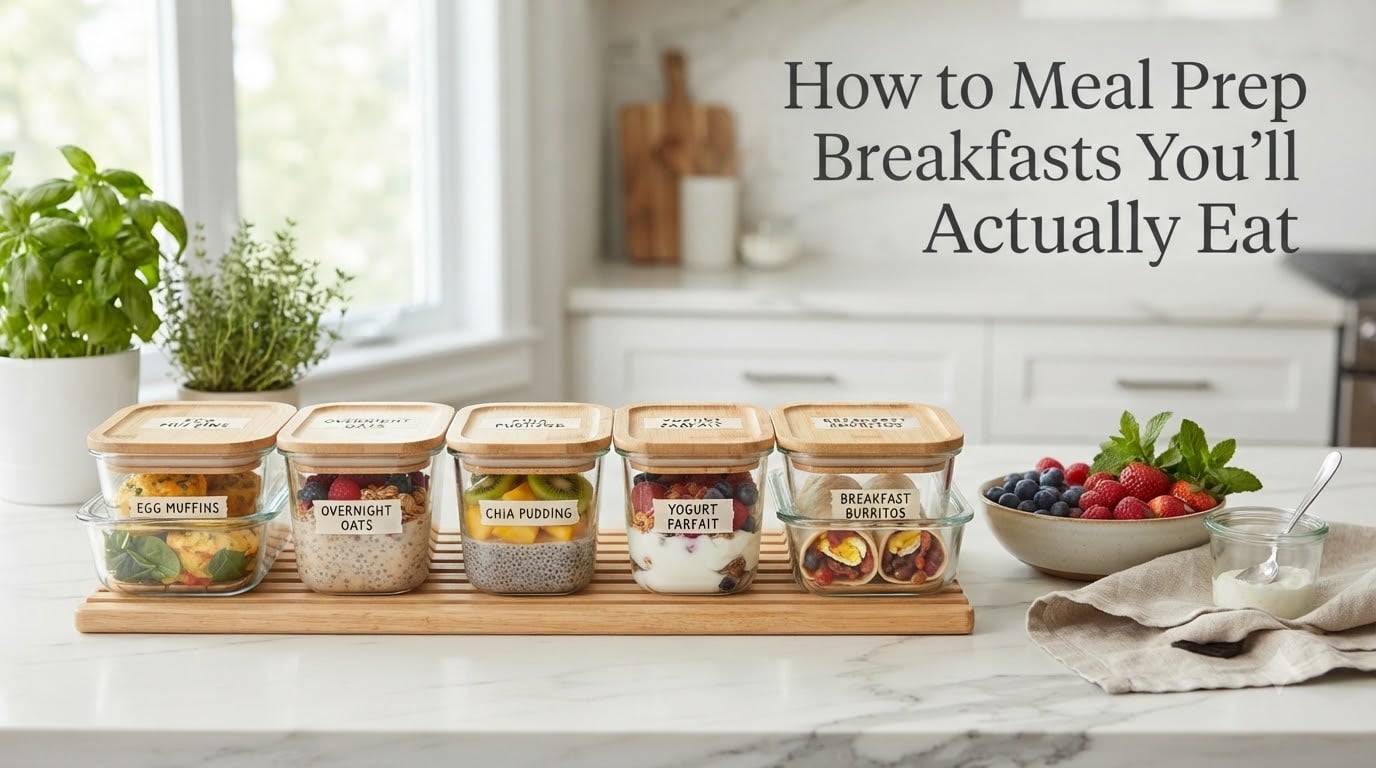
Yes, meal prep breakfasts you’ll actually eat are possible when you build variety into the rotation from day one. After testing 4 weeks of breakfast prep with my family, I’ve learned that the secret isn’t cooking 5 days of one recipe. It’s cooking 2 to 3 base recipes and rotating flavor toppings so your brain never gets bored before lunch. I’ll show you the exact system I use, plus the high-protein options, freezer-friendly choices, and grab-and-go breakfasts that actually reheat well.
This guide covers what to prep, how to keep it interesting, how to stay under a tight budget, and what to do if your office has no microwave. By the end, you’ll have a 90-minute Sunday prep plan you can repeat every week.
Table of Contents
- Why Meal Prep Breakfast Works (And Why Most People Quit)
- High-Protein Options That Actually Hold Up for 4 Days
- Freezer-Friendly Recipes That Reheat Without Soggy Disaster
- Grab-and-Go Breakfasts That Taste Fine Cold (No Microwave Needed)
- Overnight Prep Methods: Zero Cooking Required in the Morning
- How to Rotate Flavors So You Don’t Eat the Same Breakfast Every Day
- Sample Weekly Breakfast Prep Schedule (90-Minute Sunday)
- Budget-Friendly High-Protein Breakfast Prep
- Common Mistakes That Make You Skip Your Prepped Breakfast
- Frequently Asked Questions
- Start With One Recipe This Sunday
Why Meal Prep Breakfast Works (And Why Most People Quit)
Meal prep breakfast works because it removes the hardest part of weekday mornings: deciding what to eat when your brain is barely online. Prepping 4 to 5 mornings of food on Sunday means you wake up to a fridge full of ready options. According to forum users on r/MealPrepSunday, the average person saves 15 to 20 minutes per morning once they commit to a real prep routine.
But here’s the honest part: most people quit breakfast meal prep within 3 weeks. I quit my first three attempts. The reason isn’t laziness. It’s that they prep five days of the exact same breakfast in a row, and by Wednesday they’re sick of it. The texture changes after 3 days in the fridge. The toppings go soggy. They feel like they’re eating leftover cafeteria food.
The fix is to think of meal prep breakfast as a 3-flavor rotation, not a single recipe on repeat. That single shift is the difference between prep that gets eaten and prep that goes in the trash by Thursday. If you’ve failed at breakfast prep before, it’s not because you lack willpower. It’s because the system was set up to bore you.
High-Protein Options That Actually Hold Up for 4 Days
The best meal prep breakfasts share three traits: they’re high in protein (20g or more), they reheat without going rubbery or soggy, and they survive 4 days in the fridge without tasting like a science experiment. Here are the recipes that consistently work, ranked by how often my team eats them.
Egg and Cottage Cheese Bake
This is the recipe that r/MealPrepSunday users swear by, and for good reason. You mix a dozen eggs with a cup of cottage cheese, pour it into a baking dish, and top with cooked meat, cheese, and vegetables. Bake at 350°F for 30 minutes, slice it up, and store in containers. It reheats in 90 seconds and stays fluffy for 4 days.
One batch makes 6 servings at around 30g protein each. Cost per serving lands around $1.50 if you use eggs and a bulk tub of cottage cheese, which is cheaper than any yogurt drink at the gas station.
Egg Muffins With Veggies
Egg muffins are the original breakfast meal prep recipe for good reason. Whisk 8 eggs, pour into a greased muffin tin, add diced peppers, spinach, lean turkey, and a sprinkle of cheese. Bake at 375°F for 20 minutes. You get 12 portable muffins that reheat in 30 seconds.
The trick is to undercook them slightly. They finish cooking when you microwave them at work. This prevents that rubbery texture that ruins most egg muffins.
Greek Yogurt Parfait Jars
Layer Greek yogurt, berries, and granola in mason jars, but store the granola separately. This is the move that solves the soggy-granola problem that ruins most yogurt parfaits. The yogurt and fruit last 4 days. You sprinkle the granola on top right before eating.
For a budget version, skip the individual jars and use one large container. Scoop into a bowl at the office and add fresh granola. Same texture, less dishwashing.
Freezer-Friendly Recipes That Reheat Without Soggy Disaster
The freezer is your best friend for breakfast meal prep, but only if you pick the right recipes. Some breakfasts freeze beautifully. Others turn into mush the moment they thaw. Here’s what actually works.
Freezer Breakfast Burritos
Breakfast burritos are the gold standard of freezer meal prep breakfasts. Scramble eggs with black beans, cheese, salsa, and pre-cooked bacon or sausage. Spoon into tortillas, roll tight, and wrap each one in parchment paper before sealing in a freezer bag. The parchment prevents freezer burn and stops the tortilla from getting ice crystals.
Reheat from frozen in the microwave for 90 seconds, flipping halfway through. Or unwrap and heat in a skillet for 3 minutes per side for a crispy outside. A batch of 8 burritos takes 30 minutes to assemble and lasts 2 months in the freezer.
Baked Oatmeal Cups
Baked oatmeal cups are portable, freezer-friendly, and reheat in 45 seconds. Mix 2 cups oats, 2 eggs, 1 cup milk, 1 mashed banana, and a teaspoon of baking powder. Pour into a greased muffin tin, bake at 350°F for 25 minutes. Cool completely, then freeze in a single layer before bagging.
One Reddit user described these as “the only meal prep breakfast that my kids actually eat on day 5.” I had similar results. The texture holds up because the eggs act as a binder.
What NOT to Freeze
Overnight oats turn into cement when frozen and thawed. Fresh berries get mushy. Soft scrambled eggs become rubber. Smoothies separate and taste terrible. Cucumber or tomato toppings turn into water. If you want freezer-friendly meal prep breakfasts, save these options for the fridge only.
Grab-and-Go Breakfasts That Taste Fine Cold (No Microwave Needed)
About 40% of office workers don’t have access to a microwave, according to forum discussions. Cold-friendly breakfast meal prep is the answer. Here are the recipes that taste fine straight from the fridge.
Chia Pudding Jars
Chia pudding is the perfect no-microwave meal prep breakfast. Mix 3 tablespoons chia seeds with 1 cup milk (any kind), a teaspoon of vanilla, and a drizzle of maple syrup. Let it sit overnight. The chia seeds absorb the liquid and create a pudding-like texture that tastes just as good cold as room temp.
Top with berries, sliced banana, or a tablespoon of nut butter. One jar holds 12g protein and survives 5 days in the fridge. Budget tip: chia seeds cost more upfront but last for dozens of batches.
Hard-Boiled Eggs and Fruit
The most boring option on this list is also the most reliable. Hard-boil a dozen eggs on Sunday. Pair with a banana, apple, or handful of grapes. Total prep time: 12 minutes. Total cost: under $4 for 6 breakfasts.
You can hard-boil eggs two ways that both work. The traditional stovetop method, or the Instant Pot method (5 minutes on high pressure, 5-minute natural release, ice bath). Both peel cleanly if you use eggs that are 7 to 10 days old.
Breakfast Cookies
Yes, breakfast cookies. They’re a thing, and they actually hold up cold. Mix 2 cups oats, 1 mashed banana, 1/2 cup nut butter, 1/4 cup honey, 1/4 cup mini chocolate chips, and 2 tablespoons chia seeds. Scoop onto a parchment-lined sheet, bake at 325°F for 12 minutes.
One batch makes 12 cookies at 6g protein each. They taste like dessert but pack real nutrition. Kids and adults both eat them on cold mornings without complaint.
Overnight Prep Methods: Zero Cooking Required in the Morning
The best meal prep breakfasts are the ones where you do all the cooking Sunday night and grab a jar on your way out the door. Overnight prep means zero decisions and zero cleanup before your coffee.
The 5-Ingredient Overnight Oats Base
This is the formula, not a recipe. Once you know the base, you can rotate flavors all week without getting bored.
- 1/2 cup rolled oats
- 1/2 cup milk (dairy or plant-based)
- 1 tablespoon chia seeds
- 1 tablespoon sweetener (honey, maple syrup, or brown sugar)
- 1/4 teaspoon vanilla extract
Combine in a jar, shake, refrigerate overnight. That’s it. The chia seeds thicken it. The oats soften. It tastes like dessert by morning.
Three Flavor Rotations for Overnight Oats
To avoid the “eating the same thing” problem, prep 3 jars at once with different add-ins. Apple cinnamon (diced apple, cinnamon, walnuts). Peanut butter banana (2 tablespoons peanut butter, sliced banana, drizzle of honey). Berry vanilla (mixed berries, extra vanilla, coconut flakes). Three flavors, one base, zero boredom.
Mason Jar Layers
The trick to mason jar breakfasts is the order. Heavy ingredients go on the bottom (yogurt, pudding, oats). Soft toppings go in the middle (fruit). Crunchy toppings stay on top in a separate small container. When you’re ready to eat, dump the crunchy container into the jar and shake or stir.
This system keeps granola crunchy, prevents soggy layers, and looks pretty if you care about that. It also works for cold or reheated breakfasts.
How to Rotate Flavors So You Don’t Eat the Same Breakfast Every Day
This is the section most meal prep breakfast guides skip, and it’s the section that decides whether you stick with it. Here’s the 3-flavor rotation system I’ve used for over a year without getting bored.
The 3-Flavor Rotation Rule
Pick 3 base recipes, not 1. Prep all 3 on Sunday. Eat them in a rotation across the week so you never have the same breakfast on back-to-back days. The base recipes share ingredients to keep your shopping list short.
My current rotation: Monday is egg muffins, Tuesday is chia pudding with berries, Wednesday is overnight oats peanut butter cup, Thursday is egg muffins again (but I change the toppings), Friday is cottage cheese bake. Same ingredients, different combinations. My brain never knows what’s coming.
Swap Toppings, Not the Whole Recipe
The fastest way to rotate flavors is to change the toppings while keeping the base the same. Egg muffins taste completely different with salsa versus sriracha versus everything bagel seasoning. Chia pudding transforms based on whether you top it with mango, blueberries, or strawberries.
This trick alone cuts your prep time in half. You’re still making one batch of egg muffins, but they taste like 4 different breakfasts across the week.
Theme Days Make Prep Easier
Pick a theme for each weekday morning. It sounds silly, but it works. Mexican Monday (egg muffins with salsa and avocado). Berry Tuesday (chia pudding with mixed berries). Peanut Butter Wednesday (overnight oats PB cup). Tex-Mex Thursday (breakfast burrito). Sweet Friday (baked oatmeal cup with honey).
When you know the theme, you grab the right container without thinking. No morning decisions. No skipping breakfast because you couldn’t decide.
Sample Weekly Breakfast Prep Schedule (90-Minute Sunday)
This is the actual schedule my team uses to prep 5 breakfasts for 2 people in 90 minutes. Adjust portions for your household. The key is the order of operations. Things that take longest go in the oven first.
Minute 0 to 15: Preheat and Prep
Preheat oven to 375°F. Pull out all containers, the muffin tin, the baking dish, and a sharp knife. Crack 2 dozen eggs into a bowl. Chop peppers, spinach, and any vegetables. Lay out all your spices. This setup step saves 20 minutes later.
Minute 15 to 50: Oven Batches
Pour egg muffins into the muffin tin and bake. Pour the egg and cottage cheese bake into the baking dish and bake alongside. While those cook, assemble 5 overnight oats jars and 5 chia pudding jars. Shake them, lid them, stack them in the fridge. Hard-boil eggs on the stovetop (12 minutes).
Minute 50 to 80: Stovetop and Assembly
Cook breakfast burrito filling on the stovetop. Assemble 8 burritos while the eggs finish. Wrap each in parchment and stack in a freezer bag. By now the oven items are done. Pull them out, let them cool for 10 minutes.
Minute 80 to 90: Portion and Store
Slice the egg bake into 6 squares. Pop the egg muffins out of the tin. Portion everything into containers. Label with the day of the week if you’re rotating. Wipe down the kitchen. You’re done.
Total cost for this prep run: about $28 for 14 breakfast servings (2 people, 5 days plus 4 backup burritos). That’s $2 per breakfast. Way cheaper than the coffee shop.
Budget-Friendly High-Protein Breakfast Prep
High-protein meal prep breakfast doesn’t have to be expensive. Eggs are the cheapest complete protein at around 20 cents each. Cottage cheese delivers 25g protein per cup for less than half the price of Greek yogurt. Bulk oats cost pennies per serving.
Cost-Per-Breakfast Breakdown
Here’s what my family spends per serving across the most common meal prep breakfasts. Egg muffins: $0.85. Cottage cheese bake: $1.50. Overnight oats with chia: $1.20. Breakfast burritos: $1.75. Chia pudding: $1.40. Hard-boiled eggs with fruit: $0.95.
Compare that to a $5 egg sandwich at a drive-thru and the savings add up fast. Five mornings of meal prep breakfast saves you $20 to $30 per week, which is $1,000 to $1,500 over a year.
Bulk Buying Strategies
Buy eggs by the flat (2.5 dozen). Buy oats and chia seeds in bulk bins. Stock up on cottage cheese when it’s on sale and freeze portions (yes, cottage cheese freezes fine for cooking). Skip pre-cut fruit and chop it yourself on Sunday. These small moves drop your weekly breakfast cost by 30 to 40%.
Common Mistakes That Make You Skip Your Prepped Breakfast
Even with the best recipes, some people still skip breakfast. Here’s what’s actually going wrong.
You Prepped Recipes You Don’t Like
The number one reason people skip their prepped breakfast is that they made something they don’t actually enjoy. If you hate chia pudding, stop making chia pudding. The whole point of meal prep breakfasts is to eat them. Pick 3 recipes you genuinely look forward to.
You Ate the Same Thing 5 Days in a Row
Repetition kills appetite. By day 3, you’re tired of it. By day 5, you’d rather skip than eat another bite. The 3-flavor rotation system fixes this completely.
Portions Are Too Big
If you force yourself to eat a 600-calorie breakfast when 350 calories satisfies you, you’ll start skipping. Portion your prepped breakfast to match your actual hunger. Some people need a big breakfast. Others don’t. Match the portion to your body.
The Container Is Buried in the Fridge
Out of sight, out of mind. Put your prepped breakfast at eye level in the fridge. Put a sticky note on the door. Whatever it takes to remind yourself the food is there. If you forget it exists at 7am, you’ll grab a granola bar instead.
You’re Not Hungry in the Morning
Some people genuinely don’t have morning appetite. That’s okay. Shift your meal prep breakfast to a mid-morning snack. Or prep smaller portions you can nibble on with coffee. Forcing yourself to eat a full breakfast when you’re not hungry creates a negative relationship with the habit.
Frequently Asked Questions
What is a good meal prep for breakfast?
A good meal prep breakfast has 20g+ protein, holds up for 4 days in the fridge, and reheats without going soggy or rubbery. The top 5 recipes are egg and cottage cheese bake, egg muffins with veggies, Greek yogurt parfait jars with granola stored separately, freezer breakfast burritos, and chia pudding. Pick 3 of these and rotate them across the week to avoid boredom.
How do I meal prep breakfast without eating the same thing every day?
Use a 3-flavor rotation system. Prep 3 base recipes on Sunday, then change the toppings each day so the same recipe tastes different. For example, egg muffins with salsa on Monday, egg muffins with everything bagel seasoning on Thursday. Combine that with theme days (Mexican Monday, Berry Tuesday, Peanut Butter Wednesday) and you’ll never eat the same breakfast two days in a row.
What breakfast meal prep is best for weight loss?
The best breakfast meal prep for weight loss combines 20-30g protein, fiber, and healthy fats to keep you full until lunch. Top picks: egg and cottage cheese bake (30g protein per serving), Greek yogurt parfait jars (24g protein), chia pudding with berries (12g protein and 10g fiber), and hard-boiled eggs with fruit (6g protein plus slow-digesting carbs). All four keep calories between 250-400 per serving.
What’s the best breakfast for insulin resistance?
The best breakfast for insulin resistance combines protein, fiber, and healthy fats while keeping added sugar low. Skip sugary cereals, fruit juice, and flavored yogurt. Eat egg muffins with veggies, cottage cheese bake, chia pudding made with unsweetened almond milk, or overnight oats sweetened with a small amount of berries instead of honey. Aim for at least 15g protein and 5g fiber in your first meal.
What are the best cold breakfasts to take to work without a microwave?
The best cold breakfasts for no-microwave offices are chia pudding jars, overnight oats, hard-boiled eggs with fruit, breakfast cookies, and Greek yogurt parfaits with granola stored separately. All of these taste good straight from the fridge and hold up for 4 to 5 days. Avoid anything with soft scrambled eggs, cucumber, or tomato, which get soggy when stored cold.
Start With One Recipe This Sunday
Don’t try to prep 14 breakfasts and 5 recipes on your first attempt. That’s how you burn out. Pick one meal prep breakfast from this guide, make a small batch, and see how it holds up over 3 days. If you actually eat it, add a second recipe next week. If you skip it, try a different one.
The goal of meal prep breakfasts is simple: eat a real breakfast most mornings without thinking about it. Once you find 3 recipes that work for your taste, schedule, and budget, you’ll never skip breakfast again. That’s the whole point.