
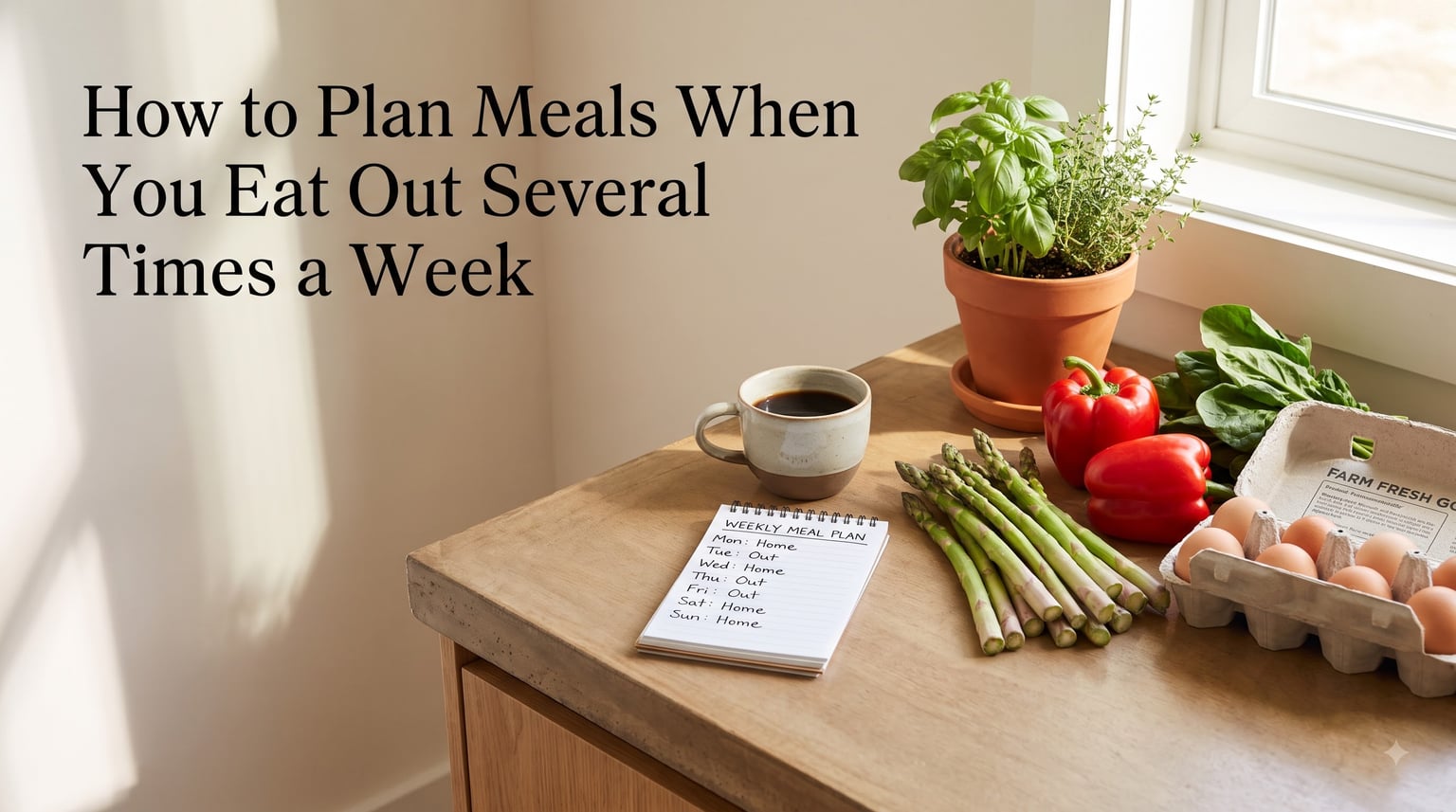
Figuring out how to plan meals when you eat out several times a week can feel like a losing game. I used to cook a beautiful Sunday meal prep, only to toss out wilted greens by Thursday because lunch meetings, date nights, and spontaneous takeout kept me away from my own kitchen. If that sounds familiar, the problem isn’t your willpower. It’s that most meal plans assume you’ll eat every dinner at home.
When you’re eating out 3 to 4 times a week, the rules change. You don’t need a 21-meal weekly plan. You need a flexible framework that fits around restaurant meals without wasting food, blowing your budget, or making you feel guilty for having a social life. In this guide, I’ll walk you through exactly how I rebuilt my approach so eating out stopped fighting my meal plan and started working with it.
Table of Contents
- Why Frequent Dining Out Makes Meal Planning Harder
- The 3-3-3 Rule for Meals When You Eat Out Often
- How to Plan Meals Around a Busy Dining-Out Schedule
- Flexible Meal Planning vs. Full Meal Prep: Which Works Better?
- Smart Grocery Shopping When You Eat Out Several Times a Week
- Restaurant Order Strategies That Support Your Meal Plan
- Sample Meal Plan for Someone Who Eats Out 3-4 Times a Week
- Frequently Asked Questions
- Final Thoughts
Why Frequent Dining Out Makes Meal Planning Harder
Frequent dining out throws a wrench into standard meal plans because those plans assume full control of your kitchen. The moment a Tuesday dinner with friends lands on the calendar, your carefully counted portions and grocery list go sideways.
Here are the three problems I kept running into, and why most beginner meal plans fail people who eat out a lot:
- Grocery quantities don’t match reality. A meal plan for 14 dinners assumes you’ll cook 14 dinners. If you only cook 9, you’re wasting food and money.
- Leftovers pile up unused. Big batch recipes designed for “family of four” don’t work in a one- or two-person household that already eats half its meals out.
- Decision fatigue gets worse, not better. When you eat out often, your brain is making food choices constantly. A rigid plan adds more decisions instead of removing them.
The fix isn’t to stop eating out. It’s to plan meals in a way that accounts for restaurant meals as a known variable, not an interruption.
The 3-3-3 Rule for Meals When You Eat Out Often
The 3-3-3 rule is one of the simplest frameworks I have found for anyone trying to figure out how to plan meals when you eat out several times a week. It is built for real life, not Instagram kitchens.
Here’s how it breaks down for a typical week with 3 to 4 restaurant meals already on the books:
- 3 home-cooked dinners. Pick three nights when you know you’ll actually cook. Rotate two of those recipes so you only learn a few dishes well.
- 3 versatile lunches. Use a “build your own” formula like grain + protein + vegetable + sauce. The same components can make a bowl, a wrap, or a salad.
- 3 pantry breakfasts. Stock oats, eggs, yogurt, fruit, and bread so breakfast doesn’t require a recipe. This alone saves 15 minutes every morning.
That covers 9 meals. The remaining 12 are flexible: restaurant dinners, takeout lunches, leftovers, or a quick scramble from the fridge. Notice what’s missing: a rigid shopping list and a guilt trip for eating out.
This framework works because it treats restaurant meals as part of the plan. You’re not “failing” by ordering pad thai on Friday. Friday was always going to be a restaurant night.
How to Plan Meals Around a Busy Dining-Out Schedule
Step-by-step planning sounds intense, but for someone eating out 3 to 4 times a week, it should take about 20 minutes total. I do mine Sunday morning with coffee. Here’s the exact method I use.
Step 1: Map your week first. Before you pick a single recipe, open your calendar and circle the days you already know you’ll eat out. Work dinners, birthdays, social plans. Don’t try to talk yourself out of them. Just mark them.
Step 2: Pick 3 home-cooked dinners to fill the gaps. Now look at the empty dinner slots. Pick three recipes based on two criteria: how much time you actually have, and what ingredients are already in your fridge. I keep a running note on my phone of “what’s about to go bad” so my recipes use up food instead of adding to it.
Step 3: Choose a flexible lunch template. Pick one structure, not seven recipes. Mine is “any grain + any protein + any vegetable + any sauce.” On Sunday I roast a tray of vegetables and cook a pot of grain. During the week I mix and match from the fridge.
Step 4: Write a scaled grocery list. This is where frequent diners usually overspend. A meal plan for 7 dinners needs 7 dinners worth of groceries. Yours needs 3. I’ll cover the exact shopping method in the next section.
Step 5: Block 30 minutes for prep, not 3 hours. On Sunday or your day off, do small batch tasks: chop onions, cook a grain, roast vegetables, hard boil eggs. That’s it. The rest of the week, you’re assembling, not cooking from scratch.
Flexible Meal Planning vs. Full Meal Prep: Which Works Better?
Most meal planning advice falls into one of two camps: full Sunday meal prep, where you cook everything in containers, or “wing it” cooking each night. When you eat out several times a week, neither extreme works well. Here’s the honest comparison.
Full meal prep works great if you have a predictable 9-to-5 and almost no social dining. The downside: it creates containers you’ll throw away because you got invited to dinner on Wednesday.
Flexible meal planning works better for anyone with a fluctuating schedule. You prep a few versatile components and assemble meals during the week. Less waste, more freedom.
After testing both for six months, the hybrid approach won for me. I batch-cook two “building blocks” on Sunday (usually a protein and a grain), then assemble 3 to 4 quick meals through the week. The rest of the dinners are restaurant meals I genuinely planned for.
Smart Grocery Shopping When You Eat Out Several Times a Week
The 5-4-3-2-1 grocery method is a game-changer if you eat out often. Instead of buying ingredients for 14 dinners, you buy just enough for the meals you’ll actually cook. Here’s how it works in practice.
- 5 produce items: Pick five fruits or vegetables you actually eat. For me that’s spinach, bell peppers, bananas, tomatoes, and one “experiment” item.
- 4 proteins: Two fresh, two versatile (eggs, canned beans, deli meat, or tofu). This covers dinners and emergency lunches.
- 3 grains or starches: Rice, bread, tortillas, or pasta. Pick what you’ll actually finish before it goes stale.
- 2 sauces or flavor boosters: Pesto, hot sauce, soy sauce, or a good salsa. These turn “boring leftovers” into something new.
- 1 treat: One fun snack so your kitchen doesn’t feel like a punishment.
The total shopping list takes about 15 items. You can hit the store in under 30 minutes and you’ll use almost everything before next week. For one- or two-person households that eat out often, this cuts grocery waste dramatically.
The biggest mindset shift here is buying for the meals you’ll cook, not the meals you wish you’d cook. If your plan has 3 home dinners, your cart supports 3 home dinners.
Restaurant Order Strategies That Support Your Meal Plan
Learning how to plan meals when you eat out several times a week also means learning how to order well when you’re not cooking. Restaurant meals don’t have to undo your home efforts.
Here are the three strategies that have made the biggest difference for me:
- Build a “normal” plate. Look for a protein, a vegetable, and a starch on the menu, instead of defaulting to pasta or a burger. Most restaurants can swap fries for a side salad.
- Eat half, take half. Restaurant portions are huge. Eating half on-site and saving half for tomorrow’s lunch reduces waste and saves real money.
- Separate enjoyment from overeating. You can love restaurant food and still leave feeling good. Savoring a meal is different from finishing it because it’s in front of you.
Social dining strategies matter just as much as food strategies. If your friends always eat out on Friday, plan your home cooking for Sunday, Monday, and Wednesday. That way Friday is a treat you built into the plan, not a failure of willpower.
Sample Meal Plan for Someone Who Eats Out 3-4 Times a Week
Here’s what a realistic week looks like using everything above. Notice the restaurant meals are written in, not squeezed around.
- Sunday: Roast chicken + sheet pan vegetables (cook extra vegetables for lunches). 40 minutes of prep.
- Monday: Chicken and vegetable grain bowls for lunch. Simple pasta for dinner.
- Tuesday: Work dinner out (planned). Lunch is leftover pasta.
- Wednesday: Tacos at home. Quick to assemble, uses up tortillas and peppers.
- Thursday: Date night out (planned). Lunch is a build-your-own bowl from Sunday’s prep.
- Friday: Friend group dinner out (planned). Use up remaining vegetables in a stir-fry for lunch.
- Saturday: Brunch out. Dinner is eggs, toast, and whatever produce is left.
That’s 3 home dinners, 2 to 3 home lunches, and 4 restaurant meals, all planned in advance. Grocery list covered maybe 18 items. Nothing went to waste.
Frequently Asked Questions
What is the 3-3-3 rule for meals?
The 3-3-3 rule is a simple meal planning framework where you plan 3 home-cooked dinners, 3 versatile lunches built from the same components, and 3 easy pantry breakfasts each week. The remaining meals are flexible, making it ideal for people who eat out several times a week and don’t want to waste groceries on dinners they won’t cook.
What are some good ideas for weekly meal planning?
Start by marking the days you’ll already eat out on your calendar, then fill only the empty dinner slots with 2 to 3 recipes you actually know how to make. Use a build-your-own lunch template like grain plus protein plus vegetable plus sauce, and keep breakfast simple with pantry staples such as oats, eggs, yogurt, and fruit. This flexible approach works much better for people who eat out often than rigid 21-meal plans.
What is the 5 4 3 2 1 rule for groceries?
The 5-4-3-2-1 grocery rule helps you shop for exactly what you’ll cook in a week by buying 5 produce items, 4 proteins, 3 grains or starches, 2 sauces or flavor boosters, and 1 fun treat. This list of roughly 15 items cuts waste, fits in a small fridge, and is perfect for one- or two-person households that eat out several times a week.
How to survive on $20 a week for food?
To survive on $20 a week for food, build your grocery list around cheap staples like eggs, oats, rice, beans, frozen vegetables, and one or two in-season produce items. Lean heavily on pantry-based dinners, keep eating out to once a week if possible, and repurpose every leftover into a next-day lunch so nothing goes in the trash.
Final Thoughts
Learning how to plan meals when you eat out several times a week isn’t about cooking more. It’s about planning smarter. Build your meal plan around the restaurant nights already on your calendar, scale your grocery list to match, and treat eating out as part of the strategy, not a failure of it. Start with the 3-3-3 rule this week and adjust from there. Within two weeks you’ll have a flexible system that actually fits your real life.