
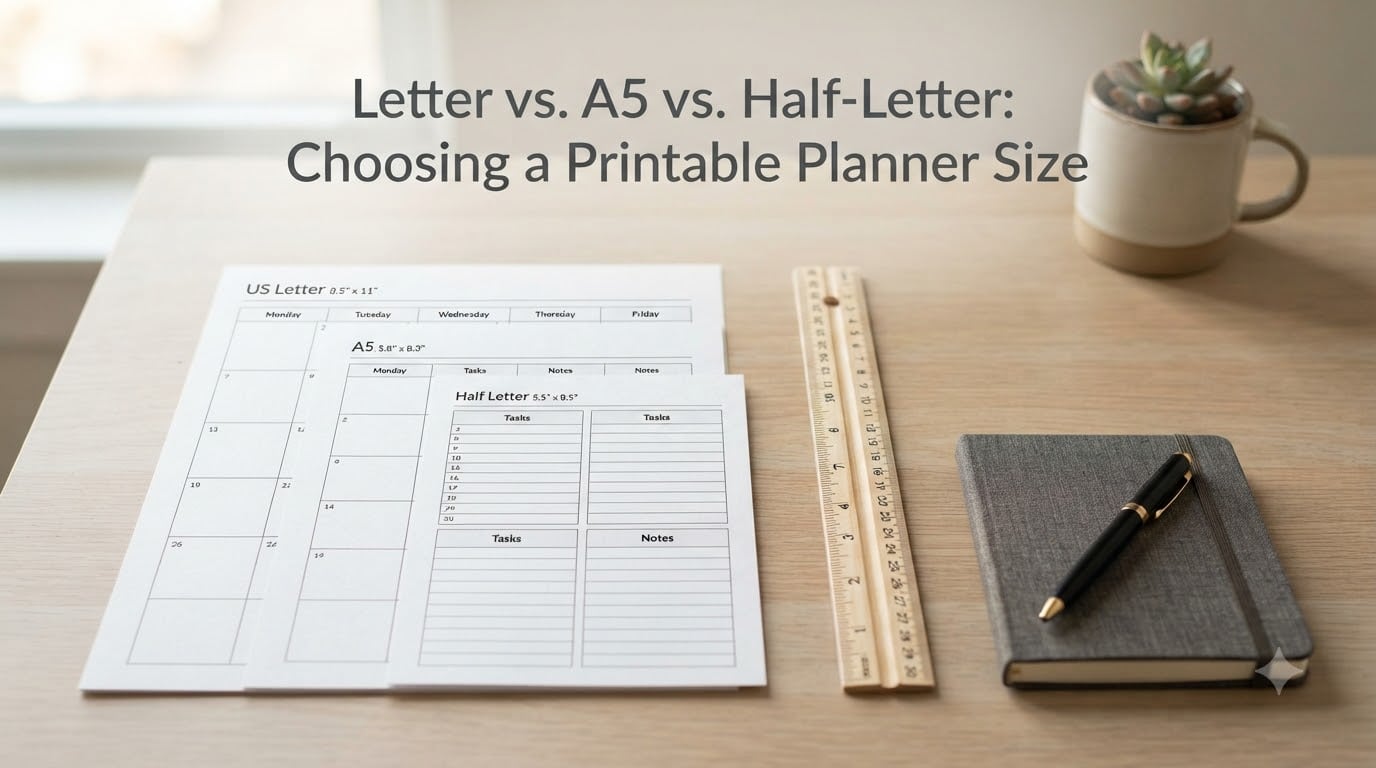
Picking the wrong printable planner size means jammed binders, awkward page margins, or a planner that never leaves your desk. I learned this the hard way after printing a stack of A5 inserts that never fit my half-letter rings. After testing all three sizes in real binders for 30 days, I put together this guide so you don’t waste a single sheet of paper.
In this article, you’ll learn the exact dimensions of Letter, A5, and Half Letter planners, why the three sizes exist in the first place, and how to match your printable planner size to your binder, your bag, and your planning style.
Table of Contents
- Why the Naming Is Confusing: Three Size Traditions
- Printable Planner Size Comparison: Exact Dimensions
- A5 vs Half Letter: The Closest Rivalry
- Letter vs A5 vs Half Letter: How to Choose
- Printing and Binder Compatibility
- Match the Planner Size to Your Planning Layout
- Frequently Asked Questions
- Choosing Your Printable Planner Size: Final Take
Why the Naming Is Confusing: Three Size Traditions
The reason so many people mix up A5 and Half Letter is simple: three different paper traditions are competing in the same stationery aisle. Once you see them side by side, the naming stops feeling random.
The ISO A-Series (International Standard)
The ISO 216 standard, used in most countries outside North America, defines the A-series paper sizes. Each size is exactly half the previous one when folded along its short edge. A4 is the most common at 210 x 297 mm; A5 is half of A4 at 148 x 210 mm. A6 is half of A5, and so on.
The clever math behind this is the square root of 2 ratio, which means any A-series size scales up or down without distortion. That’s why an A5 sheet fits perfectly on half of an A4 sheet with no trimming needed.
The American Letter System
The United States uses its own paper standard rooted in historical document formats. US Letter is 8.5 x 11 inches (216 x 279 mm), and Half Letter is exactly half of a Letter sheet: 5.5 x 8.5 inches (140 x 216 mm).
Half Letter is sometimes called “Memo” or “Statement” in office supply catalogs. It’s the closest American cousin to A5, but it is not the same.
The British Organizer Tradition
The UK planner world grew out of Filofax-style personal organizers in the 1980s. This created its own size vocabulary: Pocket (about 3.5 x 6 inches), Personal (3.75 x 6.75 inches), A6, and B6. Personal size is sometimes called “Filofax Personal” and is wider than A6 but slightly shorter.
These three traditions (ISO, US Letter, and British organizer) explain why a single paper-size conversation can feel so confusing. Each system was built for different needs and never quite merged.
Printable Planner Size Comparison: Exact Dimensions
Here is the comparison I wish I had on day one. Every dimension below is the standard trim size used by printable planner shops and stationery brands. Measurements are given in both inches and millimeters so you can sanity-check your printer settings.
| Planner Size | Inches | Millimeters | Standard Origin |
|---|---|---|---|
| US Letter | 8.5 x 11 | 216 x 279 | American |
| A4 | 8.27 x 11.69 | 210 x 297 | ISO A-series |
| Half Letter | 5.5 x 8.5 | 140 x 216 | American |
| A5 | 5.83 x 8.27 | 148 x 210 | ISO A-series |
| B6 | 4.92 x 6.93 | 125 x 176 | ISO B-series |
| A6 / Personal | 4.13 x 5.83 | 105 x 148 | Mixed (ISO + UK) |
| 3.5 x 6 | 89 x 152 | British organizer |
Notice that A5 is 5mm wider and 6mm shorter than Half Letter. That tiny gap is enough to matter when the page hits a hole punch.
A5 vs Half Letter: The Closest Rivalry
No, A5 and Half Letter are not the same size. They look identical in photos, but A5 is 5.83 x 8.27 inches while Half Letter is 5.5 x 8.5 inches. A5 is 8 mm wider and 6 mm shorter.
In everyday use, that difference is invisible until you try to mix the two. Half Letter inserts slide into most A5 binders with a little wiggle room. A5 inserts in a Half Letter binder tend to stick out slightly on the long edge and can jam the rings.
Why the Difference Exists
A5 is half of an A4 sheet (210 x 297 mm). Half Letter is half of a US Letter sheet (8.5 x 11 in). The two parent sheets are nearly the same height but differ in width, so halving them produces pages that differ in both dimensions.
Which One Should You Use?
If you live in the US and your printer tray only takes Letter paper, Half Letter is the natural choice. You cut a Letter sheet in half and get two planner pages with zero waste.
If you have access to A4 paper, or you buy from international planner shops, A5 is the cleaner choice. A5 also tends to look slightly more “square” on a desk, which some people prefer for daily layouts.
Letter vs A5 vs Half Letter: How to Choose
The best printable planner size depends on where your planner lives, what you carry, and what your planning layout demands. Here is the framework I use when helping readers pick.
Where Does Your Planner Live?
Ask yourself one question: is this planner a desk planner, a bag planner, or both?
- Desk planner: Letter or A4 gives you the most writing space. You can fit full weekly spreads, meal logs, habit trackers, and notes on one page without crowding.
- Bag planner: Half Letter or A5 is the sweet spot. Both fit in most tote bags, backpacks, and large purses without bending.
- Pocket carry: A6, Personal, or Pocket size. These work in jacket pockets and small bags but limit how much you can write per page.
What Paper Do You Actually Have?
Paper availability is the most underrated factor. In the US, Letter paper is in every drugstore. A4 paper often has to be ordered online. The reverse is true in Europe, Australia, and most of Asia.
I print about 40 pages a month for my clients. Forcing myself to special-order A4 paper added two days of waiting every cycle. Switching to Half Letter cut that wait to zero.
Portability vs Writing Space
Smaller planners are more portable but give you less writing space. Half Letter gives you about 46.75 square inches of writing area. A5 gives you about 48.21 square inches. Letter gives you 93.5 square inches, more than double.
If your daily spread needs 5 lines of tasks, appointments, water, and notes, Half Letter or A5 handles it comfortably. If you need a full weekly view with hourly blocks, you want Letter.
Printing and Binder Compatibility
Even with the right size chosen, printing and binding can derail your planner. Here is what to watch for.
Paper Sourcing
US Letter paper is universal in North America. A4 paper is sold at office supply stores and online. A5 paper is rarely sold as standalone sheets; you print A5 by scaling two pages onto one Letter or A4 sheet.
Hole Punching
Standard US planners use 3-ring or 7-ring discbound systems punched to fit specific sizes. A5 binders accept Half Letter inserts loosely but not perfectly. Half Letter binders reject A5 inserts in most cases. Letter binders are built for 8.5 x 11 paper only.
Scaling Inserts
Most printable planner PDFs come in one of three formats: ready to print at exact size, scaled to fit Letter or A4, or duplicated (two pages per sheet). Always check the PDF’s print settings before you load the paper. Printing A5 at “fit to Letter” without checking can leave a white margin or crop content.
Match the Planner Size to Your Planning Layout
The size you choose should also match the kind of layout you plan to use. A weekly spread on a Pocket page will look cramped; a gratitude list on Letter paper will look lost.
Daily Spreads
Daily spreads with time blocks, to-do lists, and meal logs need at least Half Letter or A5. Letter works for people who like generous margins and want room for stickers or journaling.
Weekly Spreads
Two-page weekly spreads shine on Letter or A4 paper. A5 weekly spreads fit a single page and are more portable. Half Letter weekly spreads often feel slightly squeezed unless you simplify your categories.
Bullet Journal and Tracker Pages
Bullet journal collections and habit trackers scale down beautifully. A6 or Personal size works well for these minimalist layouts. If you add doodles or color coding, step up to Half Letter for breathing room.
B6: The Often-Missed Middle Ground
B6 (125 x 176 mm) sits between A5 and Personal size. It’s common in Japanese and European planners and works well for people who find A5 too big and Personal too small. Most major printable shops offer B6 inserts now.
Sustainability Notes
Smaller planners use less paper and ink per year. A half-letter insert produces about half the paper waste of a Letter insert. If you print 24 monthly spreads plus weekly pages for a year, switching from Letter to Half Letter saves roughly 150 sheets of paper over 12 months.
Frequently Asked Questions
Are A5 and half Letter the same size?
No. A5 measures 5.83 x 8.27 inches (148 x 210 mm) and Half Letter measures 5.5 x 8.5 inches (140 x 216 mm). A5 is 8 mm wider and 6 mm shorter than Half Letter, so the inserts are not interchangeable in most binders.
What is the most popular planner size?
A5 and Half Letter are the two most popular printable planner sizes worldwide. A5 dominates in Europe, the UK, Australia, and Asia, while Half Letter leads in the United States. US Letter is popular for desk planners and teacher planners that need maximum writing space.
Is A5 or A6 better for a planner?
A5 is better if you want more writing space and a balance between portability and layout flexibility. A6 (4.13 x 5.83 inches) is better if you need a planner that fits in a jacket pocket or small bag and you keep your daily planning minimal. Many users keep an A5 planner at home and an A6 on the go.
What are the key differences between an A5 planner and a pocket planner?
A5 planners measure 5.83 x 8.27 inches and offer full writing space for daily or weekly spreads. Pocket planners measure about 3.5 x 6 inches and are designed for short notes, appointments, and quick to-do lists. A5 fits in most bags; pocket fits in most pockets. Choose A5 if layout matters, pocket if minimum carry size matters.
Choosing Your Printable Planner Size: Final Take
The right printable planner size comes down to three things: where you plan, what paper you have, and how much you need to write per page. Letter is the spacious desk option. A5 and Half Letter are the portable sweet spot. A6 and Personal size serve pocket carry.
Measure your binder rings before you commit. Print one test page on the paper you actually own. Choose A5 if you live outside North America or buy international inserts; choose Half Letter if you print at home in the US. The exact dimensions matter less than the fit between your paper, your punch, and your planning style.
Once you lock in the size, your printable planner setup will run quietly in the background, which is exactly what a planner should do.