
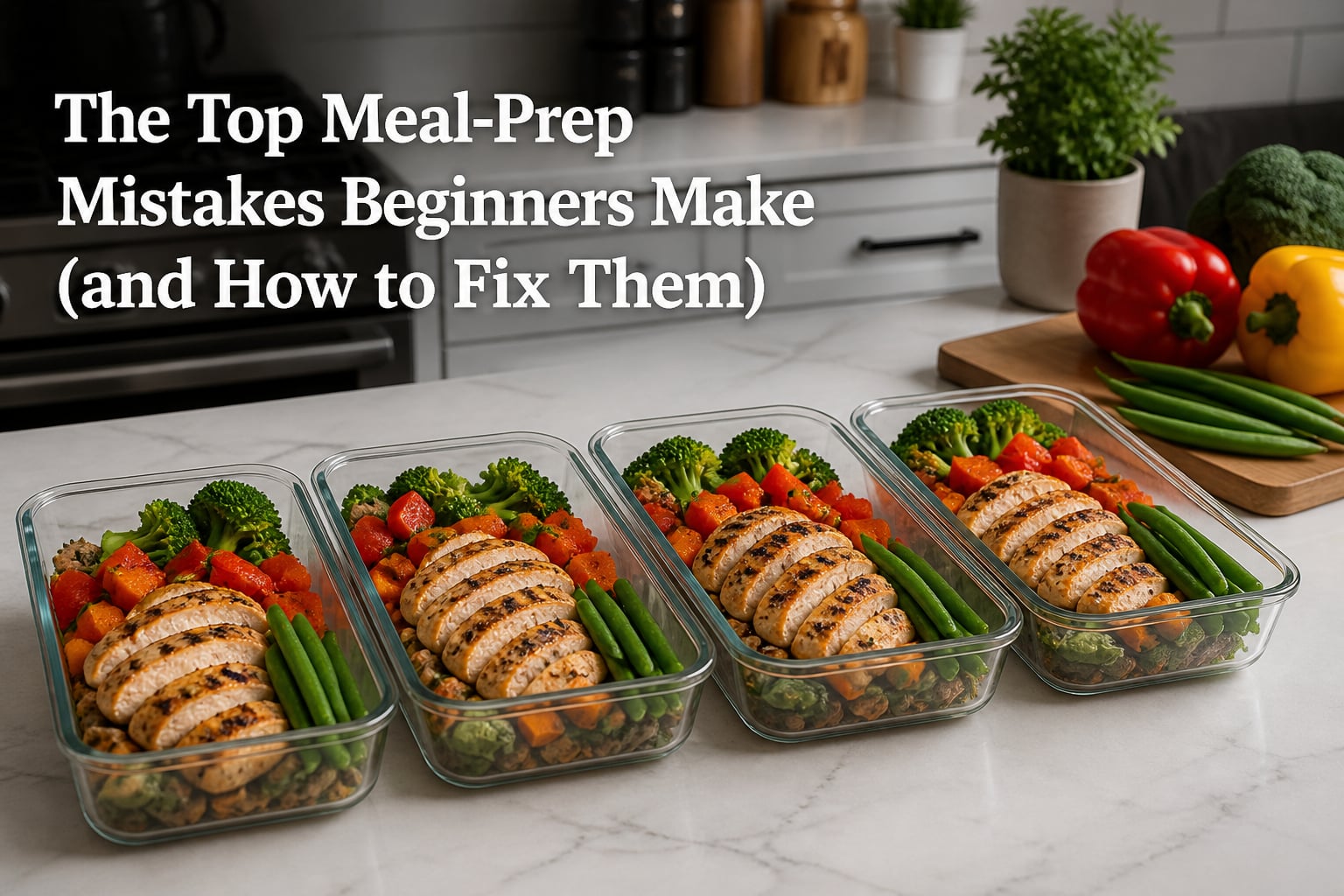
I burned through three weeks of sad, soggy chicken before I figured out what I was doing wrong.
If you’ve ever opened a fridge full of identical containers and felt immediate regret, you’re in the right place. Meal prep is supposed to make life easier, but the most common meal prep mistakes beginners make can quietly wreck your goals — especially when those goals involve losing weight.
I’ve spent the last year testing batches, swaps, and storage tricks for our team here at Best Weight Loss Planners. This guide covers the top 10 beginner mistakes that sabotage both your prep day and your weight loss results, plus exactly how to fix each one. Whether you’re searching for “beginner meal prep mistakes” or trying to figure out why your chicken breast comes out rubbery, there’s a fix below.
Let’s turn your Sunday into something that actually pays off by Wednesday.
Table of Contents
- Quick Summary: Mistakes and Fixes at a Glance
- The Top 10 Meal-Prep Mistakes Beginners Make (and How to Fix Each One)
- Mistake 1: Trying to Prep a Full Week in One Sunday
- Mistake 2: Skipping the Meal Plan and Winging It
- Mistake 3: Using the Wrong Containers (or No Containers)
- Mistake 4: Forgetting to Label Anything
- Mistake 5: Cooking Recipes You’ve Never Made Before
- Mistake 6: Skipping Snacks and Protein Variety
- Mistake 7: Over-Oiling and Oversalting Everything
- Mistake 8: Ignoring Portion Sizes and Macros
- Mistake 9: Forgetting Food Safety Timelines
- Mistake 10: Trying to Meal Prep Like an Influencer
- Meal Prep Containers and Food Safety Guide
- Frequently Asked Questions
- Final Thoughts on Beginner Meal Prep
Quick Summary: Mistakes and Fixes at a Glance
Before we dive in, here’s a scannable reference for every mistake covered in this guide. Bookmark it for your next prep session.
| Mistake | How to Fix It | Difficulty |
|---|---|---|
| Prepping a full week in one Sunday | Split prep across 2 days (Sunday + Wednesday) | Easy |
| Skipping the meal plan | Pick 3-4 tested recipes before grocery shopping | Easy |
| Wrong containers | Use 3-compartment glass containers with snap lids | Easy |
| Forgetting to label | Masking tape + sharpie on every container | Easy |
| Trying new recipes in bulk | Test recipes as single meals first | Medium |
| Skipping snacks and protein variety | Prep 2 snacks and rotate 3 proteins | Medium |
| Over-oiling and over-salting | Measure oil (1 tsp per serving) and salt at the table | Medium |
| Ignoring portions and macros | Follow the 1/2 veggies, 1/4 protein, 1/4 carbs plate | Medium |
| Ignoring food safety timelines | Eat fridge meals in 3-4 days, freeze the rest | Easy |
| Copying influencer prep | Prep 3 days max on your first attempt | Easy |
The Top 10 Meal-Prep Mistakes Beginners Make (and How to Fix Each One)
Mistake 1: Trying to Prep a Full Week in One Sunday
The biggest beginner meal prep mistake is trying to cook seven days of meals in a single afternoon. I did this my first month and ended up with a fridge full of food I dreaded by Tuesday.
Why this hurts your weight loss: Food fatigue kicks in by day three. When you stop eating your prep, you reach for takeout — and the calories add up faster than the time you “saved.”
How to fix it: Split your prep across two sessions. Cook proteins and grains on Sunday, then chop fresh veggies and assemble containers on Wednesday evening. The food tastes fresher, and you avoid the burnout that triggers off-plan eating.
Mistake 2: Skipping the Meal Plan and Winging It
Walking into the grocery store without a list is the fastest way to buy random ingredients that don’t combine into meals. I’ve watched beginners come home with chicken, three kinds of greens, and zero plan — they end up ordering pizza by Wednesday.
Why this hurts your weight loss: Without a plan, your calories balloon. Restaurant food averages 800+ calories per meal; homemade meals with a plan stay around 400-500.
How to fix it: Pick 3 to 4 tested recipes before you shop. Write a grocery list grouped by aisle. The 3-3-3 rule for meal prep is a great shortcut: 3 proteins, 3 veggies, 3 carbs. Mix and match across the week without getting bored.
Mistake 3: Using the Wrong Containers (or No Containers)
Beginners often reuse takeout boxes or buy the cheapest plastic they find. Both leak, stain, and break down in the microwave. A leaking container at work means lost lunch and a trip to the vending machine.
Why this hurts your weight loss: Container failures lead to skipped meals or vending machine runs — both of which push your daily calories over your target.
How to fix it: Invest in a small set of 3-compartment glass containers with snap-lock lids. Glass doesn’t stain, holds heat better for reheating, and lasts years. If you’re on a budget, BPA-free plastic containers with secure lids work too — just replace them every 6 to 12 months.
Mistake 4: Forgetting to Label Anything
The most upvoted comment on Reddit’s meal prep thread says it all: “No, you WON’T remember what it is; No it WON’T be obvious!! WRITE it down!” Mystery freezer meals are a universal beginner mistake.
Why this hurts your weight loss: Unlabeled food gets thrown away. Wasted prep means wasted money, and the cycle of “I prepped but ran out” pushes you back to takeout.
How to fix it: Put masking tape and a sharpie on your counter before you start prepping. Write the dish name and the date on every container. Use a “first in, first out” rotation — newer meals go to the back of the fridge, older ones to the front.
Mistake 5: Cooking Recipes You’ve Never Made Before
Cooking a brand-new recipe for the first time in bulk is one of the costliest beginner errors. I once made a Thai curry I’d never tried before, multiplied it by five, and discovered I hated the flavor by day two. Five containers wasted.
Why this hurts your weight loss: Failed experiments get thrown out. You lose money, you lose meals, and you lose momentum on your weight loss plan.
How to fix it: Test every recipe as a single serving first. If you like it, scale it up next week. Keep a “back pocket” list of 5 to 7 meals you actually enjoy eating.
Mistake 6: Skipping Snacks and Protein Variety
Most beginners prep lunch and dinner only — then wonder why they’re starving at 3 PM and grabbing chips. Skipping snacks is a top mistake because it leaves a calorie gap that junk food fills.
Why this hurts your weight loss: Hunger between meals leads to 200-500 calorie overconsumption from unplanned snacks. Studies show that planned snacks reduce total daily intake.
How to fix it: Prep two snacks per day alongside your main meals. Good options: hard-boiled eggs, Greek yogurt cups, cut veggies with hummus, cottage cheese with berries. Rotate three different proteins across the week (chicken, fish, beans) so you don’t get bored of chicken by Thursday.
Mistake 7: Over-Oiling and Oversalting Everything
This is the mistake nobody warns beginners about. A tablespoon of olive oil has 120 calories, and it’s easy to add three or four tablespoons when cooking in bulk. Oversalting makes prepped food taste worse day by day.
Why this hurts your weight loss: Hidden oil is one of the biggest calorie saboteurs in home cooking. Three tablespoons across a meal adds 360 calories you didn’t account for.
How to fix it: Measure your oil before cooking — one teaspoon per serving is plenty for sautéing. Use non-stick pans or cooking spray when possible. Add salt at the table instead of during cooking so the flavor stays bright through day four.
Mistake 8: Ignoring Portion Sizes and Macros
Many beginners assume meal prep automatically means healthy eating. But a container overflowing with pasta and chicken is still a calorie bomb. Portion control is where most weight loss plans succeed or fail.
Why this hurts your weight loss: Even “healthy” food in oversized portions stalls weight loss. A balanced plate matters more than the recipe itself.
How to fix it: Follow the plate method: 1/2 non-starchy vegetables, 1/4 lean protein, 1/4 complex carbs. For weight loss, aim for 300-500 calorie lunches and 400-600 calorie dinners. A kitchen scale removes the guesswork.
Mistake 9: Forgetting Food Safety Timelines
Many beginners eat prepped food until it looks or smells off — or worse, throw it all out by day five because they read somewhere that day six is unsafe. Both approaches waste food and money.
Why this hurts your weight loss: Food poisoning derails your plan. Throwing out food because you’re unsure of timelines wastes the prep effort entirely.
How to fix it: Follow FDA refrigerator storage times: cooked meats and grains last 3-4 days, cooked vegetables last 3-5 days. Anything you won’t eat in four days goes in the freezer. Freezer meals stay safe for 2-3 months. Yes, it is safe to meal prep for 3 days — that’s the sweet spot for fridge storage.
Mistake 10: Trying to Meal Prep Like an Influencer
Those Instagram prep stations with 30 identical containers look impressive — but they’re a recipe for burnout. Most beginners can’t sustain that level of effort, and they quit by week two.
Why this hurts your weight loss: Intense prep followed by quitting resets your routine. Consistency beats perfection for weight loss results.
How to fix it: Start with 3 days of prep, not 7. Add one day each week until you find your sustainable rhythm. The best meal prep plan is the one you’ll actually repeat.
Meal Prep Containers and Food Safety Guide
Even though this isn’t a product review, the right container and food safety knowledge make or break your prep. Here’s a quick comparison to help you choose.
| Container Type | Best For | Trade-offs |
|---|---|---|
| Glass with snap lid | Microwave, oven, long-term use | Heavier, higher upfront cost |
| BPA-free plastic | Budget builds, lightweight lunches | Stains, warps over time |
| Silicone bags | Sauces, snacks, freezer storage | Not microwave-friendly in most cases |
| Stainless steel | Soups, salads, hot foods | Not microwave-safe |
| 3-compartment trays | Portion control | Bulkier to store |
Food Safety Timeline at a Glance
Stick this on your fridge. It removes the guesswork from “is this still safe?”
- Cooked chicken, beef, pork: 3-4 days in fridge, 2-3 months in freezer
- Cooked grains (rice, quinoa, pasta): 3-4 days in fridge, 1-2 months in freezer
- Cooked vegetables: 3-5 days in fridge, 2-3 months in freezer
- Soups and stews: 3-4 days in fridge, 4-6 months in freezer
- Sauces and dressings: 5-7 days in fridge, 1-2 months in freezer
Portion Size Guide for Weight Loss
Use this visual plate method when you assemble containers. It keeps calories balanced without weighing everything.
- Half the plate: non-starchy vegetables (broccoli, spinach, peppers, zucchini)
- One quarter: lean protein (chicken breast, fish, tofu, beans) — about the size of your palm
- One quarter: complex carbs (brown rice, sweet potato, quinoa) — about the size of your fist
- Add: 1-2 teaspoons of healthy fat (olive oil, avocado, nuts)
Frequently Asked Questions
What are common meal prep mistakes?
The most common meal prep mistakes beginners make include prepping too much food at once, skipping the meal plan, using the wrong containers, forgetting to label meals, trying new recipes in bulk, skipping snacks, over-oiling food, ignoring portions, ignoring food safety timelines, and copying influencer-level prep routines that aren’t sustainable.
What is the 3-3-3 rule for meal prep?
The 3-3-3 rule for meal prep is a simple framework: pick 3 proteins, 3 vegetables, and 3 carbohydrate sources for the week. Mix and match them across your prepped meals to keep variety high without overwhelming your shopping list or prep day.
What is the 5 4 3 2 1 rule for groceries?
The 5-4-3-2-1 rule for groceries is a shopping shortcut: 5 vegetables, 4 proteins, 3 fruits, 2 grains or starches, and 1 jar of sauce or seasoning. It builds a balanced, weight-loss-friendly fridge without overbuying.
What is the 2 2 2 rule in cooking?
The 2-2-2 rule in cooking refers to storage timing: 2 hours at room temperature before refrigerating, 2 days for cooked food in the fridge before eating, and 2 months as the safe freezer limit for most prepared meals. It helps beginners avoid both food waste and foodborne illness.
Is it safe to meal prep for 3 days?
Yes, it is safe to meal prep for 3 days. Cooked proteins, grains, and vegetables all stay safe in the refrigerator for 3-4 days according to FDA food storage guidelines. Prepping 3 days at a time is the sweet spot for beginners because the food stays fresh and you avoid burnout from overcommitting.
What are tips for starting with meal prepping as a beginner?
Start small with 3 days of meals instead of 7, pick 3 to 4 tested recipes, shop with a grouped grocery list, use glass containers with snap lids, label everything with the date, prep two snacks alongside lunch and dinner, and follow the 1/2 veggies, 1/4 protein, 1/4 carbs plate method for portion control.
Final Thoughts on Beginner Meal Prep
Meal prep isn’t about perfection — it’s about removing decisions on your busiest days. The top meal-prep mistakes beginners make all share one root cause: trying to do too much, too fast. Start with 3 days, eat the rainbow, label the containers, and trust the plate method.
Each fix above is small enough to try this week. Pick the one mistake that’s hit you hardest, fix it for 7 days, and add another. Within a month, you’ll have a routine that supports your weight loss goals without the burnout. Our team at Best Weight Loss Planners is rooting for you — now go label those containers.