
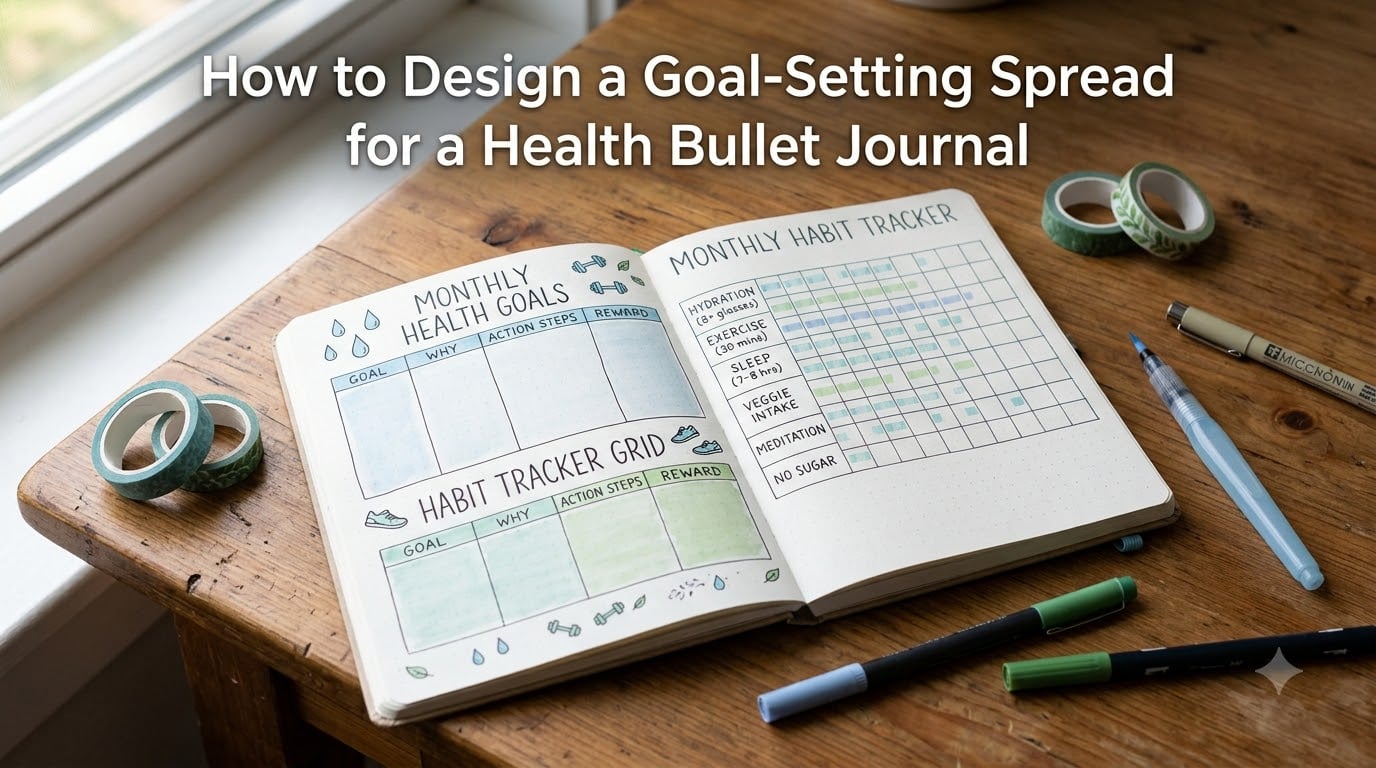
When I set out to improve my own health habits last year, I bought a fancy planner, downloaded three apps, and still felt scattered. The thing that finally clicked was a single spread in a plain dot-grid notebook: one page dedicated to my health goals, broken into weekly check-ins and a habit tracker. That single idea – designing a real goal-setting spread for a health bullet journal – is what I want to walk you through today.
In this guide, you will learn what a health goal spread actually is, how to lay out your bullet journal from scratch, the SMART goals framework adapted for wellness, the spreads that matter most, a simple color system, ADHD-friendly tweaks, and the mistakes I see most people make. By the end, you will have a clear blueprint to design your own.
Table of Contents
- What Is a Goal-Setting Spread for a Health Bullet Journal?
- How to Layout a Bullet Journal for Health Goals
- Goal Brainstorming: The First Step Before Any Spread
- Apply the SMART Goals Framework to Your Health Plans
- Essential Bullet Journal Spreads for Health Goals
- Color Coding and Visual Systems That Stick
- ADHD-Friendly Bullet Journal Techniques for Health Goals
- Common Mistakes to Avoid When Designing Your Health Spreads
- Frequently Asked Questions
- Your Next Step to Design a Goal-Setting Spread for a Health Bullet Journal
What Is a Goal-Setting Spread for a Health Bullet Journal?
A goal-setting spread for a health bullet journal is a dedicated set of pages that helps you define, track, and achieve wellness objectives through visual organization, habit tracking, and actionable planning. It is not a generic to-do list. It is a structured system that turns vague intentions like “get healthier” into specific, dated, and visible targets.
Health bullet journals borrow the original BuJo method created by Ryder Carroll but add wellness-specific collections. Think daily fitness logs, weekly nutrition reflections, monthly mood check-ins, and a habit tracker grid. The spread is the bridge between the goal you wrote down and the action you take tomorrow morning.
The most useful spreads I have seen combine four ingredients: a clearly worded goal, a measurable indicator, a tracking visual, and a built-in review point. When all four sit on a single page, you stop guessing whether you are making progress.
How to Layout a Bullet Journal for Health Goals
To layout a bullet journal for health goals, start with a future log, add a monthly goal spread, then build weekly action pages and daily trackers on top of it. This top-down structure keeps big-picture intentions connected to the small habits that actually move the needle.
Step 1: Set up an index page. Reserve your first two pages for an index so you can find every health spread quickly. Number every page and log collections as you create them.
Step 2: Build a future log. On the next two pages, draw six boxes – one for each upcoming month. Jot down any health appointments, races, or check-in dates so your goals can align with real calendar events.
Step 3: Create a monthly log. This is the spine of your health goal spread. List the month, your three top health priorities, key habits to track, and the appointments or milestones you expect.
Step 4: Add weekly spreads. Each week gets two facing pages: one for the schedule and a short list of three weekly health intentions, the other for a mini habit tracker and a reflection prompt.
Step 5: Use daily rapid logging for the rest. A simple bullet for each meal logged, workout done, or sleep note keeps daily entries fast without turning the journal into a chore.
Goal Brainstorming: The First Step Before Any Spread
Before you draw a single box, you need a brainstorm page. I learned this the hard way after designing two beautiful monthly spreads I never used because the goals on them were not really mine.
Set aside a full page and write the heading “Health Brain Dump.” Spend ten minutes writing everything that comes to mind about your health – things you want to start, stop, try, fix, or finish. Do not filter. Do not judge. The point is volume.
Once the page is full, scan for repeating themes. You will usually find clusters around sleep, food, movement, stress, and medical care. Circle the five items that light you up the most. Those become candidates for your official health goals.
Ask yourself three quick questions for each circled item: Is this goal truly mine, or am I copying it from Instagram? Can I picture myself doing the related habit next Tuesday morning? What is the smallest version of this goal that would still feel like progress? If your answer is no to any of those, leave it on the brainstorm page and pick another.
Forum users on r/bujo call this “sprint planning” – turning a big goal into a short, doable segment you can fit inside a month. It is the single technique that prevents the overwhelm most people feel when they open a fresh journal.
Apply the SMART Goals Framework to Your Health Plans
The SMART goals framework turns fuzzy health wishes into trackable targets. SMART stands for Specific, Measurable, Achievable, Relevant, and Time-bound. Every health goal that survives in my journal passes all five checks before I ink it in.
Specific means naming exactly what you will do. “Exercise more” is vague. “Walk for 25 minutes after lunch on Monday, Wednesday, and Friday” is specific. Measurable gives you a number – minutes, reps, glasses of water, hours of sleep – so you can look back and say yes or no.
Achievable keeps you honest. If you have not stretched in a year, do not commit to a daily hour-long yoga practice in week one. Relevant ties the goal to something you actually care about. Time-bound adds a deadline, which is the most underused ingredient in health goal setting.
A sample SMART health goal might read: “Drink 8 cups of water on each weekday for the next 30 days.” You can measure it, it is doable, it serves your energy levels, and the deadline is clear. Put it on your monthly spread, then break it into daily checkboxes on your weekly layout.
Essential Bullet Journal Spreads for Health Goals
Once you have goals, you need spreads to support them. These are the layouts I return to every single month, and the ones forum users consistently rate as the most useful.
The Annual Health Vision Page
Reserve one full spread for the year. On the left, sketch a simple health vision board with cut-out magazine images, hand-drawn icons, or printed photos. On the right, list your three big annual health goals and the quarter in which you will focus on each. This page is your compass.
The Monthly Goal and Habit Tracker Spread
Draw a four-column grid across two pages. The first column names the month. The second holds three top monthly health goals. The third is a habit tracker with rows for each daily habit and columns for every day of the month. The fourth column is reserved for a short weekly reflection note.
This is the spread that does the heavy lifting. After 30 days you can glance at the tracker and see exactly which habits you maintained and which slipped, without any extra logging.
The Weekly Action Spread
On the left page, write the week number, three weekly intentions drawn from your monthly goals, and the appointments or events that might affect them. On the right page, build a seven-row habit mini-tracker and a short end-of-week review with two prompts: “What worked?” and “What will I adjust next week?”
Specialized Health Collections
Add pages as needed for sleep logs, water intake, meal planning, mood tracking, gratitude lists, and workout splits. Each one is a “collection” in bullet journal language – a themed page set that lives in your index. Beginners should start with one or two collections, not ten.
Color Coding and Visual Systems That Stick
A simple color code turns a black-and-white spread into a quick-glance dashboard. Pick one color per health category – blue for hydration, green for movement, red for medical, yellow for mood, purple for sleep – and use that color consistently across every spread.
Keep the system small. Three to five colors is plenty. More than that and you spend half your journaling time deciding which highlighter to grab, which defeats the purpose. Many users stick with three: one for “done,” one for “in progress,” one for “needs attention.”
Use signifiers in the margins – a small star for goals, a circle for habits, a triangle for appointments. This lets you scan a busy spread and find any category in under a second. Consistency matters more than prettiness here.
ADHD-Friendly Bullet Journal Techniques for Health Goals
Yes, bullet journaling is genuinely good for ADHD when you keep it low-friction. The freedom of a blank page is also the biggest trap, so a few small rules keep the system usable on low-focus days.
First, simplify your daily entry to under a minute. Pre-draw a tiny habit grid at the top of each daily block so all you have to do is fill in a dot. Decision fatigue is the enemy of consistency.
Second, batch your spreads. Set aside 30 minutes once a month to draw every weekly layout for the month ahead. When ADHD makes setup feel impossible, the layouts are already waiting.
Third, reward the start, not the streak. If you skip a day, your next entry is a fresh page, not a guilt trip. Build “restart” prompts into your weekly review so a missed habit becomes a setup question, not a failure.
Fourth, keep one “anchor habit” on every spread. This is the single health behavior that anchors everything else – often a morning routine or a sleep time. When ADHD derails the day, the anchor habit stays intact and the rest can rebuild around it.
Common Mistakes to Avoid When Designing Your Health Spreads
Three mistakes show up over and over in the forums. The first is over-designing – spending hours on illustrations and never filling in the spread. Pretty is fine; functional is better.
The second is skipping the review. A weekly spread without a reflection prompt becomes a record of what you did, not a tool for change. Always leave room to ask what worked and what to adjust.
The third is ignoring migration. If a goal never moves forward, transfer it to a new spread with a fresh plan or retire it. Hoarding unworked goals is the fastest way to lose trust in your journal.
Start small, review weekly, and adjust monthly. That rhythm is what turns a stack of empty pages into a working health system.
Frequently Asked Questions
What are the 5 R’s of goal setting?
The 5 R’s of goal setting are: Record your goal in writing, Reflect on why it matters, Refine it so it is specific and realistic, Repeat it often as a reminder, and Review progress on a set schedule. They turn a passing wish into a tracked intention.
How to journal for goal setting?
To journal for goal setting, start with a brain dump page, pick the goals that matter most, rewrite each one using the SMART framework, then design monthly, weekly, and daily spreads that break the goal into trackable actions. Add a weekly review so you adjust as you go.
Is BuJo good for ADHD?
Yes, BuJo is good for ADHD when you keep it low-friction. Batch your spreads once a month, pre-draw habit grids, simplify daily entries to under a minute, and use a single anchor habit. The structure gives external memory a place to live without overwhelming you with setup.
How to layout a bullet journal?
To layout a bullet journal, start with an index page, then a future log, a monthly log, weekly spreads, and daily rapid logs. Add health collections like habit trackers, sleep logs, and mood pages as needed. Number every page and log new collections in your index as you build them.
Your Next Step to Design a Goal-Setting Spread for a Health Bullet Journal
Designing a goal-setting spread for a health bullet journal is less about artistic talent and more about choosing a structure that matches how you actually live. Pick three real goals, give each one a SMART rewrite, lay out one monthly spread with a habit tracker, and commit to a five-minute weekly review.
If you stick with that simple loop for thirty days, you will have more clarity than a year of passive planning. Open a fresh page today and start with the brain dump – that single page is where every useful health spread begins.